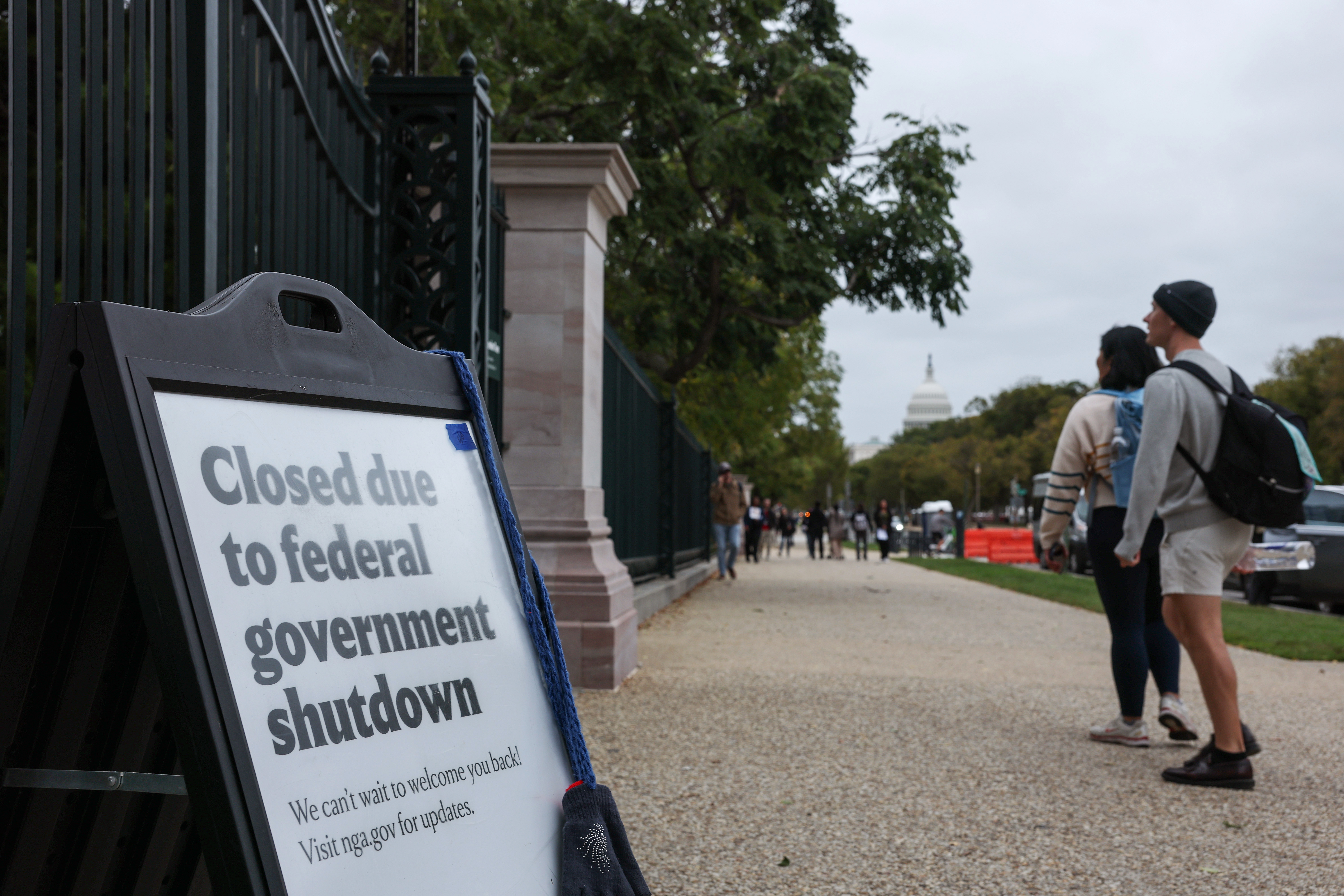


The government shutdown could cost the U.S. economy up to $14 billion, according to an Oct. 29 analysis.
The nonpartisan Congressional Budget Office, writing in a letter to House Budget Committee Chairman Jodey Arrington (R-Texas), estimated the economic impact of the government shutdown, which began on Oct. 1.
Real (non-inflation-adjusted) gross domestic product (GDP) will be lower in the fourth quarter than it would have been without the closure, the budget watchdog said.
Depending on the length of the shutdown, the annualized real GDP growth rate will be reduced by 1 to 2 percentage points.
Although most of the decline will be recovered, the Congressional Budget Office estimates that between $7 billion and $14 billion will not be recovered.
“The effects of the shutdown on the economy are uncertain,” the letter reads. “Those effects depend on decisions made by the administration throughout the shutdown. In addition, how federal employees and contractors respond to the delay in compensation is uncertain.”
Federal outlays are expected to fall by $33 billion if the shutdown ends this week. That figure rises to $54 billion if the impasse lasts six weeks, and to $74 billion if it continues through late November.
The estimates are mainly due to delayed spending for Supplemental Nutrition Assistance Program benefits, postponed compensation for approximately 650,000 furloughed employees, and paused contracts and advisory services.
“Economic activity at the end of 2025 will be lower as a result of the shutdown,” the Congressional Budget Office said.
“Real GDP will rebound when federal funding resumes, with most of the forgone output made up in the future.”
By the first quarter of 2026, real GDP growth will rebound by as much as 3.1 percentage points after federal funding resumes. The following quarter is also forecast to remain positive.
Under all three shutdown scenarios—four weeks, six weeks, and eight weeks—economic activity will return to what it would have been without the shutdown after 2026.
Arrington urged his Democratic colleagues to reopen the government.
“Democrats are playing politics, and the American people are paying the price,” he said in an Oct. 29 statement.
“Even the independent, nonpartisan Congressional Budget Office confirmed the economy will lose 1 percent in growth because of the Schumer shutdown.
“For hardworking families, that means higher unemployment, lower wages, and less money in their pockets.”
But Senate Democrats say GOP lawmakers are the ones who are avoiding efforts to reopen the government.
“Republicans are boycotting negotiations and boycotting Washington until they could just do the easy thing and sit down and talk with us about how to get this done, but they think Donald Trump is a king,” Sen. Chris Murphy (D-Conn.) told reporters.
The latest report comes after the White House estimated that the economy could lose $15 billion in lost output for each week the government is shut down.
A prolonged government shutdown could pose downside risks to fourth-quarter real GDP growth, according to economists at Oxford Economics.
They estimated that a shutdown trims growth by as much as 0.2 percentage points per week.
“For context, a shutdown that lasts the entire quarter, which has never occurred, would reduce Q4 real GDP growth by 1.2 [points to] 2.4 [points],” Oxford Economics said earlier this month.
Impasse on Capitol Hill
Republican lawmakers have suggested they would be willing to negotiate with their Democratic colleagues over Affordable Care Act subsidies but have rejected proposals to attach them to a continuing resolution.
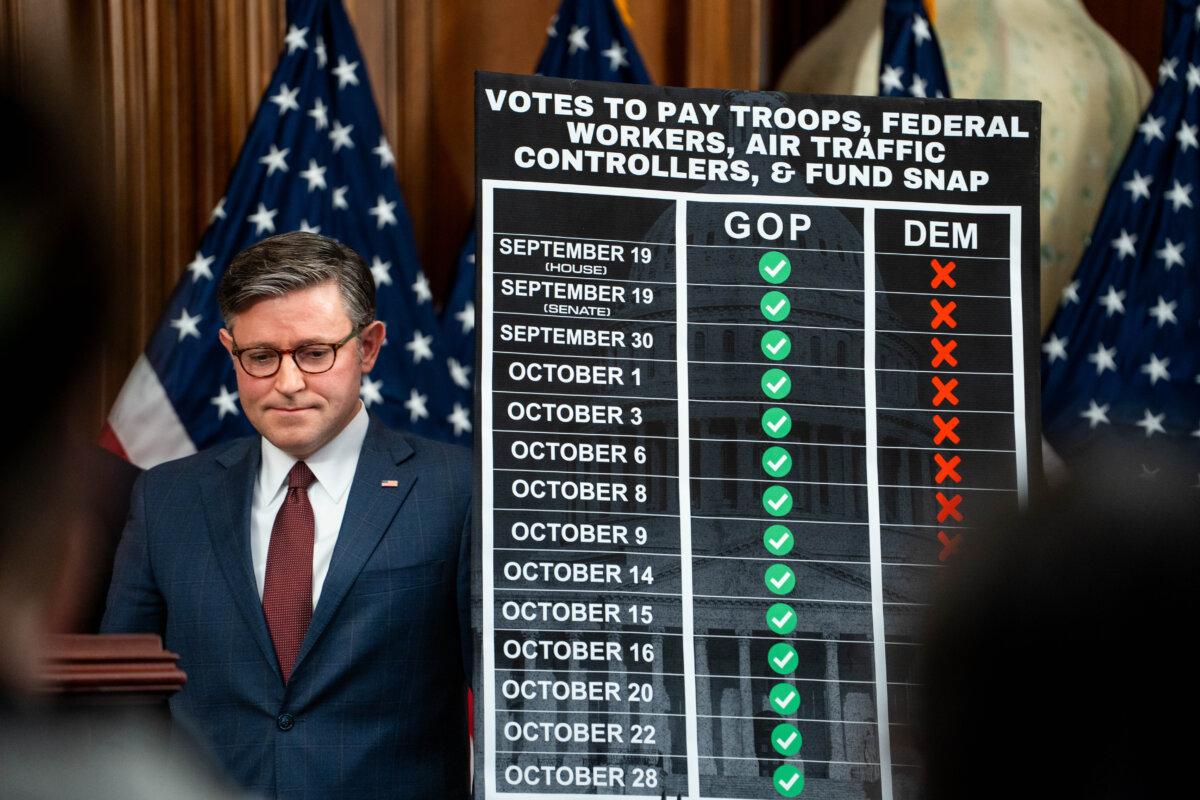
House Speaker Mike Johnson (R-La.) listens during a press conference on the 29th day of the government shutdown in Washington on Oct. 29, 2025. (Madalina Kilroy/The Epoch Times)
Continuing resolutions have failed 13 times in the Senate.
After meeting with Republicans in the upper chamber, Vice President JD Vance told reporters that “five more reasonable Democrats” are needed to reopen the government.
“If the Democrats just opened up the government, then we wouldn’t have to play this game where we’re trying to find and we’re trying to fit a square peg into a round hole with the budget, because we have such limited numbers to spread around very widely,” Vance said.
The American Federation of Government Employees, the largest union of government workers, with more than 800,000 members, urged senators to pass a clean continuing resolution and end the shutdown immediately.
“No half measures, and no gamesmanship. Put every single federal worker back on the job with full back pay—today,” Everett Kelley, the organization’s president, said in a statement on Oct. 27.
But Sen. Tim Kaine (D-Va.) said the union would not be pleased if Democrats were to reach a deal with the GOP only to “have [President Donald] Trump fire a bunch of people.”
“I know these folks very well, and they would not forgive us for doing a deal that would allow them to be fired next week,” Kaine told reporters.
“We’ve got to get a deal that Donald Trump will follow.”
Some lawmakers, including Sen. Andy Kim (D-Calif.), are blaming the president and GOP leaders for refusing to negotiate.
“It'd be easier if they actually just sit down and negotiate with us,” he told reporters.
Trump is in South Korea and will meet with Chinese leader Xi Jinping on the sidelines of the Asia-Pacific Economic Cooperation summit to iron out a trade framework between the two nations.