Doane Robinson had been state historian for South Dakota for more than 20 years. He interviewed miners, missionaries, farmers, builders, and Indians. He had collected countless historical artifacts that captured the history of the Badlands, the Black Hills, and the surrounding areas. He had written extensively about the 40th state. His great hope was that more people could be lured to visit it.
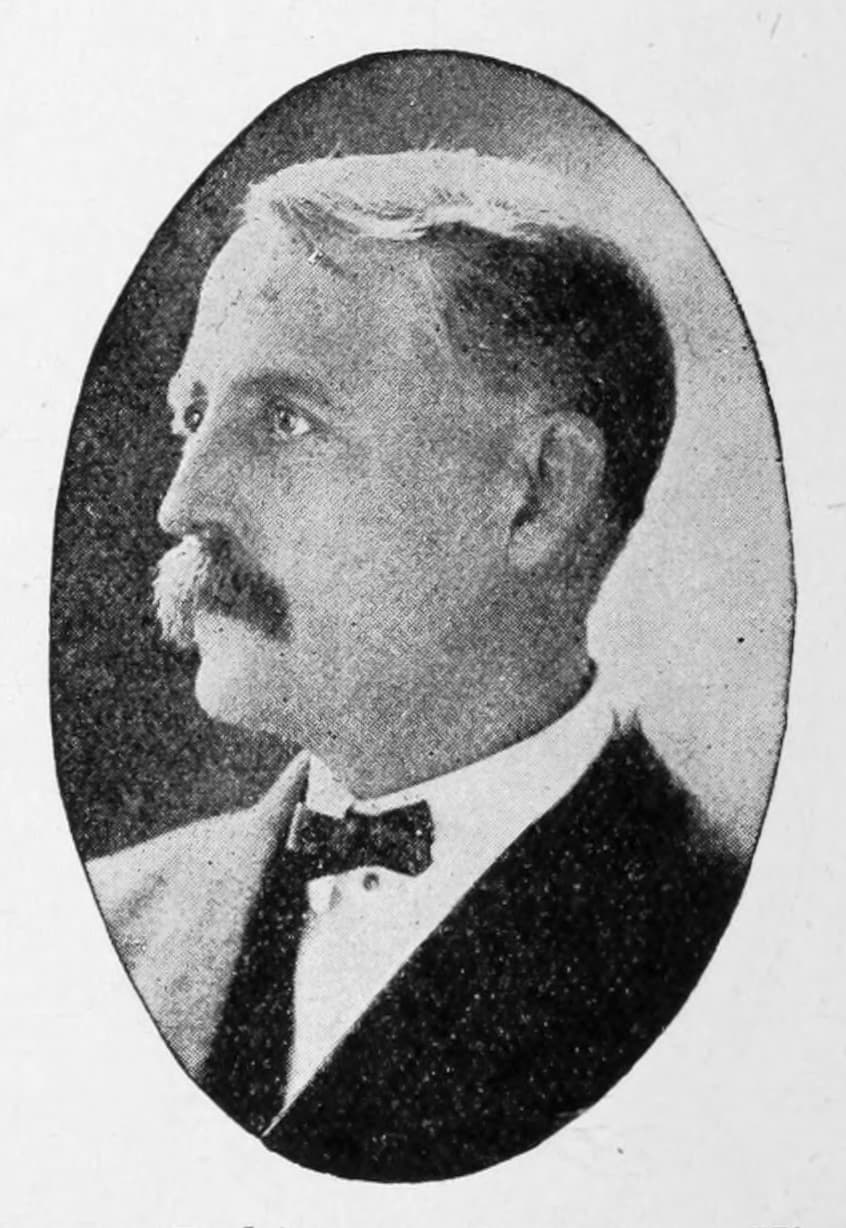
Doane Robinson, American historian, circa 1915. (Public Domain)
In the summer of 1919, about 60,000 acres in South Dakota became Custer State Park. In this large expanse of breathtaking landscape rests natural granite spires called the Needles. Three years later, the 14-mile long Needles Highway was completed. Robinson envisioned sculpting these natural granite pillars near Harney Peak into images of some of South Dakota’s most important historical figures, like Meriwether Lewis, William Clark, Sacagawea, Red Cloud, and George Armstrong Custer.
On Dec. 28, 1923, Robinson wrote to one of the nation’s best sculptors, Lorado Taft, who had sculpted Illinois’s “Eternal Indian”: a 48-foot tall statue with a 6-foot base that stands on a 77-foot bluff. It seemed to perfectly represent Robinson’s idea.
The following month, Robinson publicly discussed his idea to the Black and Yellow Trail Association in Huron, South Dakota. The idea found enthusiastic support from Peter Norbeck, who had served as the state’s ninth governor from 1917 to 1921, before being elected to the U.S. Senate, and who had been instrumental in founding Custer State Park.
Taft wrote back to Robinson with news that he was too ill to travel to South Dakota and would be unable to take on such a project. Fortunately, Robinson had a second choice lined up.
The Man at Stone Mountain
Gutzon Borglum was just outside Atlanta working away on a massive project at the behest of the United Daughters of the Confederacy. He had been hired to sculpt the bust of Robert E. Lee into Stone Mountain. Borglum thought the idea ill-conceived and thus presented and began work on his own rendition, that of Lee, Stonewall Jackson, and Jefferson Davis riding horseback and followed by Confederate soldiers.
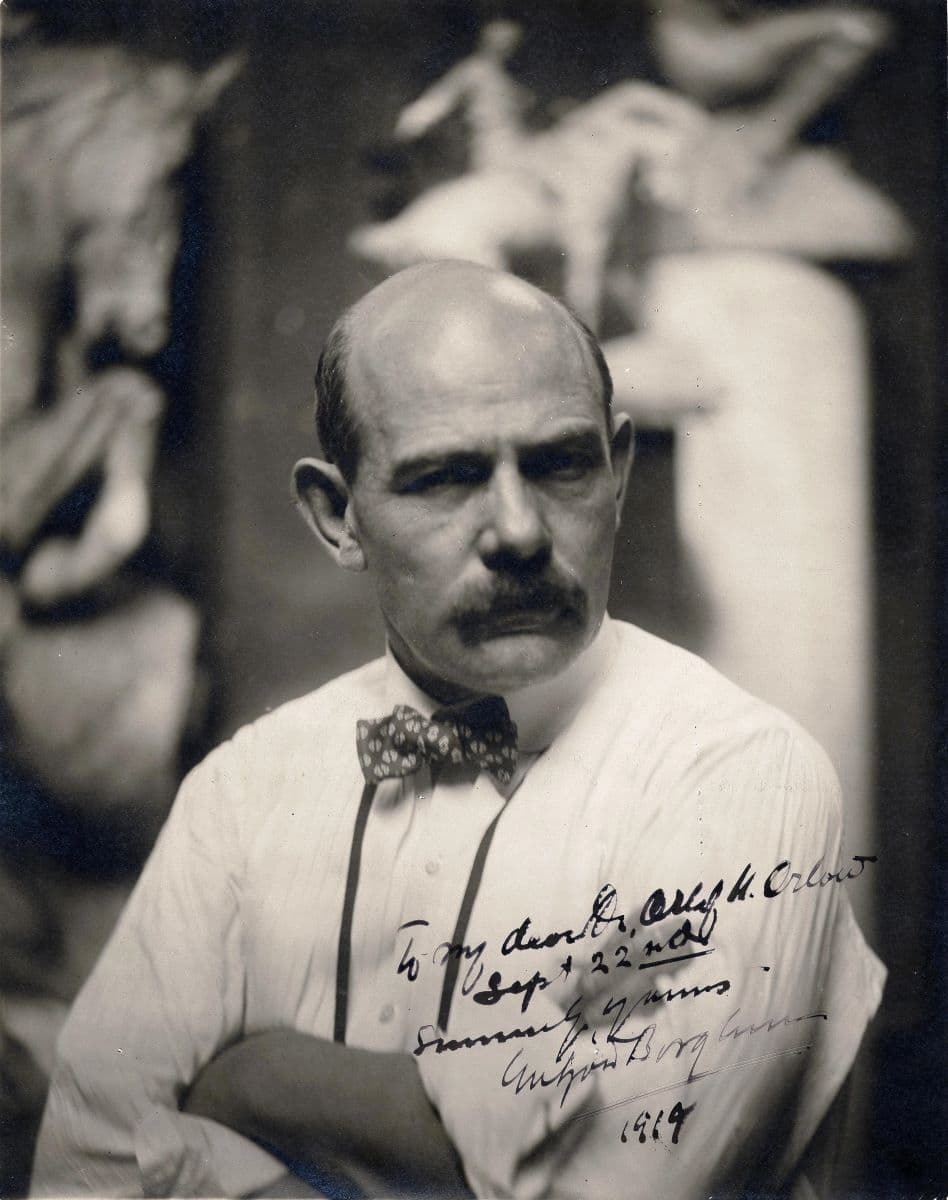
Sculptor Gutzon Borglum, 1919. It was Borglum's idea to create a national rather than state-level monument. (Public Domain)
Borglum began the project in 1923, and unveiled the face of Lee in 1924 to a great reception. For financial reasons which stemmed from Borglum expanding the vision of the project, the artist and the Stone Mountain Monumental Association (SMMA) clashed.
Robinson had read about Borglum’s ongoing work at Stone Mountain and wrote him a letter on Aug. 20 concerning his Needles vision. The timing for Borglum was perfect. He had become weary and disgruntled with the Stone Mountain project, feelings that were shared by the Confederate monument’s board of directors.
A month after receiving the letter, Borglum arrived in South Dakota to meet with Robinson to view the Needles and discuss the project. Borglum was interested in the project, but felt the Needles were too thin for such an undertaking and that a large area would be needed.
The artist returned to Georgia to finish the Stone Mountain project. That, however, did not take place. The clash left the arrangement untenable. He was fired by the SMMA. In turn, he smashed the project’s models, and left for South Dakota.
An Evolving Vision
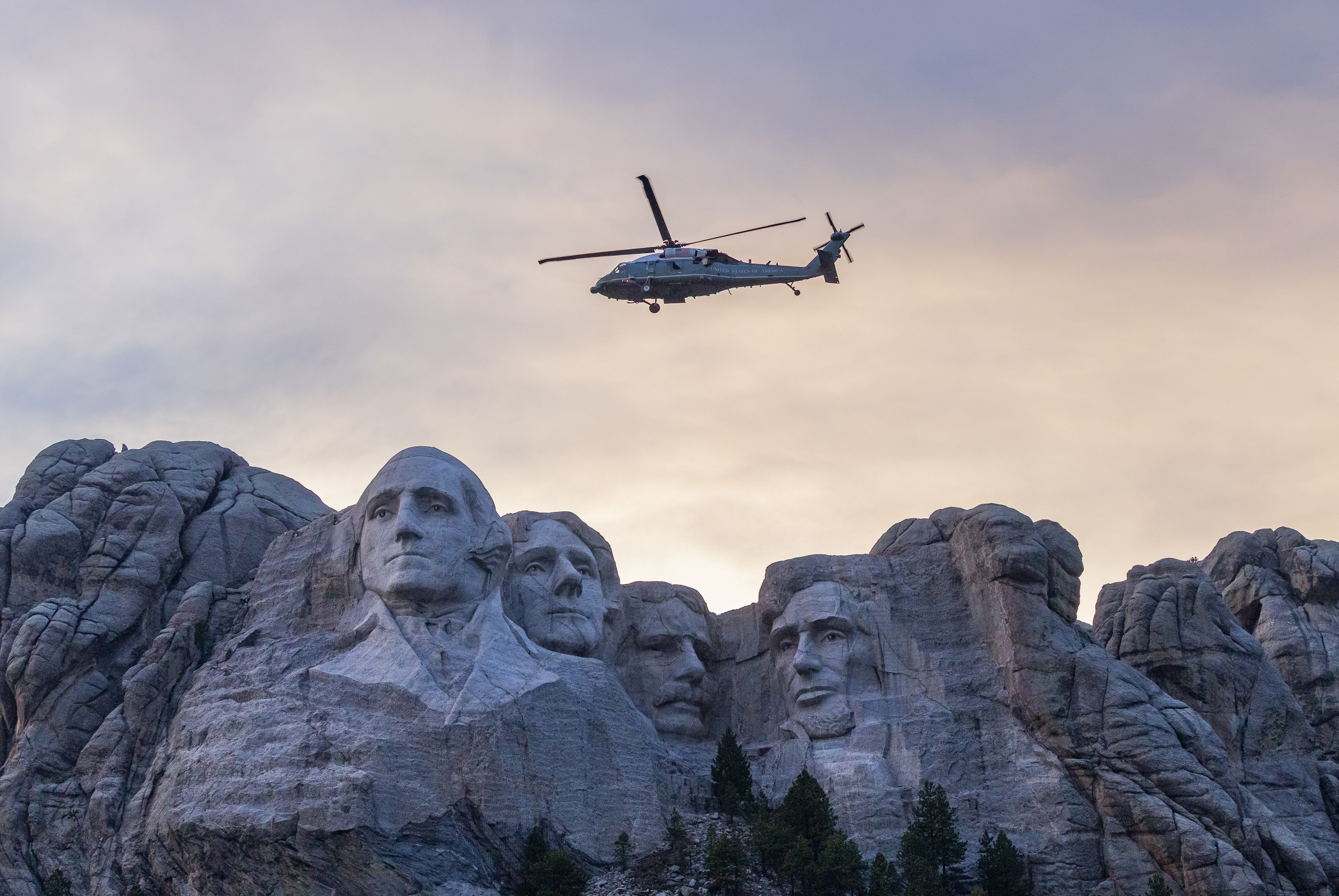
Borglum met with Robinson again and told him that the Needles idea was out; he had an idea for a more national rather than regional sculpture. His focus would be the figure of George Washington etched into the side of a mountain. Robinson and Borglum sought the ideal location. Borglum wanted a mountainside that was large enough and high enough, with stone hard enough to maintain a sculpted face, and where the sunrise would hit the sculpted image. He found precisely what he was looking for in a 5,725-foot-high mountain called Mount Rushmore.
The sculptor’s vision grew from one president to include two more—Thomas Jefferson and Abraham Lincoln. Norbeck, who held Theodore Roosevelt as his “idol and ideal,” urged the inclusion of the 26th president. Borglum had no issue with the inclusion, seeing that, while in the White House, Roosevelt had displayed the artist’s large bust of Lincoln he had completed in 1908.
The initial project design of the four presidents was from their waists up. This was then scaled down to just their heads—each at 60 feet tall. Borglum estimated it would cost $460,000 and would take five years to complete. The estimation proved extremely optimistic.
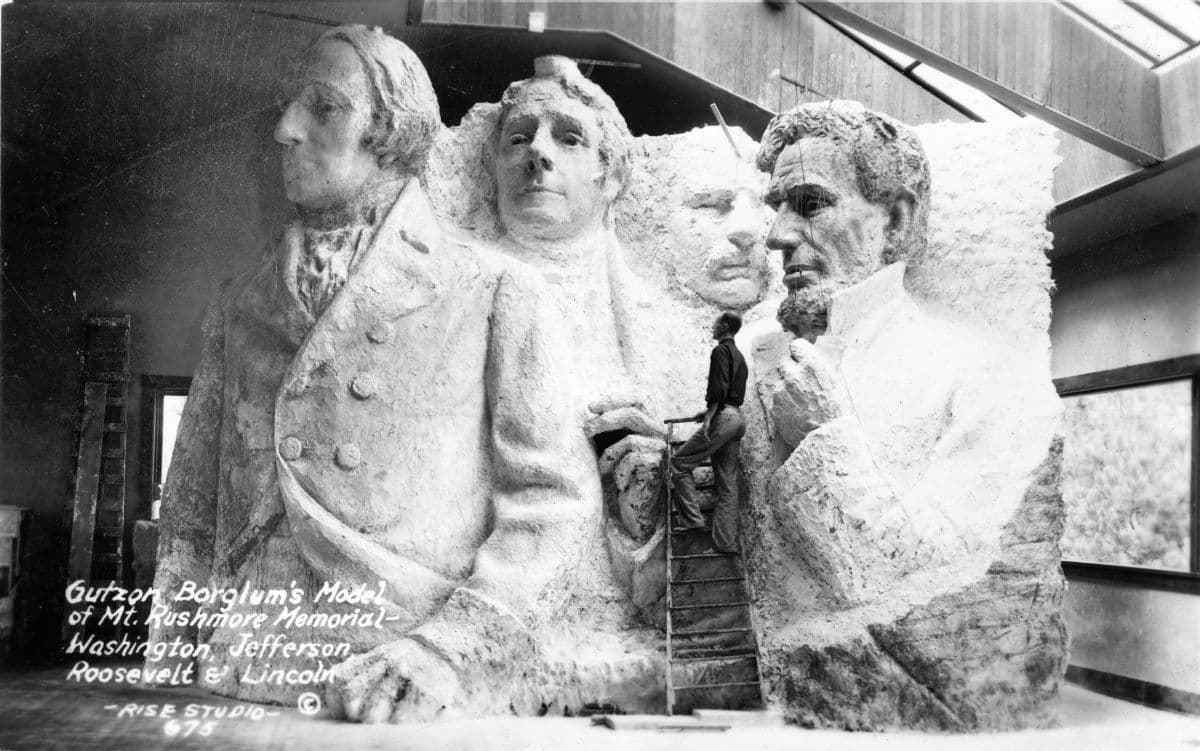
Original mockup of the Mount Rushmore sculpture "before funding ran out." Library of Congress. (Public Domain)
‘The Spirit of Patriotism’
Senator Norbeck began advocating for the new project. South Dakota congressman William Williamson wrote two bills for it—one for Congress regarding the use of federal lands and the other for the state legislature to create the Mount Harney Memorial Association, which would oversee the project’s construction. The former was quickly passed, but the latter met with local criticisms and failed twice before finally passing on March 5, 1925.
Borglum had boasted that he could raise much of the funding through private donations from wealthy individuals and that raising funds from locals would be unnecessary. Along with cost and time estimation, this would prove incorrect. Lack of funds would plague the project.
On Aug. 10, 1927, a dedication ceremony was held with distinguished guests in attendance. None were more distinguished than a man who arrived on a horse wearing a large brimmed hat and new boots. It was President Calvin Coolidge, whom Williamson and Borglum had convinced to attend. South Dakotans had gifted him the horse, hat, and boots.
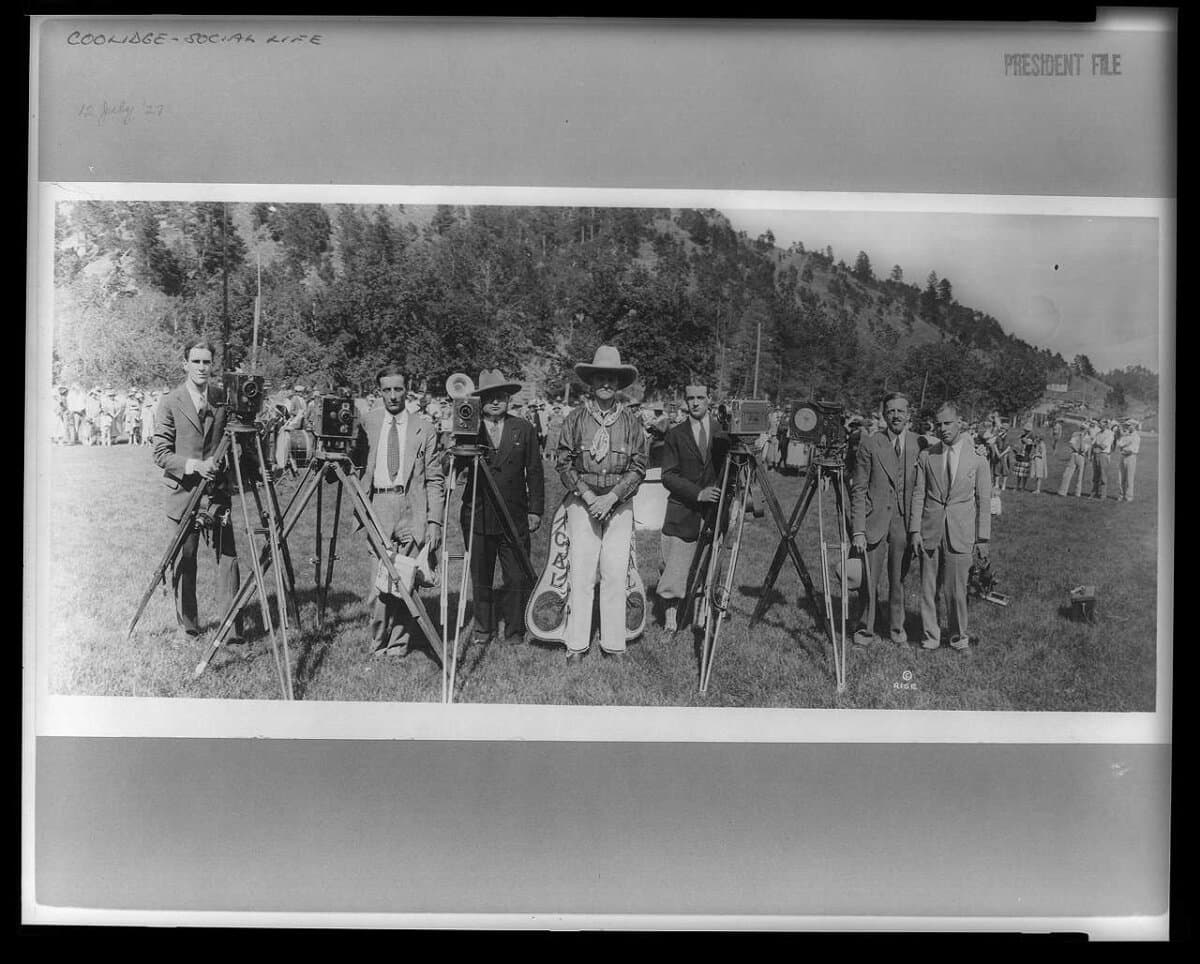
President Coolidge (C) in cowboy outfit, standing in field with photographers; mountain in background, 1927. Library of Congress. (Public Domain)
Impressed with the location and the vision for the monument, Coolidge addressed the crowd:
“We have come here to dedicate a cornerstone that was laid by the hand of the Almighty. … Here in the heart of the continent, on the side of a mountain which probably no white man had ever beheld in the days of Washington, in territory which was acquired by the action of Jefferson, which remained an unbroken wilderness beyond the days of Lincoln, which was especially loved by Roosevelt, the people of the future will see history and art combined to portray the spirit of patriotism”
Coolidge handed six ceremonial drill bits to formally begin construction.
Building Rushmore
Estimating the cost of just under $500,000, Borglum met with Secretary of the Treasury Andrew Mellon, who offered full federal funding for the monument. Borglum, perhaps believing too much in his capacity as a fundraiser, settled for half, a decision that perplexed Norbeck.
Congress passed the Mount Rushmore National Memorial Act, which was also known as the Norbeck-Williamson Act, and was signed by Coolidge on Feb. 25, 1929. The bill provided $250,000 and established the Mount Rushmore National Memorial Commission, a 12-member board. The first 10 were appointed by Coolidge, who left the final two to be appointed by the president-elect Herbert Hoover.
Work was underway. Altogether 400 workers were used with as many as 30 at any one time. Only one additional artist was hired, Korczak Ziolkowski, who lasted 19 days before exiting after an argument with Borglum’s son, Lincoln.
The faces of the four presidents nonetheless began to come into form, though not by chisel and hammer, but by dynamite. Borglum had learned this method when working on the Stone Mountain project. In fact, 90 percent of the Mount Rushmore National Memorial was produced through strategic and precise dynamite explosions.
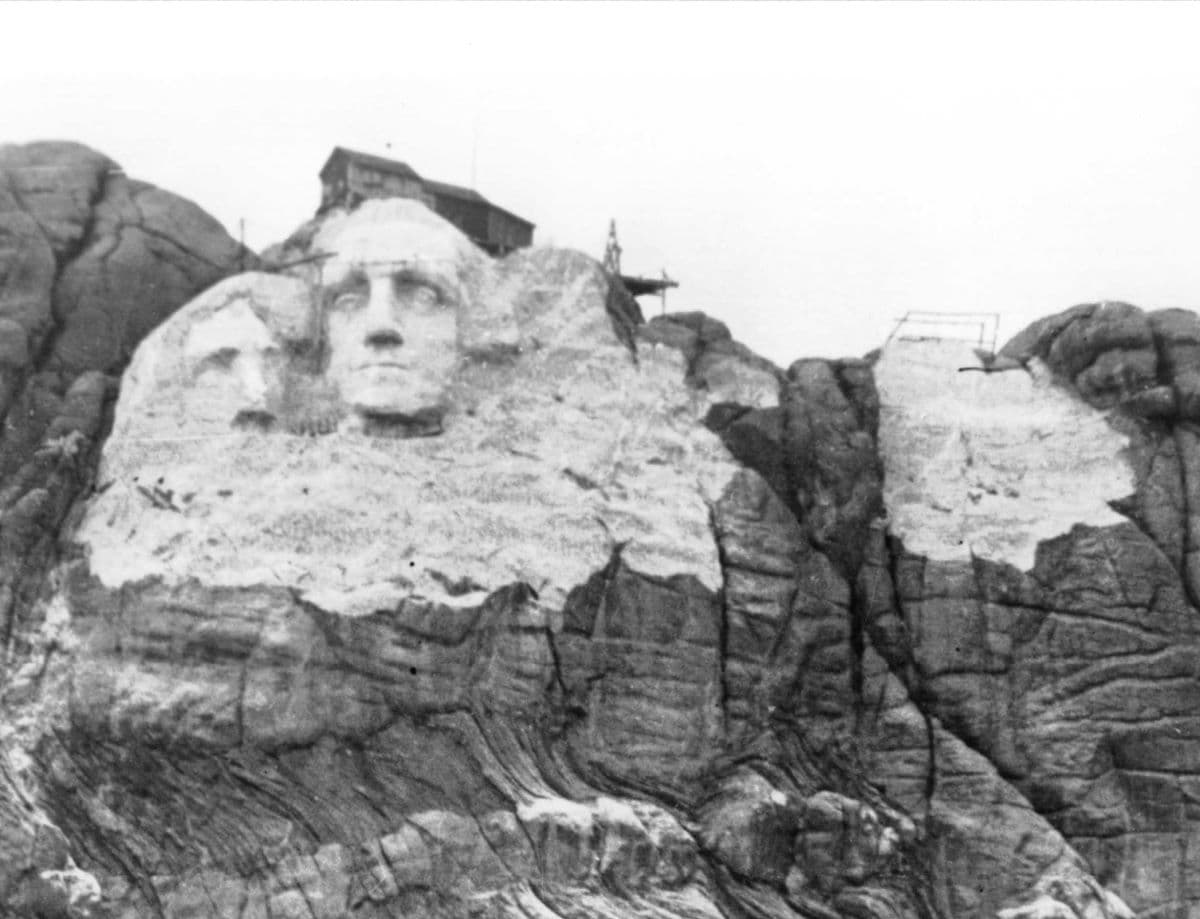
Construction underway, with Jefferson leftmost, before unstable rock necessitated a design change. (Public Domain)
Slow Going to Completion
Despite Borglum’s artistic direction, the effective use of dynamite, and federal support, there would be significant slowdowns throughout. The estimated five years turned into 14, specifically due to funding issues—an issue that could have easily been avoided had Borglum accepted Mellon’s offer.
Borglum, perhaps realizing his error, spent years haggling for more federal funds. Norbeck also worked to secure federal funding through President Franklin Roosevelt’s New Deal Works Progress programs. The Mount Rushmore project proved large enough, important enough, and patriotic enough to receive those funds, and far more than had been estimated. Altogether the cost reached nearly $1 million, of which $836,000 came from federal monies.
Some of the money had been going to a side project within the Mount Rushmore National Memorial. It was called the Hall of Records, which Borglum had envisioned as a place for America’s most precious historical records. This part of the project had not been disclosed to Congress, which threatened to cut funding if the side project continued. Borglum begrudgingly ended it.
Washington’s head was completed in 1930, followed by Jefferson’s in 1936, Lincoln’s in 1937, and Roosevelt’s in 1939. As the years progressed on the project, Lincoln Borglum became more involved, ultimately leading the charge toward the end. It was during this week in history, on Oct. 31, 1941, with funds exhausted and the heads completed that the Mount Rushmore National Memorial was declared complete.
Legacies
Robinson, who had birthed the idea of a South Dakota memorial and had brought Borglum in for the project, had taken a very far back seat to Borglum, the political figures, and the 12-member memorial commission (in which he was unfortunately never included). Nonetheless, his dream of luring visitors to South Dakota was achieved, as Mount Rushmore enjoys nearly 3 million visitors annually.
Just before reaching Mount Rushmore on Iron Mountain Road, visitors must pass through the short Doane Robinson Tunnel. Next to the tunnel, a marker explains Robinson’s contribution to the memorial and cites him as “The Father of Mount Rushmore.”
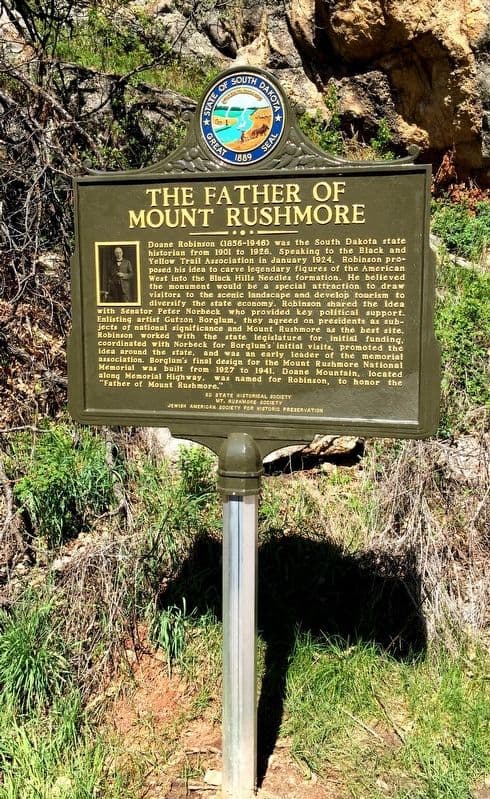
Doane Robinson marker—"The Father of Mount Rushmore." (<a href="https://commons.wikimedia.org/wiki/User:Jrryjude">Jrryjude</a>/<a href="https://creativecommons.org/publicdomain/zero/1.0/deed.en">CC0</a>)
Iron Mountain Road is part of what was declared an impossible creation—a 70-mile figure-eight byway called the Peter Norbeck Scenic Byway. It is considered one of the 10 Most Outstanding Byways in America. Norbeck’s marker is less than a mile from Robinson’s.
Although Borglum died months before the project was officially announced as completed, he did witness the completion of the four presidents’ heads, which he viewed as “the formal rendering of the philosophy of our government into granite on a mountain peak.” Regarding his vision, he once said, “I want somewhere in America, a memory of the great things we accomplished as a nation, placed so high it won’t pay to pull it down for lesser purposes.”
On July 3, 1991—50 years after Borglum’s death and after the memorial was completed—an official and formal dedication ceremony was held at Mount Rushmore. President George H.W. Bush stood before the monument and said, “On the eve of this Fourth of July—and the 50th anniversary of this monument—let us express our undiminished devotion to the ideals of Washington, Jefferson, Lincoln, and Roosevelt, ideals as towering and solid as the monument that honors them.”
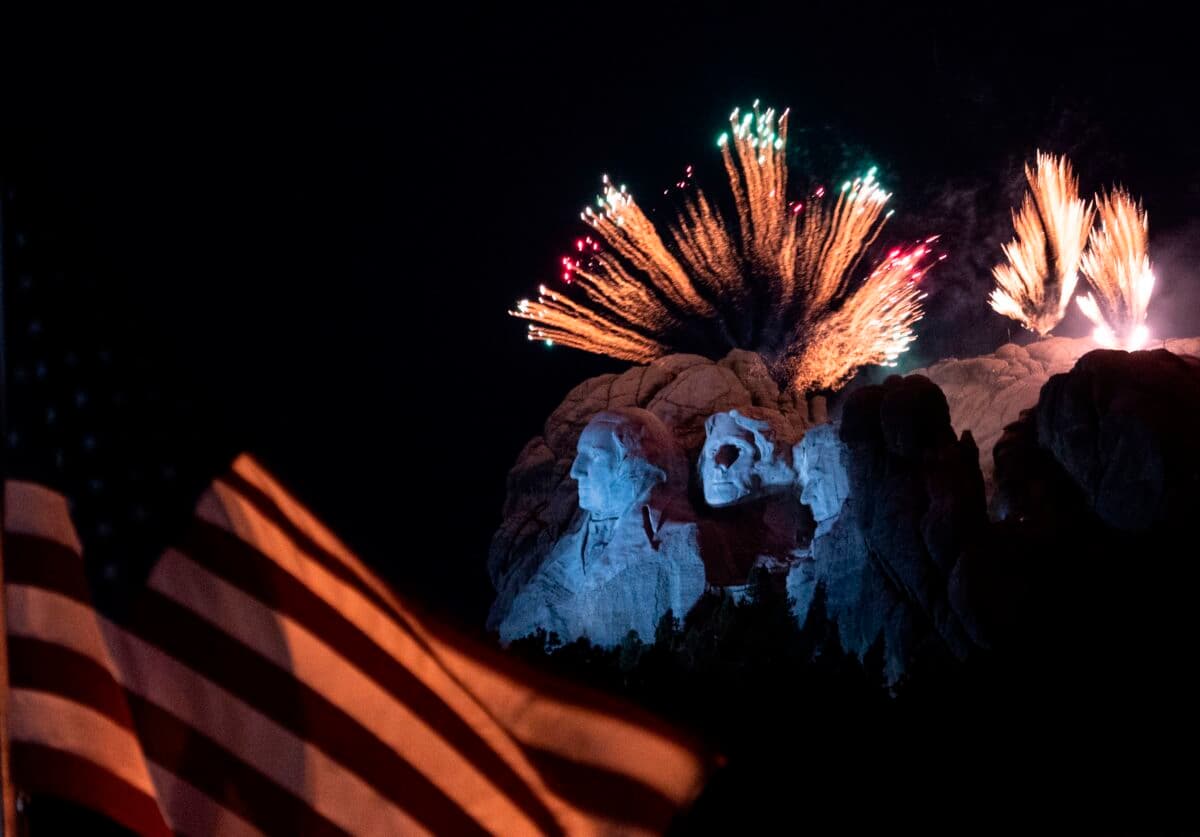
A U.S. flag flies as fireworks explode above the Mount Rushmore National Monument during an Independence Day event in Keystone, S.D., on July 3, 2020. (Andrew Caballero-Reynolds/AFP via Getty Images)
Never miss a This Week in History story! Sign up for the American History newsletter here.
What arts and culture topics would you like us to cover? Please email ideas or feedback to features@epochtimes.nyc.