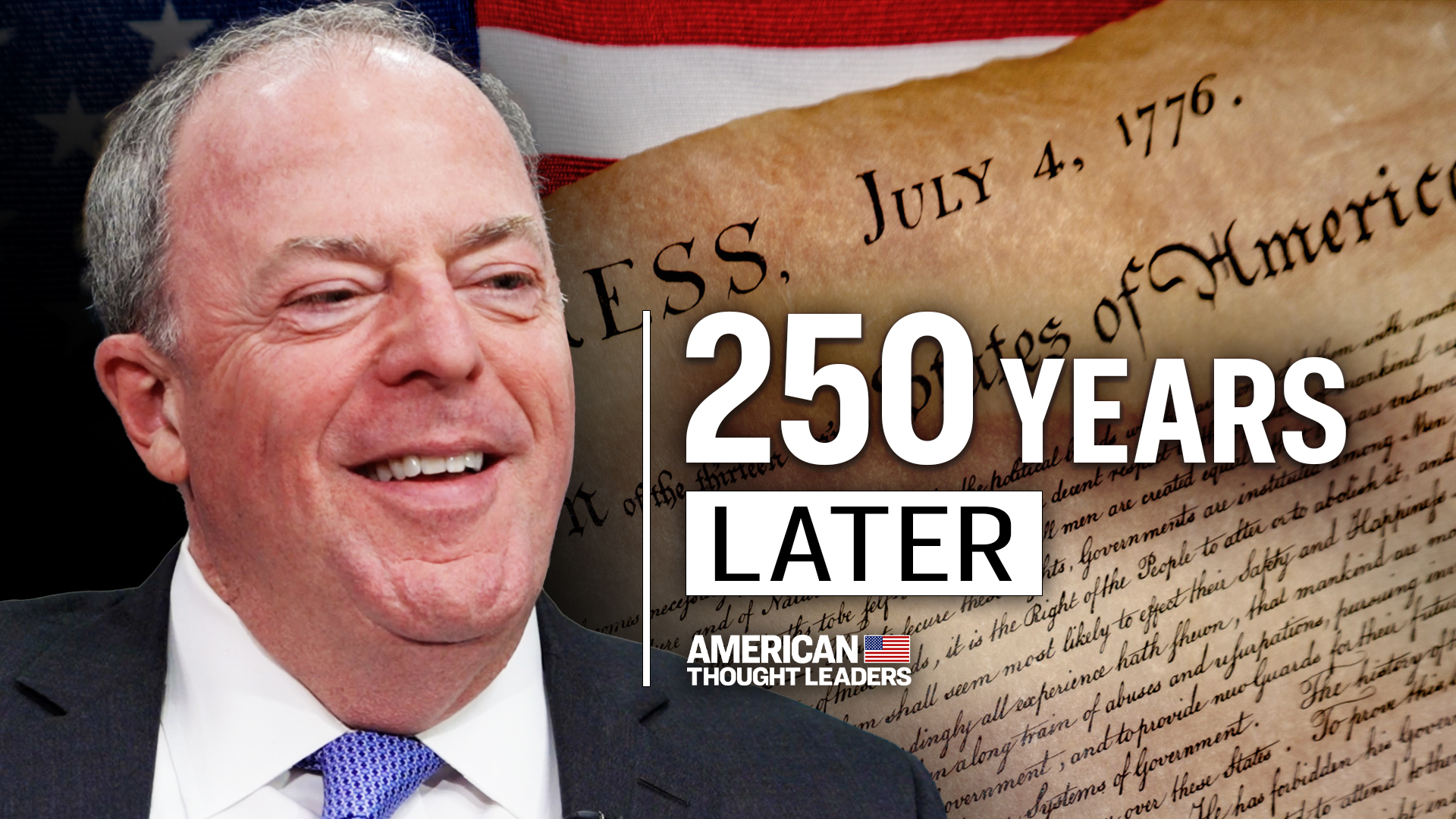

[RUSH TRANSCRIPT BELOW] Matthew Spalding is a professor of constitutional government at Hillsdale College and author of “The Making of the American Mind: The Story of The Declaration of Independence.”
A century ago, progressive historian Carl Becker argued that whether or not we have natural, inalienable rights as described in the Declaration had become a meaningless question. He believed that the idea of natural rights was not a veritable truth but merely a creed or faith of the men of his time and a product of historical circumstances.
Spalding disagrees. He argues that the existence of natural rights and natural law lies at the very heart of the Declaration of Independence. “It’s a claim of truth,” Spalding says.
Spalding regards the Declaration as America’s “epic poetry”: “It’s the heart of America ... really the heart of Western civilization.”
The founders saw themselves as part of, and as a continuation of, a deep and long tradition, in particular the Greek, Roman, and Judeo-Christian beliefs in natural law and free will.
However, after the American Civil War, early American progressives no longer viewed it that way, he says.
Their goal was to transform the United States into what they considered a modern state, and they turned away from natural law and God-given rights, and they viewed the U.S. Constitution as a “living document.”
Now more than ever, it is vital to rediscover the true meaning and importance of the Declaration, Spalding argues.
Views expressed in this video are opinions of the host and the guest, and do not necessarily reflect the views of The Epoch Times.
RUSH TRANSCRIPT
Jan Jekielek:
Matthew Spalding, such a pleasure to have you on American Thought Leaders.
Matthew Spalding:
Great to be with you.
Mr. Jekielek:
You said something in your new book about the Declaration of Independence that really made me think. You said the American mind was not revolutionary, but it was radical. Explain that to me.
Mr. Spalding:
Well, partially that stems from my interest in the meaning of words. You know, it wasn’t revolutionary. And my reference there is oftentimes we think of the American Revolution as a precursor to and akin to other modern revolutions, the French Revolution, but, of course, looking ahead to the Russian Revolution, the Chinese Revolution, and the Cuban Revolution, that sense of a revolutionary spirit. And America wasn’t that. We might want to come back to that, but it was something very different; it was radical. And I use the word radical going back to the original meaning of the word, which is rootedness or root, as in radish root.
So the American Revolution, as we call it, or the American founding, as I prefer, we can talk about that. The War of Independence is another war of independence. They were faced with this absolutely unique set of circumstances, given where they were, where they came from, the international situation, and the progressive time and thought over time that shaped them. And to solve their problem—their political problem, their military and strategic problem, their cultural problem, their challenges, if you will—they decided to go back to the deepest roots of the thing.
And so that’s what I meant when I said it was radical. Now, in the world in which they were operating, that was revolutionary in the sense that it was a shift, a great shift, politically, culturally, morally. But it was not a radical overthrowing; it was radical to the fundamental roots that really shaped what they were doing. That’s what I meant by radical.
Mr. Jekielek:
And what do you mean by progressive thought that shaped their minds? That might sound suspicious.
Mr. Spalding:
Yes, I didn’t mean in the progressive sense that it changes in the sense of... Early in my book, I talk a lot about the meanings of history. And history, with a capital H, is what we normally think. History kind of takes on a life of its own and is directional. That sense of progress, no, not at all. But they had a sense of history in which individuals are making their own decisions.
Man is metaphysically free and makes choices. That’s what man is by nature, going back to the Greek understanding of logos. And man is part of history, but they can shape history. But as a result, there is a certain progress, if you will, not capital P, but small p, that builds on each other in the sense that Greek thought was the foundation of Roman thought. That starts shaping thought and the Stoics.
And then Christianity changes all of that. And that kind of builds and goes back to Greek and Roman thought. It adds to that Christian thought that shapes the medieval world, that shapes the changes in especially European thought coming into England, the English rule of law that then creates America. And it’s that sense of thought over time that shapes them.
Mr. Jekielek:
Well, okay, this is really interesting because you meditate on this question quite a number of times throughout that sort of the distinction of progress according to the way you just described and this other perhaps capital P form of progress or progressive thinking. Explain to me the difference between this. It’s a foundationally different way of approaching it.
Mr. Spalding:
Yes, it is. And it’s something that, you know, our world takes for granted, a modern way of thinking, and their world really took for granted this older way of thinking. We need to clarify that before we in any way proceed. I mean, the Declaration begins when, in the course of human events, the very first line. And I had to think about that for a while because when we hear history, we hear, you know, well, you know, kind of this arc, this kind of thing which we have no control over that has a life of its own.
You know, you’ve heard the phrase a million times, just talking to someone casually, you’re on the wrong side of history. That’s not how they thought of it. You know, that modern way of history is really shaped by kind of modern thinking, post-French Revolution, German thinking, German historicism, which is there’s kind of this spirit of history that is this kind of rational, progressive, in the bad sense, thing that we then merely try to kind of follow and shape ourselves to that sense of history.
Carl Becker, the famous progressive historian who wrote what was really the most famous and beautifully written book on the Declaration in the 1920s, was very much of that camp. So he wrote a beautiful book about the Declaration, but at the end, he asked and answered his own question, which is, to ask whether the Declaration is true or not is a meaningless question. Well, why is it meaningless?
Well, because it’s been overcome by history. It’s no longer significant anymore. History has evolved. The Founders’ generation, which is really history prior to the French and the German revolutions in thought, was that man was rational. He possessed logos, the great Greek discovery, if you will, about man, and that man makes decisions, makes mistakes, there are tragedies in history, does noble and great things, great accomplishments, writes books, all of these things.
Indeed, the original Greek word for history is chronos, as in chronology. History is kind of this, all these things over time, which we can study and learn lessons from. That’s a very different understanding of history. If you see yourself as merely a cog in the wheel of history, you’ve got a different approach to what you should do.
On the other hand, if you see yourself as, no, no, I’m a human being that is metaphysically free and capable of making decisions, capable of building things, capable of shaping history itself, capable most importantly of being free, which is, that’s the radical claim, right? Then that changes how you might operate.
So think about it in international terms today. You’re in a country somewhere off in the world that has a form of government, despotic, communist, whatever it might be. Do you think of it as, well, this is my fate in history over which I have no control? Or do you think that me and my fellow people are actually capable of changing that history? We could shape that history because we have the freedom to shape history. Those are two very different views of the world.
Mr. Jekielek:
If I may, it’s like foundationally different. And I keep wondering to myself, why are we not learning the lessons of history? You know, for example, the Greeks figured out that nemesis always follows hubris, for example. That’s a great lesson. It’s good to know that, right? Because then you might sort of like go easy on the hubris or at least think about it. Or at least be aware that that can happen, right? I mean, I think some of the most horrible decisions I’ve made, I don’t have a ton of them, but when I think about it, it was often in this kind of hubristic way of thinking. And indeed, there was nemesis, right? But I didn’t know about that. I didn’t study it, right?
Mr. Spalding:
No, there’s something about that. It’s striking how often my own students, and since my graduate school where I teach is in the Hillsdale campus in Washington, D.C., I have older students who are involved in politics. It’s striking how often a student will be kind of hearing some of these arguments about the founders, what they were thinking, or reading Cicero or the Greeks, and it strikes them as, oh, that’s what I was just observing the other day.This is about politics right now. There is something permanent about this. So this view of history messes up things at different levels.
But the older way of thinking about politics, going back to the Greeks and the Romans and then the Christian tradition on top of that, was that things change, our lives, the particular things around us, the circumstances, the economy, the actual circumstances of who’s ruling at a particular time. But again, because man is metaphysically free, his mind is free; there are certain things that can be known and certain things that don’t change. So you can have permanent principles, including permanent lessons about human nature. But you also then have constantly changing particulars.
So today we’re stuck in this world where either everything changes all the time and nothing is true, kind of a modern relativism; it’s all, you know, nothing matters. Or we have this view that we must be this absolutist view, and we actually don’t have much to say about it. It’s almost kind of this Kantian modern sense that there are absolutes and that’s all there is. We’re losing the human in that world, which is why a good portion of my book is to kind of recognize that modern world.
And if you understand something like the Declaration, we need to get out of that world because that’s not the context in which they wrote it, but it’s also not the artificial modern world that modern academic thinkers have created for us. We need to get back to what that human world, that world of politics in that human sense, meant. And so talking about history and what is reality and is man metaphysically free? What can they know? All of that pushes us, and the Declaration draws us into that world.
Mr. Jekielek:
Well, and it’s very interesting. I find that we are in the 250th year of the United States, and there are indeed all sorts of big celebrations planned. I find it fascinating, as someone who didn’t grow up learning much about the Declaration of Independence, frankly, or the Constitution, or that founding. I was Canadian, and we sort of viewed it from this, you know, we burned the White House once, and we’re proud of that perspective. And then I went into biology, so I didn’t have any of that. But like, why? It seems almost odd that it’s the Declaration of Independence that defines that anniversary of 250 years, not the Constitution, which is what you might think, right?
Mr. Spalding:
Yes, it’s actually a great question. And there is something unique about that. And it took me a while to think about and figure this out. I had some wonderful teachers that helped me do this, of course. But the Constitution is a framework of government. Now, it’s the greatest framework historically. It’s the greatest constitution in world history. But it’s a framework.
What explains the framework? If it was just the Constitution, it would be limited. There’s not enough there. It assumes we’re all equal before the law. Why? The Constitution assumes that we the people are sovereign, and thus there are three branches of government, none of which is sovereign. Why? The Constitution assumes there are powers of government. Where do those come from?
So, as a practical matter, you need the Declaration. The American system of law goes back to the Constitution. Our most important laws are first law. It’s the supreme law of the Constitution; our most important laws are first law, it’s the supreme law of the land, but to understand the Constitution, you need the Declaration. And the Founders always saw them as two sides of the same coin, or to put it in terms of kind of classical Greek thinking, they believe Plato’s laws talk about there being the law, but then there also must be a preamble to the law, something that puts it in the right philosophical context. That’s the Declaration.
To put it in a more immediate sense, the importance of the Declaration. The Declaration is, I like to say, it is America’s epic poetry. And Jefferson, you know, all honor to Jefferson, as Lincoln said, is a wonderful writer. It’s heavily edited and has all sorts of things. We can get into that, but it’s just a beautiful document, and we often don’t read the whole thing. You should read the whole thing, not just the famous words, and it was clearly understood at the time to be not merely a declaration of independence in the sense that we’re breaking with England; it’s severing that relation, yes, but throughout the document, it severs a relationship and it creates a new one. It clearly is saying a new nation.
The Declaration assumes we are one people, and these people are going to be a sovereign people and have the right to do the things that all sovereign states have a right to do. So they clearly understood it as being this birthday, if you will. There’s a prehistory that leads up to it, an announcement, a birth announcement, if you will. There’s an article in the Confederation, a first attempt at a constitution, which is a failure. And then the Constitution, which is the framework. And these were seen as the two bookends.
So yes, it is the Declaration, but it’s the Declaration where you get the philosophical mooring, the statement of rights, the beautiful language about all men being created equal. So naturally, the human mind naturally goes back to the Declaration. And, you know, I’m always struck by, if you think of other people in the world, what do they quote? What do they look to? What do they hold up? Yes, it’s American rule of law in the Constitution, but it’s the Declaration of Independence.
Mr. Jekielek:
So let’s talk about this: all men are created equal, you know, very early in the Declaration. What does it really mean?
Mr. Spalding:
So they set up the Declaration, that opening paragraph, when in the course of human events, we’re going to sever our relations; we’re going to start this new nation according to the laws, and they set their standard, the laws of nature and of nature’s God. So they’ve created this first paragraph, which announces what they’re doing. It’s kind of slow in how it begins, when the course of human events, and they’ve set their standard, the laws of nature, and nature’s God. And then Jefferson kind of changes it in this kind of staccato language. He studied rhetoric, as did John Adams.
And I want to point out before we get to the line about equality, it says, we hold these truths to be self-evident. That is a very powerful line. It doesn’t say, we have some of our personal opinions we'd like to share with you. It’s a claim of truth. And this goes back to my earlier point that the mind is metaphysically free. It’s capable of grasping truths.
And indeed, some truths are so important they’re self-evident. You can understand them such that it’s so true that we can all understand them. The idea of self-evidence, the concept most famously articulated by Aquinas, also goes back to Aristotle. And the first of those self-evident truths is that all men are created equal, which is, if you think about it, the most radical statement you could think of, partly because it’s not obvious, but it is self-evident.
If you know what man is, which is a rational animal that is metaphysically free to make decisions and choices and think and deliberate and decide, then you understand that they’re equally human because that’s by nature what they do. It’s not a claim that they’re all the same size and shape and color. Some aren’t, you know, handicapped. Millions and millions and millions of reasons why they’re all different: hair color, you name it. No, that has nothing to do with it.
It’s a grasping of something that is different for some deep reason, some fundamental reason, which is what man is. Man’s not a dolphin. Man’s not a fire hydrant. Man is a human being. That is a radical thing. Talk about going back to the most basic concepts. Okay, we’re going to go back there. That’s our starting point.
Mr. Jekielek:
It’s sort of radical, except people kind of knew that, right? Humans are different.
Mr. Spalding:
Yes, but they knew that they were different, but there was something about them. I mean, so for instance, and I tell my students this all the time, when we walk into a room, what do we immediately do? We start, we see somebody right there. That’s an assumption on my part, right? We naturally recognize this is another human being, and we start talking to them. Perhaps we have a different language, but we get around, but we begin to do what human beings do. So that’s what they mean by self-evident.
What’s radical is that this is going to be the beginning point of our politics. So they’re going back to something that is not unknown. I mean, the Christian tradition clearly has a sense of equality. We’re all equal in the eyes of God. There’s a concept of equality in the Romans, clearly, in Cicero, and even in Aristotle, there’s a sense of equality because we’re equally rational. So it’s not new in that sense, but what is new is the politics of it.
All politics prior to the American founding, the American Revolution, the War of Independence, whatever you want to call it, were ruled by the despot, the king, the aristocracy, the tribal leader, the family leader, whatever it might be. This is a radical idea. Our policy is going to bend with the notion that we are equal, which, of course, then, you know, the other truths in that first paragraph follow from that. Okay, well, they’re created equal, and created is an important word we'll have to come back to, and they’re endowed by their creator with certain unalienable rights: life, liberty, and the pursuit of happiness.
Out of that, well, the only fair way to proceed is that governments are instituted based on the consent of the governed. And if government is not upholding those truths, securing those rights, we can alter or abolish it and institute new government. So it’s really logical; they don’t necessarily all follow exactly as a philosophical matter, but it’s a logical building up of an argument that comes from this notion that we are equal.
Mr. Jekielek:
I keep thinking about something that you meditate a lot on in the book, which is this concept of natural law, right? I came across it colloquially first, then I found it in C.S. Lewis. And, you know, frankly, I’ve just, over the last 10 years or so, been learning about it. And we hear about it, but we don’t actually understand what it is. And it stands in stark contrast to this sort of, I don’t know, statist approach that rights come from the state. Can you just explain this a little bit?
Mr. Spalding:
First of all, I'll point out the misconception. A lot of times we hear this word, you know, natural law, and we think of, oh, that’s some sort of religious mumbo jumbo or some sort of mystical magic or some weird thing that’s, you know, put on top of something else. That’s not all the claim.
The natural law tradition, and I emphasize that word tradition because this really goes back to the very beginning, begins with the Greeks. The Greeks and the Romans and the Christian tradition, the medievals, the whole trajectory up to Hooker, John Locke, and Algernon Sidney, the folks that more directly influenced the American Founders, and the American Founders themselves.
And it builds off this claim, going back to our earlier discussion about logos, man is rational, which means man can understand certain things fundamentally, such as all men are created equal. He can understand certain things in the nature of things. He can understand the essences of certain fundamental things. He can make distinctions.
And upon that, he can build certain understandings of things. It doesn’t answer every question; it doesn’t answer every theological question by any means, but it understands certain fundamental questions based on reason. It’s a rational activity. It’s not necessarily theological at all, although the Christian tradition recognizes the natural law tradition and expands it and adds a higher ultimate aim in Christianity in particular, but it’s still rational.
Aquinas, who’s the most famous writer on this concept of natural law, in the Summa Theologica, says that Christianity is not necessary to have natural law. Natural law is the rational creature’s participation in eternal things. Right now, his world has been created by God, but it’s not revelatory, this natural law. It’s what man naturally is. Paul in Romans talks about the pagans who don’t have the law, by which he means the law of Moses, but they still act as if they understand the nature of things, right? So it’s a rational recognition of certain common truths.
Now, you play that out over time. There are more complicated versions of this and different ways of putting it all together and arguments, different things like that. But the argument is in there in the nature of things. There are certain things we can come to understand.
Mr. Jekielek:
Is this morality we’re talking about?
Mr. Spalding:
What it is when we hear morality a lot we think of it as a theory that we’ve imposed. What it really is growing out of is man’s natural understanding of reality around them. Man has this reason, which means man is capable of thinking in ideas, in universal concepts, right? Human beings. And we can talk about things like justice.
So it comes from Aristotle. Well, okay, you play that out. So it doesn’t answer every question, but it might be that there are certain things we can actually rationally understand, which are the basis of politics, such as all men are created equal. Now, it has the word created in there, which is a little bit of a twist.
But having said that, the notion of human equality follows by reason. Well, if that’s the case, then that would imply, as the argument to the founders would clearly play out, that implies that no one by nature, or say by divine right, can rule us. The only fair way to do this is by consent. The king has no claim on us as subjects.
So there is a very substantive natural law argument within the American founding. and it’s not something that they kind of discovered later, let’s say in John Locke, or they read some book and decided to adopt this theory. What it is, is this tradition, going back to the Greeks, the Romans, built upon and augmented by the Christian tradition.
But then there were other thinkers. It eventually jumped ahead to the document, John Locke on the Glorious Revolution. Then there was Algernon Sidney, who very much did influence America. They were part of that tradition, man being unique, having a certain nature, having certain, there are certain laws of this nature, but also man has certain rights by nature.
Again, and that’s exactly where the Declaration is. So it’s not that it’s some sort of crazy harebrained idea that they discovered and imposed. It’s more that the American founders saw themselves as part of a deeper, longer tradition, which they then went back to for guidance.
So going back to your distinction between natural law and statism, another way to put that would be they were faced with what? The options they had before them were the divine rule of the king. OK, we don’t want that option. The absolute and arbitrary rule of parliament, which was kind of an almost Hobbesian Leviathan, you know, all power subsumed under the state—we don’t like that option either, right? So it’s the rule by force that is the alternative.
And so instead of the rule by force, they begin in the sense it’s radical—no, no, no, it’s not the rule of force; it’s the rule of man, and he makes his decisions freely because he has metaphysical freedom. And he makes those decisions among his fellows because we are created equal, and just government is based on consent. That’s the radical alternative.
Mr. Jekielek:
And so, I mean, it’s kind of bizarre that in a lot of ways, I think, across many societies today, we’ve come to kind of believe that, you know, the rule of the state, or just kind of assume that that’s just how things work.
Mr. Spalding:
I completely agree. This is the problem. And actually to tie these things together, this modern notion of the rule of the state is also tied very much to this notion of progress in history with a capital H, which is to say that if you read early American progressives—we see this elsewhere, but the American progressives after the U.S. Civil War, something I’m more familiar with—where is progress going?
Progress is the development and evolution of the modern administrative state. And so there is a connection between those things. And what did the modern American progressives want to do? They wanted to turn the Constitution into a living document. But in order to do so, we have to undermine its moorings, which is the Declaration. They wanted to kind of rework all that stuff and deconstruct it, as we say nowadays.
So there is, you know, the modern statist approach, whether it’s the despot, the aristocracy, the monocle, the communist state, or rule by the Supreme Court, or whatever it might be, those are all modern deviations. What I want to try to get us back to is a sense of limited government, of human freedom and liberty at the centerpiece of all of this. And the story in America is the American Constitution, but you have to go back to the Declaration.
That’s where the real mooring is, which is why, yes, it’s the 250th anniversary. It’s very important right now to reread the Declaration of Independence. But there’s also a deeper reason to go back to the Declaration. The Declaration is our epic poetry. It’s the heart of America. And in the modern day and age, the heart of America, in this principled sense of its meaning, is really the heart of Western civilization, which is what we want to recover in a world that’s gone in a very different direction.
Mr. Jekielek:
Well, and correct me if I’m wrong here, but I’m under the impression that every modern liberal democratic constitution is based on the American. Is that the case?
Mr. Spalding:
In general. I think the American constitutional order radically changed. I mean, talk about one of those turning points in history. The American, this moment, if you will, that creates the constitution based on the Declaration, radically changes the sense of modern democratic arguments and constitutionalism. And so written constitutionalism really kind of grows out of the American experience. And that’s extremely important. My point is that written constitutionalism by itself, if it loses its grounding, is merely mere majoritarianism.
Mr. Jekielek:
Okay, explain that.
Mr. Spalding:
Well, it’s whoever makes the laws. Whatever you want to do goes. Think of whatever terrible European democratic constitutional country is doing in its policies. If things can go awry if you’ve lost your grounding and the Declaration gives you the grounding. Consent. What are the most fundamental rights? We don’t have a right to whatever we claim.
We have rights deeply grounded in our human nature. And we are equal. Equal in what sense? Equal in this fundamental sense of being human, which has something to do with what we do as human beings in terms of thinking, deliberating, and practicing liberty.
Mr. Jekielek:
Well, so let me talk about something that initially amused me as I started this show, American Thought Leaders. And then I realized it was really profound. I would say, well, we’re a democracy, right? And then people who have looked at this enough would say, ah, Jan, no, no, we are a constitutional republic.
Mr. Spalding:
Republic, right.
Mr. Jekielek:
Okay. And it’s so interesting, right? Because, you know, again, you think of democracy as this very positive thing. There isn’t one person that decides; it’s the people deciding, right? This is the consent of the governed. But actually, democracy is really rule by the mob, right? This is, again, my perspective. Like, it’s basically like the group can be wrong.
And we see that again and again in history; the majority could be really wrong and could actually institute really horrible things. So that’s where these inalienable rights come in that aren’t actually subject to democracy, and that’s fascinating and incredibly important. So, I said initially I thought it was funny, but then I was, you know, no, actually this is unbelievable; there’s something actually going on there, right?
Mr. Spalding:
That’s right. Part of the brilliance of the American system is the way in which they combine these two things: a constitutional system, which is democratic, but it’s a constitutional republic. You’re exactly right, which is to say it’s constitutional in the sense that the rule of law, and it’s the written rule of law, is at the center. It’s a republic in the sense that it’s representative. But broadly speaking, it’s democratic as a form of government in the sense that the people are sovereign. But how do you do that when all of history teaches this lesson that rule by the demos almost always goes bad at some point if it becomes merely one of the popular passions?
Well, the American founders did two different things which are key to that. One is that framework of the Constitution. I mean, gosh, read James Madison and all the debates; it’s just brilliant. You create a framework that has the effect of slowing down opinion, the demos, breaking it up. We have a House and we have a Senate, but then breaking it up further since you have a legislature, an executive, and a Supreme Court. The objective is to maintain the constitutional rule of law. So, you have checks and balances and separation of powers, which was just brilliant. I mean, the ideas had been kind of developing, percolating, but they really do it, and it’s a brilliant structure.
But behind that constitution, which in many ways is checking and balancing and holding at bay the more of the mob spirit of the demos, behind that framework is the Declaration, which is a deep and fundamental statement that, no, no, no, the people are sovereign because they are equal in some deep and fundamental way. And that is the most fundamental thing. They’re the ones that have rights. Students are people who talk about so-called states’ rights, which is often meant to say, well, we’re going to talk about federalism and its importance.
But the concept of state rights makes no sense in the American system. No government has rights. The federal government has no rights. States have no rights. Counties have no rights. The dog catcher has no rights as a dog catcher. Right? Government has no rights. The people have rights. And so in that sense, it’s democratic. We all have rights equally. I don’t have more rights than you do, even though you come from another country. That doesn’t matter. Once you’re a citizen, we are of equal status and my rights are just as valuable as your rights.
Indeed, in general, all persons, the Constitution talks about persons that have those rights. That’s democracy. That’s, you know, a sense that we are all equally involved in this. But then the framework filters that, shapes it, and forms it into opinions that go through the legislative process and the executive process of executing the laws and the checks and balances and that kind of thing. So it brings these things together so that, yes, our form then is a constitutional republic.
Mr. Jekielek:
Let’s talk briefly about Cicero. So again, being a relatively new student of all of this, the last 10 years, let’s say, I didn’t grasp the importance of this, you know, Roman, I suppose, well-known Roman in forming American thought. Maybe tell me a little bit about this.
Mr. Spalding:
Yes, in my book I recognize the importance of Cicero for a couple of practical reasons. One is the American educational system at the time of the founding. And if you think of the signers of the Declaration and then those who are then later framers of the Constitution, they’re educated. Many of them have legal studies, which didn’t necessarily mean law school but meant they thought about and studied law. Often their education was still based on a classical model, which meant they studied foreign languages, especially Latin, and also Greek. If you were learning Greek at the time of the founding, that means you read the New Testament in Greek, and you read Virgil and other important Greek writers.
But they all studied Latin, and if you studied Latin, the greatest Latinist to study, to learn Latin, is Cicero. So they all read Cicero. Cicero is also a very important figure in the rule of law. So if you study law, you read Cicero. So he was everywhere. He’s quoted throughout their writings. And the other thing that’s important about Cicero is the extent to which Cicero is a student of the Greeks. So he brings the Greek tradition in.
But also you see in Cicero a more robust sense of the natural law. Remember, he’s pre-Christian. So this is evidence now that there’s a natural law even before Christianity. And he emphasizes the rule of law. He also emphasizes there’s more of a sense of equality in the sense that we are all fellow citizens. And there’s a sense of a republic.
Remember, what is he doing? He’s defending the republic from Caesar. So there are numerous ways in which he’s a key figure for the Americans, such that in the midst of their fighting with the king, they’re also shaped by Christianity, but this pagan Roman figure turns out to be very important and very helpful to them in making their argument.
Mr. Jekielek:
What would you say is his biggest contribution?
Mr. Spalding:
It’s hard to say. I mean, one is just kind of the general study and outline of how to think about law, which is very important; he writes on that a lot. The natural law concept really comes through Cicero because of the influence of the Stoics. But then, you know, a lot of this, you read him in the Latin, so a lot of his general understandings of virtue, duty, and honor, which he’s getting and building out from the Greeks, are very influential. So I would say it’s kind of across the board, but it’s essentially transferring the Greek understanding of the logos and reason and virtue, which is probably the most important thing.
Mr. Jekielek:
I would imagine that a lot of that is what’s actually been lost today.
Mr. Spalding:
This is absolutely true. So when we, again, think back to our early discussions about how history is understood, how democracy and republic, all these various terms of art, were in our modern world. What do we lose because of all that? Well, we lose how they understood history, how they understood man’s reason, but then how they understood the tradition that came before them and what they inherited, which was what?
It was largely the kind of Greek and Roman understanding of virtues, duty, and honor, and what a republic is. Republican Rome was a model for them. And then the Christian tradition, which, you know, shapes that and adds to those virtues, the Christian virtues. I mean, all of that is, if not set aside, because there are critics who want to get that out of history.
But also we just kind of don’t talk about that anymore because we’re so affected. This notion of history is always looking forward. Progress takes us away from those things. And we forget, or we’re told to forget and ignore all that. There’s nothing there to see. And you can’t read this stuff, read their letters, read their correspondence, read their debates.
It just inundates you with all of these references, which are all references to history, constant references to history, constant references to the Greeks and Cicero and the Romans. And constantly, it’s very clear. They’re writing in the moral horizon of the Christian tradition, either with specific biblical references throughout their writings or more generally; they’re clearly in a culture that has been shaped by the whole ethic of the Christian tradition.
Mr. Jekielek:
Yes, and that’s kind of a big argument that you make. The Declaration and the Constitution assumed a moral people, right? In a Christian sense.
Mr. Spalding:
There’s a general assumption that they make that the kind of people, the Constitution is made for a certain type of people. And that is a people that has absorbed their history. They’ve studied their own history. They’re British, but they’ve got this understanding of the Declaration of Principles on Equality. But yes, there’s a moral culture around all of that, which is very important.
I don’t treat it as some sort of 18th-century thing and we’re over that. You really can’t read the Declaration in particular. The Constitution doesn’t, it’s not there in the same way. You have to go back to the, it’s the other side of the coin, if you will, the Declaration. The Declaration’s understanding of rights, of consent, of the very grounding of the American regime. It’s not doctrinally religious.
And that was important, remember, because they wanted to get away from the religious wars of Europe between the Catholics and the Protestants, but then between various Protestant groups. They wanted to not have that happen here, and many of them had come here to seek religious liberty. So they didn’t want to go there.
Having said that, there’s a clear theology of the Declaration that you can’t ignore. You know, there’s often this sense that we want to, well, the Declaration is merely a kind of secularism and secular rationalism. They’re a bunch of deists. There’s really no there there. I’m sorry. It’s just there in the various words, and again, it’s throughout their writings. I mean, it opens with a reference to the laws of nature and of nature’s God.
There are two individual characters in the Declaration. One is a bad guy. Spoiler alert. It’s King George III. If you didn’t know that, just kind of ignore that and move on. But the only other individual in the document is God, the laws of nature and of nature’s God. And it turns out the same God, all men are created equal. It’s a creator God who specifically creates man. And not only does he create man, but this God endows man with specific rights: life, liberty, and the pursuit of happiness.
And then towards the end of the document, there’s an appeal to the supreme judge of the world for the rectitude of our intentions. So this God is the same God that can see our intentions, the rectitude. And then at the very end, there’s an appeal, another appeal, this time to divine providence, which says the idea of a God that intervenes sometimes. You know, the old claim, it’s the watchmaker God, and then just kind of ignores it. Divine Providence clearly implies that, no, God is somehow overseeing man’s affairs.
George Washington, for instance, clearly understood that and believed that in some very particular instances during the American Revolution when the Americans were withdrawing from Long Island. They were about to be completely obliterated by the British, and they escaped over the East River into Manhattan and then escaped into New York. A fog came up and prevented the British ships from attacking them, and he said that was divine providence.
My point is, you really can’t read the Declaration, which means you can’t understand its notion of rights, unless you understand that there is a theological sense here that, setting aside what it is in particular, it’s not, you know, this is not the New Testament. This is not, you know, the man; this is not the God that became man in flesh, but there’s almost an Old Testament sense of this God that’s clearly in their horizon.
It just boggles the mind that Jefferson, who was the draftsman, would have written something that would not have been acceptable to the rest of the signers. John Witherspoon was the chaplain. The Presbyterian minister was a chaplain. John Hancock, the president of the Continental Congress, was a devout Congregationalist. He knew his audience, and he wrote to his audience. And then Congress adds a few of those references.
So clearly, they had a theology in mind here, but an intention that it would be very non-sectarian, non-specific. It was generally something we could all understand, a natural theology, but it clearly does point beyond that towards this God that sees your intentions and sometimes intervenes in world affairs.
Mr. Jekielek:
Well, but this is, I think, what people have argued. I’ve seen this argued that the reason that there are these types of references is because so many people of the day were religious themselves, so it wouldn’t have made sense. So it’s really, the argument would be something like this: it’s really a secular document, but it has, you know, it’s peppered with some religious references to accommodate those poor souls who are afflicted with religion or something like this, right?
Mr. Spalding:
Yes, but it really makes no sense, right? I mean, you need theology. And again, it’s non-sectarian. It’s non-specific. It’s not making a religious claim. But it’s important, if you understand what we might call the great chain of being, which is an old medieval term. And the Declaration requires us to make this assumption, which is we’re not animals in the sense that we’re not, you know, dogs or dolphins or, right. We’re human beings, human beings that somehow have this divine gift.
And in turn, we’re not God, even though many of the modern say we are gods, we’re not God. And our rights, the fact that we’re created equal, all of that is because of something other than ourselves, something outside ourselves, something that transcends man, something transcendent, yes, and so it’s that the hierarchy, if you will, that actually is necessary to understand the Declaration, and it’s clearly, clearly written with that intention. These are not merely rhetorical asides that serve no purpose.
The fact that the reference to the beginning, to the laws of nature and of nature’s God, I mean, the laws of nature, I’ve been talking about that, and of nature’s God, the same laws are also the laws of nature’s God. Natural law, we understand them by reason, but also there’s a sense, which in theological terms is what we call general revelation, that through our reason we can understand by looking around us that there is a God.
Jefferson, as the writer, and the committee never got rid of that, never debated that, understood these are the two great realms, if you will, reason and revelation to which we are appealing. That is significant. That’s more than merely a rhetorical flourish. That’s meaningful.
Mr. Jekielek:
Yes, and you developed that quite a bit in The Making of the American Mind. Maybe as we, I don’t want to give up the whole book here. I found it quite a deep and thoughtful read. Maybe just tell me a little bit about what happened, the actual historical events, how ultimately this was signed and what happened to some of the people. There were consequences for being a part of this. And just to give people a flavor of what they might find in there.
Mr. Spalding:
We’ve been talking about some of the larger concepts here, but what I really wanted to do with the book was tell a story. Because I think the way you draw people into the ideas is actually the story. And indeed, you had made an earlier reference to C.S. Lewis. To me, C.S. Lewis was a model to some extent in the sense that his autobiography, which is called Surprised by Joy, is about his own conversion.
But Joy is also his wife. It’s this wonderful tip of his hat to his wife as well. But he talks in that book about how he studied history because originally he was studying pagan mythology and all of these things. But by studying that history, it often drew him into these transcendent things and eventually the eternal things. So there’s a sense of telling good history. History draws people into these higher truths.
So I spent a lot of time in the book talking about the history at the beginning, which is how we got to the Declaration, how it was written. Jefferson actually arrives late. He’s almost an add-on at the very end, but he’s got a reputation for being a good writer. He’s kind of brought in and eventually gets onto this committee to write the Declaration. But on the committee, the two other key people are Benjamin Franklin and John Adams, along with Jefferson and a couple of others.
They decide he’s going to be the penman. There are debates I talk about, especially feminist debates between John Adams and John Dickinson, who doesn’t oppose it in principle but doesn’t think it’s the right time; we should wait, we want to do this. So all of that kind of gets us to that point.
Things start moving very rapidly once we learn that George III hired Hessians, for instance, to fight against the Americans. They know that the British are literally coming. The ships. Indeed, one of the things in the book, which I just find an amazing story, is that July 2nd, which is the day they pass independence, before they then spend two days debating and editing the written document of the Declaration, those days, those exact same days, in 1776, Washington is in New York, and they spot British ships arriving at the New York Harbor. And they’re landing troops on Staten Island on July 2nd, the same exact day. It’s a phenomenal story.
So that’s the front end, and then the majority of the book then goes through the document, which we’ve kind of been looking at different pieces, but I go through the whole thing, every paragraph and what it says. But then there’s a, I end with the discussion of the iron men, and that actually comes from a speech of Lincoln’s in which he’s beginning his debate with Stephen Douglas when he was running for Senate. So this is now in the 19th century. And it’s on July 10th, so it’s near the 4th of July. And he’s in the middle of all this. He kind of takes him aside and he quiets the crowd and says, you know, everything we have here today, everything the world sees that America has, our success, our freedoms, we know is because of those men and what they did. They were iron men. So it’s Lincoln’s phrase.
And then I have a discussion about what happened to them. You know, we have a sense today that somehow they are just, you know, these dainty individuals who are sitting around debating and wearing tricorne hats and wigs and riding with quill pens. These were, I mean, manly figures who were literally giving up their lives, their fortunes, but not their sacred honor. John Witherspoon, who was the chaplain, had a son who was killed by a cannonball at Germantown. Richard Stockton, also of New Jersey, was captured and tortured, but he wouldn’t recant the Declaration. He was let go, but he was essentially destroyed. They destroyed all of his property. He died very soon thereafter.
The signers in New York were all tracked down by the British. Twice, they tried to capture Jefferson. The signers from New York were all searched for. Francis Lewis, they went to his house. He wasn’t there, but his wife, Elizabeth, was. The house was surrounded by cavalry. She wouldn’t give up. They sent ships up Long Island Sound and bombarded the house until she gave up. She was captured. She was only released because George Washington forced a prisoner exchange.
Robert Morris, probably one of the wealthiest, if not the wealthiest man at the time, was the financier. He was the superintendent of finance for the whole revolution. At one point, he was giving, signing what are called Morris notes. He was using his own personal credit to buy supplies for the revolutionary army, for the Continental Army. He, in today’s dollars, gave the equivalent of $32 million. He died in a pauper’s prison because his other investments and his real estate investments went bad at a certain point. So he died completely broke. It’s a phenomenal story.
So the beginning, how we got there, is a discussion of the document itself, but then what happened, what happened to them. If we’re thinking today that these are kind of these, you know, delicate ideas and not really getting down in the middle of things, it’s a powerful, powerful story.
Mr. Jekielek:
Yes, and I really did enjoy reading it. And, you know, it’s funny, over Christmas, I got another book about the Declaration, which I’m going to be looking at. I haven’t had a chance to look at it yet, but I think it’s a little bit simpler. And some other paraphernalia, I think my family realized that I’m very interested. As we’re going to finish up, a final thought from you?
Mr. Spalding:
I want to add something that would actually be great for your audience in particular, which is that I come back to that Lincoln speech in 1858 in Chicago. He asked a really interesting question towards the end of this discussion about July 4th and the Declaration. What happens when they’ve all died? Because they were 19th century figures. This was actually when they were all dying. They were all gone.
Those who fought in the revolution were all dying. It was a generational shift. What happens when they’re gone and you can’t have fathers teaching sons, teaching their sons, teaching their sons? It kind of fades away. Or more importantly, he says, what about all those people who come to America and don’t have ancestors who fought in the American Revolution? What about them? What makes them?
And then he gives, which is just a beautiful, famous answer. But then they read that old Declaration of Independence and they see there what those men said: all men are created equal. And that is the moral principle in all of us, all of us. That’s the electric cord, he says, which is true. That gets back to our beginning. Why the Declaration? Why do people point to the deck? Because that’s the, you know, that’s the energy, and anybody can read that.
So there’s always been the sense that anybody in the world can read that. We’re a particular nation. This is a particular country. We’re a particular people, yes. But the principles for which we stand, that we aspire to, that we hold out to anyone else in the world, especially those who are oppressed or living under tyranny, is that electric cord: all men are created equal. So I think the Declaration is our epic poetry, but it’s always, it’s dynamite in the modern world about freedom. So I'll leave with that.
Mr. Jekielek:
Matthew Spalding, it’s such a pleasure to have had you on.
Mr. Spalding:
It has been great to be here and have this conversation with you. Thank you.
This interview has been partially edited for clarity and brevity.