
Taiwan’s military has restored “anti-communist patriotic education” for academy graduates after 24 years, reviving a course for new officers as Beijing intensifies pressure on the island and its armed forces.
The Defense Ministry said the training helps new officers understand national security threats and clarify why they fight and for whom they fight.
The program began in 1965, was renamed “patriotic education” in 2002, and returned this year under its original title, the ministry said.
The course targets military academy graduates, not civilian schools. Its curriculum includes cross-strait policy, Chinese Communist Party military threats, cognitive operations, recruitment tactics, penetration efforts, and authoritarian expansion.
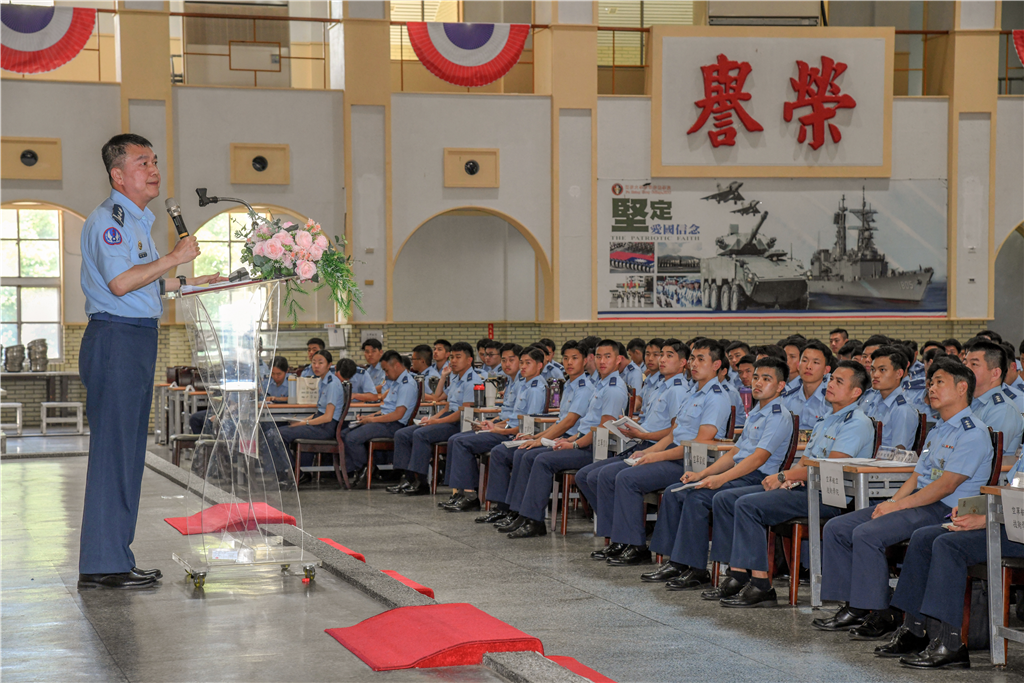
President Lai Ching-te delivered a similar message days earlier at the June 30 joint graduation ceremony for Taiwan’s three services and eight military academies at National Defense University’s Fu Hsing Kang campus.
Lai urged the new officers to build a clear sense of friend and foe, oppose communism and annexation, defend democratic freedom, and resist threats and inducements.
The restoration comes as Beijing has put more of its political messaging toward Taiwan into law. China’s Patriotic Education Law took effect in 2024, and Taiwan’s Mainland Affairs Council has warned that Beijing’s 2026 “ethnic unity and progress” law could be used to pressure Taiwanese people to support Beijing-defined unity work.
Course Centers on Threat Awareness
The restored course opened July 1 at National Defense University’s Fu Hsing Kang campus under the official title “Anti-Communist Patriotic Education” for graduates of Taiwan’s three services and eight academies. Chief of the General Staff Gen. Mei Chia-shu delivered the opening address.
The program then moved from military command to political warfare and historical instruction. On July 2, Mainland Affairs Council Minister Chiu Chui-cheng and Academia Historica President Chen Yi-shen taught sessions in person. On July 3, National Security Council adviser Vincent Huang lectured on the methods Beijing has used in recent years to wage cognitive warfare against Taiwan.
Air Force Commander Gen. Cheng Jung-feng separately addressed Air Force-bound graduates during an “anti-communist patriotic education” seminar.
Vice Defense Minister Hsu Szu-chien closed the program on July 5 at Fu Hsing Kang, framing the training around enemy awareness, crisis readiness, modern warfare, and the defense of Taiwan’s democratic system and way of life.
The ministry has not released the full syllabus, course hours, or evaluation method.
Experts Point to Counterintelligence
Taiwanese lawmaker Chen Kuan-ting told the Chinese edition of The Epoch Times that the course should not stop at slogans or general patriotic messaging.
Chen said meaningful defense education should address the actual threats Taiwan’s forces face, including Chinese intelligence collection, organizational penetration, cognitive warfare, and efforts to probe military deployments and sensitive information.
Counterintelligence awareness should become a practical capability, not just a secrecy reminder, Chen said. He said training should explain how hostile actors may use business cooperation, religious groups, veteran organizations, local networks, or online communities to make contact, gather information, or recruit personnel.
Former Marine Corps instructor Peng Chieh-shen told the outlet that Taiwan’s armed forces are a major target of Chinese Communist Party (CCP) penetration and need anti-communist education inside military academies. He said younger officers should understand the CCP’s political nature, infiltration methods, and the risks posed by spy cases inside the military.
Peng also urged the Defense Ministry to extend stronger anti-communist education to political-warfare personnel, senior officers, and promotion-track training programs. He said infiltration can erode combat power.
Lai Warns New Officers on China Threat
Lai’s graduation remarks put the course in a broader defense frame.
He said Taiwan faces military activity across the East China Sea, Taiwan Strait, and South China Sea, along with gray-zone harassment and other compound pressure.
He also warned that Beijing targets Taiwan’s armed forces through infiltration, division, sabotage, and espionage.
“Facing various threats and challenges, as well as China’s infiltration, division, sabotage, and espionage activities targeting our armed forces,” Lai said, graduates must stand firm.
Taiwan is a self-governed democracy. Beijing claims the island as part of China and has not ruled out using force to bring it under its control. Taiwan’s government rejects that claim.
Beijing Puts Ideology Into Law
Maj. Cheng Ching-yen and Lt. Col. Lin Cheng-jung in Taiwan described Beijing’s Patriotic Education Law as an attempt to turn CCP messaging into a legal framework and warned that it could affect Taiwan’s national security.
The law requires patriotic education across schools, workplaces, public institutions, families, online spaces, and among people Beijing describes as compatriots from Hong Kong, Macao, Taiwan, and overseas Chinese communities.
Retired Maj. Gen. Ke Yongsen, an associate research fellow at the Institute for Chinese Communist Political and Military Studies in Taiwan, has described Beijing’s patriotic-education campaign as part of the CCP’s political-warfare environment.
Taiwan’s Mainland Affairs Council raised a separate warning over Beijing’s 2026 law on ethnic unity and progress, which took effect July 1. Unlike the Patriotic Education Law’s focus on ideological instruction, the 2026 law gives Beijing a new legal framework for pressing “ethnic unity” and “Chinese national community” claims, including toward Taiwan.
In July 2 briefing materials, the council said that with the new law, Beijing could pressure Taiwanese people to take part in unity work and treat refusal as damaging ethnic unity.
The council said the 2026 law goes beyond Beijing’s 2005 Anti-Secession Law by shifting from punishment of alleged separatist conduct to pressure on broader groups to actively support Beijing-defined unity.
Military Training, Not a Society-Wide Law
Taiwan’s restored course operates on a narrower track.
Beijing’s patriotic-education and ethnic-unity laws are nationwide frameworks under one-party rule. Taiwan’s course is a defense ministry program for military academy graduates under elected civilian leadership.
Chen, the Taiwanese lawmaker, told The Epoch Times that democratic countries also use military and civic education to explain what soldiers are defending. He said Taiwan’s patriotic education should focus on the country, the Republic of China (the Taiwan government’s official name), and the democratic way of life shared by its people, not obedience to a political party or slogan.
The defense ministry has not released the full curriculum or said how long the restored title will remain in use.