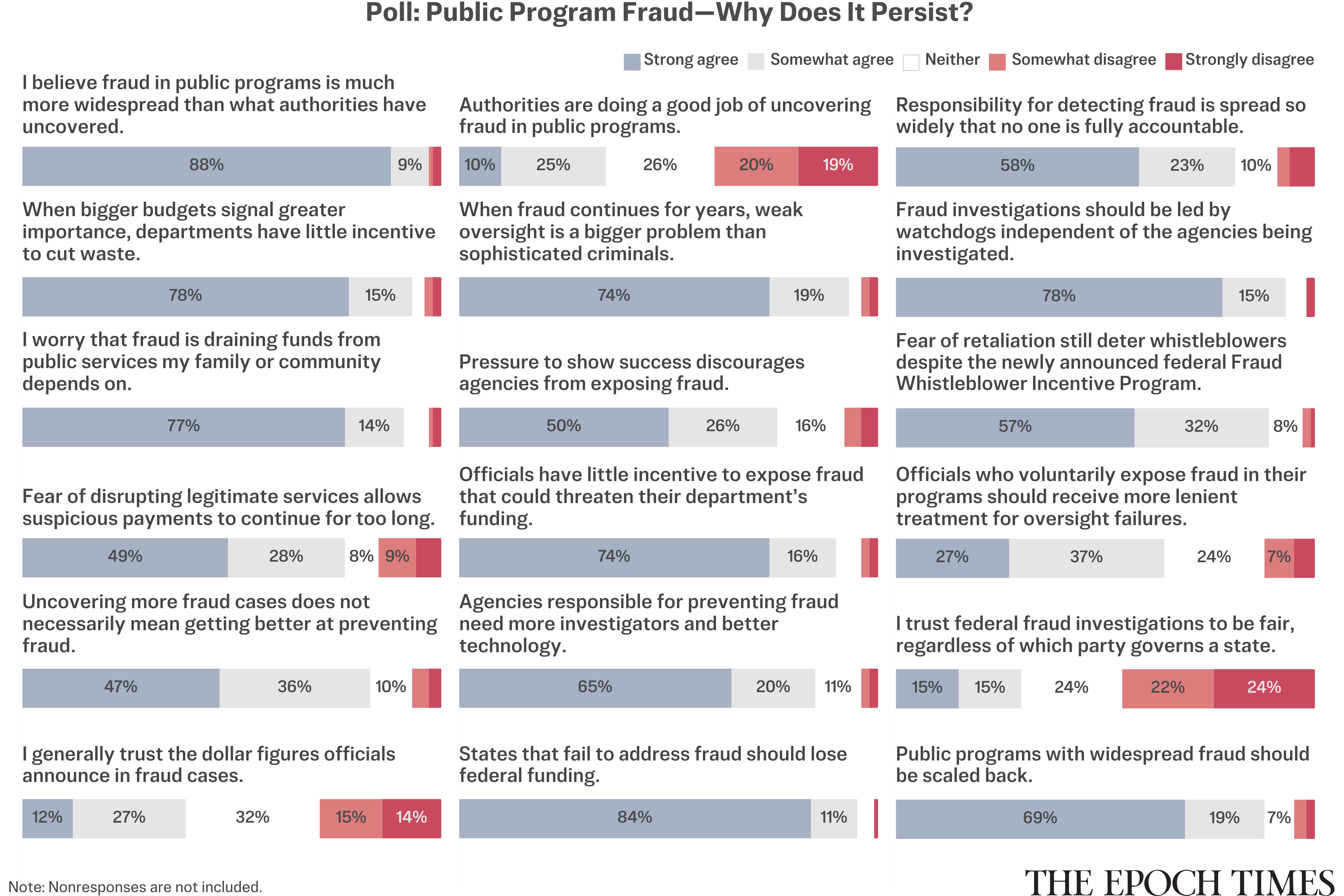

The Trump administration says it has increased efforts to fight fraud within the federal government, which is an issue of major concern to Epoch Times readers.
A survey, conducted in the days immediately following this month’s midterm election, found that respondents were deeply concerned about fraud and what government officials are doing to stop it.
In fact, when asked what they believe is the biggest reason public program fraud can continue for years, the largest percentage of respondents (45 percent) believe it’s because officials want to protect their budgets or reputations.
Widespread Concern
Vice President JD Vance announced a crackdown on fraud just last month, even calling on Americans to pledge to do what they can to stop scamming, swindling, and other forms of fraud in the United States.
When Epoch Times readers were asked, 97 percent agreed that fraud in public programs is likely much more widespread than what authorities have uncovered.
Ninety-three percent of readers agreed they worry that bigger budgets signal greater importance, and departments have little incentive to cut waste.
This is seen as having significant impact, since 91 percent of readers are concerned fraud is draining funds from public services their family or community depends on.
More than three-quarters of respondents (77 percent) agree that they fear a disruption of legitimate services allows suspicious payments to continue.
Unfortunately, 83 percent of readers also believe that uncovering fraud doesn’t necessarily mean getting better at preventing fraud.
Readers were widely divided, however, on whether they trust the dollar figures officials announced in fraud cases. About 39 percent said they trust the figures, and 32 percent said they neither agree nor disagree, and 29 percent disagree.
Government Intervention
The responsible use of taxpayer funds is something the Trump administration says it is committed to working toward, including ensuring that vulnerable groups, such as the elderly, indigent, and disabled, are shielded from fraud.
Vance called on public agencies to work to prevent benefits fraud. However, about 35 percent of those surveyed agree they believe authorities are currently doing a good job of uncovering fraud in public programs.
Over 90 percent of readers said they agree that when fraud continues for years, weak oversight is a bigger problem than sophisticated criminals.
However, a little over three-quarters of readers (76 percent) believe that pressure to show success in their departments discourages agencies from exposing fraud. Ninety percent of readers also believe that officials have little incentive to expose fraud that could threaten their department’s funding.
When asked if agencies responsible for preventing fraud need more investigators and better technology, 85 percent agreed.
However, 95 percent of those polled think that states that fail to address fraud should lose federal funding.
Future Action
While some consider fraud to be a way of life for many in government agencies, 81 percent of readers believe responsibility for detecting fraud is spread so widely that no one is fully accountable.
Most readers want more action from the federal government, and 93 percent think fraud investigations should be led by watchdogs independent of the agencies being investigated.
Almost 90 percent of readers think that fear of retaliation still deters whistleblowers despite the newly announced federal Fraud Whistleblower Incentive Program.
Meanwhile, about 64 percent of respondents agree that officials who voluntarily expose fraud in their programs should receive more lenient treatment for oversight failures.
When questioned about whether they trust federal fraud investigations to be fair, regardless of which party governs a state, almost half (46 percent) disagreed with the statement. Around 30 percent agreed.
However, a large majority of those polled (88 percent) agreed that public programs with widespread fraud should be scaled back.
When asked what change would do the most to prevent public program fraud, 26 percent of respondents said stricter checks before payments are made would move the needle significantly.
Twenty-one percent called for greater accountability for officials who ignore warning signs, and 18 percent said there should be independent oversight of public programs.
The Epoch Times conducted this reader survey on Nov. 4–5, 2026, by email and social media, generating 647 responses.