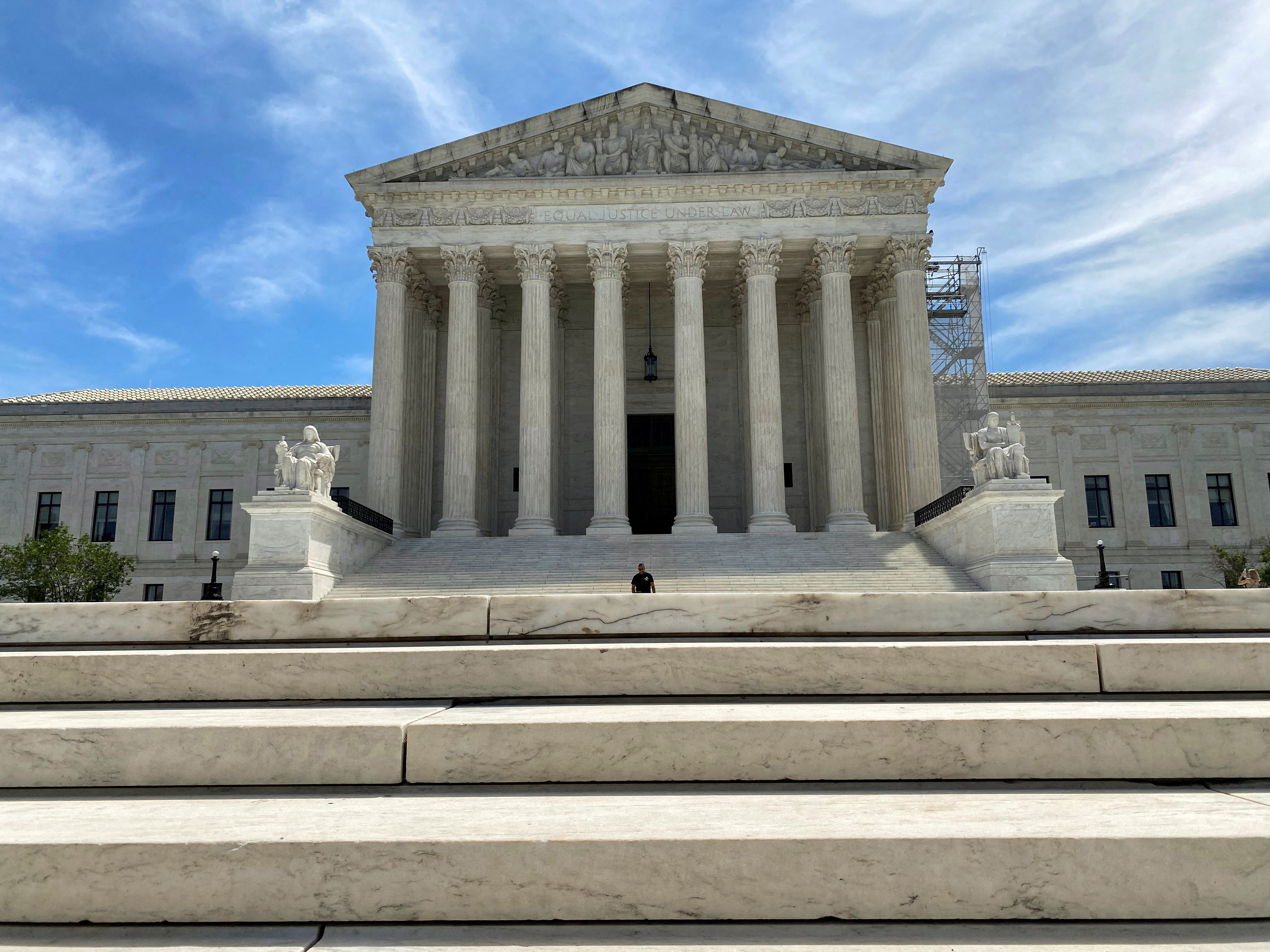
The Supreme Court on Dec. 3 will take up a case examining when and how a street preacher who was already convicted for violating a city law can challenge the law to prevent further prosecution.
Gabriel Olivier, a Christian street evangelist, was arrested in 2021 after demonstrating outside a city amphitheater. According to a court filing by the city of Brandon, Mississippi, Olivier was part of a group of individuals heckling concertgoers through a megaphone, calling them “whores,” “sissies,” and “Jezebels.”
Although the city did not attempt to ban this speech outright, a local ordinance requires protesters to carry out their demonstrations in a designated area about 265 feet away from the amphitheater entrance. It also bans loudspeakers that are audible within 100 feet of the amphitheater. Olivier was charged with violating this ordinance.
Olivier pleaded no contest to the charges, paid a fine of $304, and was given a suspended sentence of 10 days in prison.
He later filed a civil suit alleging violation of his First Amendment rights based on 42 U.S. Code, Section 1983, which allows individuals to sue governments over alleged violations of their civil rights. Olivier has asked for an order preventing the city from enforcing the ordinance in the future.
A federal district court dismissed the suit based on the Supreme Court precedent of Heck v. Humphrey. There, the high court ruled that plaintiffs cannot file suit under Section 1983 if their success “would necessarily imply the invalidity of a prior conviction.”
In his petition to the Supreme Court, Olivier said the Heck case does not apply to him because he is not looking to overturn his previous conviction, but instead is seeking protection from future prosecution.
Olivier originally intended to seek monetary damages, but later dropped that part of his suit. Therefore, he argues, the relief he is seeking from the court is only “forward-looking.”
In the Heck case, the defendant was imprisoned, which allowed him to bring a habeas petition in an attempt to gain his freedom. Olivier told the court that since he was not imprisoned, he was never able to bring such a challenge to the city’s ordinance.
Olivier is asking the Supreme Court to rule that the Heck precedent does not apply if the defendant in question did not have access to a habeas claim.
The Department of Justice (DOJ) has intervened in the case, partially supporting and partially rejecting Olivier’s position.
In its amicus brief, the DOJ urged the high court to allow Olivier to bring his Section 1983 claim. Denying his right to sue would put him in the position of having to obey a law he thought was unconstitutional, or else purposely violate that law so he could bring his claim after he was arrested again, the DOJ argued.
However, the government disagrees with Olivier’s assertion that Heck does not apply to his case because he is not in custody and cannot bring a habeas claim.
The application of Heck “depends on the nature of the plaintiff’s claim, not whether the plaintiff was (or is) in custody,” the DOJ’s brief reads.
The government noted that Justice David Souter, in ruling on Heck’s case, had already made the custodial argument Olivier makes, but the majority of the justices “expressly rejected Justice Souter’s approach.”
The City of Brandon, in its response, said that Olivier’s First Amendment claim had more problems than just the Heck precedent.
Spring Siders, who was present with Olivier when he was arrested, also filed suit against the city. Even though her case was unhampered by a Heck challenge—she had not been arrested or charged—her suit failed on the merits.
“Like Siders’ challenge, [Olivier’s] challenge would fail even if Heck were no issue,” the city wrote.