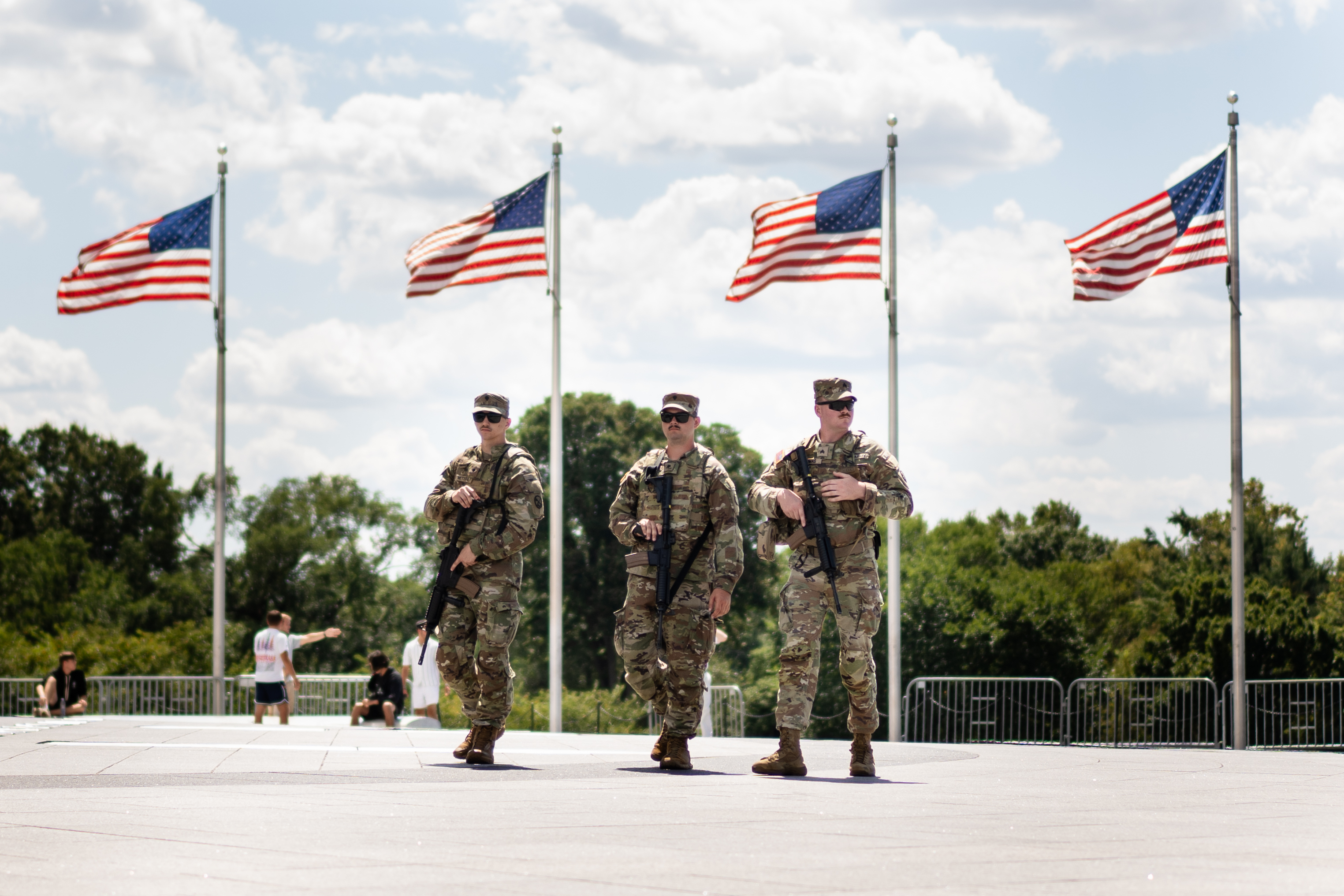

A federal judge on Nov. 20 ordered the Trump administration to end its deployment of National Guard troops in the nation’s capital.
The president had said the troops were needed to deal with rampant crime and violence in the District of Columbia and support federal immigration law enforcement efforts there.
On Aug. 11, Trump signed a presidential memorandum, in which he said the local D.C. government “has lost control of public order and safety in the city.”
“It is a point of national disgrace that Washington, D.C., has a violent crime rate that is higher than some of the most dangerous places in the world,” the document stated.
Although the federal Posse Comitatus Act restricts the ability of the federal government to use military resources for domestic law enforcement, a president may take over, or federalize, state National Guard troops on an emergency basis in certain circumstances.
However, the D.C. National Guard is in a unique position because the District of Columbia is a federal enclave and not a state. The president is the commander-in-chief of the D.C. National Guard.
D.C. government attorney Mitchell Reich said during an Oct. 24 hearing that the Trump administration’s deployment was unlawful because no statute authorizes the federal government to carry out law enforcement activities in the District of Columbia.
He said that Congress has exclusive jurisdiction, or authority, over the District of Columbia and has enacted a highly detailed militia code that spells out when the president may deploy the D.C. National Guard. That code states that the president may use the Guard to deal with riots and similar disturbances and requires that before he does so, civil authorities must request assistance, which they have not done, Reich said.
He alleged that the federal government’s position is that the president has “essentially unbounded authority to deploy the [D.C. National Guard] as a parallel police force in the District of Columbia.”
Deputy Assistant Attorney General Eric Hamilton said at the same hearing that the National Guard members were “not doing law enforcement.” The National Guard was carrying out a protective function and was not involved in “core law enforcement activities,” Hamilton said.
When a guardsman temporarily detains someone, “they’re doing it for protective purposes. ... they aren’t doing it to enforce a law,” he said.
Hamilton said a Guard member will detain someone “to neutralize what was a threat, and this is consistent with their ability to provide protection.”
The new order by U.S. District Judge Jia Cobb came after she heard oral arguments on Oct. 24 on the District of Columbia government’s federal lawsuit that was filed on Sept. 4.
Cobb held that President Donald Trump’s takeover of the D.C. National Guard runs afoul of the U.S. Constitution and unlawfully interferes with local officials’ authority to control law enforcement in the District of Columbia.
The judge said the president has authority to call up the National Guard only “through the exercise of a specific power outlined in state law,” and not for “whatever reason” he sees fit.
Cobb said the court rejects the federal government’s “fly-by assertion of constitutional power, finding that such a broad reading of the President’s Article II authority would erase Congress’s role in governing the District and its National Guard.”
Article II of the U.S. Constitution spells out the president’s powers.
The president “has no free-floating Article II power to deploy the [D.C. National Guard] for the deterrence of crime,” she said.
“Historical practice confirms this understanding of the President’s authority.”
Cobb paused enforcement of her new order to allow the federal government to appeal.
D.C. Attorney General Brian Schwalb hailed the new ruling.
“Normalizing the use of military troops for domestic law enforcement sets a dangerous precedent, where the President can disregard states’ independence and deploy troops wherever and whenever he wants,” Schwalb said.
White House spokeswoman Abigail Jackson expressed disagreement with the ruling.
“President Trump is well within his lawful authority to deploy the National Guard in Washington, D.C., to protect federal assets and assist law enforcement with specific tasks,” she said.
“This lawsuit is nothing more than another attempt—at the detriment of D.C. residents—to undermine the President’s highly successful operations to stop violent crime in D.C.”
The Associated Press contributed to this report.