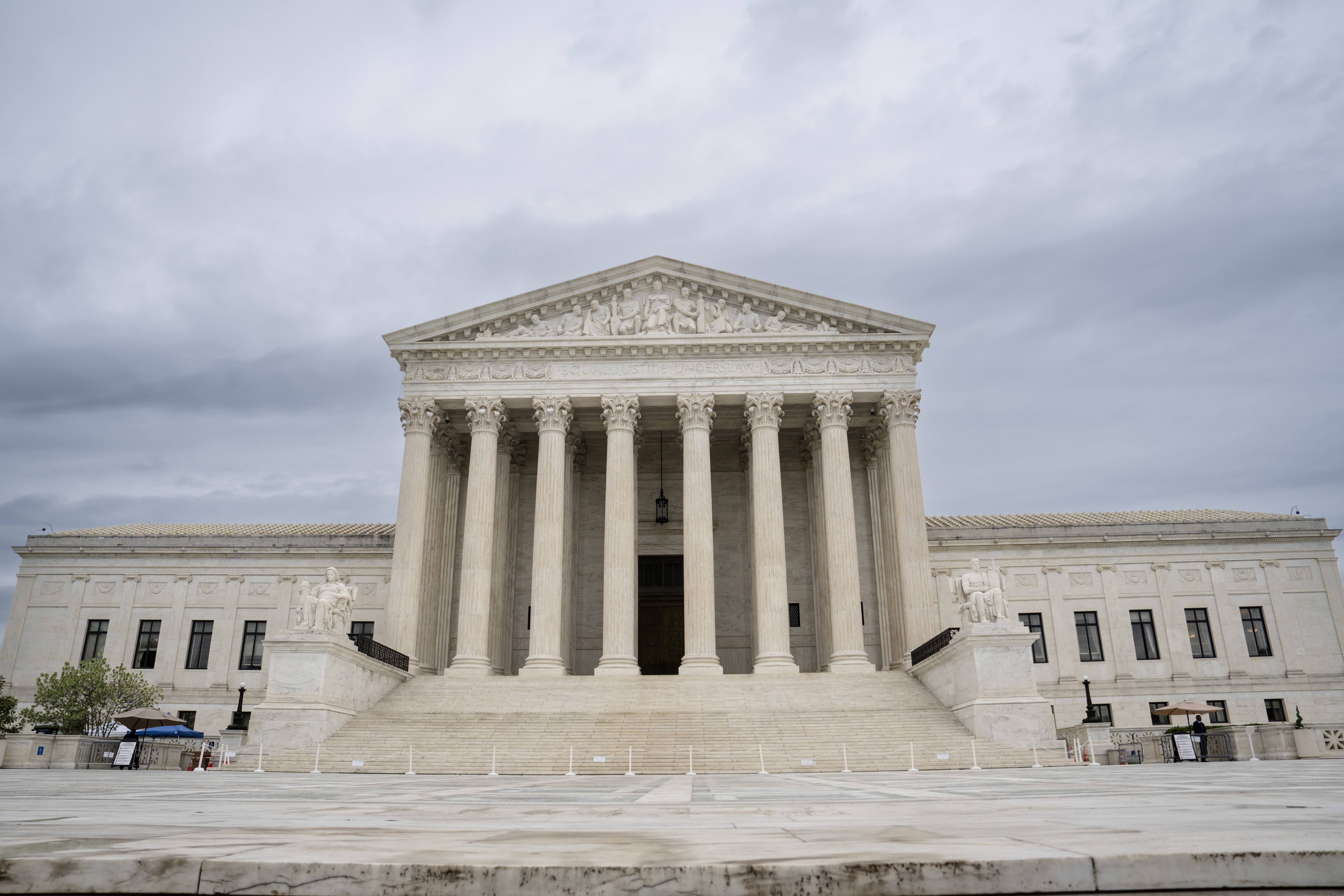

The Supreme Court has declined to issue a ruling on the role of IQ scores in overturning death sentences, saying that it was wrong to take up the case in the first place.
In a per curiam, or unsigned opinion on May 21, the Supreme Court said it “improvidently granted” an order to consider the dispute.
Justices Clarence Thomas and Samuel Alito penned dissents, the latter of which was partially joined by Chief Justice John Roberts and Justice Neil Gorsuch.
The case, known as Hamm v. Smith, focused on an Alabama man, Joseph Clifton Smith, who said he was too intellectually disabled to receive the death penalty. His case was partially based on the Eighth Amendment, which bars cruel and unusual punishment.
The Supreme Court said in 2002 that executing intellectually disabled individuals violated that amendment. Since then, lower courts have wrestled with how to apply IQ scores and other evidence to determine intellectual disability.
Smith had received five IQ scores: 75, 74, 72, 78, and 74. Each was just above the 70-point benchmark Alabama used to determine intellectual disability. The U.S. Court of Appeals for the 11th Circuit said Smith’s IQ scores didn’t provide enough proof because some were within the margin of error.
In a concurring opinion on May 21, Justice Sonia Sotomayor said the court was “not equipped in this case to provide any meaningful guidance on how courts should assess multiple IQ scores.” Her opinion, which was joined by Justice Ketanji Brown Jackson, said that there wasn’t enough of an evidentiary record to decide the case.
She also said that the lower court’s decision wasn’t specific enough for the justices to adjudicate effectively.
“Although the parties offer to this Court a variety of approaches to assessing multiple IQ scores that States could adopt, the litigation below did not focus on whether a precise methodology exists that courts must use,” she said.
“Without the benefit of an evidentiary record or decisions below trained on the specific theories now advanced by the parties, this Court rightly concludes that it should not provide more detailed guidance beyond what this Court’s cases have previously said.”
Thomas, who dissented from the decision in Atkins, said that the initial ruling should be overruled.
“As this case shows, though, Atkins has bred only confusion and absurdity,” he said. “Nothing in the text or history of the Constitution supports Atkins.”
He added that the court had failed to bring clarity to the issue, resulting in Alabama not being able to carry out a lawful sentence.
Alito, whose opinion was joined by Thomas and partially joined by Gorsuch and Roberts, similarly said the court had failed to provide clarity on the issue.
“The Court shies away from its obligation to provide workable rules for capital cases,” he said. “In doing so, the Court disserves its own deathpenalty jurisprudence, States’ criminal-justice systems, lower courts, and victims of horrific murders.”
The appeals court, he said, erred in using one of Smith’s lower scores to determine whether his true IQ was below 70. He added that while factors such as sleep deprivation could artificially lower someone’s score, there was no reason why a test score would overestimate someone’s intelligence.