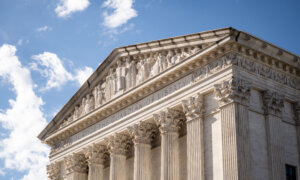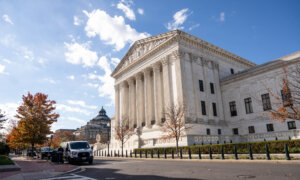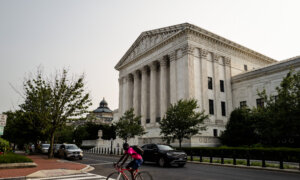
The Supreme Court on Oct. 3 temporarily lifted a block on the Trump administration’s attempt to remove protected status for Venezuelan migrants, opening the door to deportations.
The decision followed a similar decision by the court in May and came after the U.S. Court of Appeals for the Ninth Circuit had weighed in on the issue.
“Although the posture of the case has changed, the parties’ legal arguments and relative harms generally have not,” the court said. “The same result that we reached in May is appropriate here.”
Justices Sonia Sotomayor, Elena Kagan, and Ketanji Brown Jackson said they would have denied the administration’s request to halt the lower court block.
“We once again use our equitable power (but not our opinion-writing capacity) to allow this Administration to disrupt as many lives as possible, as quickly as possible,” Jackson wrote in a dissent.
Temporary Protected Status (TPS) is a designation the executive branch can use to prevent deportation of a group of people over concerns that they cannot return safely to their home country. The Biden administration offered this for Venezuelans in 2021 over what it described as a humanitarian emergency in the country.
After the designation was extended and the Trump administration took office, Secretary of Homeland Security Kristi Noem canceled one of the extensions so that it would end in April. A federal judge in California responded by imposing a preliminary block on that decision.
The Supreme Court halted that preliminary block from the district court in May, but the district court followed with a final judgment against the administration. When the administration appealed to the U.S. Court of Appeals for the Ninth Circuit, a panel of judges refused to halt the effects of the district court’s judgment.
It said that the Supreme Court’s decision from May was given “without explanation” and that the justices, at the time, didn’t have the benefit of a more fully developed record.
“We can only guess as to the Court’s rationale when it provides none,” the court said.
The Justice Department said that the appeals court’s decision was “indefensible” and that the lower court’s final judgment had the same flawed reasoning as its initial order.
“Lower courts cannot treat [the Supreme] Court’s orders as good for only one stage of only one case by gesturing at irrelevant distinctions, subjectively grading the persuasiveness of the Court’s perceived reasoning, or faulting the Court’s terseness,” U.S. Solicitor General D. John Sauer said in September.
Each of the Supreme Court’s decisions occurred on the emergency docket, which means they temporarily halted lower court orders while allowing litigation to play out in the legal system. The case is now expected to go back to the Ninth Circuit, where it could once again be appealed to the Supreme Court for a more thorough decision.
Sauer has argued that the decision to terminate temporary protected status, which affects around 300,000 people, was part of Noem’s discretion and not something that courts could review.
The National TPS Alliance, which had sued the administration, told the Supreme Court that its “stay of a different order from a different phase of this case does not entitle Defendants to the same relief here.”