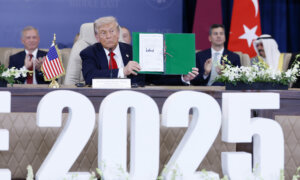

President Donald Trump addressed the nation last night, telling Americans that U.S. military objectives in Iran were “nearing completion.” Read more on highlights from the address.
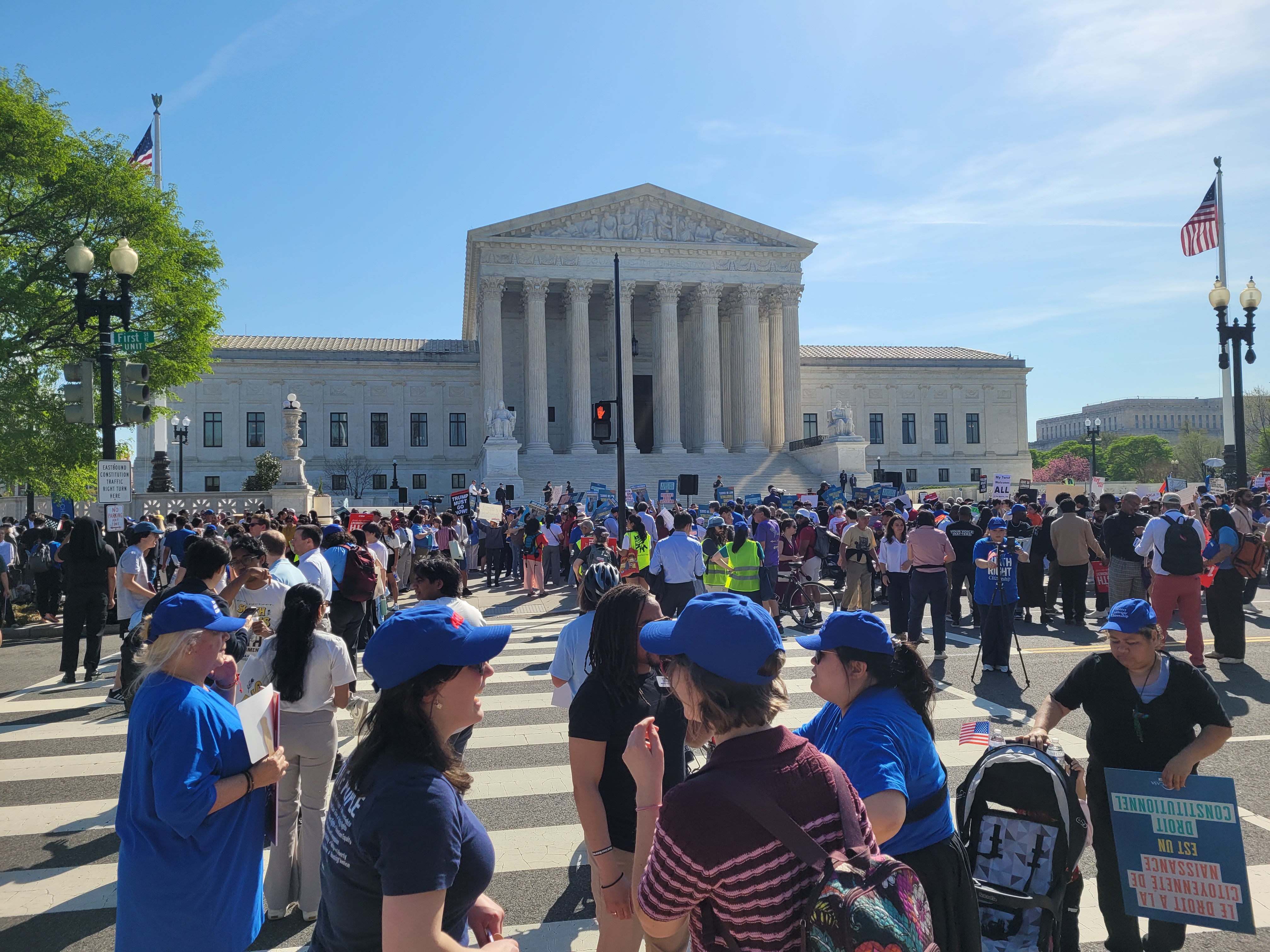
The Supreme Court heard oral arguments for more than two hours on April 1, probing whether President Donald Trump had violated the Constitution with his order restricting birthright citizenship.
The case, Trump v. Barbara, focuses on a portion of the 14th Amendment known as the citizenship clause that says, “All persons born or naturalized in the United States, and subject to the jurisdiction thereof, are citizens of the United States and of the state wherein they reside.”
During oral arguments, the justices asked whether the amendment was intended to cover the children of illegal immigrants and others whose parents were temporarily in the United States.
They also questioned their own precedent and how Congress had spoken about the issue. Here are some of the key takeaways from the arguments.
Justices Skeptical
The justices questioned the government’s argument for upholding the executive order, suggesting it would be hard to enforce.
Chief Justice John Roberts also said the examples the government offered to bolster its interpretation of “subject to the jurisdiction thereof” were “very quirky,” ranging from ambassadors’ children to children of enemies invading the country.
Roberts said it’s difficult to leap from those “idiosyncratic examples” to a broad class of non-citizens without straining the meaning of the citizenship clause.
Importance of Domicile
Roberts, Justice Samuel Alito, and Justice Elena Kagan focused on how often the word “domicile” appears in United States v. Wong Kim Ark during arguments.
The landmark 1898 ruling held that a child born in the United States to parents who were permanent residents is a U.S. citizen.
Roberts noted that “domicile” is referenced 20 times in the opinion, raising questions about its significance. “Isn’t it at least something to be concerned about?” he asked.
Cecillia Wang, arguing on behalf of those challenging the executive order, acknowledged that Wong Kim Ark’s parents were domiciled in the United States but emphasized that the court’s decision did not hinge on that fact. Instead, she argued, the ruling turned on the location of birth—making domicile “irrelevant.”
“You dismiss the use of the word domicile,” Roberts responded. “It appears in the Wong Kim Ark opinion 20 different times, including in the question presented and in the actual legal holding.”
Congress’s Intent
Many of the justices’ questions indicated their decision would be heavily informed by how Congress had discussed the 14th Amendment and birthright citizenship.
Justice Brett Kavanaugh noted that a portion of the 14th Amendment gave Congress power to enforce its provisions. That section could be important when the justices review whether Trump is violating the Immigration and Nationality Act.
That law, passed in the 20th Century, used the same phrasing as the 14th Amendment. However, documents from that time indicate that Congress didn’t intend to use that language to limit citizenship based on domicile.
‘Revisionist’ History?
Determining Congress’ intent could entail looking at its statements from not just the 20th Century, but also the post-Civil War period when the amendment was ratified.
Kagan, at one point, suggested that Sauer was advancing a “revisionist” view of history in interpreting the Wong Kim Ark case.
“But the rationale of the case is really quite clear,” Kagan said.
“It says there was this common law tradition. It came from England. We know what it was. Everybody got citizenship by birth except for a few discrete categories, which were the ones that the Chief Justice mentioned at the beginning.”
By contrast, Alito suggested that historical sources might not have envisioned the situation the Trump administration faced.
“What we’re dealing with here is something that was basically unknown at the time when the 14th Amendment was adopted, which is illegal immigration,” he said.
‘Birth tourism’ Impacts are Low Priority
Roberts gave his view that the concept of “birth tourism” has “no impact” on the legal decision before the court. Birth tourism is where female non-U.S. citizens travel to the United States to give birth so that their child can be born a U.S. citizen.
Roberts’ statement came after Sauer cited reports that there could be more than 1.5 million people from China alone engaging in the practice.
“We’re in a new world now ... where 8 billion people are one plane ride away from having a child who’s a U.S. citizen,” Sauer said.
He also said that there are 500 birth tourism companies in China that help Chinese nationals travel to the United States so that they can give birth to children so that the newborns are U.S. citizens at birth. They then return to China.
—Sam Dorman; Matthew Vadum; Jackson Richman; Stacy Robinson
BOOKMARKS
President Donald Trump said Wednesday that the United States will leave Iran “pretty quickly.” but will return if necessary. “They won’t have a nuclear weapon because they are incapable of that now, and then I‘ll leave, and I’ll take everybody with me, and if we have to, we'll come back to do spot hits,” Trump said.
The FDA has given the go-ahead to Foundayo, an obesity pill from Eli Lilly. “We believe Foundayo can help level the playing field for those living with obesity or who are overweight and living with weight-related complications,” David Ricks, chair and CEO of Eli Lilly, said in a statement.
A Belgian court has ordered Poland and Romania to take delivery of, and pay for, $2.2 billion worth of Pfizer-made COVID-19 vaccines. The countries had signed a contract for the shots in 2021, but tried to back out later.
A federal judge has declined to hear a settlement agreement between the IRS and a Texas church that would allow it to endorse political candidates without losing tax-exempt status. Congress—not the court—is the appropriate body to make those decisions, the judge wrote in his order.
More than 4 million children have signed up for Trump accounts, the IRS said this week. Parents can start contributing to those accounts on July 4, and the government is offering a $1,000 pilot contribution bonus.
—Stacy Robinson