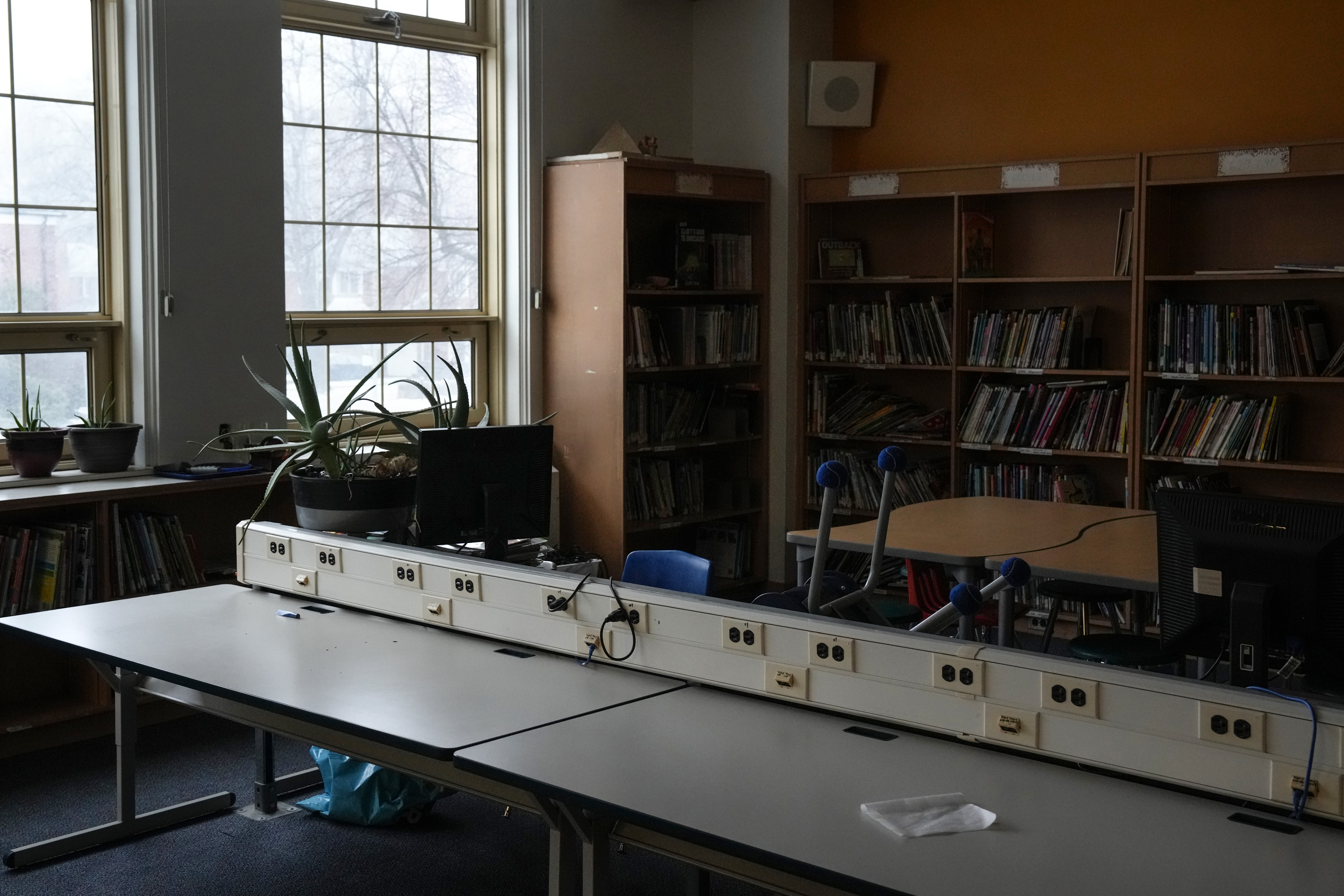
School libraries in Canada face a deepening “crisis” driven by chronic underfunding, staff layoffs, and the shift from traditional book collections to tech-focused “learning commons” strategies, a new report suggests.
Shifting educational funding models have eliminated protected funding for libraries, enabling school boards to slash book acquisition budgets, according to a report released by the Aristotle Foundation.
The “School Libraries in Crisis” report is authored by Dr. Paul W. Bennett, director of the Schoolhouse Institute, a senior fellow of Education Policy at the Macdonald-Laurier Institute, and chair of researchED Canada.
The report details a transition from school libraries with book-laden shelves to digital access hubs, collaborative meeting zones, and general student gathering spaces.
Bennett argues that the decline in traditional libraries is further exacerbated by stringent equity-focused weeding policies and ongoing “culture war” disputes regarding book selection.
“While intended to promote inclusion, these processes have often led to the removal of classic works and pre-1970 books, effectively narrowing students’ exposure to foundational texts,” he said.
He cited one example at Erindale Secondary School in Mississauga, Ont., which is part of the Peel District School Board (PDSB).
The report details the story of Grade 10 student Reina Takata, who returned to school in the fall of 2024 to find that many of her favourite books were no longer on the shelves, and many of the library’s bookshelves were nearly bare.
Nearly half of the library’s collection vanished, and Takata learned from the school staff that this was based on the school’s implementation of a new “equity-based” book-weeding policy, the report noted.
The board said it was following an Ontario Education Ministry mandate that it carry out a diversity audit of its school libraries.
The school board received a set of directives from the ministry in 2020 after a provincial review of board practices, which included evaluating “books, media and all other resources currently in use for teaching and learning.”
But Bennett said the board carried out a much wider “diversity audit” than necessary, eliminating the “The Hunger Games” series of books, along with “Roll of Thunder, Hear My Cry,” a novel that delves into the challenges faced by African Americans in Mississippi during the 1930s.
General weeding to get rid of damaged, mouldy, or factually inaccurate books in favour of good-quality books is a standard practice at most libraries, Bennett said, “to ensure collections remain a trusted source of current, updated information. But he said the Peel school board’s disposal went far beyond that.
Public criticism of the board’s book purge caught the attention of then-Education Minister Stephen Lecce in 2023, who wrote to the board asking it to halt the process.
“It is offensive, illogical and counterintuitive to remove books from years past that educate students on Canada’s history, antisemitism or celebrated literary classics,” Lecce wrote in a 2023 statement.
Funding Changes
British Columbia was the first province to remove funding protections for teacher-librarians. In 2002, the government passed Bills 27 and 28, giving school districts greater flexibility to allocate operating funds, including money previously designated for libraries. Teacher-librarian positions subsequently fell by more than one-third over the next 15 years.
Ontario took a slower path to similar funding changes. The province introduced its student-focused education funding formula in 1998, followed by a decades-long decline in the number of elementary schools employing full-time teacher-librarians.
The Ontario Ministry of Education replaced the long-standing Grant for Student Needs in 2024 with the new Core Education Funding model, giving school boards greater flexibility in allocating funds for teacher-librarians and library staff, rather than protecting all library-related funding for specific purposes.
Those shifts in priorities means building library book collections is no longer the priority for school libraries, Bennett argues.
‘Learning Commons’ Model
Bennett also cited the “learning commons” concept outlined in Canadian School Libraries’ 2023 policy framework as a concern.
The framework expressed that libraries are no longer using metrics like collection size to indicate library effectiveness and that having a great collection of books does not guarantee “that learning is taking place.”
The report also cited academics who advocate for transforming school libraries into “creative maker-spaces and newcomer reception centres well supplied with graphic novels appealing to teens.”
Bennett argues that traditional books should be at the centre of Kindergarten to Grade 9 education, and proposed a model combining classics with important Canadian works.
“It begins by confronting what has happened to erode the foundations of a liberal education, beginning in the early grades,” he wrote. “One of the clearest signs of the unacknowledged crisis is the virtual disappearance of children’s classics in the Canadian Kindergarten to Grade 9 curriculum and the dominant trend of replacing reading whole books with snippets in and outside of the classroom.”
The emphasis on books is not just about tradition, Bennett said. His report highlights comprehensive research in cognitive science and education that demonstrate the importance of reading entire books for developing comprehension, background knowledge, and critical thinking.
He recommends that libraries be restored as “sanctuaries for books and spaces primarily reserved for quiet reading, reflection, thought, and informed discussion.”
He also suggested school libraries rethink their equity guidelines, which he said imposes a form of “quiet censorship,” on classic literature, and exclude the majority of books and materials published prior to 1970.
He recommended assisting classroom teachers and teacher-librarians during the transition by offering refresher courses and in-service workshops to increase the number of educators knowledgeable about, and genuinely motivated by, the classic works of modern North American civilization.
“We have a growing generation of students with less exposure to whole books, sustained reading, and the cultural literacy essential to full democratic citizenship and deeper understanding of our cultural traditions,” Bennett added.
“We must restore libraries as cultural sanctuaries—places where students encounter challenging ideas, develop reading stamina, and build the shared knowledge needed to become informed citizens in a democratic society.”