
U.S. Secretary of State Marco Rubio promised to strengthen cooperation with Central Europe on Feb. 15, kicking off a two-day excursion with the conservative leaders of Slovakia and Hungary.
Both Slovakia and Hungary rely on Russian oil and gas, a point of contention between other European Union bloc nations and Washington after sanctions were imposed on Moscow after its 2022 invasion of Ukraine.
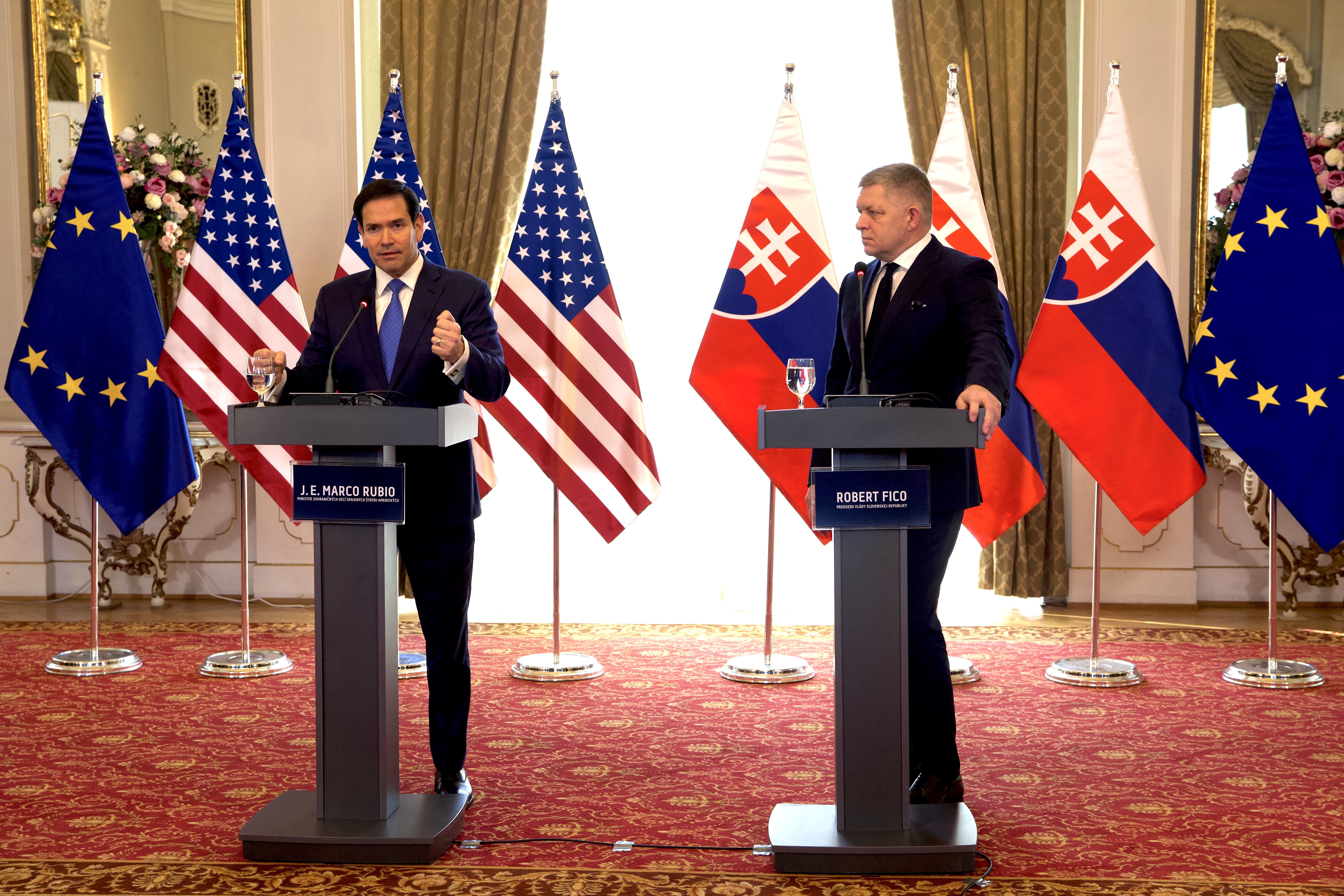
Meeting first with Slovakian Prime Minister Robert Fico and Slovakian President Peter Pellegrini on Sunday, Rubio discussed energy and military defense, marking the first visit in seven years by a U.S. secretary of state to the Central European nation.
Slovakia, which has a population of 5.5 million, shares a border with Ukraine.
“Under President [Donald] Trump, this administration is going to make not just Slovakia but central Europe a key component of how we engage the continent and the world,” Rubio said. “We are not just going to engage in meetings and pleasantries, but in concrete actions that we will take together in ways that are beneficial to your people and our people.”
The U.S. State Department said last week that Rubio planned to discuss bilateral issues, including NATO responsibilities, as well as energy cooperation with the two EU member states.
Before leaving the United States for Europe on Feb. 12, Rubio told reporters, “These are countries that are very strong with us, very cooperative with the United States, work very closely with us.”
Simultaneously serving as Trump’s national security adviser, Rubio greeted the Slovak president on Feb. 15 after arriving in Bratislava. The discussions focused on energy and defense.
“An important topic of the talks was ... defence cooperation and the fulfillment of commitments arising from NATO summits,” Pellegrini’s office said in a statement.
Later on Sunday, Rubio met with Fico—a month after the Slovak prime minister visited the U.S. president in Florida. Rubio’s visit on Feb. 15 followed his appearance at the Munich Security Conference over the previous days.
Rubio also plans to meet with Hungarian Prime Minister Viktor Orban on Feb. 16.
Orban is considered one of Trump’s closest allies in Europe, and Budapest has hosted multiple Conservative Political Action Conference events that pull together conservative activists and leaders from around the world, with another planned in March this year. Orban is behind in most polls weeks out from Hungarian elections in April.
Both Hungary and Slovakia have also maintained close relationships with Moscow and they have criticized, and sometimes delayed, the implementation of EU sanctions on Russia while opposing additional military aid to Kyiv.
After many EU nations ceased buying energy and petroleum from Russia after its invasion of Ukraine, Slovakia and Hungary continued sourcing gas and oil from Moscow, which the United States has criticized.
Rubio suggested these topics would be discussed on his trip, but he did not elaborate.
While Fico has criticized the EU as an institution in deep crisis while complimenting Trump and suggesting he would bring peace to Europe, the Slovak prime minister recently criticized the United States for its recent capture of former Venezuelan leader Nicolás Maduro.
Hungary and Slovakia have also come up short on Trump’s push to have all NATO members increase their military spending to 5 percent of their gross domestic product. Both countries have increased their military spending to NATO’s minimum 2 percent threshold, far lower than some other NATO countries.
Last month, Slovakia signed a deal with the United States on nuclear cooperation, and Fico said that American company Westinghouse would likely be involved in building a new nuclear power plant.
Reuters contributed to this report.