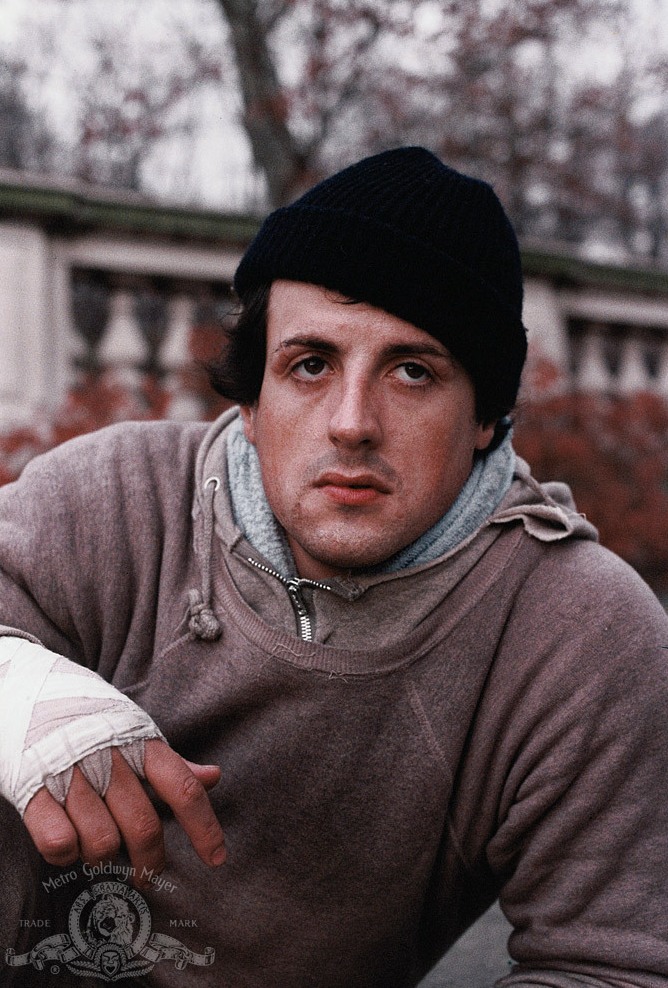

Who’s the greater fighter? Is it the boxer who needs only one round to win and can knock out every opponent with a single punch? Or is it the one who lasts the most rounds, rising even after being knocked down by stronger, bigger opponents?
Contrary to popular belief, greatness, not just in sports, is measured not only by what’s achieved, namely victories. It’s measured also by the quality, quantity, and range of resistance faced and overcome. Greatness isn’t so much in the simplistic win-loss outcome but in the sincerity, consistency, and intensity of effort before that outcome.
Success, then, is more a process than a product. It’s a journey, not just a destination, as seen in the 1976 film “Rocky.”
As part of the 1970s celebrations of 200 years of American independence, world heavyweight boxing champion Apollo Creed (Carl Weathers) proposes a title match in Philadelphia. When he runs out of big-ticket opponents, he gives a shot at the title to a local contender, Rocky Balboa (Sylvester Stallone).
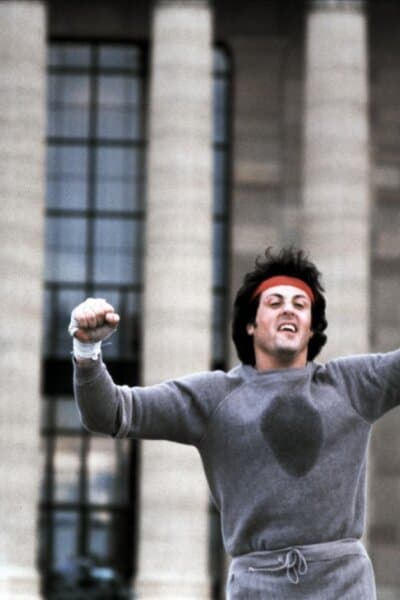
Rocky Balboa (Sylvester Stallone), in "Rocky." (United Artists)
‘Go the Distance’
Impoverished Rocky is an obscure boxer. Just participating in the match promises good money. So, he hires trainer Mickey Goldmill (Burgess Meredith) and cornerman Paulie Pennino (Burt Young), the brother of Rocky’s sweetheart, Adrianna “Adrian” (Talia Shire). Rocky trains hard, fearing he’ll lose, yet he decides to “go the distance,” putting his best foot (and fist) forward.
Even within an obscure circle, Rocky’s had 44 victories. He’s also had 20 defeats. That’s taught him tenacity.
Apollo’s been undefeated in 46 fights, albeit at higher levels. He doesn’t know what it’s like to lose. Ironically, he’s more vulnerable to the emotional, psychological impact of being overpowered, however briefly. Rocky? He’s made a habit of rebounding; getting pummeled doesn’t perturb him as it does Apollo.
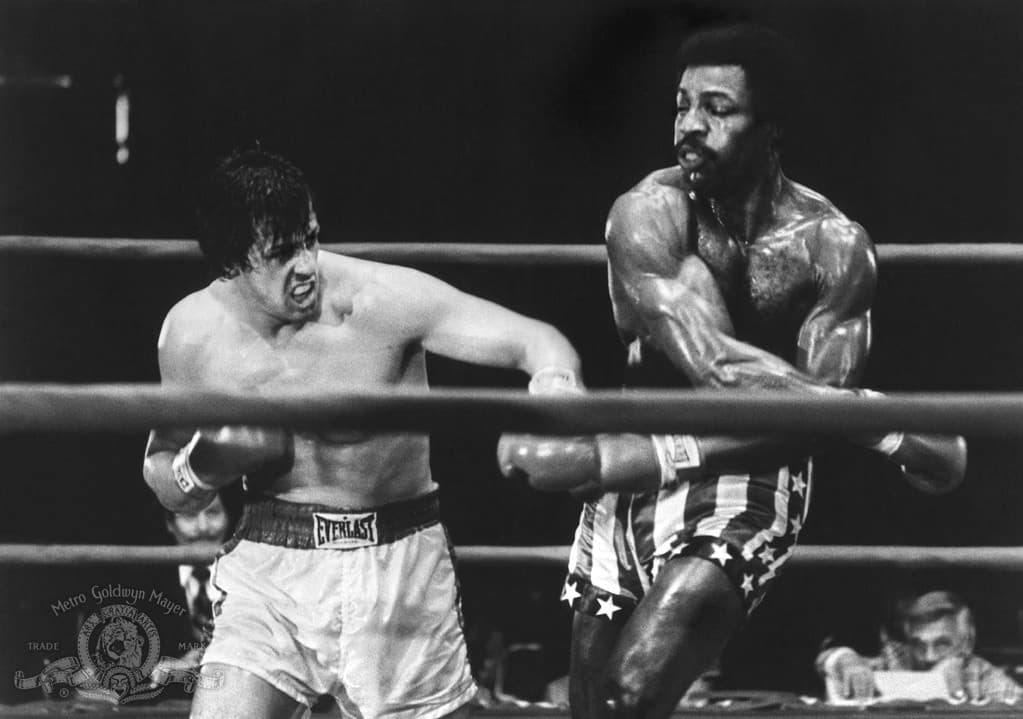
Rocky Balboa (Sylvester Stallone, L) and Apollo Creed (Carl Weathers), in "Rocky." (Metro-Goldwyn-Mayer)
Rocky’s verbal crutch, “Ya know what I mean?” eases his nagging self-doubt but does nothing to erase it. Apollo may be his rival inside the ring, but Rocky’s greatest rival outside it is himself and his self-defeating fear and pride.
In a huff, Rocky initially rejects Mickey’s offer to train him, merely because that offer comes so late in life; Rocky’s 30, while Mickey’s 76. But self-awareness humbles Rocky; tantrum over, he gracefully accepts Mickey’s offer.
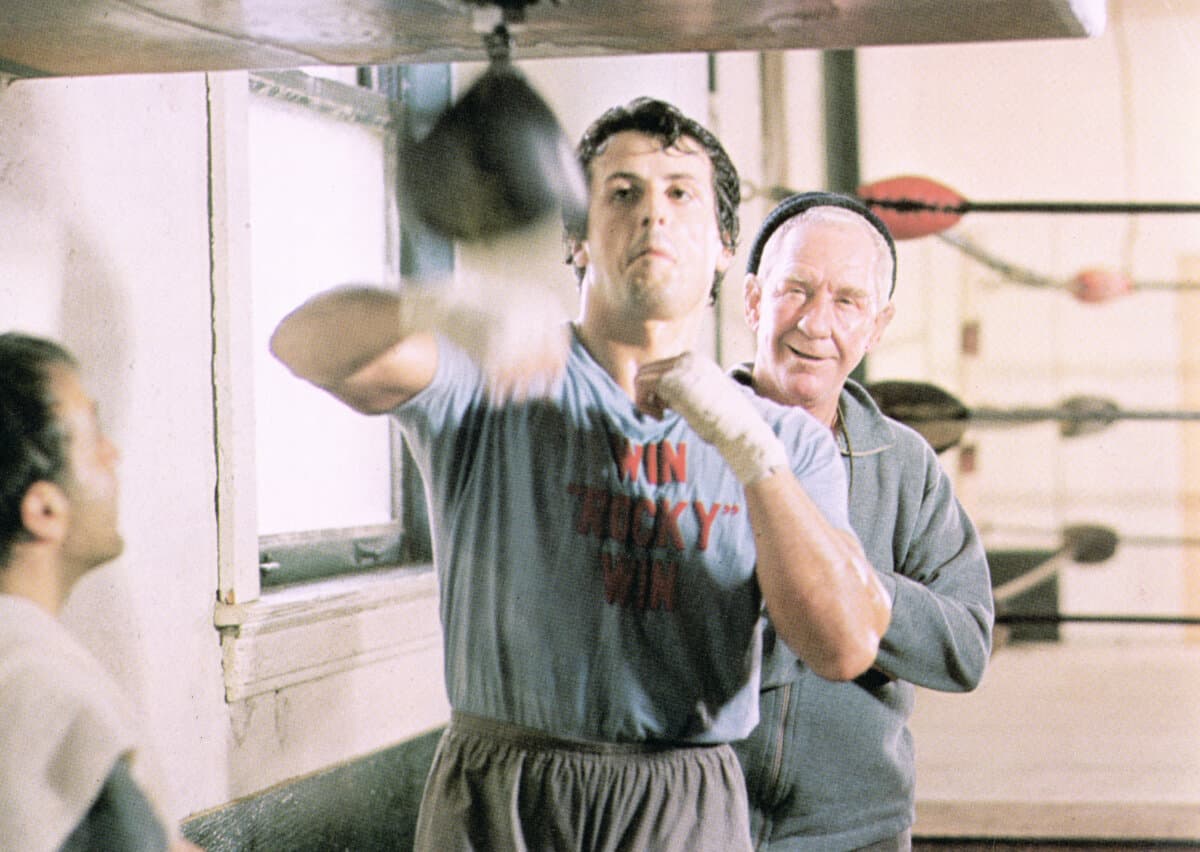
Rocky Balboa (Sylvester Stallone, L) and trainer Mickey Goldmill (Burgess Meredith), in "Rocky." (Metro-Golwyn-Mayer)
Looks are deceptive. The greater fighter isn’t always the “undisputed” champion, the one who never loses. Sometimes it’s the one whose climb up has been the hardest, the one who doesn’t know how to give up or give in.
Take for example Rocky’s first full sentence: “When do I fight again?”
A single round doesn’t test a contender’s knowledge, experience, skills, and attitudes as much as a series of rounds does, especially rounds with different, increasingly difficult challenges. They test his emotional responses to rebuffs, not just his hand-eye coordination. Also, the rounds test his intellectual reflexes, not just his stamina and strength.
Filmmaker and actor Stallone takes that life lesson beyond the boxing ring. He shows that losing is part of winning. Those who’ve never tasted defeat usually struggle to savor, let alone hold on to, victory. Defeat is, by far, the better teacher.
Protection From Failure
Overanxious parents sometimes naively try to protect their children from failure. That stunts their children’s growth; they behave immaturely when failure eventually strikes in adulthood, as it surely will.
One needn’t crave failure, but the very prospect of it shouldn’t daunt to the point where it’s avoided. Then, one starts looking for easy wins to sustain a false sense of prolonged success.
Stallone’s screenplay champions persistence, whether it’s in honing one’s judgment, mastering a skill, or wooing a woman.
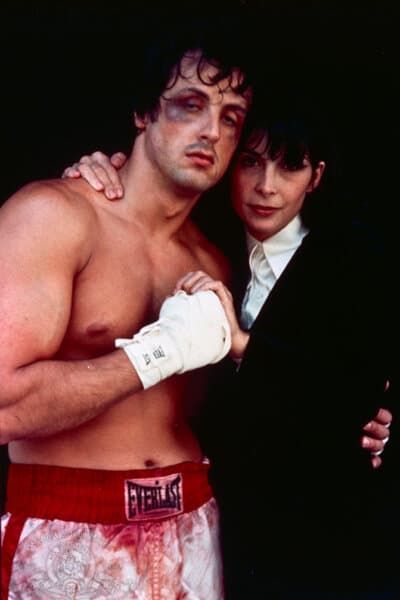
Rocky Balboa (Sylvester Stallone) and Adrian Pennino (Talia Shire), in “Rocky.” (United Artists)
Like Rocky, the reclusive Adrian’s fighting, too. Bullies mistake her shyness for a slow intellect. Paulie calls his sister a loser, perversely imagining it’ll inspire her somehow to become a winner.
She has to fight her inner demons and learn to love Rocky, flaws and all. Later in the franchise, they marry. But here, well before all that, Stallone’s making a point. Marriage, too, is an expedition, not an event.
To Rocky, wooing an infuriatingly reticent Adrian is like going the distance in the ring, round by round. Gentlemanly to a fault here, he pleads “come on” nearly a dozen times just to get her to come up to his room on their first date, while she stands at his doorstep, ruminating.
After the bruising match, a newsman shoves a microphone in Rocky’s face, asking him what he was thinking about. Ignoring and answering him at the same time, a bloodied Rocky shouts into and above the crowd, “Adrian!”
Check the Internet Movie Database website for plot summary, cast, reviews, and ratings. You can watch “Rocky” (1976) on Prime Video, Paramount, and YouTube TV.
These reflective articles may interest parents, caretakers, or educators of young adults, seeking great movies to watch together or recommend. They’re about films that, when viewed thoughtfully, nudge young people to be better versions of themselves.
What arts and culture topics would you like us to cover? Please email ideas or feedback to features@epochtimes.nyc.