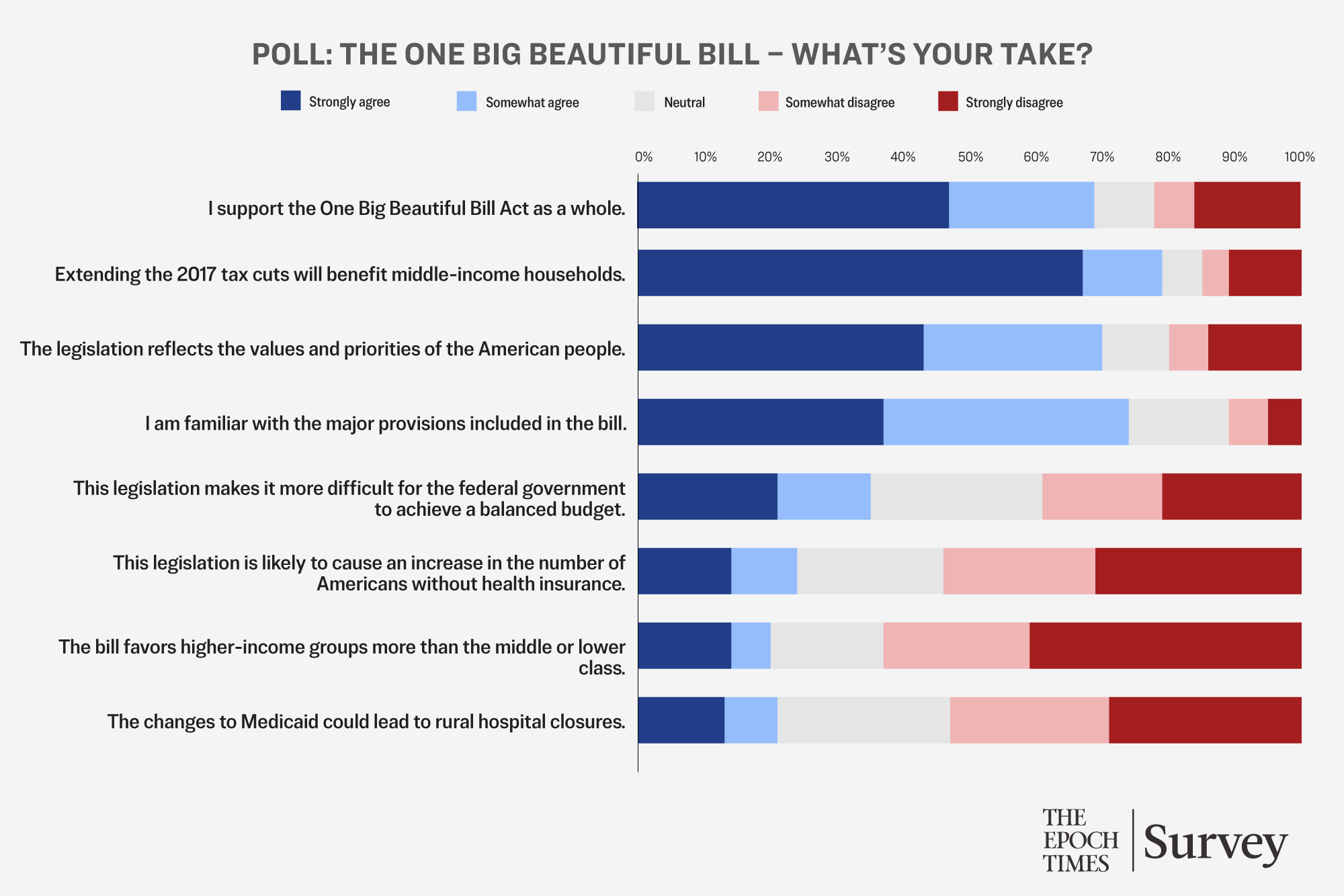

Readers of The Epoch Times have strong opinions about the legislation known as the One Big Beautiful Bill.
The massive budget reconciliation bill was signed into law on July 4, providing the funding and direction for President Donald Trump’s second term.
The cornerstone provision was the permanent extension of the 2017 tax cuts, but the bill also includes tax breaks on tips, overtime, and Social Security income; completion of the border wall; $150 billion in defense spending; and repealing so-called green energy tax credits.
Though the bill is lengthy at over 900 pages, nearly three-quarters of respondents (74%) believed themselves to be familiar with its contents.
Opinions about the bill broke along party lines, as they did in Congress itself.
Party, Gender, Age
More than two-thirds of readers saw the bill favorably, but among Republicans that number was 81 percent. Just 8 percent of Democrats had a positive view of the bill.
On this question, and throughout the survey, Independent voters tended to see the bill positively, but less so than Republicans. A clear majority of Independents favored the bill (55%), but their unfavorable responses (34%) were much higher than among GOP readers (11%).
Asked what was good about the bill, hundreds of Democrats responded simply, “Nothing.”
Republicans favorably mentioned two issues more than any other: tax cuts and increased border security.
There was very little gender gap among respondents. Men were slightly more positive toward the bill overall than were women but by just 3 percentage points.
Age provided another significant break point for readers. Those younger than 35 provided a mirror image of the next oldest generation. Younger people were more likely to see the Big Bill negatively than positively (63% to 26%).
Readers aged 35 to 64 were the exact opposite, 63 percent positive and 26 percent negative.
“I don’t think the bill thinks of the good of the whole versus the benefits it’ll give to the few,” one younger woman wrote.
“This will save my salon and spa business thousands of dollars per year, as we collect and process almost $100,000 in tips,” wrote a woman aged 35 or older.
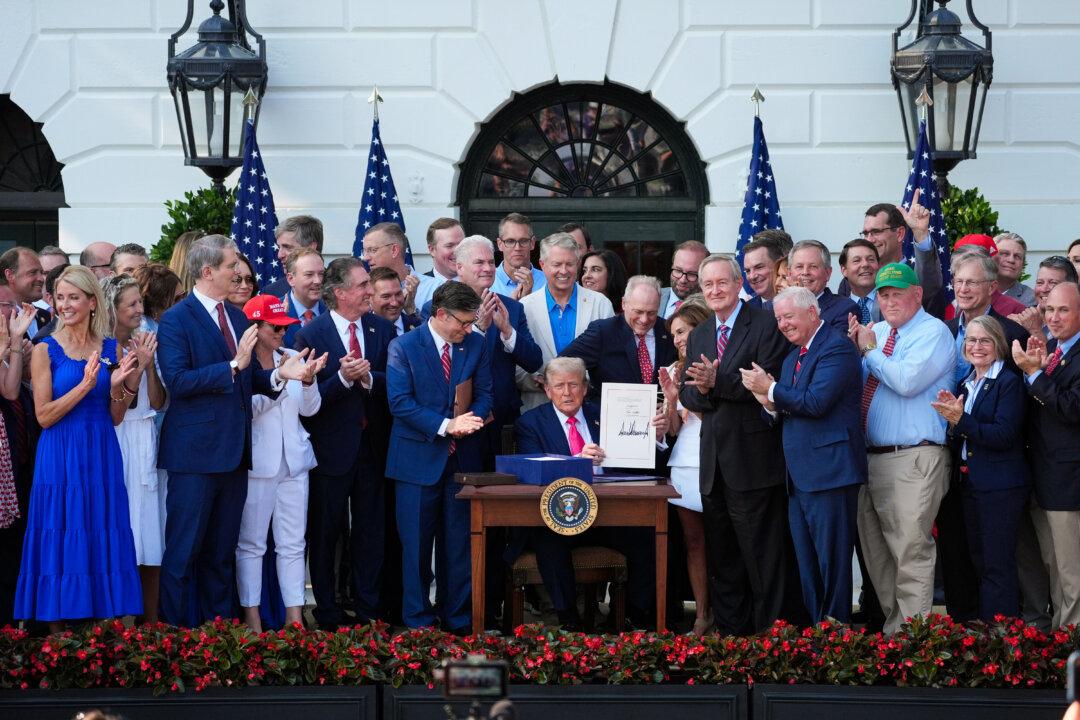
President Donald Trump signs his signature bill of tax breaks and spending cuts at the White House in Washington, surrounded by members of Congress, on July 4, 2025. (AP Photo/Evan Vucci)
Respondents age 65 and older were solidly behind the bill, with 73 percent viewing it favorably.
Those breakpoints were consistent on most questions. However, the number of neutral responses increased with some issues.
Clear majorities of both Republicans thought the bill reflects the values of the American people (81%) and does not favor the wealthy over the middle class (71%).
A Republican man wrote, “Even with the higher deficit, the increased revenue from tariffs combined with a healthier America, a revived work force, and the removal of foreign interlopers will make for a stronger country.”
Independents agreed but less strongly with 56 percent saying the Big Bill reflects American values and 53 percent agreeing that it does not favor the wealthy.
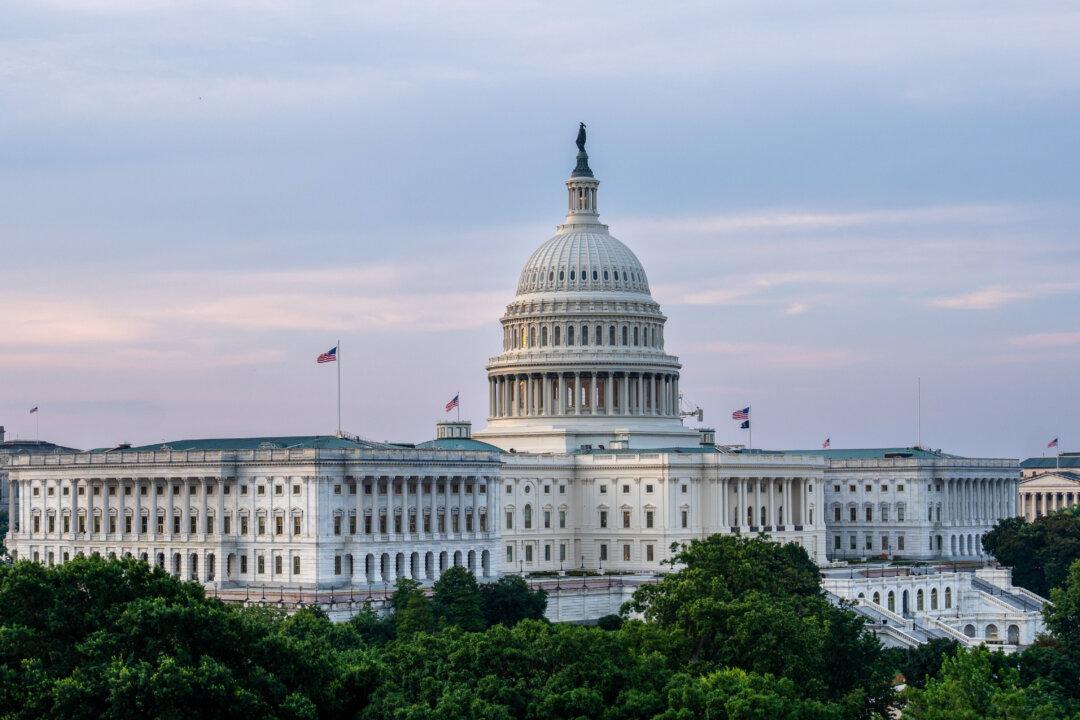
The U.S. Capitol building in Washington, on July 1, 2025. (Madalina Kilroy/The Epoch Times)
Democrats strongly disagreed, with 87 percent believing it does not reflect American values and 77 percent thinking that it favors the wealthy.
“The legislation gets everything wrong,” wrote a Democratic woman. “It takes benefits and additional taxes away from the poor and middle class, and the wealthy voter.”
Less Certainty on Budget, Health Care
The impact of the Big Bill on the national budget caused a dramatic shift among Republicans. This was the only issue on which a majority of GOP readers did not have certainty about the positive impact of the bill.
Just 43 percent disagreed with the statement that the legislation makes it more difficult for the federal government to balance the budget.
Asked what’s wrong with the bill, one Republican wrote, “[It] did not cut enough of the budget. Still too much waste, fraud, and abuse.”
Independents were even less sure about the fiscal impact of the bill. Forty-four percent thought the bill would make it harder to balance the budget.
“Cut spending, cut pork, cut regulations—this bill does little to none of that,” wrote an Independent reader. “What happened to a balanced budget?”
Questions on health care also caused a noticeable shift among Republican and Independent readers.
Democrats had made the issue a focal point in Congressional debates, asserting that changes to Medicaid enrollment practices and federal spending would cause millions to lose coverage, threatening the viability of small, rural hospitals.
On these issues, certainty among Republicans fell sharply as the number of neutral responses hit well above 20 percent.
Fewer than 60 percent of Republicans agreed strongly that the Big Bill would increase the number of uninsured Americans, a noticeable drop from the 89 percent favorability toward tax cuts.
At the same time, 24 percent of Republicans were neutral about whether the bill would cause a loss of health coverage, and 29 percent could not decide whether the bill would force the closure of some rural hospitals.
However, a majority of Republican readers still believed the bill would not harm rural health care. Noting that the bill includes a provision to shore up small hospitals, a Republican woman wrote, “Rural hospitals are getting extra funding, so they won’t close.”
Independents showed similar movement on these issues, with the percentage of neutral responses rising from the teens into the mid 20s.

A nurse transports a patient on a stretcher inside Brookdale University Hospital and Medical Center in New York, on July 1, 2025. (AP Photo/Andres Kudacki)
This Epoch Times Reader Survey was conducted by email and social media on July 9–10, 2025, and received 19,766 responses.