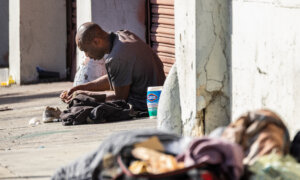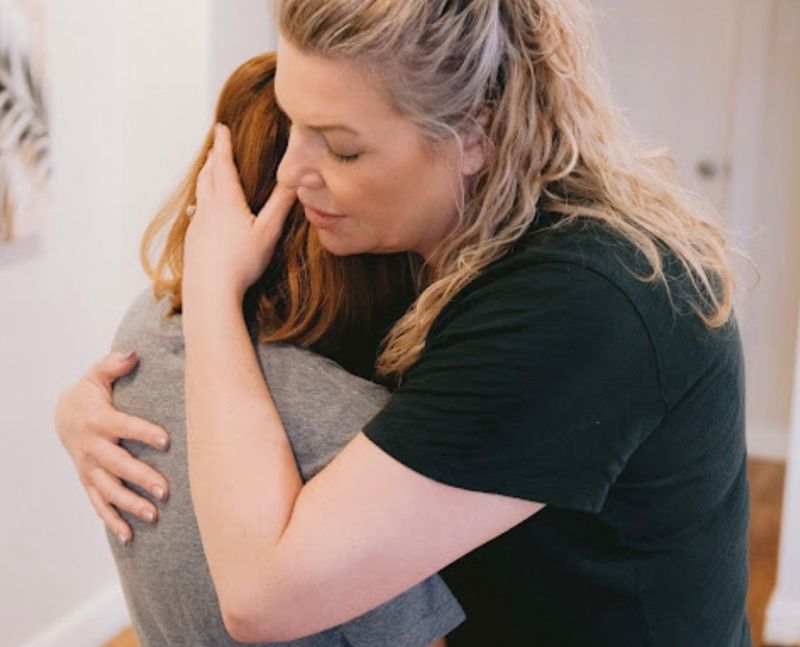

The girl was 11, with a learning disability. Her “boyfriend” was 29. He was brazenly trafficking her on the streets of Oakland.
The girl’s mother—a single mom who lived in low income housing—took intern Erica Hazlett aside at a children’s hospital. Was there something Erica could do to help her daughter?
Erica was working at the hospital in California as part of her master’s degree in social work. Her job was to provide resources and help. “No problem,” she said.
She soon learned it wasn’t that simple. Her supervisor told her there were no homes or resources available for the trafficked pre-teen. And at that time, her legal options were limited. There was almost nothing she could do.
“And so I decided to start an organization that would help to rescue and restore children who had been trapped in human trafficking all over the world,” Erica said.
That organization is Future Voices, an anti-human trafficking organization that works to recover and restore child victims of exploitation. Erica says she has helped recover more than 450 children from human trafficking worldwide. She heads the Texas-based organization with her husband, Bob Hazlett.
The couple’s work is focused on giving back the future to those from whom it has been stolen, Bob Hazlett told The Epoch Times.
“Many of the children that have gone through our homes would not have had the education, the careers, or the family that they had,” he said.

A red light district in Pattaya, Thailand, on March 15, 2019. Erica and Bob Hazlett's work has taken them to five countries to rescue human trafficking victims. (Shutterstock)
Why They Work
Erica Hazlett’s work led to six homes for human trafficking survivors in five countries. More than 300 children have come through the organization’s two homes in the Philippines alone in the past 15 years.
“We have some incredible stories about those changed lives,” Bob Hazlett said.
The couple has worked in Ethiopia, Nigeria, Thailand, the Philippines, the United States, Mexico, and other countries.
The motivation for the Hazletts’ work is the people they rescue. Erica Hazlett is insistent that seeing human trafficking victims as individuals rather than statistics is vital.
Bob Hazlett told the story of Jacob, an infant who was discovered outside one of the Hazletts’ homes in the Philippines in a trash bag.
“He still had the afterbirth attached to him,” Bob Hazlett said.
The home’s director heard the baby’s cries and got him emergency medical care. Today, “he is 11 years old, he plays six instruments, he’s the happiest boy,” Bob Hazlett said.
“He is also a sign for this generation that we are not going to let children be thrown away, but we’re going to look for them. We’re going to help to recover them,” he said.
“We’re going to help to restore them. That’s a testimony and a story that I think should be hopeful for any of us, that we can get involved and we can change a future.”
Not everyone supports what the Hazletts are doing. Erica Hazlett recounted five years of litigation that has plagued the couple. The litigation, backed by an unnamed billionaire, has shut down some of their homes.
Erica Hazlett said this is just one part of the pushback that advocates against human trafficking experience: “Advocates for human trafficking [victims] come under incredible persecution, and so we’re working at both state and federal levels to increase protections for children who have been trafficked and for the advocates who work tirelessly to protect them.”
The couple said they’re pushing for better legal protections for anti-trafficking advocates in the United States, something they say would be “groundbreaking.”
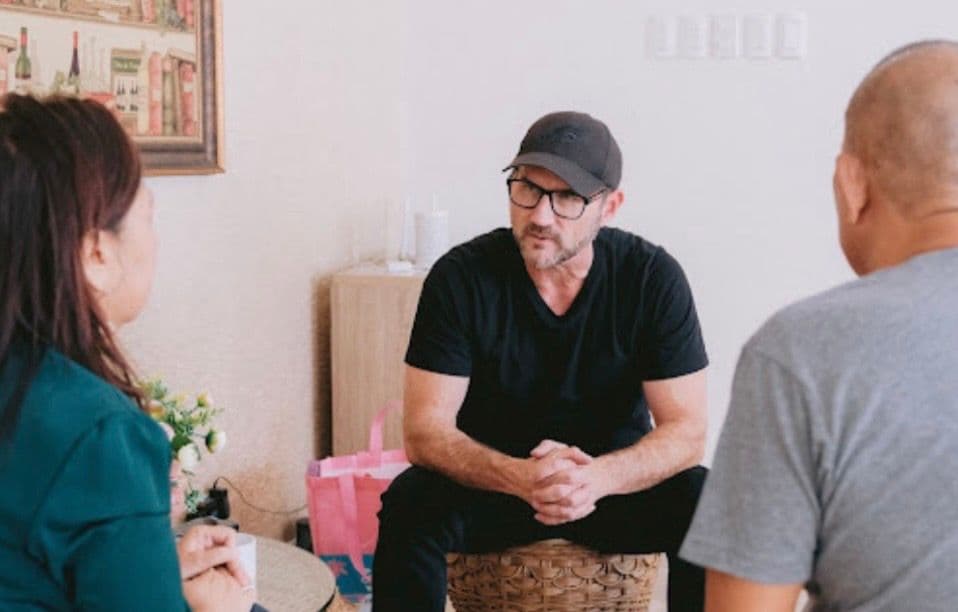
Future Voices co-founder Bob Hazlett meets with directors of the organization's home for rescued human trafficking victims, in the Philippines, in this file photo. (Courtesy of Bob and Erica Hazlett)
Rescue Isn’t Enough
The Hazletts emphasized that rescue from their captors is just the first step for those who have been trafficked. Survivors need safety, education, and a warning that they could be trafficked again in the future.
Bob Hazlett recounted taking children from one of the couple’s homes to a local mall where he gave each of them a little bit of money to buy something for themselves: “For some of them, [it was] the first time in a mall. For some of them, the first time on an escalator, the first time that they held money in their hand.”
That night, one of the boys wept and told Bob Hazlett it was the first time he was able to cry over what he had experienced.
“I believe it was because he felt safe, he belonged, and so he could feel his pain, and when he could feel his pain, he could heal from his pain,” Bob Hazlett said.
Erica Hazlett told the story of AJ, who was trafficked in the Philippines. She was 12 years old when she was rescued from a brothel, where she and other children were kept in conditions so degrading that AJ described it as like a pig farm.
After her rescue, AJ earned a high school diploma, married, and trained in electrical technology. Years later, she pursued a job opportunity in the Middle East, but once she arrived, her passport was taken, and she was labor trafficked once again, in a country where she had no way of finding help.
“When I sat and talked to her, she told me they didn’t let her eat, they took her passport, they made her work from house to house to house, cleaning over and over,” Erica Hazlett recalled.
She said AJ didn’t initially recognize what had happened.
“I said: ‘AJ, do you understand that this was a type of trafficking? This was labor trafficking,’” Erica Hazlett said.
“Even AJ, who had been sex trafficked and lived in our home and understood about human trafficking, didn’t realize that she had become revictimized.”

Putting a human face to trafficking is vital to getting help for survivors, says Erica Hazlett. Seeing each child trafficked as someone who has a future inspires people to take responsibility for them. (Shutterstock)
Resilience
Erica Hazlett said one of the most profound things she has discovered when working with children who have been victimized is their incredible resilience.
“I have seen over the last 15 years ... that these children are often more resilient than children who have been given the best and who have been given lives that parents were fully involved in,” she said.
After 276 school girls were kidnapped by Nigeria’s Boko Haram terrorists in 2014, Erica Hazlett took a team to Nigeria to help. She wound up working with five girls who escaped their captors.
“Of those five girls, three have graduated from university. Two are working full-time jobs. One of them is studying to be a doctor. One of them is an officer in a branch of the military, and they’re all thriving,” she said.
“This is what it looks like when children have been given education, love, support, therapy and the ability to dream about a future that does not include exploitation.”
She said that when she first became involved in the fight against human trafficking, she wondered what children who experienced massive abuse would look like in 20 years.
“What I found is that these kids, if they’re given the things that they need to thrive and recover ... can be even more exceptional than children who did not endure as much abuse as they did,” she said.
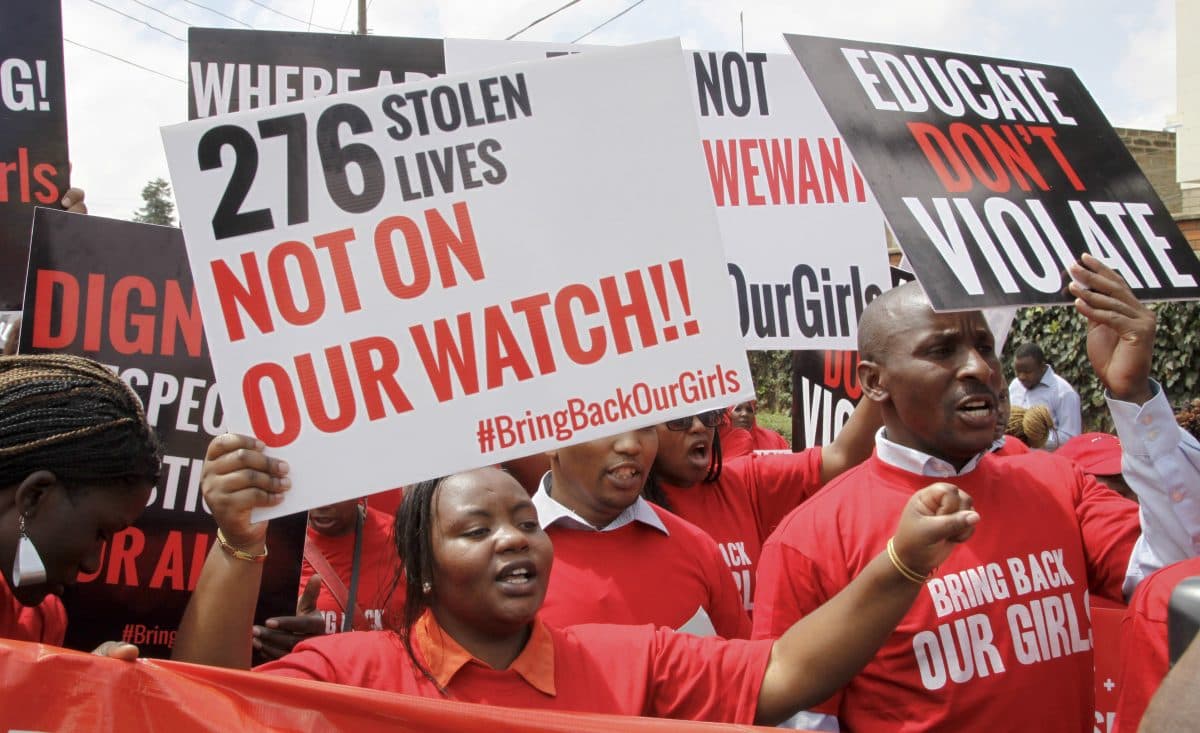
A coalition of Kenyan women's groups stage a protest demanding the release of schoolgirls abducted in Nigeria by Boko Haram terrorists, in downtown Nairobi, Kenya, on May 15, 2014. (Khalil Senosi/AP)
Everyone’s Responsibility
The responsibility to stop human trafficking belongs to everyone, the Hazletts say.
“Over 50 million people are trapped in human trafficking, and it’s a $150 billion industry,” Bob Hazlett said, pointing out that minority faith groups are often targeted as victims. “So this is an issue that everyone should be aware of and involved with.”
Human trafficking isn’t just one issue among many, Erica Hazlett said.
“When you’re talking about child trafficking, you’re talking about one of the greatest evils that exists on this earth, and children are not able to rescue themselves from human trafficking,” she said.
Not only is the trafficking of children heinous, but it’s also something that has deep roots in business and government, she said. Because it’s so pervasive, it has to be solved “from many different angles,” Erica Hazlett said.
At the top of her wishlist: increased protections for child victims of human trafficking that will allow their information to remain private, changes to laws that will support children recovered from trafficking, and for people to have both a local and a global mindset.
“I think as soon as we humanize someone, regardless of what social injustice or oppression they’re currently facing, then we want to take responsibility,” she said.
“All of a sudden you say: ‘Wait, this isn’t just a throwaway child. This isn’t a child who should be thrown in a trash bag or exploited and their innocence taken by another human being. This is a human being with a future and a hope. With help, this child could be a doctor or a lawyer or a world changer.’”
“‘Why should I get involved?’” Erica said.
“Because you’re taking responsibility to make sure that human beings remain human, that we protect the most important part about humanity, that we protect the vulnerabilities of people, and that we make sure that we’re protecting them in a way that we can be proud of.”
As for Bob, he said the mission is clear: “We’re going to continue raising leaders that have compassion. We’re going to continue advocating for a spirituality that cares, and we’re going to continue recovering and restoring children who have been trafficked.”
This article is part of the “Heroes Wanted” campaign, honoring the brave men and women who fight to end human trafficking. The Epoch Times and sister outlet NTD Television are proud partners of Kaleido.Charity and the Fifth Annual International Summit Against Human Trafficking in Washington from July 21 to July 23.
To learn about many more remarkable heroes, visit Kaleido.charity/HeroesWanted, watch their videos, and VOTE (once per day) for the hero who inspires you the most. Voting ends Sept. 23, 2026.