Some men dream of being successful businessmen. Others want to tame a wild piece of land. Many want to be great leaders, soldiers, sports stars, or travelers. The type and scale of a dominant dream varies from man to man, but always it constitutes the inner fire that puts a light in the man’s eye. It’s that certain subject that causes a stillness to steal over him and faraway look to materialize on his face. In colloquial terms, it is his “passion.”
Ben Jonson wanted to be a poet and playwright. Jonson, who lived in England at the turn of the 17th century, worked his way up from being a lowly apprentice bricklayer to strutting the stages of London and penning essays, poems, and plays to great acclaim. Indeed, many consider him second only to his friend and rival Shakespeare in the category of Elizabethan dramatists.
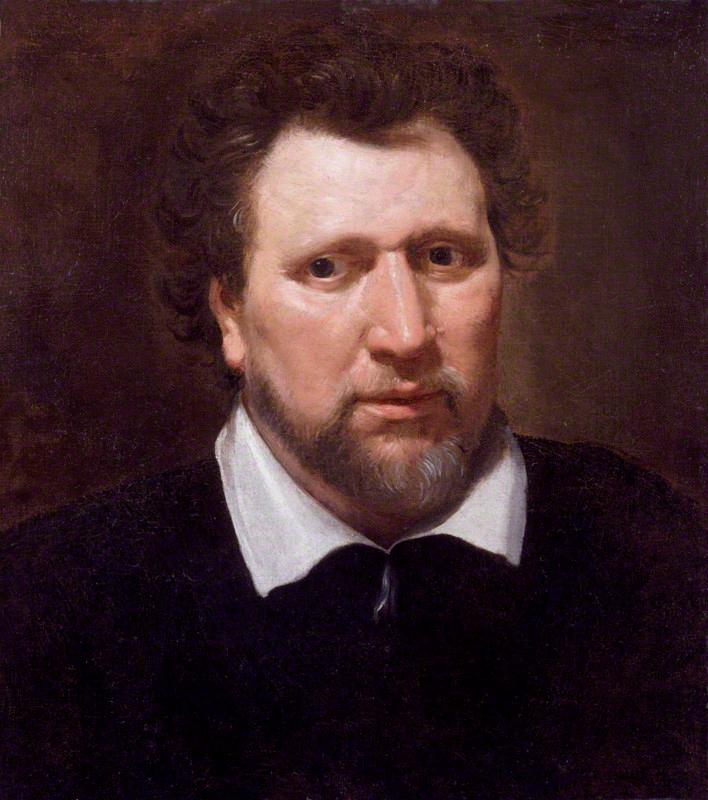
A portrait of Benjamin Jonson, 1617, by Abraham van Blyenberch, oil on canvas. (Public Domain)
Jonson was well-known for his satirical plays such as “Volpone,” “Every Man in His Humour,” and “The Alchemist.” In addition, he was an extremely accomplished poet whose verses are among the most anthologized in the English language. Jonson was a lively figure. “The Oxford Companion to English Literature,” describes him as “arrogant and quarrelsome, but fearless, warm-hearted, and intellectually honest.”
What did this arrogant and brilliant writer consider his greatest artistic achievement? It was neither his plays nor his poems. He tells us what it was in a short lyric from around the year 1603 titled “On My First Son.”
Farewell, thou child of my right hand, and joy;
My sin was too much hope of thee, lov'd boy.
Seven years tho' wert lent to me, and I thee pay,
Exacted by thy fate, on the just day.
O, could I lose all father now! For why
Will man lament the state he should envy?
To have so soon ’scap'd world’s and flesh’s rage,
And if no other misery, yet age?
Rest in soft peace, and, ask'd, say, “Here doth lie
Ben Jonson his best piece of poetry.”
For whose sake henceforth all his vows be such,
As what he loves may never like too much.
Jonson wrote this poem on the death of his 7-year-old son, which occurred on the boy’s birthday–the “just day.” His son was also named Benjamin–alluded to by the line “child of my right hand,” the literal meaning of Benjamin in Hebrew. This elegy is a heartrending, deeply bittersweet poem, and an exquisite expression of a father’s love and a father’s grief. The father’s conflicted feelings give the poem tension and authenticity. In his grief-stricken state, the father half-wonders whether he did something wrong, whether he had “too much hope of thee,” his dead son—some kind of excessive attachment—that made God take the boy away. Yet, he also recognized that the boy never fully belonged to him, that his fatherhood was instead a kind of stewardship: “Seven years tho’ [you] wert lent to me.” He believes that his son was a gift given on loan for those sweet seven years.

A young boy eats breakfast on his own. (Suzanne Tucker/Shutterstock)
With the apostrophic “O,” the father vents his sorrow, desiring for a moment that he could “lose all father[hood] now”—so as to be spared the pain of loss. But just afterward, he reinterprets his son’s fate in a positive light. His son has escaped suffering, the pains of the world, unruly passions, and old age. In this reflection, the poem sounds a note of peaceful acceptance.
The poem’s final quatrain seems to deepen this quiet and equilibrium as Jonson weaves a beautiful epitaph for his son. “Rest in soft peace, and, ask'd, say, ‘Here doth lie/ Ben Jonson his best piece of poetry.’/ For whose sake henceforth all his vows be such,/ As what he loves may never like too much.”
In “The Classic Hundred Poems,” literature professor William Harmon explains, “Jonson … knew that ‘poetry’ means ‘things made’ or ‘products,’ so that, by a reversible conceit, one may speak of one’s poems as children and of one’s children as poems.” Jonson’s son is thus his best poem. The father prays that he won’t love anything so much as his son in the future—to avoid the pain—yet he knows that this love was one of the most important experiences of his life.
Jonson’s epitaph for his son speaks to several profound truths about fatherhood, particularly the way that joy and sorrow intermingle for a journey of grief. It speaks of the indescribable joy of fatherhood, but also how fatherhood makes a man vulnerable in a way he’s never been before.
It isn’t just the death of a child—even just to watch a child suffer or stumble or lose his way, and be unable to fix it, wounds a father. Fathers walk around with bruised hearts.
But for all that, it’s worth it. The final lines of Jonson’s poem make his opinion clear. He considered his son to be his “best piece of poetry”—the best thing he ever made, the most beautiful piece of art he ever produced. Even though the boy didn’t even live to manhood, Jonson understood that any human is more precious, meaningful, and beautiful than any work of art. Jonson’s son was his masterpiece.

Three generations of fathers and sons spend time together. (PeopleImages.com - Yuri A/Shutterstock)
I suspect most fathers feel the same way about their children. I wrote earlier of a man’s passion–the businessman, the farmer, the soldier, the writer–who dream of what they’ll accomplish in these fields. Some men achieve these dreams. Some men don’t. But I suspect that, in either case, a man who becomes a father is surprised to discover that his most important work turned out to be quite different from what he expected. I think most men are surprised to discover that the new lives they bring into the world establish a firmer hold on their heart than any “project” or “passion.”
A man is blindsided by what he experiences when, for the first time, his baby grips his finger and stares up at him with wide, wet, wondering eyes. Suddenly, his “projects” mean something different than before. Suddenly, he is vulnerable. But he wouldn’t have it any other way.
What arts and culture topics would you like us to cover? Please email ideas or feedback to features@epochtimes.nyc