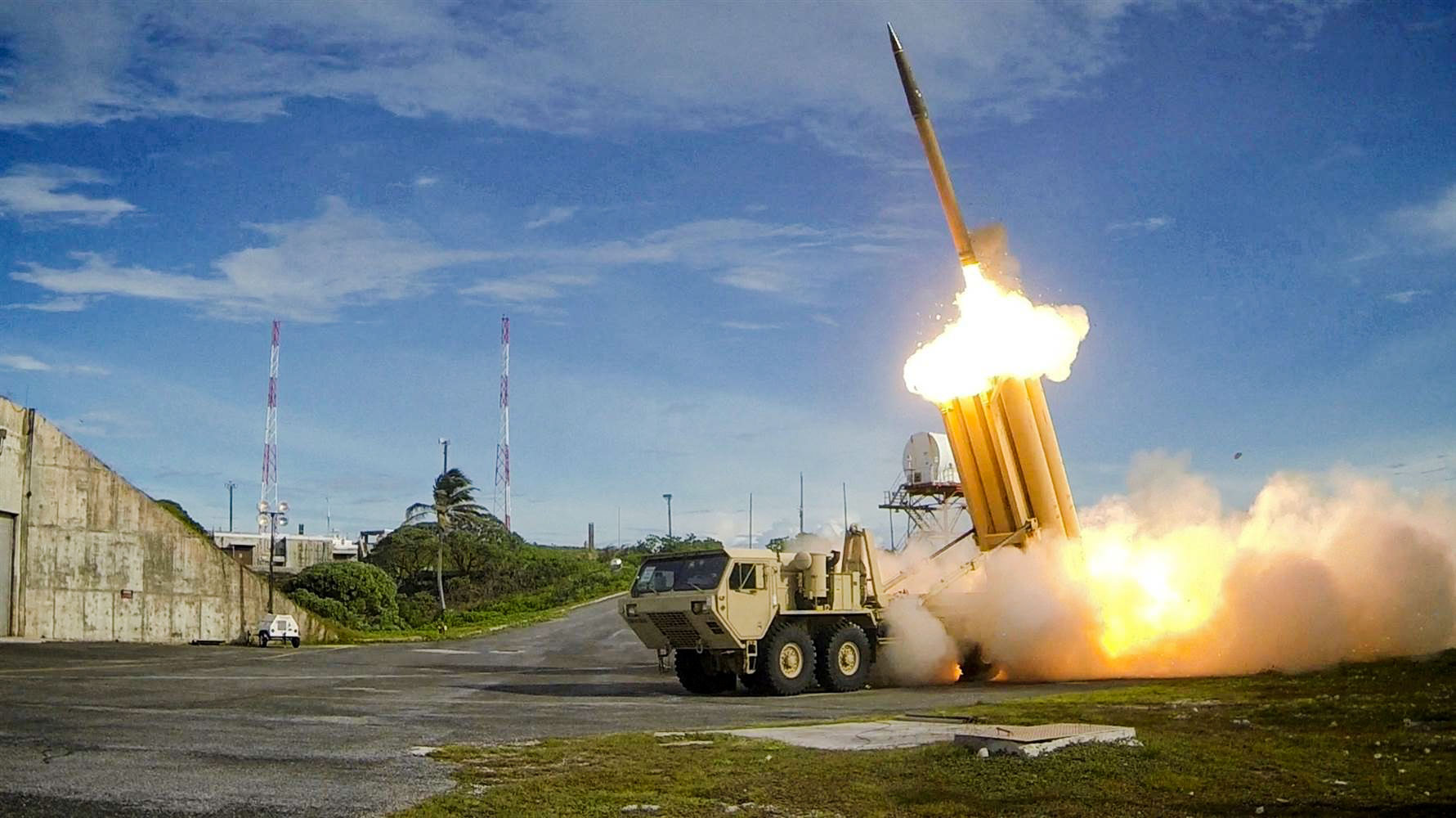

The War Department announced two major framework agreements on Aug. 31 to ramp up production of Patriot and Terminal High Altitude Area Defense (THAAD) interceptor missiles.
General Dynamics Ordnance and Tactical Systems and Lockheed Martin have signed seven-year procurement contracts for missile subcomponents.
The contracts will support the U.S. military’s THAAD and Patriot Advanced Capability-3 Missile Segment Enhancement (PAC-3 MSE) interceptor programs.
“Today’s announcement represents an example of the evolution of how we partner with industry to expand the Arsenal of Freedom, outpace emerging threats, and ensure the Warfighter never faces a fair fight,” Michael P. Duffey, undersecretary of war for acquisition and sustainment, said in a statement.
The agreements were disclosed just weeks after the Pentagon announced similar contracts with Northrop Grumman and Lockheed Martin to increase interceptor missile production.
The Center for Strategic and International Studies (CSIS) released a report in July showing that U.S. stockpiles of Patriot and THAAD interceptors had been significantly diminished in defense of U.S. bases from Iranian strikes.
As part of the agreements announced on Aug. 31, General Dynamics will increase production of highly specialized interceptor components, the Pentagon stated.
“Together with the Department of War, we’re expanding production capacity, strengthening the supply chain, and accelerating delivery of critical capabilities like PAC-3 and THAAD to meet the needs of the Arsenal of Freedom,” Lockheed Martin told The Epoch Times in an email on Aug. 31.
Goals include tripling the production capacity of components for Patriot interceptors and quadrupling production of components for THAAD interceptors. The agreements also include increased production of essential subcomponents, such as shroud deployment systems, motor cases, and seeker housings and midsections.
“General Dynamics and Lockheed Martin have answered the call,” Duffey said on Aug. 31. “We are cutting red tape, shortening timelines, and rapidly scaling our domestic manufacturing capacity to deliver the advanced air and missile defense capabilities.”
The Pentagon noted that funding for the agreements would be subject to annual appropriations. It stated that the contracts provide the defense industry with a “stable, long-term demand signal” by guaranteeing minimum annual procurement quantities, allowing companies to invest in facility upgrades, workforce expansions, and bulk material purchases.
General Dynamics Ordnance and Tactical Systems President Josh Thompson said that the Aug. 31 agreements reinforce the company’s role as a “trusted manufacturing partner delivering the critical components that enable our nation’s most advanced missile defense systems.”
“We are proud to support these significant efforts and to continue working closely alongside Lockheed Martin and our other customers to expand production capacity for these important programs,” he said. “We are already investing ahead of demand in capital expenditures, long-lead materials, and workforce expansion to ensure we can rapidly increase production capacity and deliver at the speed required to support the Department of War and our customers.”
Patriots, described as the world’s most advanced air defense missiles, and THAADs, the only U.S. missile system designed to intercept targets inside and outside the atmosphere, are both critical munitions the U.S. military uses to defend against enemy attacks.
CSIS released a report on July 27 estimating that the U.S. military’s Patriot interceptor stockpile had decreased by at least 65 percent since the start of the Iran war on Feb. 28. The report also estimated that the military’s THAAD interceptor stockpile had decreased by at least 38 percent throughout the war.
Katherine Thompson, a senior fellow in defense and foreign policy at the Cato Institute and former Pentagon official, told The Epoch Times that six months of the Iran war have “exacerbated the stress on U.S. critical munitions stockpiles already facing limitations” following drawdowns to arm Ukraine during its ongoing war with Russia.
“Many of the munitions under the greatest strain, including Patriot, THAAD, and Tomahawk, are essential to the U.S. ability to meet its highest-order strategic priority: resourcing deterrence in the Indo-Pacific vis-a-vis China,” she said.
“Between the heavy expenditure of the Iran war and the prior drawdowns to arm Ukraine, the U.S. now faces a real overextension of its military power relative to its ability to resource its commitments.”
The Pentagon previously announced framework agreements with Northrop Grumman and Lockheed Martin on Aug. 3 to triple production capacity for PAC-3 MSE interceptor components and quadruple production capacity for THAAD interceptor components.
Additional framework agreements with Boeing and Raytheon, a division of RTX Corp., were also announced by the Pentagon on Aug. 14. These will increase production of components for the U.S. military’s Standard Missile-3 Block IB and Block IIA interceptors.
The Pentagon also announced a $22.9 billion contract with Raytheon on Aug. 17 to increase production of long-range Tomahawk cruise missiles to more than 1,000 per year.
President Donald Trump acknowledged earlier this month that certain U.S. weapon stockpiles were “tighter,” but he has maintained that the United States has large munition stockpiles.
“What we’ve used is peanuts,” he told Fox News on Aug. 17. “We have a lot of mid-level weapons.”