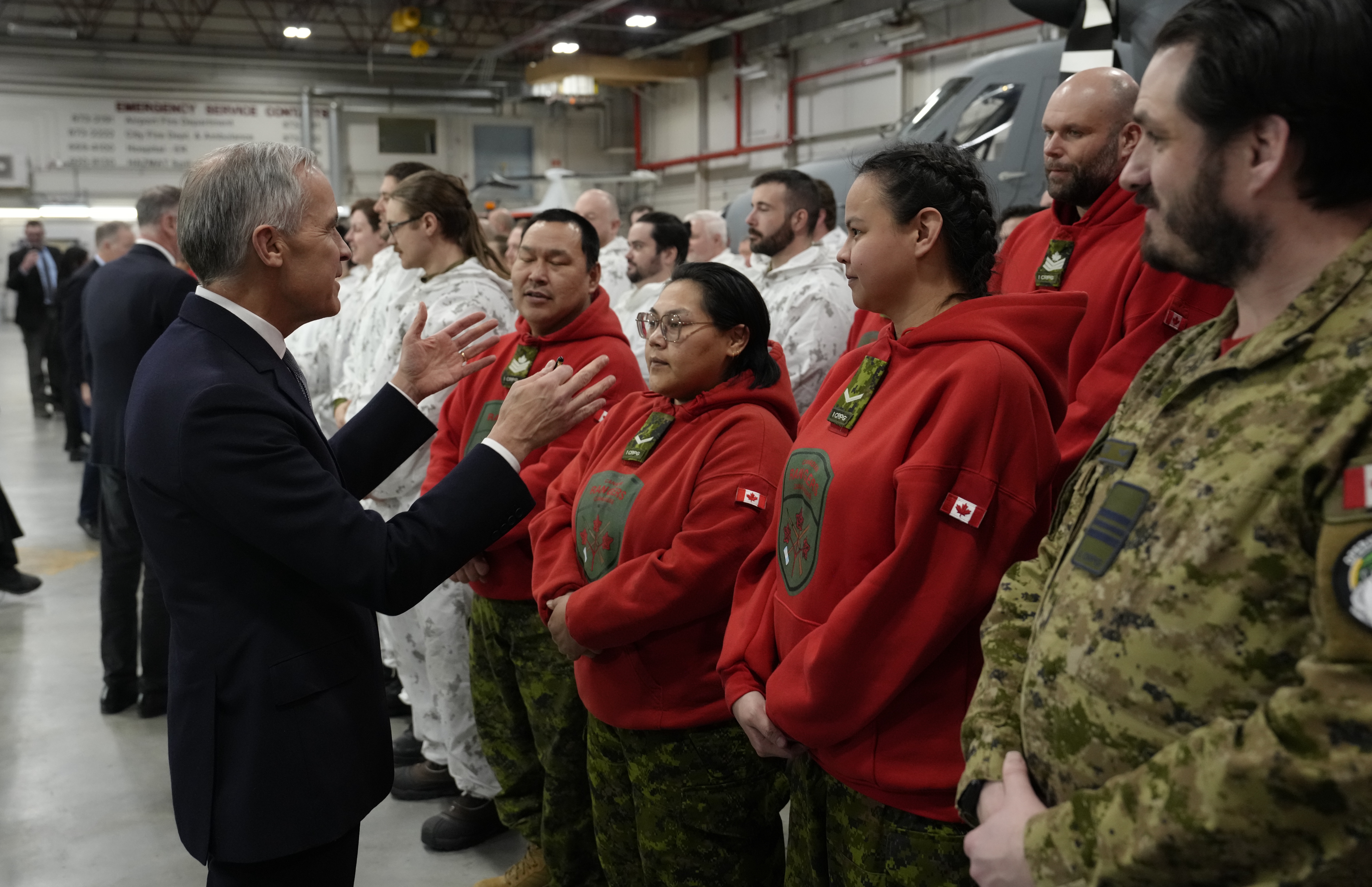

The federal government is allocating nearly $35 billion to boost military presence in Canada’s northern region and to improve infrastructure.
Around $32 billion of the funding will be used in military forward operating locations in Yellowknife, Inuvik, Iqaluit, and Deployed Operating Base 5 Wing in Goose Bay, N.L.
“With this plan, we are taking control of our future,” Carney said in Yellowknife on March 12. “We will no longer rely on others to defend our Arctic security or to fuel our economy. We’re taking full responsibility for defending our sovereignty.”
The announcement also includes $2.67 billion to build four new remote operating hubs across the North to support rapid military deployment.
The funding forms part of Canada’s 2022 commitment for NORAD modernization, which originally outlined $38.6 billion in spending over 20 years. The modernization plan includes purchasing two over-the-horizon radar modules.
The government says the work on the bases is expected to take about a decade.
Asked whether the overall cost of the NORAD modernization effort could increase, Carney said the evolving threat environment will require ongoing reassessment.
“We will be constantly updating what we need,” he said. “Sometimes we won’t need expensive systems that we thought we needed because things have moved in a different direction. Sometimes we‘ll need new systems, and we’ll be updating those through updates to the defence strategy, but also through the budget process.”
Ottawa recently introduced a $6.6 billion strategic defence industrial strategy to boost domestic military manufacturing capability. Carney said the plan would create more Canadian jobs and strengthen Canadian defence companies. Conservative Leader Pierre Poilievre said the plan is creating more bureaucracy without adequately boosting capacity.
Upgrades
The base upgrades will include improvements to airfields and the construction or repurposing of hangars, ammunition compounds, fuel facilities, and housing. Officials say all of the bases will be capable of accommodating fighter jets, including Lockheed Martin F-35s.
Ottawa is also allocating a combined $294 million to revitalize the airports in Rankin Inlet, Nunavut, and Inuvik, Northwest Territories.
Currie Dixon, premier of the Yukon, said in a statement he was “surprised and disappointed” that none of the new funding will go to the territory.
“The Yukon is home to the largest city in the North and more than a third of the total population of the North,” Dixon said. “Despite this the federal government seems to have completely overlooked the Yukon.”
He said he welcomed the significant investment in neighbouring territories but urged Ottawa to recognize the Yukon’s strategic importance.
R.J. Simpson, premier of the Northwest Territories, said the announcement represents “an important step forward” for the territory and for Canada’s Arctic.
“The Arctic is central to Canada’s future,” Simpson said. “Strengthening infrastructure, transportation and energy systems in the North helps ensure that Canada can fully exercise its sovereignty while unlocking opportunities for people who live here.”
The Canadian Press contributed to this report.