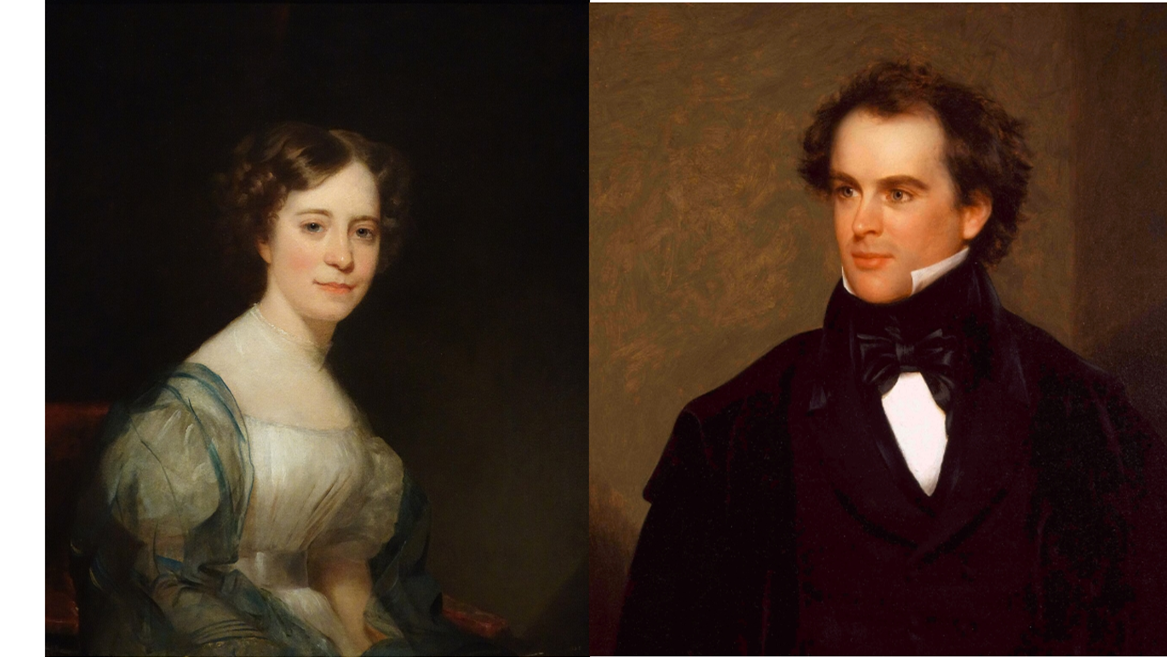
Born in Salem, Massachusetts, Nathaniel Hawthorne (1804–1864) was a bred-in-the-bone New Englander. He was descended from John Hathorne, one of the judges in the Salem witchcraft trials in the late 17th century. Later, Hawthorne added the “w” to his name to distinguish himself, some said, from that ancestor.
At age 4, when his father, a ship captain, died at sea of yellow fever, Hawthorne, his mother, and two sisters took up residence with her brothers in Salem and lived, as well, at times in Maine.
Educated at home, Hawthorne, at 17, was compelled to go to Bowdoin College in the fall of 1821 by his uncle. In the spring of that year, “quite reconciled to going to college,” he wrote to his mother, “I have not yet concluded what profession I shall have.” He ruled out becoming a minister, lawyer, or doctor, then asked: “What do you think of my becoming an author, and relying for support upon my pen?”
Though he mocked that possibility as well—“authors are always poor devils”—graduation from Bowdoin four years later found that this ambition had hooked him.
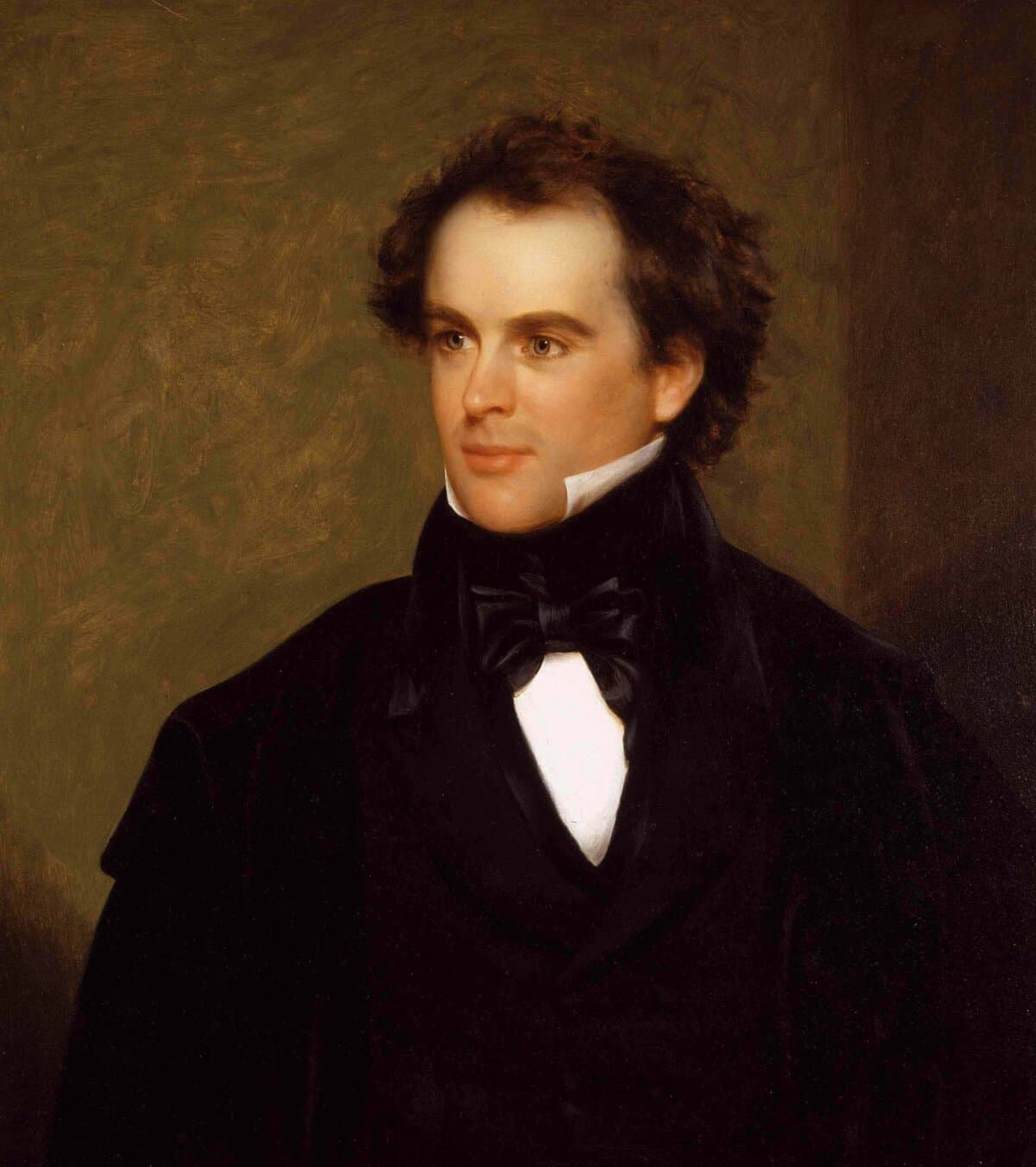
Portrait of Nathaniel Hawthorne, 1841, by Charles Osgood. Peabody Essex Museum. (Public Domain)
A Writer’s Workshop of One
Returning to his Salem home in the summer of 1825, degree in hand, Hawthorne settled into a bedroom that gave him a view of the town’s wharves. Here, for over a decade, sharing the house with his mother and sisters, he lived almost as a recluse. Here, too, he forged the writer who would one day produce “The Scarlet Letter” and classic short stories like “Young Goodman Brown.”
His days soon acquired a rhythm all their own. He devoted mornings to reading and writing; afternoons served up more of the same, often with hours given over to dreaming and meditation. During these years of isolation he borrowed more than 700 books from the Salem library, studying not only their contents but also, in the case of fiction, the ways in which different writers worked their prose.
Evenings were for long walks often followed by a favorite treat—a bowl of chocolate paste mixed with breadcrumbs—and conversing or reading books with his sisters. His meals were otherwise often delivered to his bedroom. Like him, the three female members of this house also maintained a distance from one another while under the same roof. Once, referencing their solitary lives, Hawthorne said, “We do not even ‘live’ at our house!”
He did publish, at his own expense, a novel based on his years at Bowdoin, “Fanshawe,” a commercial failure. Later, when his talent and his reputation were coming to fruition, and embarrassed by this early effort, he attempted to track down all copies of the book and destroy them. However, enough survived so that the novel forms a part of his work today. Several of the stories and nonfiction sketches he composed during these wilderness years were published, but again with little recompense or recognition.
At times during this long period of isolation and discouragement, Hawthorne considered approaching his relatively wealthy uncles and entering into business, yet onward he slogged, learning and practicing his chosen craft. That effort is a preeminent example of fortitude and patience without promise of reward.
Eden
The publication of “Twice-Told Tales,” a collection of stories that finally gained a large public audience, is often cited as ending this long self-imposed struggle. But, along with other biographers, George Edward Woodbury points to the real sunshine that dispelled Hawthorne’s gloom: Sophia Peabody. Woodbury wrote:
“There can be no doubt that in his own mind the acquaintance and growing intimacy which now sprang up between himself and Sophia Peabody coincided with the disappearance of the solitary depression of these years,—for him the twelve years ended when he first saw this small, graceful, intensely alive invalid, dressed in a simple white wrapper, who had come down from her room to meet him in the family parlor.”
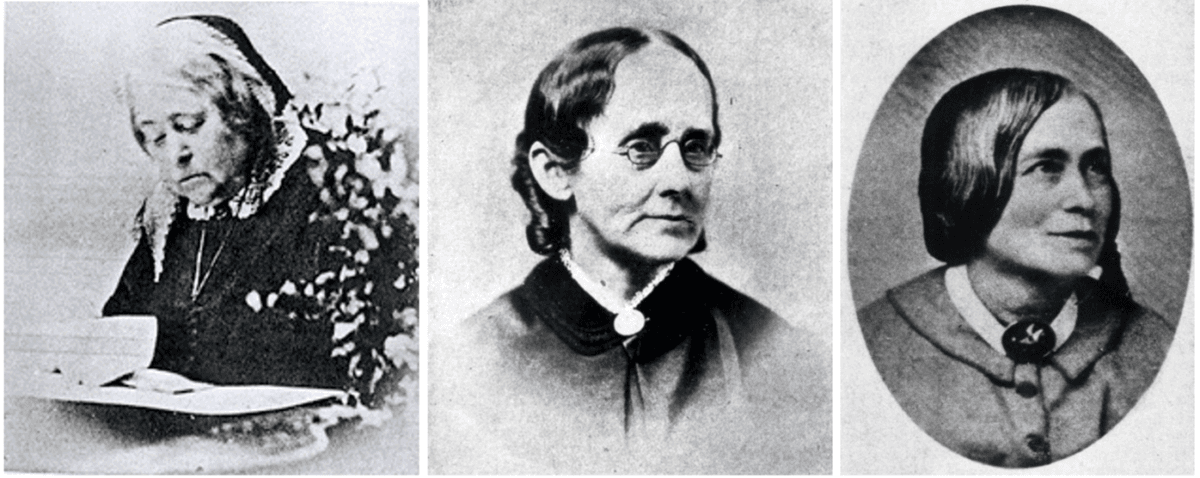
The Peabody sisters: Elizabeth, Mary, and Sophia. (Public Domain)
Their courtship and engagement were long and complicated, and when they finally married in 1842, Hawthorne was 38, Sophia, 33. Both were much older than usual for a first marriage at that time, both had the quirks and habits that accompany years of living alone, and Sophia was often sick and bedridden with headaches.
These obstacles to marital happiness notwithstanding, their marriage remains one of the most beautiful in the history of American letters.
They moved to Concord, home of Ralph Waldo Emerson and so a gathering place for other writers, including many of the Transcendentalists. Hawthorne was not one of these, and in “Mosses From an Old Manse,” he wrote of them: “Never was a poor little country village infested with such a variety of queer, strangely dressed, oddly behaved mortals, most of whom took upon themselves to be important agents of the world’s destiny, yet were simply bores of a very intense water.” The Old Manse was the house and property he and Sophia rented there, and it was this place that they dubbed their “Eden” and “Paradise.”
Though they had referred to each other as husband and wife since their 1839 engagement, now Hawthorne crowned Sophia with titles like “My Dove” and “Belovedest,” while, to Sophia, he was her “Beloved Husband.” Soon after the wedding, she wrote to her mother: “It is a perfect Eden round us. Everything is as fresh as in first June. We are Adam and Eve and see no persons round! The birds saluted us this morning with such gushes of rapture, that I thought they must know us and our happiness.”
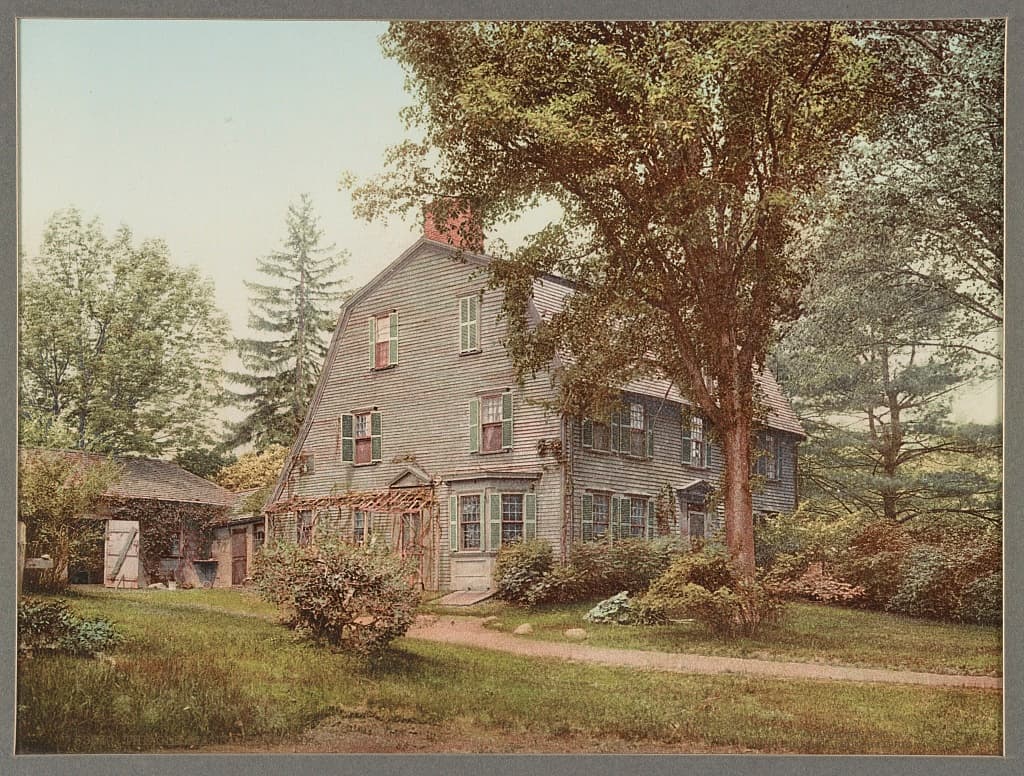
The Old Manse, Concord, Mass. Library of Congress. (Public Domain)
Hawthorne demonstrated his immense affection for Sophia by gifts of labor rather than presents. Too poor to engage a housekeeper, and always aware of Sophia’s fragile health, he did much of the cooking and cleaning. In an article celebrating the 180th anniversary of their marriage, writer and lecturer Richard Smith concludes:
“But it’s no stretch to say that the couple’s happiest years were the ones that they spent at the Manse. Hawthorne and Sophia embraced their marriage with the passion of people half their age, and the old house was filled with love, romance, and happiness; a ‘blissful seclusion’ where, Hawthorne would remember, ‘all my dreams became realities.’”
Loyalty and Courage
Hawthorne befriended Franklin Pierce, the future president of the United States (1853–1857), at Bowdoin, and the two remained close for the rest of their lives. When the ailing Hawthorne died in 1864 on a trip to the mountains of New England, it was Pierce who was at his side and who accompanied his corpse home to Sophia and the three Hawthorne children.
That friendship survived a brutal test. In the years immediately preceding the Civil War and during the war itself, many New Englanders despised Pierce for his prewar friendship with Jefferson Davis, president of the Confederacy. Many even wondered if he was in collusion with his friend.
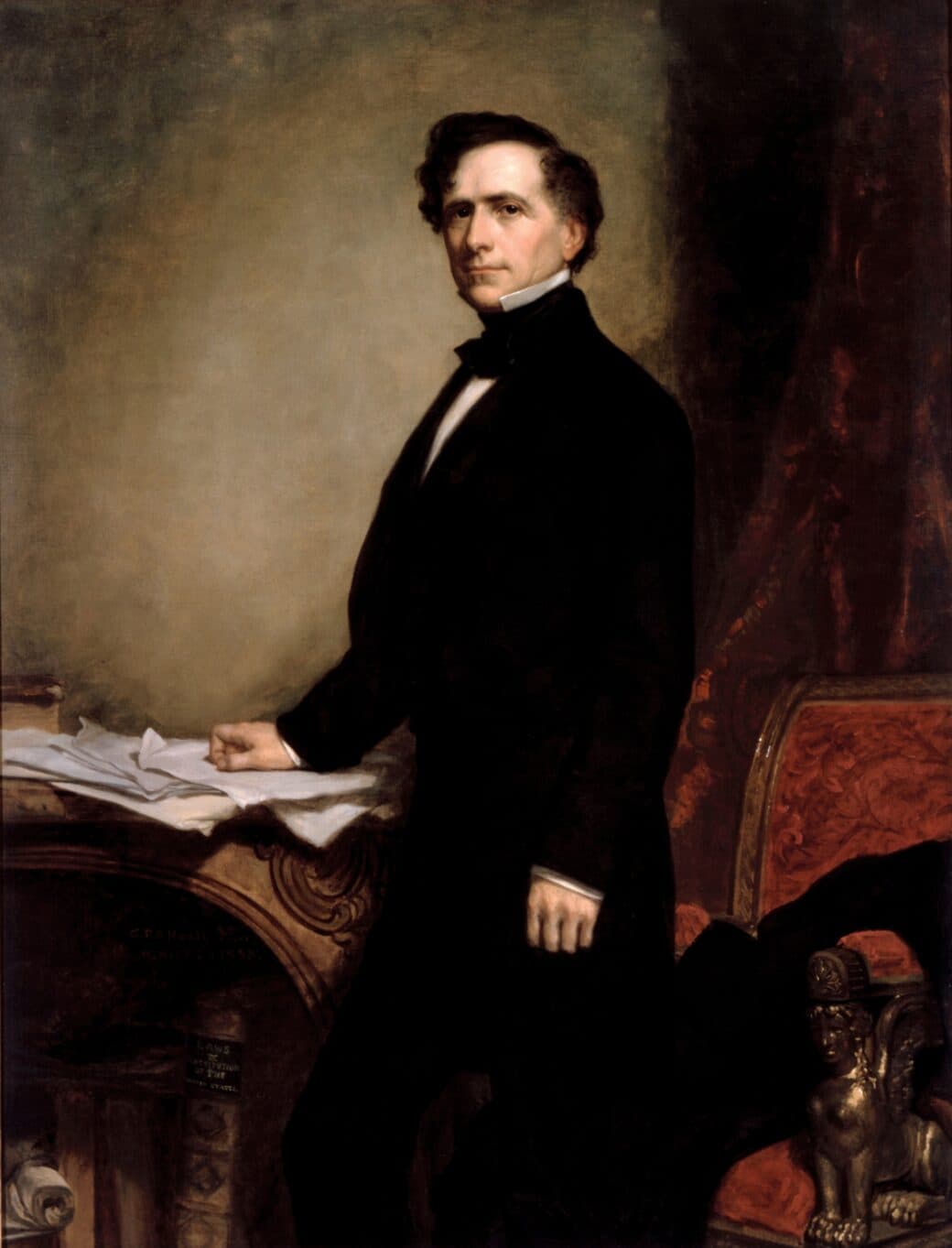
A portrait of Franklin Pierce. (White House Collection/White House Historical Association)
In 1863, while the Battle of Gettysburg raged, Hawthorne sat at his desk in Concord and wrote out a long dedication to his old friend Pierce for his forthcoming “Our Old Home.” Some acquaintances, neighbors, and other writers were outraged when Hawthorne told them he intended to lead off his book with this salute. Some turned their backs on him, some were baffled, and his publisher James T. Fields urged him to abandon the dedication, saying that it would kill book sales. Hawthorne refused, citing the aid that Pierce had rendered in helping him finish the book, and then added: “[I]f I were to tear out the dedication, I should never look at the volume again without remorse and shame.”
Others, however, did tear out the dedication, quite literally. Emerson, for example, excised it before allowing the book into his library. As Hawthorne recorded, “My friends have dropped off from me like autumn leaves.” Nevertheless, his lengthy dedication ended with this defense of Pierce:
“[W]ith a sense of your character in my deeper consciousness as among the few things that times has left as it found them, I need no assurance that you continue faithful forever to that grand idea of an irrevocable Union. … [I]t rests among my certainties that no man’s loyalty is more steadfast, no man’s hopes or apprehensions on behalf of our national existence more deeply heartfelt.”
In his article “In Concord: The Friendship of Pierce and Hawthorne,” Anthony Bergen relates how this animosity toward Pierce was demonstrated even at graveside by the cold reception he received from many of the mourners. “Franklin Pierce’s closest ally at Hawthorne’s funeral was the man lying in the casket.” Pierce joined Hawthorne in death four years later, the victim of heavy drinking and loneliness.
In 1871, Sophia Hawthorne died of pneumonia in England and was buried there. In 2006, her body and that of her oldest daughter, Una, were transported across the Atlantic and reinterred next to Hawthorne on Authors Ridge in Concord’s Sleepy Hollow Cemetery.
Husband and wife and love, reunited at last.
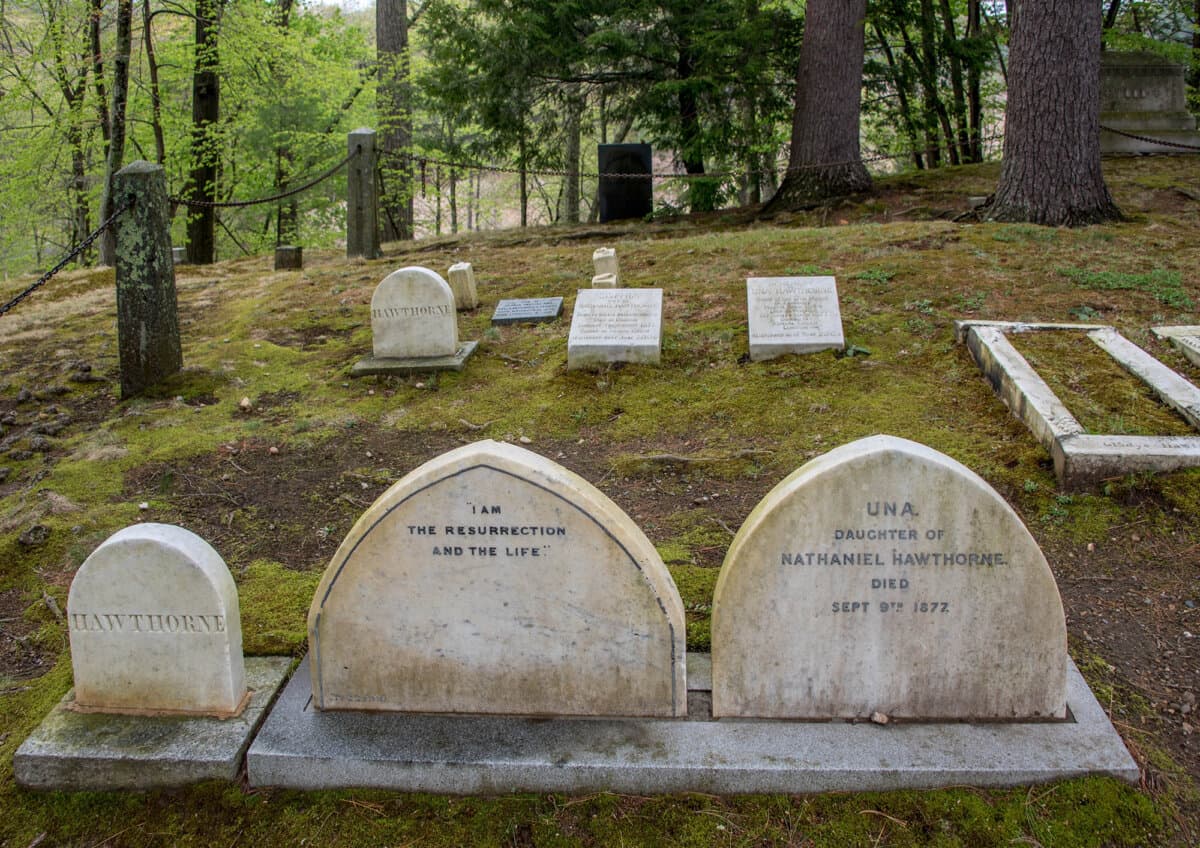
The grave of Nathaniel Hawthorne, his wife, Sophia, and daughter Una at Sleepy Hollow Cemetery, Concord, Mass. (ChicagoPhotographer/Shutterstock)
What arts and culture topics would you like us to cover? Please email ideas or feedback to features@epochtimes.nyc.