
HOUSTON, Texas—For the first time in more than 50 years, astronauts set off on a course away from Earth orbit to fly around the moon.
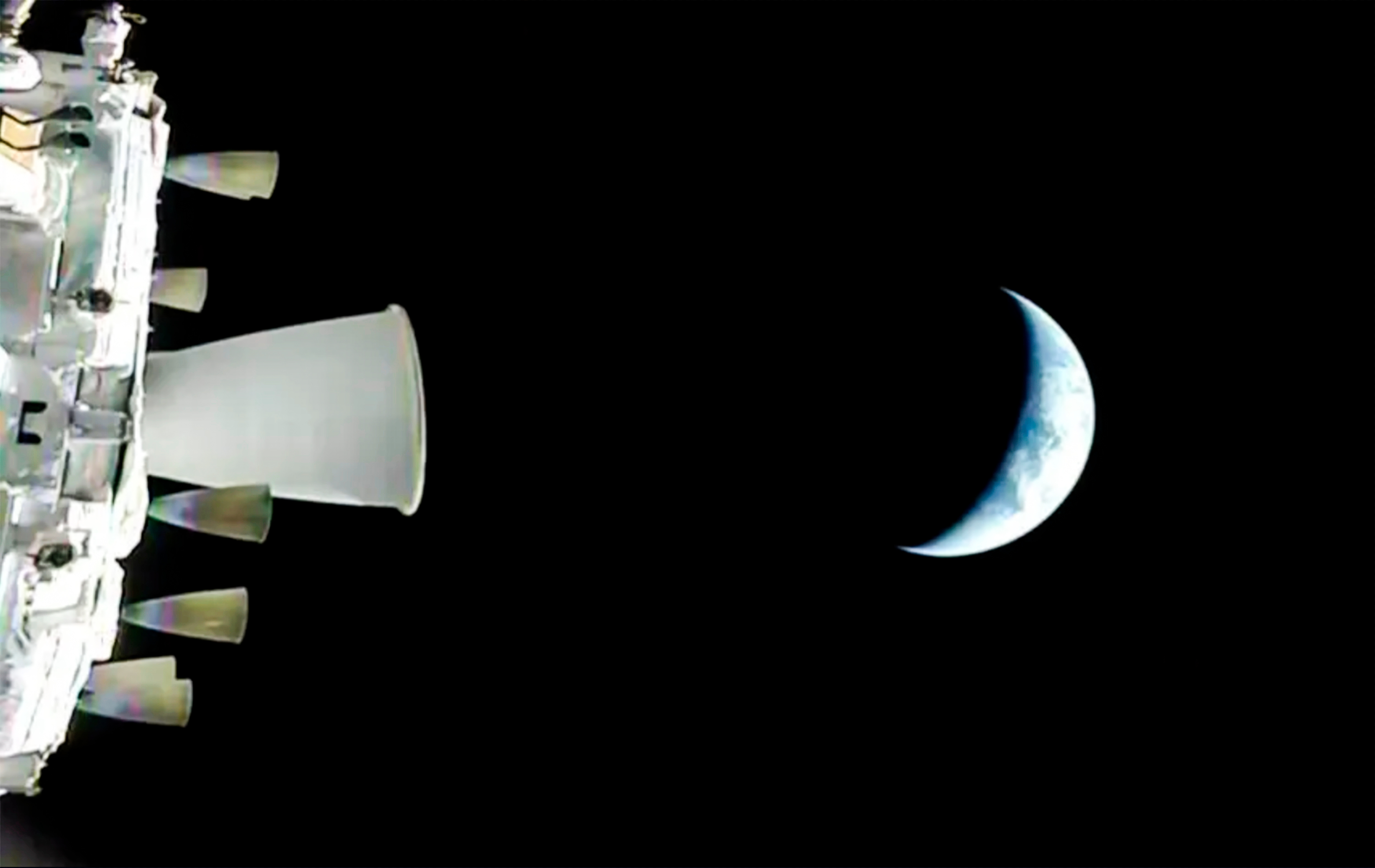
At approximately 7:50 p.m. ET on April 2, NASA astronauts Reid Wiseman, Victor Glover, and Christina Koch and Canadian Space Agency astronaut Jeremy Hansen fired their spacecraft’s main engine, committing themselves to leaving the bonds of Earth and heading for the moon.
First, the Orion spacecraft Integrity used gravity to build up speed, swooping down from a point in high Earth orbit tens of thousands of miles high to just 115 miles above Earth’s surface.
Then, the engine on its European service module came to life. Burning several hundred pounds of fuel for five minutes and 50 seconds, Integrity catapulted itself beyond Earth’s orbit, reaching speeds nearing 25,000 mph.
NASA calls this seminal point of the mission the “trans-lunar injection burn.”
While it was always NASA’s intention to send Artemis II to the moon, its historic launch and subsequent engine burns took the crew no further than a high Earth orbit, where a gauntlet of tests and checkouts needed to be completed before a moonshot could be undertaken.
Those tasks were completed, the Artemis II Mission Management Team and flight directors in Mission Control gave the go-ahead, and humanity’s first journey to the moon in this millennium officially began a little more than one day and one hour into the mission.
What Comes Next
With Artemis II committed to a flight around the moon, specifics of some of the upcoming mission milestones became more clear. Those details were shared by Judd Frieling, ascent flight director for the mission, and Lori Glaze, acting associate administrator for NASA’s Exploration Systems Development Mission Directorate, at a post-burn press conference at Johnson Space Center in Houston, Texas.
Just before midnight CT on April 5, Wiseman, Glover, Koch, and Hansen will become the first astronauts in more than 50 years to enter lunar space.
Mission Day 6 is then set up to be the most eventful day since launch day. Integrity will fly past the moon and set a new space travel record for the farthest any astronauts have flown from the Earth.
According to Frieling, Artemis II will fly more than 219,000 nautical miles away from Earth (252,000 statute miles), beating Apollo 13’s previous record of 216,000 nautical miles.
Once beyond the moon, Glaze said that the crew will re-orient the ship and see a full solar eclipse.
“I think the crew is excited about it,” she said. “I know they did a little training to learn about what they’re going to see. It‘d be really cool when they’re out beyond the moon, be able to look back at the moon eclipsing the sun. They’ll be able to see the sun’s corona.”
They will then commence the flyby. Integrity will pass over the far side of the moon on April 6 at an altitude between 4,000 and 5,000 miles from the lunar surface.
Frieling added that only about 20 percent to 30 percent of the moon’s far side would be lit by the time the astronauts get there. But mission leaders are confident that the astronauts will still get great footage of the lunar surface, and see areas that have never been seen before by human eyes.
NASA officials also continued to point out that the partial lighting would create long shadows on the surface—helping to enhance visible relief and reveal things like ridges, crater depths and rims, and slopes that are more difficult to detect when fully illuminated.
Then, on Day 7, as Wiseman, Glover, Koch, and Hansen begin their journey home, they will have their call with the International Space Station. That call will be the first ship-to-ship communication between astronauts simultaneously in low earth orbit and deep space.
Free-Return Trajectory
Artemis II’s course across the proverbial channel of deep space between the Earth and the Moon is what NASA calls a “free-return trajectory.”
That means they will pass by the moon at the necessary speed and distance to perform a truly out-of-this-world U-turn, using lunar gravity to slingshot around the far side and back to Earth.
It’s called a free return because it does not cost any additional fuel from another major burn. However, smaller thruster operations for course correction might be required during their flight.
Frieling and Glaze noted that the crew could turn around and head back home if necessary. But after one to two days after the trans-lunar injection, it would not be feasible, and it would be better for them just to remain on their course around the moon.
“From this point forward, the laws of orbital mechanics are going to carry our crew to the moon, around the far side, and back to Earth,” she said.
While it left Earth moving close to 25,000 mph, Frieling pointed out that Integrity will actually get slower and slower as the Earth tries to pull it back down. Once it is grabbed by the moon’s gravity, it would have slowed to around 1,300 feet per second, which is just 886 mph. But that speed will pick up again once it gets pulled by the moon and falls closer and closer to Earth, returning to and possibly exceeding 25,000 mph.
Artemis II is expected to return home by splashing down in the Pacific Ocean on April 10.