
“Dying is easy. Comedy is hard.”
That deathbed aphorism, attributed to Edmund Gwenn, who played Santa Claus in “Miracle on 34th Street,” contains a hard nugget of truth. Cracking jokes with grandkids on the front porch is one thing, but drawing laughter from an audience by means of a play or a story can be dicey. Comedy is like that rubber reflex hammer physicians use to make your knee bounce. If that knee doesn’t bounce, a writer’s attempt at humor is DOA.
Irish writer Frank O’Connor could make that knee kick the foot to the ceiling.
“My Oedipus Complex,” the story of a boy dealing with his father’s return from a war and reclaiming and the ensuing battle for his mother’s affection, is an O’Connor comedy classic. Others include “The Genius,” in which a boy thinks himself a genius and tries to impress a girl with his high IQ, and “The Drunkard,” a story that mixes humor and pathos when a boy tries to keep his father from drinking but becomes drunk himself.
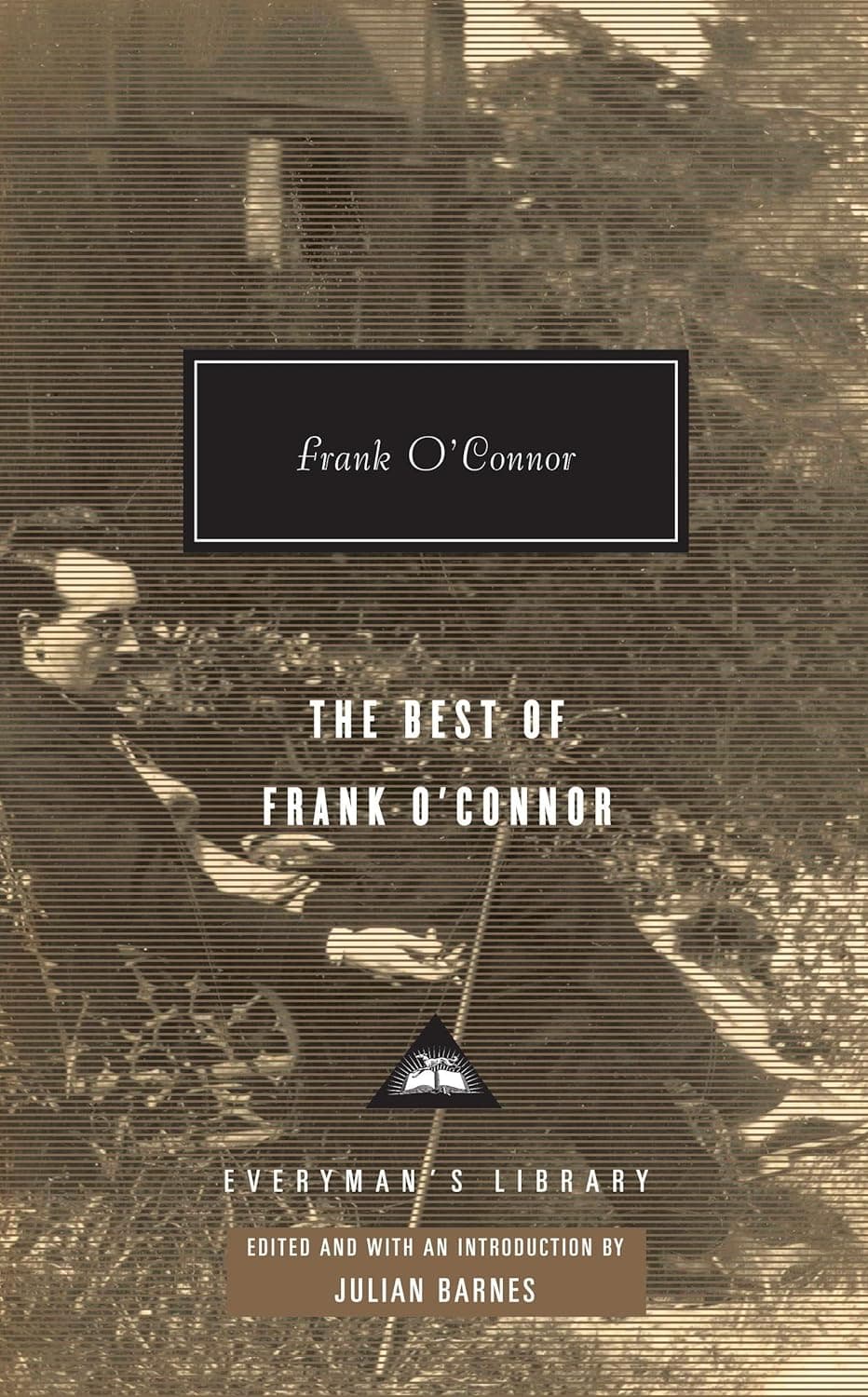
"The Best of Frank O'Connor," published in 2009, contains O'Connor's best short stories. (Everyman's Library)
O’Connor had a special talent for looking at the world through the eyes of a male adolescent, often with hilarious results. Given that gift and given that many people right now are in the middle of Lent, “First Confession” is the perfect vehicle for taking a ride into O’Connor’s world.
The Bare-Bones Basics
Jackie, 7 years old, narrates this story. He’s upset because Gran has come to live with them, an old woman who walks around barefooted, drinks from a jug of porter, eats with her fingers, and favors Jackie’s older sister, Nora. When Jackie hides under the table to avoid Gran’s cooking, Nora tries to force him to eat, whereupon Jackie frightens her off with a bread-knife.
Meanwhile, Jackie is also preparing for first confession. His teacher is “an old woman called Ryan” who comes after school every day “and talked to us of hell.” She also explains the examination of conscience, which precedes confession, leaving Jackie terrified that he has “broken the whole ten commandments.”
On the day the class is scheduled for confession, Jackie escapes by claiming he has a toothache and misses school, but then receives word from Mrs. Ryan that he is to go to the general confession on Saturday. With his mother unable to accompany him, Nora takes him, tormenting him all the while with visions of what the priest will say to a boy who despises his Gran and lashed out at his sister with a bread-knife. But the young priest turns out to have a heart of gold, and Jackie leaves the confessional with a light penance and some candy.
This is the cut-and-dried version of O’Connor’s story, as sparse as Gran’s favorite meal of “a pot of potatoes with—sometimes—a bit of salt fish.” Time now for a taste of the spices that O’Connor added to this dish.
On the Way to Perdition
Here’s Nora dragging Jackie to confession:
“Now, that girl had ways of tormenting me that Mother never knew of. She held my hand as we went down the hill, smiling sadly and saying how sorry she was for me, as if she were bringing me to the hospital for an operation.
“‘Oh, God help us!’ she moaned. ‘Isn’t it a terrible pity you weren’t a good boy? Oh, Jackie, my heart bleeds for you! How will you ever think of all your sins? Don’t forget you have to tell him about the time you kicked Gran on the shin.’
“‘Lemme go!’ I said, trying to drag myself free of her. ‘I don’t want to go to confession at all.’”
When they arrive at church, Nora casts off her false pity, and “she became the raging malicious devil she really was. ‘There you are!’ she said with a yelp of triumph, hurling me through the church door. ‘And I hope he’ll give you the penitential psalms, you dirty little caffler.’” That last word is Cork city slang for a young scamp or rascal.
Climbing Mount Confessional
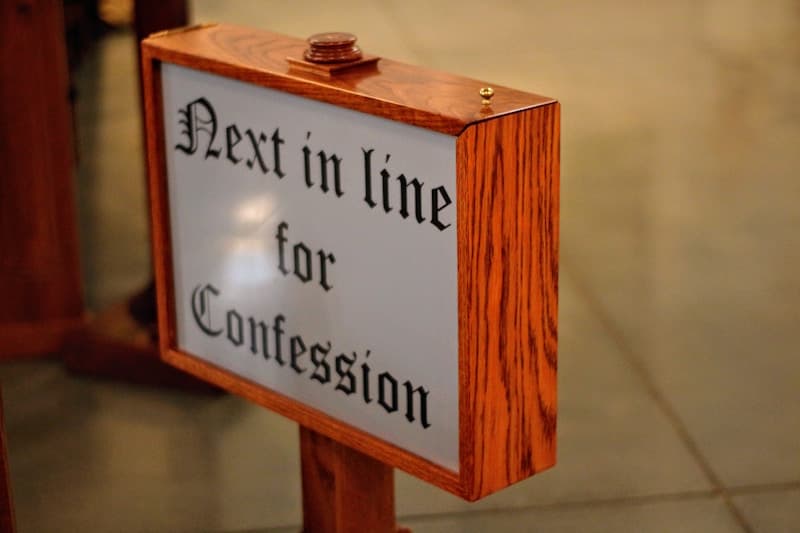
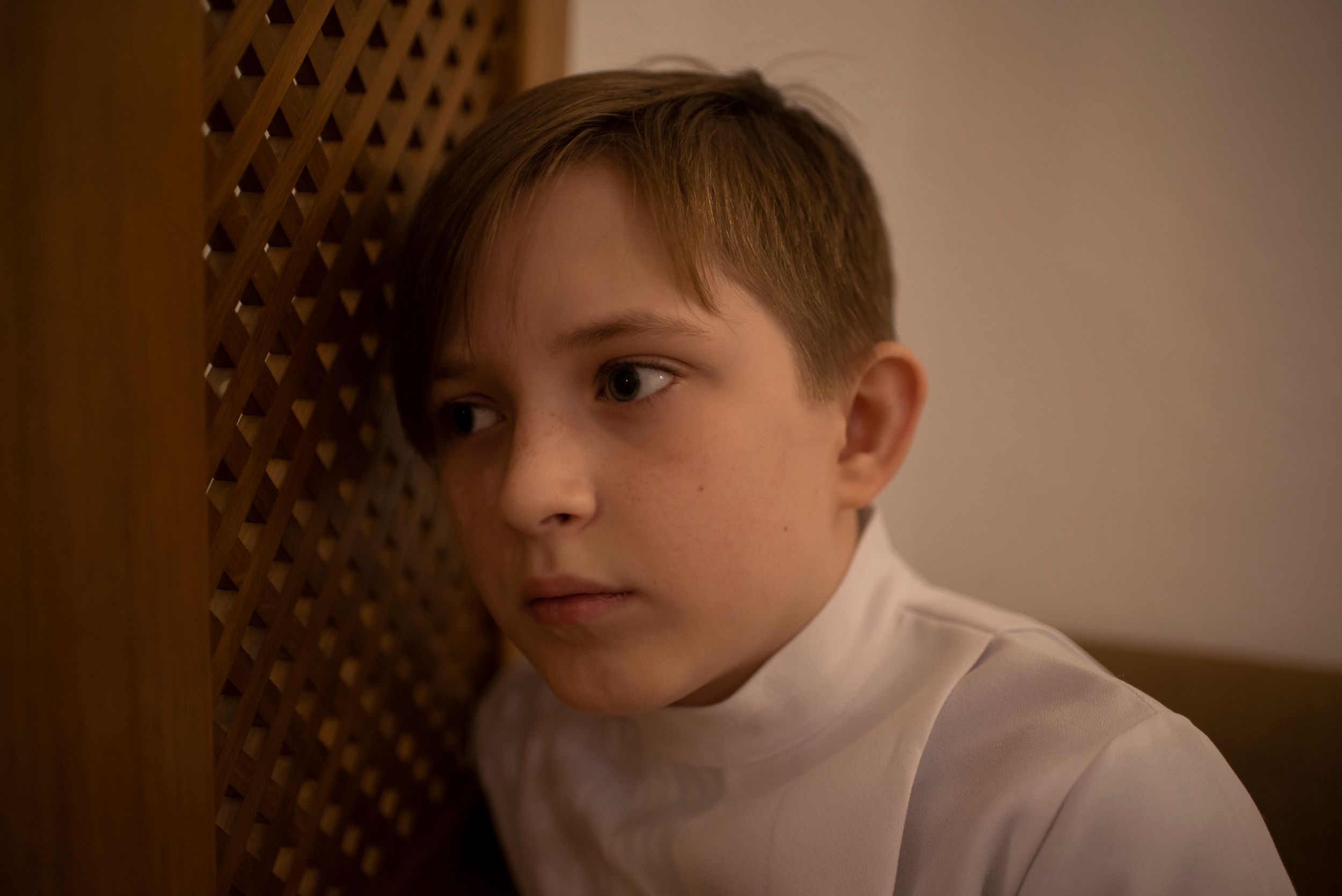
Jackie gets in line for confession, in "First Confession" by Frank O'Connor. (Shalone Cason/Unsplash)
When Jackie at last enters the dark confessional, he mistakes the ledge that is for leaning against when kneeling for the kneeler itself and climbs precariously atop it. When the priest opens the sliding panel, Jackie is effectively hovering on the wall above him.
“‘Bless me, father, for I have sinned: this is my first confession,’ I rattled off all in one breath, and swung myself down the least shade more to make it easier for him.
“‘What are you doing up there?’ he shouted in an angry voice, and the strain the politeness was putting on my hold of the moulding, and the shock of being addressed in such an uncivil tone, were too much for me. I lost my grip, tumbled, and hit the door an unmerciful wallop before I found myself flat on my back in the middle of the aisle. The people who had been waiting stood up with their mouths open. The priest opened the door of the middle box and came out, pushing his biretta back from his forehead; he looked something terrible.”
An embarrassed Nora scampers down the aisle, berates her brother, and clips him in the ear. The priest orders her back to her pew to continue her penance, helps Jackie to his feet, and advises him to wait until he has finished hearing the sins “of the old ones” before hearing Jackie’s “crimes of a lifetime.” When that time comes, he gets Jackie properly ensconced in the confessional and then steps into the other side of the box.
‘Hanging Is a Horrible Death’
Jackie’s confession is the peak of humor in O’Connor’s story.
“‘Well, now,’ he said, ‘what do they call you?’
“‘Jackie, father,’ I said.
“‘And what’s a-trouble to you, Jackie?’
“‘Father,’ I said, feeling I might as well get it over while I had him in good humour, ‘I had it all arranged to kill my grandmother.’
“He seemed a bit shaken by that, all right, because he said nothing for quite a while.”
That one sentence is the most subtle bit of humor in the story and the most amusing. Jackie mistakes the priest’s stillness for shock at his plans for murder, whereas it’s really a signal to the reader that the priest is shaking with silent laughter.
From this point on, the priest’s ability to enter Jackie’s world carries the comedy along. Here, for example, he offers a sympathetic ear and a nuanced comment about Nora, which the boy misses.
“‘Begor, Jackie,’ he said, ‘do you know you’re a terrible child?’
“‘I know, father,’ I said, for I was just thinking the same thing myself. ‘I tried to kill Nora too with a bread-knife under the table, only I missed her.’
“‘Is that the little girl that was beating you just now?’ he asked.
“‘Tis, father.’
“‘Someone will go for her with a bread-knife one day, and he won’t miss her,’ he said rather cryptically. ‘You must have great courage. Between ourselves, there’s a lot of people I’d like to do the same to, but I’d never have the nerve. Hanging is an awful death.’
“‘Is it, father?’ I asked with the deepest interest—I was always very keen on hanging. ‘Did you ever see a fellow hanged?’
“‘Dozens of them,’ he said solemnly. ‘And they all died roaring.’
“‘Jay!’ I said.
“‘Oh, a horrible death!’ he said with great satisfaction. ‘Lots of the fellows I saw killed their grandmothers too, but they all said ’twas never worth it.’”
Three Prayers and Some Sweets
Nora awaits Jackie outside the church seated on a porch railing. When he walks through the door accompanied by the priest, she’s furious—“she was mad jealous because a priest had never come out of the church with her.” She pumps Jackie about his confession, incredulous after learning that the priest had only given her brother “three Hail Marys” for his penance. She wants to know if he confessed “about Gran and all” and about coming after her with the bread-knife. “I did to be sure,” Jackie tells her.
“‘And he only gave you three Hail Marys?’
“‘That’s all.’
“She slowly got down from the railing with a baffled air. Clearly, this was beyond her. As we mounted the steps back to the main road, she looked at me suspiciously.
“‘What are you sucking?’ she asked.
“‘Bullseyes.’ [a traditional Irish hard candy].
“‘Was it the priest gave them to you?’
“‘Twas.’
“‘Lord God,’ she wailed bitterly, ‘some people have all the luck! ‘Tis no advantage to anybody trying to be good. I might just as well be a sinner like you.’”
Readers may find several takeaways from “First Confession.” They might consider it a slice-of-life glimpse of family and church in mid-20th-century Ireland. They might recall some moment from their own childhood when a kindly adult eased their confusion and anxiety. In Nora, they might recognize those self-righteous hypocrites in their own lives who find fault with others while ignoring their own wrongs and transgressions.
But the finest gift bestowed by “First Confession” is that commodity all too often missing in our hurried and harried daily lives: laughter.
Enjoy!
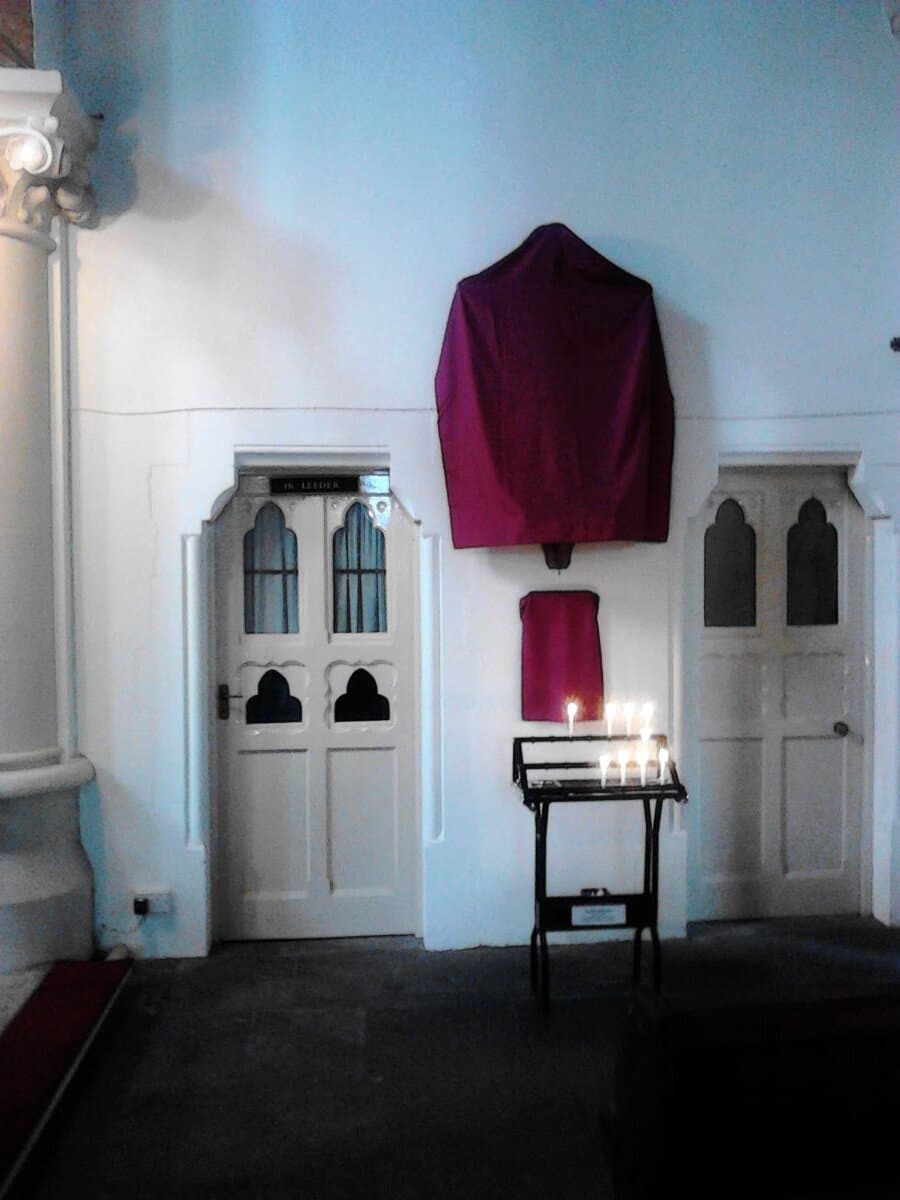
Functional 19th-century confessionals in St. Pancras Church, Ipswich, England. (<a href="https://commons.wikimedia.org/wiki/User:JASpencer">JASpencer</a>/<a href="https://creativecommons.org/licenses/by-sa/3.0/">CC BY-SA 3.0</a>)
What arts and culture topics would you like us to cover? Please email ideas or feedback to features@epochtimes.nyc