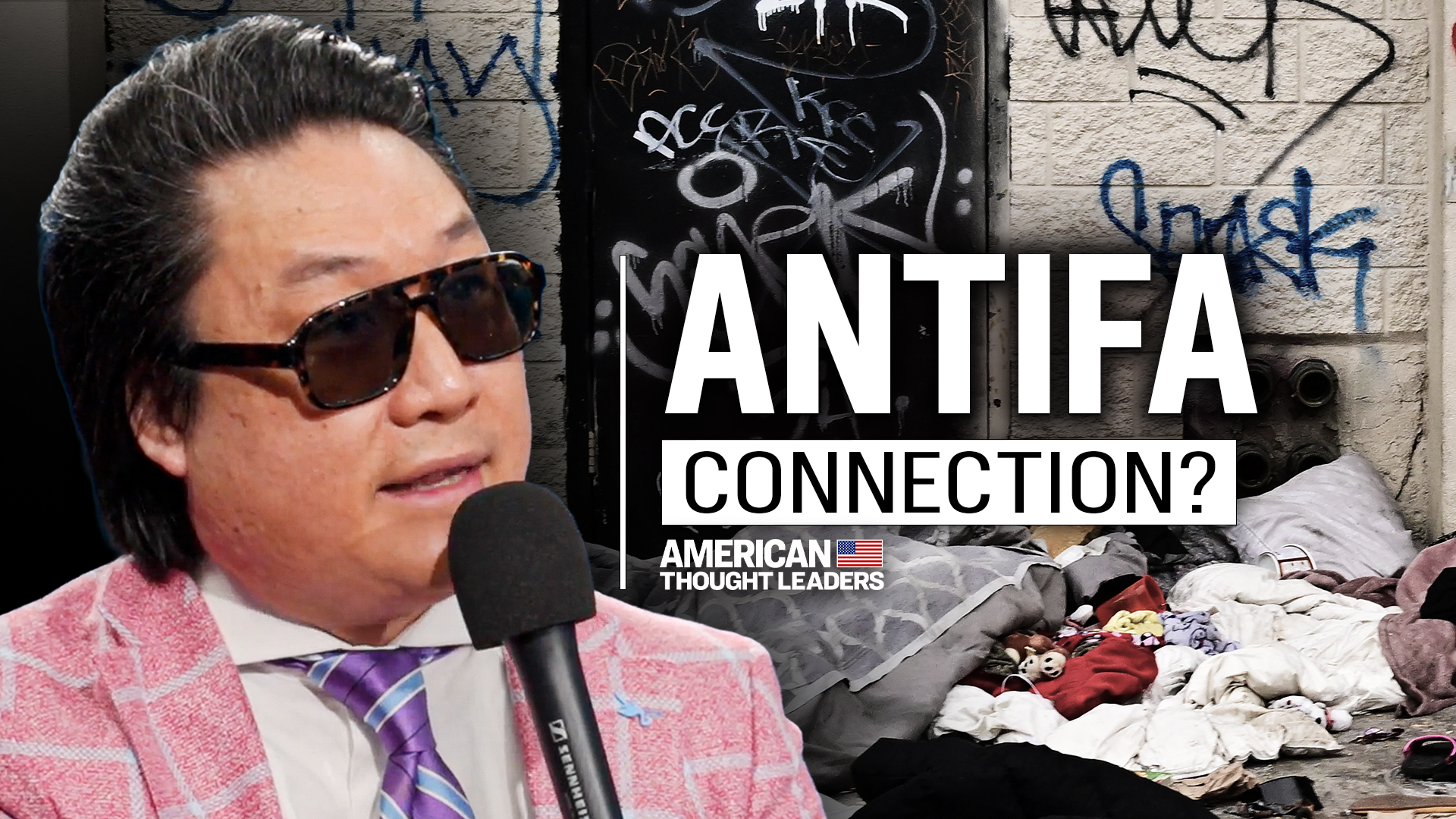

[RUSH TRANSCRIPT BELOW] “I’m seeing crime, chaos, and death on the streets of America. ... The homeless are being used. And Antifa, the far left activists, they want to keep the tent encampments on America’s streets to show that capitalism isn’t working,” said Jonathan Choe, a reporter for Turning Point USA’s Frontlines and a senior journalism fellow at the Discovery Institute.
At Turning Point USA’s AmFest conference, I sat down with Choe to discuss his investigations into Antifa and the homelessness epidemic in America.
While some nonprofits are really helping people, Choe said, he believes a sizable portion of the sector has become a multi-billion-dollar “cash cow” of grift and counterproductive aid.
“For years now, the so-called experts of the medical community—instead of getting people into treatment and recovery—have been giving away free meth pipes, fentanyl foil,” he said.
In 2025, he and several of his colleagues worked on a joint study by the Capital Research Center and the Discovery Institute that revealed a notable intersection between Antifa and the homelessness nonprofit space, he said.
Antifa members have embedded in the homelessness nonprofit sector and many of them have day jobs in the space, he said.
“A lot of [Antifa’s] ideas to bring communism, Marxism, to destabilize America, to usher in a brand new communist revolution that’s part of the homeless industrial complex now,” he said.
In October 2025, Choe and other journalists, including Andy Ngo, participated in a White House roundtable to share their knowledge about Antifa with President Donald Trump.
A month earlier, Trump had signed an executive order designating Antifa as a domestic terrorist organization. And in July 2025, he signed another order called “Ending Crime and Disorder on America’s Streets” that takes a more aggressive treatment-first instead of housing-first approach to homelessness.
Many states, including Washington and California, are now suing the Trump administration.
Views expressed in this video are opinions of the host and the guest, and do not necessarily reflect the views of The Epoch Times.
RUSH TRANSCRIPT
Jan Jekielek:
Jonathan Choe, such a pleasure to have you on American Thought Leaders.
Jonathan Choe:
Hey, thanks. This has been a dynamic week so far here at AmFest, so I’m excited to be here.
Mr. Jekielek:
Well, the last time I saw you, I think you were at a roundtable with the president talking about Antifa. What has come of this focus on Antifa and this apparent designation of Antifa as a domestic terror organization?
Mr. Choe:
Well, swift prosecution and some arrests, and obviously we want to see more, but you know, most recently, there were four people arrested in Texas. They were allegedly trying to plant bombs around a nice facility, so you know that was, in my opinion, influenced by this theme of Antifa now, finally, in the national consciousness. These folks are saying they’re not part of Antifa, but obviously, the telltale signs are there.
Mr. Jekielek:
And when it comes to, I mean, I think this consciousness around Antifa being real, because, of course, we’re always told it’s not an organization or whatever. I’m trying to understand, you know, is this something that’s actually being impacted? Of course, there was this arrest, but is this something, because it’s a loose network in many cases, right? So it’s hard to pinpoint. Is this actually in the process of being dismantled?
Mr. Choe:
Well, look, bottom line, let me be very clear. I’m on the front lines of these protests in Seattle and Portland and other parts of America. And when people are wearing all black, blocking streets and waving flags that literally say things, I want to take them at face value, okay? So there’s no doubt about that. And then, when destruction, chaos, and destabilization of a city occur because of their violence, that’s Antifa. I’m going to take them at face value. Okay, so there’s no doubt about that. And then when there is destruction, chaos, and destabilization of a city because of their violence, that’s Antifa. I’m going to take them at face value.
Now, in terms of prosecutions is not my job; it’s on the administration now. It’s on the feds. Local authorities are barely doing anything about it, unfortunately, still. And that’s the problem, right? And look, I can only speak about what’s happening on the front lines in Portland right now.
There is a lawsuit filed by my colleague Nick Sorter, who was also part of that White House roundtable, where they’re now trying to figure out if Portland Police Dept. actually colluded with Antifa leaders in terms of communication. So that’s going to be really interesting to find out. But this is an issue that is going to carry into the new year, and we’re hoping to see more prosecutions.
Mr. Jekielek:
Okay. Well, let’s put a pin in that. The big issue that you work on with the Discovery Institute is this issue of the homeless industrial complex and homelessness more broadly. Now, it seems like that itself is being impacted also by the policies of this administration.
Mr. Choe:
Yes, it’s been a real privilege being a part of Discovery’s media team for the past three years now. We’re going into our fourth year there. I primarily focus on the Fix Homelessness Initiative, where we, you know, tell stories about the homeless drug crisis that has ravaged many cities in America, especially on the West Coast. Crazy enough, the top three states with the most homelessness in America are New York.
Rather, here’s the order: California, New York, then Washington, where I live. Can you believe Washington is number three? So with that said, we’ve had senior fellows from the Discovery Institute now go to the U.S. Department of Housing and Urban Development [HUD], and they’re creating and crafting the policies for the Trump administration.
So Trump’s most recent executive order essentially takes money from these failed housing-first initiatives, where for the past decade they’ve been giving away apartments, studios, no questions asked, no requirements to get jobs, no requirements to go into detox, at the expense of taxpayers to people living on the streets. That hasn’t been working, so now they’re going to be taking those federal funds and putting them towards programs that focus on detox, that focus on treatment, that focus on dealing with mental illness. So we believe there’s going to be a big change.
Mr. Jekielek:
So, I mean, I think a key operative term here is accountability, right? There has to be some kind of accountability relationship. Is that right?
Mr. Choe:
Right. So the accountability is going to be really simple as far as I know. These nonprofits, the cities, and the states that have been receiving federal funds to deal with the homeless crisis on the streets, when they apply now for these federal grants to fund their programs, they’re going to have to prove and show that their programs are now geared towards treatment and recovery first. Again, instead of just giving away apartments and studios under their failed housing-first program.
Mr. Jekielek:
Okay. Are there case studies now where something has changed, something is working?
Mr. Choe:
It’s so new, it hasn’t even been a year since Trump’s executive order has been put out, but we’re hearing anecdotally, and I can speak for what’s happening in places like San Francisco, Seattle, and Portland. These nonprofits under the so-called homeless industrial complex, they’re running around like their hair’s on fire right now because they’re being forced to pivot.
Now, obviously, what they’re going to do is they’re not going to go away. This is a multi-billion dollar industry where they’ve taken advantage of federal dollars for so many years, so in some cases they’re simply trying to change the language and say, hey, we’ve always been about detox and recovery. But again, the proof is going to be in their programs when they apply. What will it really look like?
Here’s the other piece that is happening a lot in these cities and states like Washington, for example. They’re suing the Trump administration. California is doing this as well, and they’re fearmongering. They’re going to say all these people living in these housing, first apartments, permanent supportive housing are going to be forced onto the streets. That’s not going to happen. Now, of course, when you press the leaders, the CEOs, all these nonprofits making more than $400K a year, and you say, okay, hey, will you take a pay cut? Then, silence. So again, it really has been grift for so many years.
I want to be really careful at the same time not to throw everyone in the same basket because there are nonprofits that have been doing good work, groups like Salvation Army, Union Gospel Mission. But again, these are faith-based groups, in many cases, that have not been taking the federal funds. I think a lot of that money is now going to be deployed into those types of working programs.
Mr. Jekielek:
Fascinating. Okay, so tell me a little bit about what you have seen in your reporting, and maybe we'll include some of the video that you’ve taken in these areas. But tell me about, over the last several years that you have been working with the Discovery Media team, what you saw, what you found.
Mr. Choe:
Unfortunately, my punchline now is the video doesn’t lie. I’m seeing crime, chaos, and death on the streets of America. I mean, Seattle looks like a third-world country right now. You have tent encampments in the downtown core and taking over public parks. San Francisco, Portland, Los Angeles— even worse. So there truly is a crisis on the streets, but it’s been the wrong public policies and the wrong approaches that have essentially enabled this problem to spiral out of control.
So right now we are in a rinse-repeat cycle. I'd believe out of all the four cities that I mentioned, I called the four horsemen of the apocalypse. San Francisco probably will turn around much quicker than the other cities that I just mentioned because they have a mayor, Daniel Lurie, who is focused on treatment first. He publicly has acknowledged that housing first is failing.
And here’s the other piece to this equation: something called harm reduction. Your audience may not know what this is, but for years now, the so-called experts of the medical community, instead of getting people into treatment and recovery, have been giving away free meth pipes, fentanyl foil, and needles.
Now, I get it. During the ‘80s, during the AIDS crisis, we needed clean needles, and in many ways, I’m still for clean needles, but what do you need free meth pipes for? What do you need fentanyl foil for? The DEA has said one pill can kill. So why are we allowing these people to smoke fentanyl and enabling them to do that with these kits? It makes no sense.
Mr. Jekielek:
What change have you seen over those three years that you’ve done this work?
Mr. Choe:
I think there are. I know for a fact, I think the establishment and some of the politicians who have presided over this failure, are starting to realize the current plan is not working, so to double down on this would be foolish. But I think the biggest change has been the independent journalists like myself and people at the Discovery Institute who have now been spotlighting this narrative—that’s the story about America’s homeless crisis. It’s been ignored for so long that we’ve now been able to show the counter-narrative.
For example, I worked in corporate media for 20-plus years. And whenever we would cover homelessness on the streets, it would be during Thanksgiving. We would go to the shelters or the people volunteering at the soup kitchens, and we would all feel good. But nobody would get into the root causes.
So the few outlets that did cover this crisis would be sort of the more Left-leaning NPRs of the world. And when they brought their experts on, the experts would always say, when they would be asked how do you solve homelessness? What are the root causes?
They would always say, build more housing. But what they would never get into was the other side. And that’s the research the Discovery Institute has been bringing now to the national conversation. The root causes, the data clearly now shows, are drug addiction, mental illness, and broken relationships. Unfortunately, a lot of the public policy has not been able to address those three issues.
Mr. Jekielek:
So, of course, it takes time to effect change, even as there are these changes in policy or rules that are being implemented from the HUD side of things. You said that the nonprofits are concerned or they’re trying to pivot very quickly.
Mr. Choe:
They’re pushing back.
Mr. Jekielek:
Oh, they’re pushing back. Absolutely. They’re saying they don’t want the policy. They want to stick with what was before.
Mr. Choe:
Of course, because they’re making billions of dollars. Their cash cow is about to be crippled and disrupted.
Mr. Jekielek:
Well, I mean, couldn’t they just do the new thing and also take the money?
Mr. Choe:
They could, but behind a lot of this is a dangerous far-left ideology. And that’s the piece that a lot of people have not been able to get into. We’ve looked into it, and what I’ve found in my own personal reporting is that you have the far-left progressives who have been captured almost by a religion. and that has infiltrated and seeped into the homeless nonprofit space.
And this is what I talked about, getting back to the White House roundtable. Out of my 12 colleagues who have covered Antifa on the front lines and the protests, and I’ve done that as well, what we brought was a joint study with the Capital Research Center and the Discovery Institute, and we presented that to the Trump administration.
Part of that data and research showed that there was an intersection between Antifa violent militants and the homeless nonprofit space. In other words, a lot of the Antifa folks, when they weren’t trashing the streets, their day jobs would be in the nonprofit homelessness space. So a lot of their ideas to bring communism, Marxism, to destabilize America, to usher in a brand new communist revolution, that’s part of the homeless industrial complex now, and that’s what we called out.
Mr. Jekielek:
Fascinating. So just how big is this overlap?
Mr. Choe:
It’s hard to quantify, to answer, to be perfectly blunt. It’s there, it’s in pockets, and it’s in places like San Francisco, but especially in places like Portland and Seattle, again, where I have personally reported. I’m connected to pretty much everybody in the homeless outreach space, and these homeless outreach workers during sweeps when they’re trying to get these men and women into shelter have Antifa members who are essentially blocking them and preventing the homeless from being taken into, you know, houses.
Mr. Jekielek:
Essentially, basically, you’re kind of telling me here that the homeless have been, you know, unwittingly employed as tools in the revolution or something.
Mr. Choe:
100 percent right. In other words, the homeless are being used. Antifa, the far-Left activists, want to keep the tent encampments on America’s streets to show that capitalism isn’t working. So they are literally, in some cases, setting up encampments. I mean, go online right now to see what’s happening real-time in Seattle in front of Starbucks HQ. There are numerous encampments now set up.
Now in that situation, they’re trying to get a new union deal, okay, and they’re trying to get more money for their workers, but a lot of those folks, these professional activists who also protest, you know, in the homeless space, they cross over worlds as well, so they’re working in unison. So it is this very interesting constellation network of activists and protesters working in various nonprofit spaces, and what they try to do at the end of the day is about wrecking capitalism while working on the ground.
Mr. Jekielek:
What’s the craziest thing you’ve encountered?
Mr. Choe:
The saddest at the same time is seeing children, babies. I did a story last year where we uncovered an infant sleeping with her mom in an encampment, and we asked the mom point-blank, why don’t you go into a shelter? There are people who will put you up in a hotel to transition until you can get an apartment. It was always the relationship with another guy, the guy who was addicted to drugs, staying on the streets, and she wanted to be with her baby daddy.
So that’s, in many cases, what’s been preventing these families from getting into safer, more stable situations because you have a family member addicted to drugs on the streets. And let me be very clear, you know, this isn’t like the crack and cocaine epidemic of the ‘80s. This is fentanyl. We’ve never seen a drug like this. It’s been the game changer.
Mr. Jekielek:
So I was in San Francisco very, very recently, a couple of weeks back. And, you know, I made a point of kind of going through different parts of the city, even the Tenderloin, which is kind of known to be the most, let’s say, populated with people who have mental illness and no housing. And it really did look different. Like, I saw—I mean, I think there’s been a significant impact. I mean, because I was there a year before, and it really didn’t look good at all. So, I mean, it’s possible to shift pretty quickly, it seems to me. You mentioned you thought San Francisco would be first.
Mr. Choe:
Right, and it comes down to leadership. It comes down to surrounding yourself with truth-tellers. It comes down to administrations getting rid of these activists who essentially want to keep the status quo. And in San Francisco, I want to be very clear, Daniel Lurie inherited a mess that’s been in the making for several decades now. So it’s not going to change overnight.
But clearly, the other key piece to this is law enforcement, bringing the police to actually enforce drug laws that are already on the books, as opposed to a lot of these progressives. Now, especially in Seattle, we’re dealing with a mayor-elect in Katie Wilson, and on the campaign trail, she said she would not clear homeless encampments in parts of the city. She wanted to make sure that people would not be moved until they got apartments. That’s just unrealistic. And that’s the type of ideology, strategy that these cities are under, and they’re failing.
Mr. Jekielek:
What do you think, based on your work, based on this treatment-first approach that you’ve been looking at the research around, what is the kind of correct process for a city to take?
Mr. Choe:
I believe the cities right now that are dealing with the current homeless drug crisis on the streets, first of all, have to acknowledge that the current plan is not working and that it’s been a mistake. And that’s probably the hardest thing to do for many of these politicians who have put their reputations on the line. And nobody wants to get behind a failed public policy.
But again, I think San Francisco has been a great example, a brand new mayor coming in, and Daniel Lurie saying, we’ve made a mistake. This isn’t working. We have to do better. And we have to save lives. And he’s made a commitment to that. That’s one of his top pillars. And until other politicians and leaders take that courageous step, we’re going to see the same cycle continuing. And the mistake is housing first.
Housing first has been tried now. And let me be very clear. It’s not like housing first has only been tried for a few years; it’s been tried for more than a decade. It started under, you know, Bush number two at the tail end and the Obama administration. You know, President Obama said unsheltered homelessness under housing first would end within a decade. It’s been 12 years now, and it’s still failing.
And it wasn’t until President Trump and his administration finally came in and realized, my God, America’s streets look like a war zone. How did we get to this point? So it takes, again, courageous leadership, risk-taking, and a willingness to go against the status quo, to be a contrarian, to really get out of this mess.
Mr. Jekielek:
There’s this idea of a kind of extreme sort of liberalism, right? When you’re saying, well, I don’t want to force anyone to do anything. I don’t want them to…I can’t stop them from taking their drug because it would be wrong for me to force them, coerce them, or whatever. The other view is, and from everybody that I’ve talked to on the street with whoever’s made it off the street, they’ve said someone came in and there was an intervention. I got arrested.
I mean, there are many scenarios, but it all had to do with them being kind of almost forced off the street in some way. In some cases, it was a family member. But, okay, so what does it look like to do treatment first? Is there an aspect or element of coercion here? Do people have to make those decisions on their own? How does this work?
Mr. Choe:
You pretty much described what treatment first should look like. That does require intervention. It does require offers to go into treatment. And it should be easier to go into treatment facilities. One of the biggest issues right now in places like Seattle is that we don’t have enough treatment facilities that are easily accessible.
Treatment facilities should be next to every single housing first facility as far as I’m concerned, and we assume the taxpayers, the voters, assume that this treatment and recovery is in these buildings where the homeless have essentially been warehoused, but that’s not the case at all. In fact, you don’t even have enough workers to deal with these people.
So what you’re doing is pretty much shoving drug addicts and mentally ill people under the same roof as people who may be just a step away from getting that treatment and back into society under a one-size-fits-all approach. And it’s been awful. You have, in some cases, drug dealers living in these Housing First facilities. So, number one, we’ve got to make treatment much easier to access.
Mr. Jekielek:
It’s such an easy target, right? If you have people who are just coming off of drugs or are just addicted, I mean, what better place to sell drugs, I guess, right?
Mr. Choe:
Right, you have the ecosystem right there. Why not live there and benefit? And there’s very little vetting that’s been going on. And here’s the other piece that’s really, in my opinion, sinister. You have these outreach workers who are getting millions in taxpayer dollars, and I’ve seen it with my own eyes. They’re not offering treatment and recovery. They simply go and check on people, give them a granola bar, a bottle of water, and ask, hey, do you need any other supplies? They’re just keeping them there.
The outreach that I see that’s been working is direct intervention, saying, hey, you can’t camp on this public sidewalk; here are the options. I will physically take you to treatment and detox. If they refuse, bring in the cops. At the end of the day, we’re at a point right now where we have to make a dress, and as you said, there have been numerous people—now hundreds, thousands of people—who have had testimonies that the 72-hour detox is essential.
Let me be very clear: we’re not talking about permanent prison just for camping on the streets or being a drug addict. We’re saying it’s temporary. Get your mind cleared. And from that point on, after release from jail, you’re going straight into detox and recovery. That is the key. That’s what needs to be implemented. So we'll have to wait and see if that’s going to be the approach.
Mr. Jekielek:
Oh, well, I mean, this is absolutely fascinating. So this connection—I still keep thinking about this connection between Antifa and the homeless complex. Where else are these connections that you’ve found? Because I’m sure you’ve found others as well. What other systems is Antifa connected to?
Mr. Choe:
I’ve been covering Seattle now for the past six years. I’m from Boston, on the East Coast. I talked to my reporter friends in that market. They have no idea what Antifa even is. So, in my experience, it has been more of a West Coast phenomenon. So what I’ve seen, again, is Antifa in the homeless space, but also in these government nonprofit spaces as well—areas that focus on DEI implementation, for example, LGBTQ, transgender nonprofits.
That’s where I see a lot of these disenfranchised workers embedded. So again, you have this ecosystem. You have the DEI. You have the LGBTQ community and the homeless space, the drug addiction space, all in cahoots with one another. And that’s what I’ve seen.
Mr. Jekielek:
And I mean, using federal money or state money.
Mr. Choe:
Yes, indirectly. Because essentially, these alleged Antifa members are getting salaries from these nonprofits, right? Now, obviously, there’s no carve-out for, oh, this goes to our Antifa militants who act as muscle during homeless encampment sweeps so we can, you know, block the cops from moving our homeless, you know, friends out on the streets. So you don’t have anything blatant such as that, but just the direct funding to some of these nonprofits.
And that’s what the White House right now is looking at as well, the money trail, the funding from the Tides Foundation, from Open Society Foundation, you know, from Soros, it’s all there in writing. And until that funding network gets dismantled, we’re going to see, again, more of the grift, more waste when it comes to federal dollars.
Mr. Jekielek:
Okay. Well, Jonathan, this has been a fascinating conversation for me. A final thought as we finish up?
Mr. Choe:
Again, I cannot emphasize the importance of independent media now in this information war that we are clearly in. We’re in this mess partly due to the fact that only one side of this narrative has been put out there. Housing is first. We’ve got to get more affordable housing.
And the narrative about drug addiction, mental illness, and broken relationships? Nine out of ten people I interview on the street say they were kicked out from their home because they had an abusive parent or they had a drug addiction. It wasn’t a lack of housing.
Here’s the other secret. A lot of these folks, if we can help restore those relationships, they don’t need new housing. They just need a bus ticket back home to mom and dad. So I think that’s been one of the biggest insights that I’ve seen on the streets in the past year.
Mr. Jekielek:
Well, Jonathan Choe, it’s such a pleasure to have had you on.
Mr. Choe:
Thanks again.
This interview was partially edited for clarity and brevity.