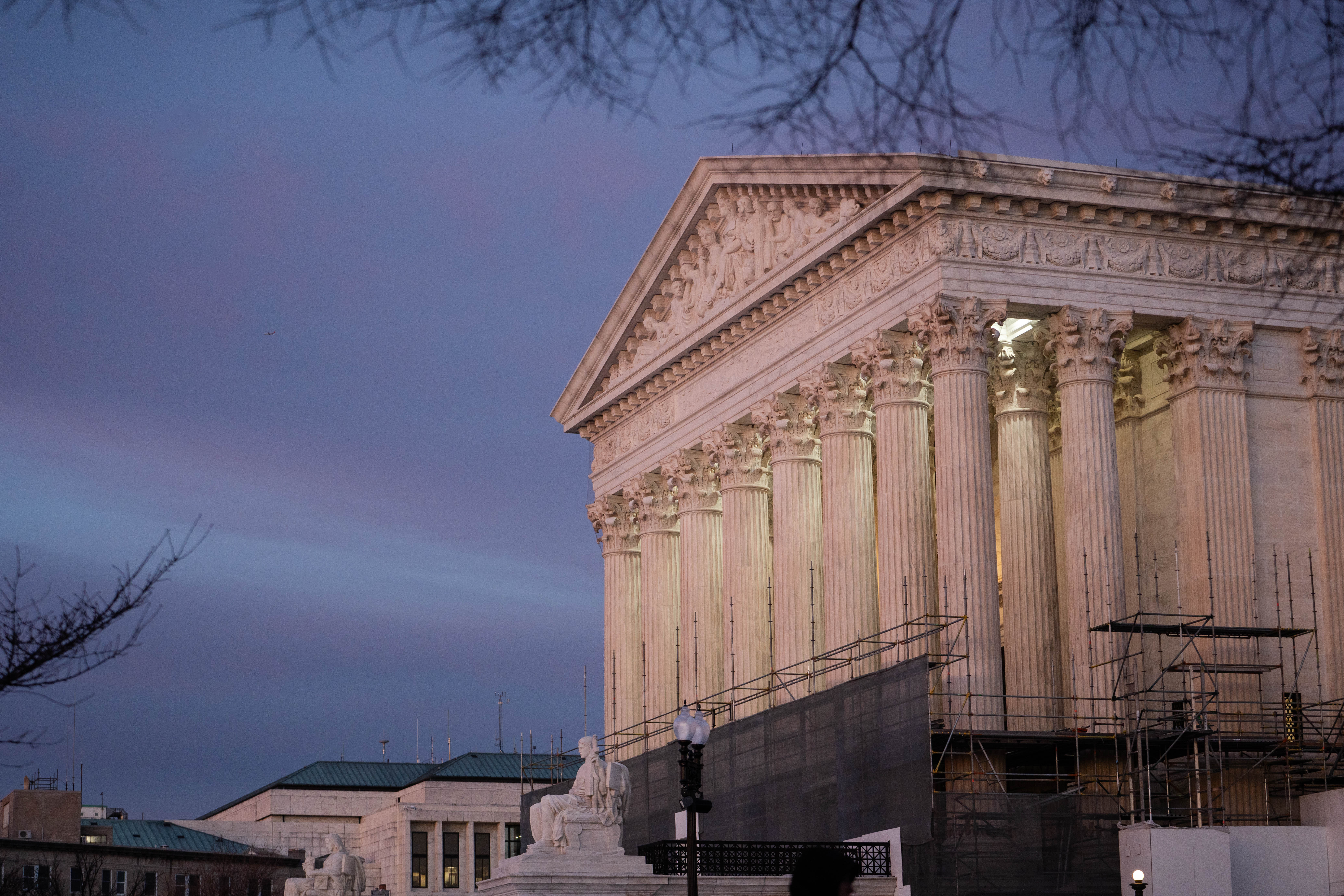
The Supreme Court seemed poised on Jan. 21 to allow Federal Reserve board member Lisa Cook to remain in office despite the president’s attempt to fire her.
President Donald Trump alleged that Cook engaged in mortgage fraud that disqualified her from having so much control over monetary policy. After a lower court blocked his attempt to fire Cook, Trump filed an appeal that eventually made its way to the Supreme Court.
It arrived on the Supreme Court’s emergency docket, meaning that the justices considered a more tentative decision that would cause Cook to either remain in place or leave as additional litigation unfolded.
During oral arguments on Jan. 21, the justices considered a wide range of questions, such as whether Cook received due process and how their decision would affect the economy.
Here are the main takeaways.
Signals Sent by Decision
In emergency docket cases such as this one, the Supreme Court generally does not issue final rulings on narrow legal questions. Instead, it weighs multiple factors, such as who is most likely to win the underlying legal argument and who would be most harmed by its decision as litigation continues.
One of those factors—whether the decision is in the public’s interest—was mentioned by multiple justices.
“We have amicus briefs from economists who tell us that if ... we grant you your stay, that it could trigger a recession,” Justice Amy Coney Barrett told Solicitor General D. John Sauer. “How should we think about the public interest in a case like this?”
She appeared to be referring to briefing from experts who indicated that the Supreme Court’s decision could disrupt the economy by undermining the perception of the Fed’s independence.
“We know that the independence of the agency is very important, and that that independence is harmed if we decide these issues too quickly, and with not due consideration,” Justice Sonia Sotomayor told Sauer.
“So, waiting, to me, to have at least the lower courts look at these issues first makes the most sense to the public’s confidence and to the world’s confidence about the due process of law.”
Federal Reserve’s Independence
The Jan. 21 oral arguments were just the latest flashpoint in ongoing legal battles over Trump’s attempts to fire prominent public officials. Although the justices have
indicated a willingness to back Trump’s firings for certain agencies, they seemed more
reluctant when it came to the Federal Reserve.
As the U.S. central banking system, the Federal Reserve sets monetary policy with impacts that ripple through the economy. The hearing came after Trump publicly disagreed with Fed Chairman Jerome Powell over that policy. Meanwhile, the Justice Department started investigating Powell over his Senate Banking Committee testimony in June 2025 concerning the renovation costs for the Federal Reserve office buildings.
During oral arguments, Justice Brett Kavanaugh suggested that the Justice Department was proposing a legal theory that would make it too easy to fire governors such as Cook. More specifically, he suggested that Sauer was not allowing enough judicial checks on the president’s firings.
“That would weaken, if not shatter, the independence of the Federal Reserve,” Kavanaugh said.
Concerns About ‘Hurried’ Process
Justice Samuel Alito suggested that the process had rushed forward after allegations surfaced that Cook may have committed mortgage fraud before joining the Fed.
“When this was before the executive branch, it was handled in a very cursory manner,” he said. After that, the case progressed in a “hurried manner,” and was “being handled by everybody,” including the executive branch, the federal district court, and the U.S. Court of Appeals for the District of Columbia Circuit, he said.
Although Sauer offered a factual basis for Cook’s removal, Alito said, “No court has ever explored those facts.”
Justice Ketanji Brown Jackson suggested to Paul Clement, an attorney for Cook, that his client was entitled to some kind of determination of the facts of the case, and that that had not happened. A hearing was needed to establish the facts, such as when Cook signed the mortgage applications and what she thought she was agreeing to, Jackson said.
Barrett told Sauer that the government had already “spent a lot of time litigating [Cook’s] case” and suggested that it might have been better to have put those resources into holding a hearing on her removal.
What Kind of Hearing Is Required?
Justice Neil Gorsuch asked Sauer what kind of hearing Cook would be entitled to, should the Supreme Court find that she is entitled to one.
Gorsuch asked whether it would be legally sufficient to summon Cook to the Roosevelt Room of the White House, allow the presentation of evidence by a lawyer, and then render a decision.
Sauer said in that situation that it would be “entirely” up to the executive branch to decide how to conduct such a hearing. The fact that the word “cause” appears in the Federal Reserve Act does not mean that Cook was entitled to a notice and a hearing, he said. He said that if Congress wanted to create such a requirement, it could have said so.
Justice Elena Kagan asked Sauer whether his position is that there is no notice and hearing requirement, and that all the president must do is inform Cook that she is fired.
Sauer said the president still had to provide a cause and that it had to relate to Cook’s conduct, fitness, sufficiency, or competence.
“We concede it cannot be for policy disagreement—or for no reason at all or at will,” Sauer said.
Chief Justice John Roberts asked Sauer why, if the government is correct in saying that the courts lack the authority to reinstate a removed officer such as Cook, the justices were wasting their time “wondering if there’s cause or not.”
Sauer said he shared that concern, noting that since 1789 the courts have recognized that the president has the power to order interim or suspensory removals.