
WASHINGTON—A federal judge said on Dec. 16 that he is unlikely to block President Donald Trump’s plan to build a 90,000 square-foot ballroom on White House grounds, at least for now.
U.S. District Judge Richard Leon told the court that the violation of the plaintiff’s procedural right to comment on the plans was probably not enough to show irreparable harm, and did not justify the request for a temporary emergency block.
Leon told the court he was reserving judgement about the merits of the case and plans to hold the government accountable for its assertion that it will confer about the construction with the proper agencies within the next two weeks.
“Let me assure you something: The court will hold them to that,” he told the plaintiff’s attorneys. “They’ve got till the end of this month.”
The National Trust for Historic Preservation in the United States, a private nonprofit that promotes public input on changes to the “nation’s architectural heritage,” has alleged that the president skipped procedural requirements by demolishing the East Room structure to build the new ballroom.
The organization said federal statutes required the Trump administration to submit its plans to the Committee on Fine Arts, the National Capital Planning Commission, and Congress before breaking ground.
Trump has touted the new ballroom for months, saying the East Room—the largest gathering room in the White House—is in poor shape. The government also stated in court documents that the ballroom is inadequate for large-scale White House events, which instead are held on the lawn, under tents.
The issue is not the construction of the new ballroom, an attorney for the plaintiffs said during a hearing in the District of Columbia on Tuesday.
“It’s about the need to follow the law if you want one,” he said.
National Trust points to laws including 40 USC 8106, which says “a building or structure shall not be erected on any reservation, park, or public grounds of the Federal Government in the District of Columbia without express authority of Congress.” It also alleged that the administration did not publish an environmental impact study as required by law.
The suit, filed against Trump and the heads of agencies such as the National Parks Service and Department of the Interior, asked the court to block further construction on the project until approval and public comment have been secured.
It also asked the court to declare that Trump violated separation of powers by skipping congressional approval.
The government has responded that the suit is irrelevant.
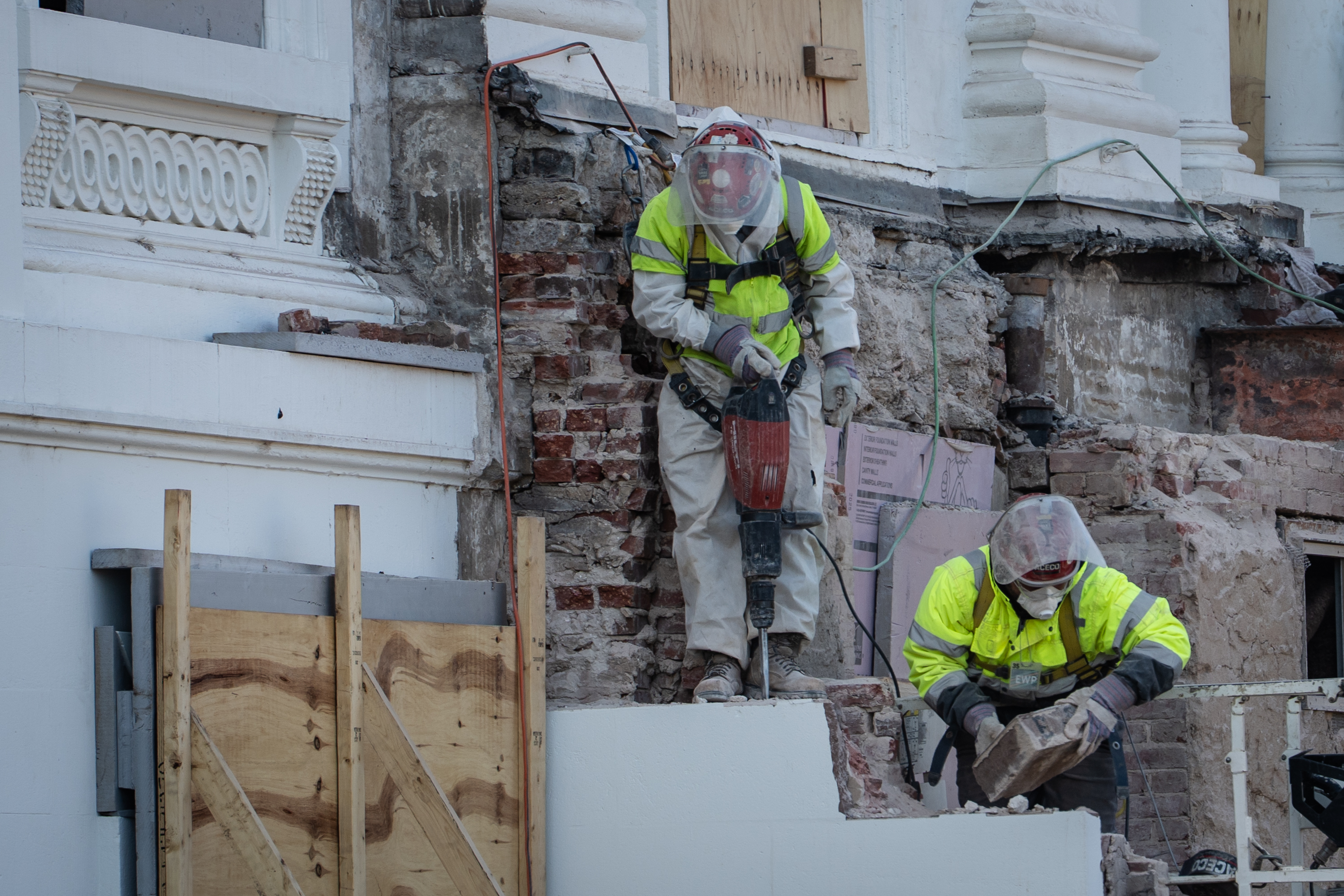
“Plaintiff’s claims concerning demolition of the East Wing are moot because the demolition has already occurred and cannot be undone,” the Trump administration wrote it its response.
“The President possesses statutory authority to modify the structure of his residence, and that authority is supported by background principles of Executive power.”
The government said it intends to consult with the National Capital Planning Committee once its plans are finalized, so court involvement is unnecessary. Trump is in the process of replacing members of the Commission of Fine Arts, after firing the previous panel in October, but they will also be consulted.
Matthew Quinn, deputy director of the Secret Service, has submitted a declaration to the court saying that the contractor for the project has not finished installing “temporary security measures,” and a halt to the construction would pose a security risk.
Leon said he would hear arguments on the matter in January and that if the administration did any more construction between now and then, “they should be prepared to take it down” as it might violate the plaintiff’s rights.