Artistic talent seems to run in the veins of some families. One was the Morans.
The artists in the Moran family included four brothers, their spouses, and their children. The son of one of the Moran sisters, Elizabeth Moran Ferris, was inspired not only by his father but by his creative uncles.
Jean Leon Gerome Ferris (1863–1930) would produce the most complete collection of paintings documenting American history.
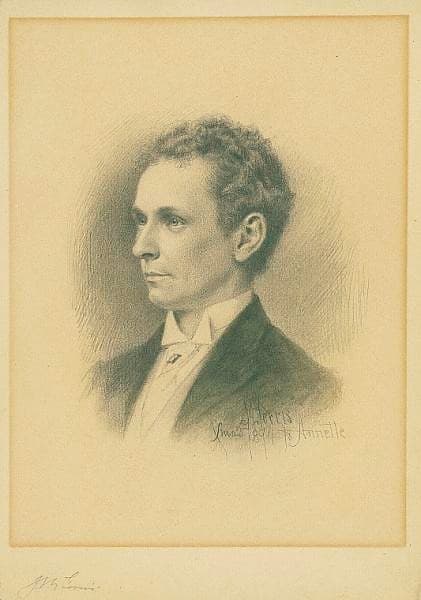
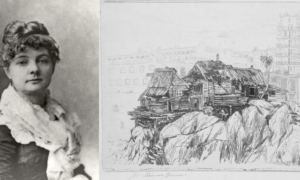
A portrait of Jean Leon Gerome Ferris, 1894, by Stephen James Ferris. Drawing. (Public Domain)
Jean was born Aug. 8, 1863, in the distinctly American city of Philadelphia. His father, Stephen James Ferris (1835–1915), painted and did portrait etchings; he also had a large print collection.
Stephen named his son after French painter and sculptor Jean-Léon Gérôme, with whom he had studied in Paris.
As Jean’s first teacher, his father trained him in engraving. In 1879, 16-year-old Jean was enrolled at the Pennsylvania Academy of Fine Arts, where he studied with French painter Christian Schussele (1824–1879). His father and some uncles also studied and later taught there.
When Jean was a boy, his father took him on trips abroad to supplement his education in art. In Europe, young Jean observed the work of the finest artists, past and present.
After graduating from the Pennsylvania Academy of Fine Arts, Ferris studied formally in Europe, traveling to Paris in 1884. He studied with William-Adolphe Bouguereau (1825–1905) at the Académie Julian.
While in France, he also met his namesake, Gérôme. Although the famous French artist didn’t take him on as a student, he offered him valuable advice, which would shape his future career. While in Europe, Jean also studied at the South Kensington School in London.
Developing His Career
After concluding his studies in Europe, Jean returned to the United States and began establishing himself as a painter in the popular genre of Orientalism. Jean called himself J.L.G. Ferris professionally.
His early works display this style, as the subjects were from the Middle East and Far East, reflecting romantic imagery straight out of the “1001 Arabian Nights.” The artist later dismissed these early paintings as studies in technique rather than masterpieces of subject matter: “I had been painting genre pictures which were practically only studies in technique from the living model simply to acquire facility of execution, with no subject worthy of mention.”
Nevertheless, the artistic training and eye which these Orientalist paintings demonstrated gained him the beginning of a reputation as an artist. In 1882, even before his European studies, Jean displayed an Orientalist oil painting, “Feeding the Ibis,” which was priced at $600. Later, his Orientalist paintings were displayed at the Pennsylvania Academy of Fine Arts in 1887, 1888, and 1890.

“The Landing of William Penn,” by Jean Leon Gerome Ferris. Ferris's portrait depicting the New Castle, Delaware landing by William Penn, the founder of the Province of Pennsylvania. (Public Domain)
Ironically, Ferris didn’t build his career on selling paintings. When he sold his historical painting “General Howe’s Levee, 1777” in 1898, the 35-year-old artist was distressed at having to part with it.
This wasn’t due to a sentimental connection to his work. His dream was to produce a collection of paintings on American historical subjects. This goal could only be accomplished, he surmised, if the paintings remained together. Thus, he vowed not to sell any more of his American history paintings. Instead, he supported himself by making book and magazine illustrations, creating unrelated historical paintings, and selling the reproduction rights to his works, which produced prints and postcards of the pictures. These low-priced prints made Jean’s work very accessible to and popular with the masses in the first few decades of the 1900s.
‘The Pageant of a Nation’
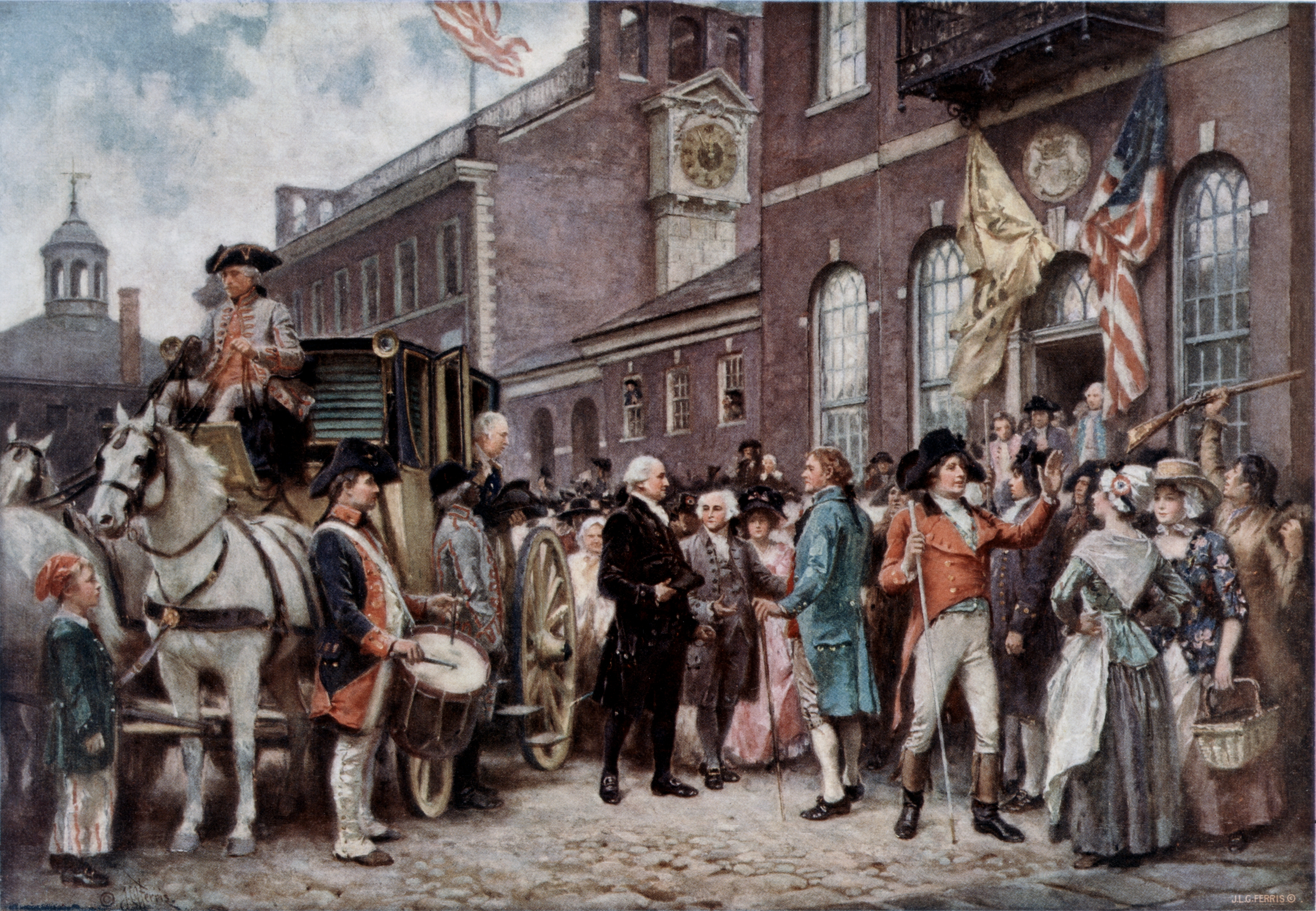
In the early years of the 20th century, Jean produced 78 oil paintings depicting important moments in American history, dating back to the discovery of the New World in 1492. This is the largest collection of American historical paintings produced by one artist.
Jean was largely inspired to create this impressive collection by advice which Gérôme had given him as a young art student. Jean recalled, “His axiom was that one would paint best that with which he is most familiar, and he strongly discouraged the habit of so many American artists to imitate blindly European methods and subjects.”

“The First Thanksgiving 1621,” 1912, by Jean Leon Gerome Ferris. (Public Domain)
In producing this huge body of paintings, Ferris showed amazing dedication. He noted that “the attendant difficulties” for American figure painters in producing works with historical subject matter “seemed insurmountable,” namely the “lack of patronage, that most essential thing.” Although the reproduction rights made this project more financially feasible, that paled in comparison to the idea of having them displayed together.
That dream was realized in 1913, when the complete collection was put on display in Philadelphia’s Independence Hall. It was displayed there until 1930, the year of the painter’s death. It was then moved to nearby Congress Hall “as a loan to the city … under agreements that forbid it being scattered.” Doubtless because of this condition, Jean’s heirs failed to secure future display opportunities, so the paintings have been in storage.
A Colorful American History
While many websites display a portion of the collection, the most complete record seems to be a YouTube video, which features all 78 paintings in chronological order of subject matter, along with extra American historical paintings at the end.
The paintings show not only famous public events but also deeply personal and human moments in the lives of America’s greatest leaders. They include George Washington, Benjamin Franklin, and Abraham Lincoln.
Although the series concludes in the mid-1860s with the end of the Civil War, there are two later subjects: “A Word to the Kaiser” (1902) and “Sunk Without a Trace” (1917). These last two paintings were produced later than the rest and added to the collection after 1917, since Jean continued painting until the end of his life.
The legacy of any American artist who distinguishes himself for his talent and technique is a valuable contribution to his nation. Jean took this patriotic duty a step further by dedicating the better part of his career to creating a beautifully vivid and colorful account of America’s most important historical scenes.
His artistic contribution is a very important part of the American Renaissance, a movement that studied and celebrated the United States’ glorious past.
What arts and culture topics would you like us to cover? Please email ideas or feedback to features@epochtimes.nyc.