
Some 100 miles off the Chinese coast, the democratic island of Taiwan has existed for decades under a creeping communist shadow.
Deeming it a breakaway province, the Chinese Communist Party (CCP) has been steadily asserting control over the island, bullying it with military jets and simulating what Adm. Samuel Paparo, commander of U.S. Indo-Pacific Command, calls “dress rehearsals” for attack.
But as the world fixates on how and when Beijing will make its move, inside Taiwan, the battle is already on. It’s a war without gunfire.
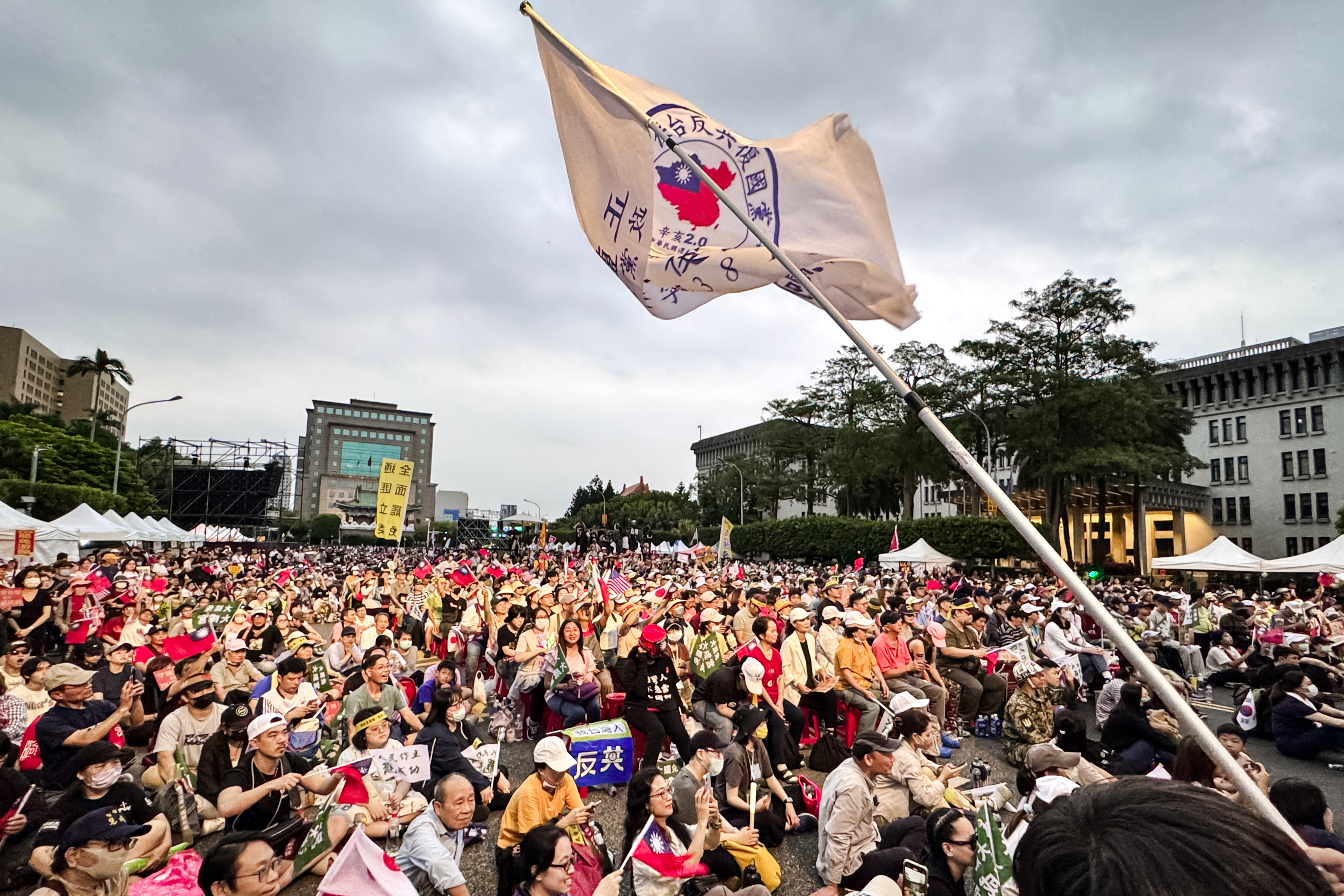
Over the past few months, a grassroots movement has swept through Taiwan, aiming to remove dozens of lawmakers from a political party seen as selling out the nation’s interests to Beijing. Ultimately, two-thirds of the targeted politicians survived a recall vote on July 26, an outcome that the movement’s leaders and analysts say only underscores the depth of CCP infiltration.
The legislators are members of the opposition Kuomintang Party (KMT), known today for its pro-Beijing leaning. Leading a slim majority in the legislature, the party provoked backlash after a series of unpopular moves: slashing Taiwan’s defense budget, striking down bills that aimed to counter threats from China, and forcing through changes to expand the party’s legislative power despite mass protests. When the power grab failed in court, the KMT-led coalition imposed a procedural rule that effectively paralyzed the Constitutional Court of Taiwan.
Public anger boiled over in January, with defense spending cuts the final straw. Calls to flip the legislature, dubbed the Great Recall, bubbled up throughout Taiwan. One rally calling out communist influence drew tens of thousands of people to the streets. Approximately 1.3 million Taiwanese signed petitions to unseat one-fifth of the island’s lawmakers, all of whom are members of the KMT, in order to transfer more power to the ruling Democratic Progressive Party, which is more aligned with Western interests.
Recall advocates faced an uphill battle as they attempted to take down officials in their respective strongholds. It was an unprecedented action in Taiwanese history, where only one Taiwanese lawmaker had ever been recalled.
Although the campaign was a “tactical defeat” on its own, on a grander scale, it was a “strategic victory,” said Miles Yu, a China policy adviser in the first Trump administration.
By taking the issue to the ballots, he said, voters forced KMT lawmakers to defend themselves and clarify their stance on China, and that has shifted the discourse.
“The baseline right now is really about whether you’re anti-communist or you are CCP-friendly,” he said on the “China Insider” podcast, which he hosts as director of the China Center at Hudson Institute.
Yuan Hongbing, an exiled Chinese legal scholar with insider access to Beijing’s top rung, said the turn of events represents an “awakening.”
In the face of tyranny and coercion from the Chinese regime, Taiwanese society is fighting back, he told The Epoch Times, calling the situation an “unprecedented battle.”
The KMT has tried to shake off the pro-Beijing label. It acknowledges the importance of strong defenses but continues to engage with mainland China, arguing that dialogues are crucial to calming tensions and promoting mutual benefits.

The legislators of the Democratic Progressive Party protest against the opposition Kuomintang Party and Taiwan People's Party over legislative reforms in Taipei, Taiwan, on May 21, 2024. The protest centered on alleged foul play and a lack of debate over reforms that would give the legislature greater powers of scrutiny over the government. (Annabelle Chih/Getty Images)
‘The Territory That the CCP Most Vies For’
The democratic island is small, about the size of Maryland, but it plays an outsized role in the global economy, churning out more than 90 percent of the world’s most advanced chips, according to the U.S. International Trade Commission.
By some measures, Taiwan ranks among the freest societies in the world, a stark contrast with mainland China, where the CCP rules with an iron fist and punishes anyone deemed a challenge to its power.
But that freedom is increasingly under assault.
Besides conducting near daily military harassment and live fire drills around Taiwan, Beijing has been intensifying a quieter attempt to penetrate the island from within.
Since 2020, Taiwan has prosecuted 159 individuals for allegedly spying for China. Among them were 95 current or retired soldiers. With money in one hand and sticks in the other, the Chinese regime has secretly groomed informants from deep inside Taiwan’s government to feed intelligence back to China and readily open the doors to the enemy when Beijing strikes, warned Taiwan’s National Security Bureau.
In March, Taiwanese President Lai Ching-te declared mainland China a “foreign hostile force,” describing the regime’s extensive campaign to “divide, destroy, and subvert us from within.”
He unveiled 17 countermeasures, including a stricter review process for visiting Chinese nationals, disclosures for cross-strait exchanges involving Taiwanese public officials, and clearer conduct guidelines for actors and singers working in China.
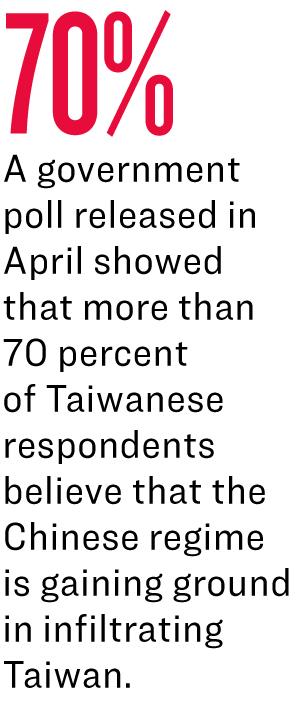
A poll released in April by Taiwan’s Mainland Affairs Council, an administrative agency responsible for handling China affairs, showed that more than 70 percent of approximately 1,100 Taiwanese respondents believe that the Chinese regime is gaining ground in infiltrating Taiwan.
They have also recently watched CCP authorities tighten their grip on the once free-spirited Hong Kong not far away.
“Of all places in the world, Taiwan should be the staunchest against the Chinese Communist Party,” Taiwanese social media influencer Wen Tzu-yu told The Epoch Times.
“Taiwan is the territory that the CCP most vies for.”
Taiwan is a centerpiece in the first island chain, the barrier against the Chinese regime’s military aggression in the Indo-Pacific and beyond.

Taiwan’s Secretary-General of the National Security Council Joseph Wu (2nd L), President Lai Ching-te (C), and Minister of National Defense Wellington Koo (3rd R) pose with army officers in front of a U.S.-made Abrams tank in Hsinchu, Taiwan, on July 10, 2025. Taiwan’s Defense Ministry is tightening restrictions on access to military intelligence for service members with China ties amid concerns about Chinese Communist Party infiltration. (I-Hwa Cheng/AFP via Getty Images)
Conquering Taiwan would be the first step in a CCP campaign to take on the United States, according to Wen, who has become the face of the recall movement targeting KMT pro-Beijing lawmakers.
Yuan holds the same view.
“Annex Taiwan, and the CCP would have a gateway to expand its communist authoritarianism,” he said. “The fate of Taiwan is consequential to everyone in the 21st century.”
If Taiwan were to fall, the rest of the world, including the United States, would become more susceptible, said Rep. Nathaniel Moran (R-Texas), who sits on the House Select Committee on the CCP.
“Taiwan is absolutely a testing ground,” he told The Epoch Times. “We have to be with Taiwan every step of the way—we cannot falter in that.”
Lessons From Hong Kong
Wen said his efforts against CCP influence are motivated by the regime’s broken promise regarding Hong Kong.
Eight years ago, Wen briefly contemplated a career in mainland China. After graduating from college, he went on an all-expenses-paid trip to China to compete in a film competition, winning the third-place prize. Around him, Chinese state companies and major media platforms extended dazzling offers designed to woo Taiwanese such as him. He nearly took the bait, he said, but was glad he didn’t.
Two years later, in 2019, protests erupted in Hong Kong as millions of people resisted a bill allowing extraditions to mainland China. As the former UK colony struggled to fend off Beijing’s encroachment, Wen saw the perils that lay ahead for his homeland, and just how close he had come to becoming a tool for the CCP propaganda machinery—one of the “useful idiots,” he said.
Wen is now known as Pa Chiung on YouTube, with 1.2 million subscribers who watch him pan Chinese propagandists and “CCP bootlickers.”
“No one was out there to warn me at the time,” he said.
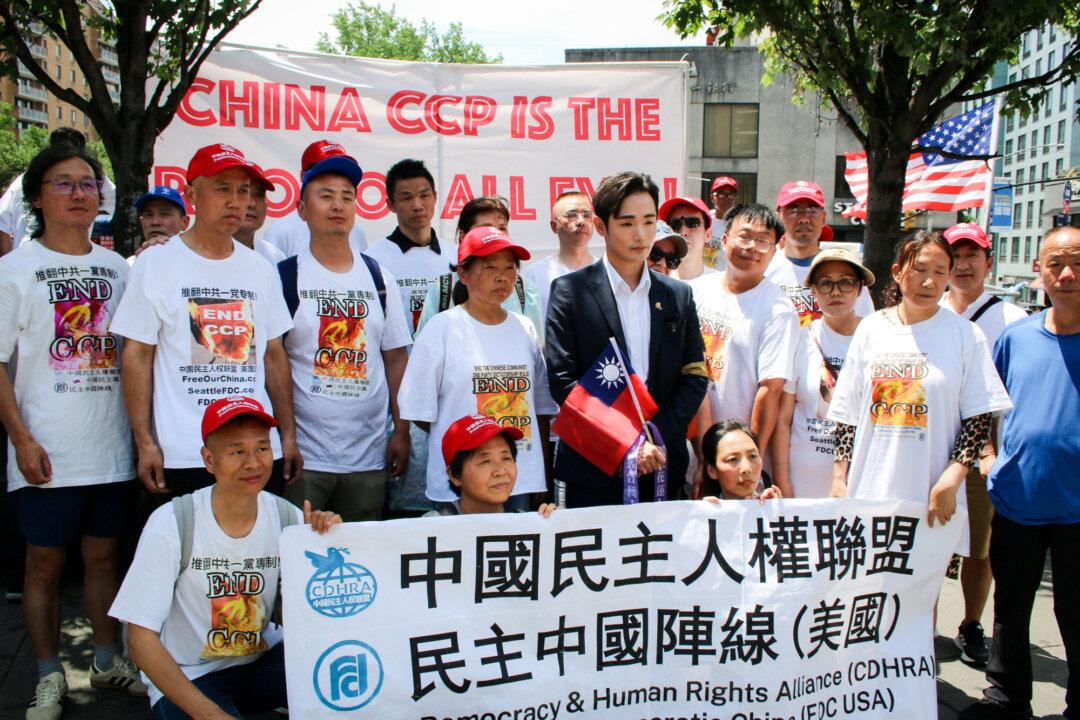
Wen Tzu-yu, a Taiwanese YouTuber known as Pa Chiung, participates in an anti-Chinese Communist Party rally in the Flushing neighborhood of Queens in New York City on June 29, 2025. Wen called Taiwan “the territory that the CCP most vies for” in a recent interview with The Epoch Times. (Edwin Huang/The Epoch Times)
‘Taking Taiwan With the Lowest Cost’
Despite the KMT’s warmer relationship with Beijing, it was once the mortal enemy of communist forces attempting to overthrow KMT’s rule; the two sides fought a fierce civil war. A decade into the war, in 1937, Japan invaded, giving the weaker communists a chance to rise while the KMT was distracted by the external foe.
Japan surrendered in 1945, but by then, the KMT had few reserves left to fend off CCP leader Mao Zedong’s communists when civil war resumed. In 1949, a KMT general was persuaded to open the gates of the capital, then known as Beiping, without a fight, cementing the CCP’s victory and leading the KMT to retreat to Taiwan.
That takeover became the “Beiping Model,” the template that a Chinese general has referred to as the most desirable way to “resolve the Taiwan issue.”
Then and now, Beijing relies on one of its “magic weapons,” the United Front Work Department, which hides its hand behind a broad network of state and non-state actors in a global operation to direct, buy, or coerce influence. For years, it ran some 100 secret police stations in more than 50 countries. Through individuals embedded in the Chinese diaspora and sometimes within Western governments, it harasses dissidents, tarnishes critics, and manipulates policies to its favor.
One recent high-profile Taiwanese victim of intimidation was Vice President Hsiao Bi-khim. During Hsiao’s 2024 visit to Prague weeks before taking office, a Chinese diplomat tailed her and attempted to ram her motorcade, an act that Taiwan’s Mainland Affairs Council likened to “acts of political terror.”
As Taiwan’s biggest trading partner, China has repeatedly wielded economic leverage as a weapon. It has blocked agricultural products while making deals with select KMT-represented regions, putting the heat on Lai and his Democratic Progressive Party.
The CCP’s United Front also punishes Taiwanese businesses in China for stepping out of line, organizes pilgrimage visits for Taiwanese with mainland ancestry to tighten emotional bonds, entices Taiwanese celebrities to speak in Beijing’s favor, installs eyes and ears in key Taiwanese state and civil sectors, and poaches Taiwan’s diplomatic allies to isolate the island internationally. In the weeks leading up to Taiwan’s 2024 elections, more than 100 village chiefs from the island took Beijing-sponsored trips to China, triggering election interference concerns.
The Chinese regime also cultivates political parties to spread its messaging. In January, Taiwan’s Ministry of the Interior asked the Constitutional Court to disband the China Unification Promotion Party, founded by crime syndicate boss Chang An-lo, on the grounds that the party was acting at the behest of the CCP. Prosecutors accused a couple affiliated with the party of spreading Chinese propaganda in exchange for cash, and sentenced another three people in March for recruiting military spies.

Crime syndicate boss Chang An-lo (C), leader of the China Unification Promotion Party, chants with supporters during the inauguration of Taiwanese President Tsai Ing-wen in Taipei, Taiwan, on May 20, 2016. In January, Taiwan’s Interior Ministry asked the Constitutional Court to disband the party, alleging that it acted at the behest of the Chinese Communist Party. (Isaac Lawrence/AFP via Getty Images)
“I don’t think enough people, though, are educated on this facet of how the PRC works,” Michael Studeman, former commander of the U.S. Office of Naval Intelligence and a retired Navy rear admiral, said at a July congressional hearing, using the acronym for People’s Republic of China.
“This is all-spectrum, all the time, all domains. It’s more insidious than we want to give it credit [for].”
The end goal, Studeman said, is to erode the Taiwanese public’s will so that it acquiesces to—or embraces—a future under mainland Chinese rule.
Compared with sending soldiers or firing off missiles, this less visible campaign has clear advantages, said Wang Shiow-wen, an assistant research fellow with Taipei-based military think tank Institute for National Defense and Security Research.
By using this tactic, she told The Epoch Times, the CCP is attempting to take Taiwan “with the lowest cost.”
‘Frog in Boiling Water’
The Chinese regime’s elaborate effort to lure the Taiwanese was outlined in a documentary Wen released in December 2024, featuring a former pro-Beijing figure, Taiwanese rapper Chen Po-yuan.
Feigning interest in a Chinese venture, Chen flew to the nearest Chinese province, Fujian, and through his mainland connections, met with a Taiwan-born man who had pocketed the equivalent of a $70,000 state subsidy to run a startup incubator targeting Taiwanese influencers.
The man flashed his mainland residency card, then quickly warned Chen to not publicize the fact because he was breaking a Taiwanese law in procuring it. The card comes with many perks for the Taiwanese, and he told Chen that he could get him one like it in a month. The man had office space and subsidized housing for anyone willing to make videos boosting the regime’s image.
He promised tens of thousands of dollars in venture funds.
“They go step by step,” Chen told The Epoch Times. “They start off simple, giving you a bit of money for some normal travel promotion.”
But once one gets a taste of it, the handlers may press further. Sooner or later, the influencers have to check their behavior and toe the Party line, he said, likening the situation to a “frog in boiling water.”
The documentary, upon release, quickly racked up millions of views.
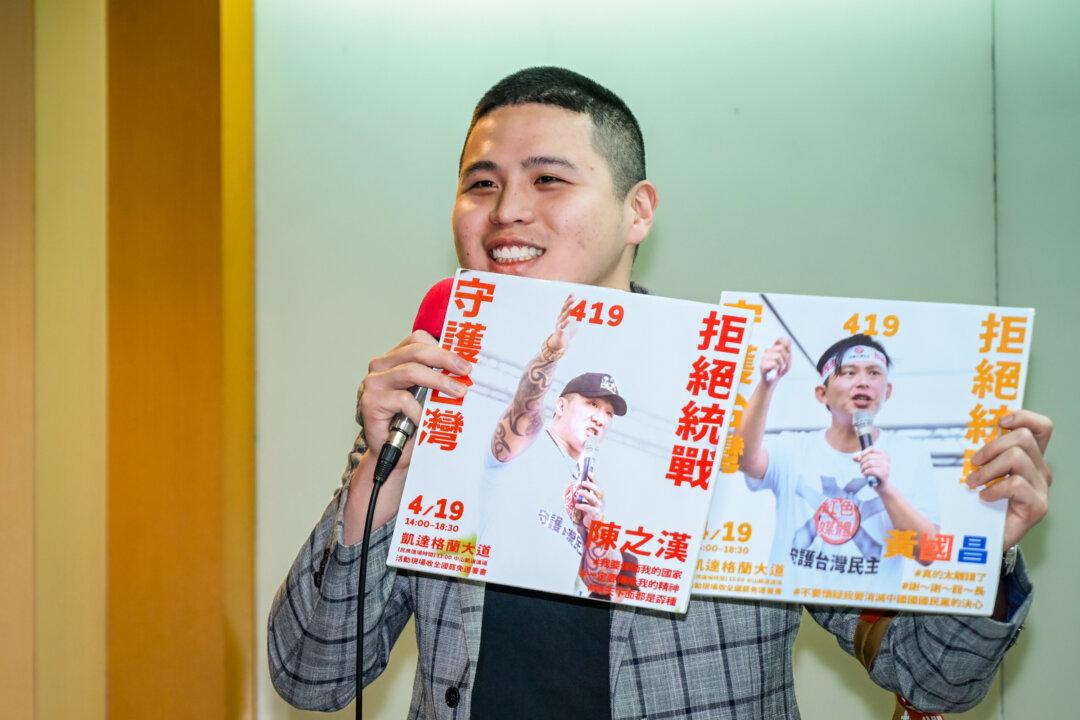
Chen Po-yuan, Taiwanese rapper, invites people to attend an upcoming pro-recall rally in Taipei, Taiwan, on April 17, 2025. (Sung Pi-lung/The Epoch Times)
Chen knew the CCP playbook firsthand. Born in 1999, he learned martial arts at China’s Shaolin Temple at age 13 and later enrolled in Huaqiao University, a school for overseas students overseen by the United Front Work Department. The propaganda was so successful that Chen considered himself a Chinese patriot. His cellphone’s background wallpaper was a picture of Chinese leader Xi Jinping.
After graduation, he stayed in China, often writing songs to order that varied from combating fraud to expressing political loyalty. One of the highest-paying orders came from a Chinese official, who requested a song attacking then-U.S. House Speaker Nancy Pelosi (D-Calif.). Pelosi was making a trip to Taiwan, the highest-level U.S. official to do so in a quarter century. The official handed Chen a stash of cash that amounted to roughly $4,000.
But the income stream did not last. Two years after China’s Taiwan Affairs Office praised Chen for a hit song endorsing Beijing’s COVID-19 pandemic control measures, he said he was conned by his business partner, the son of a state-affiliated Taiwanese group leader in China, and lost all his investment money. No one stood up for Chen.
Reality Bites
Three men named in the viral film for holding dual identities have since lost their Taiwanese status. In a wider investigation that followed, Taiwan’s Defense Ministry cut off military intelligence access to dozens of active-duty military members for also holding residency permits in China. Taiwan’s immigration officials also deported three Chinese influencers who immigrated through marriage, citing their videos supporting China’s military unification of the territory.
While Chinese authorities have touted the mainland as “wonderful, advanced, and safe,” a place that the Taiwanese would want to return to repeatedly, the regime has also been quick to turn its back on its supporters once their value has dried up.
Zhao Chan, better known by her online alias Xiaowei, is one of the three mainland Chinese forced to return to China.
In a twist of irony, three months after going back to her hometown in China’s Guizhou Province, Zhao found herself going head-to-head with village officials. The state-run reservoir had flooded parts of the village, and she was entitled to damage compensation, she said. After a fruitless back-and-forth, she aired her grievances online, only to see her videos deleted. The police woke her up with a midnight phone call, warning her to not step out of bounds.
What happened to Zhao could happen to anyone, said Xiaofang, a mainland Chinese who lived in Taiwan for three decades after getting married.
“A lot of people think if they toe the Communist Party line, the CCP will give them special favors—it’s simply impossible,” she told The Epoch Times.
Such people, she said, “don’t understand the true nature of the Chinese Communist Party.”
It is easy to fall into the trap, said Rep. Carlos Giménez (R-Fla.). The United States has long thought China “benign” and has only belatedly “woken up” to the reality, he told The Epoch Times.

Rep. Carlos Giménez (R-Fla.) speaks during an interfaith roundtable on the Chinese Communist Party's threat to religious freedom in Washington on July 12, 2023. (Madalina Vasiliu/The Epoch Times)
“The Chinese have a way of painting a really nice picture of who they are, but it’s all a facade—you’ve got to look behind the wall and look behind the curtain to see the reality of what China really is,” Giménez said.
“I’m sure that there are some Taiwanese who feel like, ‘Wow, we should all be one China.’ I’m sure they’re in there. But then you do so by giving up your freedom.”
‘Can’t Let This Go’
Wen said he is readying himself for the worst: the day when he might need to pull the trigger in the battlefield.
Because of the strict gun restrictions in Taiwan, he drills at a gun range in the United States.
“It’s a day I’m preparing for every moment, even though I don’t want it to ever come,” he said.
But his chief focus is the here and now.
Since the documentary came out, the Taiwan Affairs Office in Beijing has named Wen three times in press briefings. It has labeled him—and other vocal critics of the CCP in Taiwan—as “anti-China,” and has vowed retaliation.
Wen is unmoved.
“They intentionally confuse China with the Chinese Communist Party,” he said. “I’m not anti-China, I’m anti-CCP.”
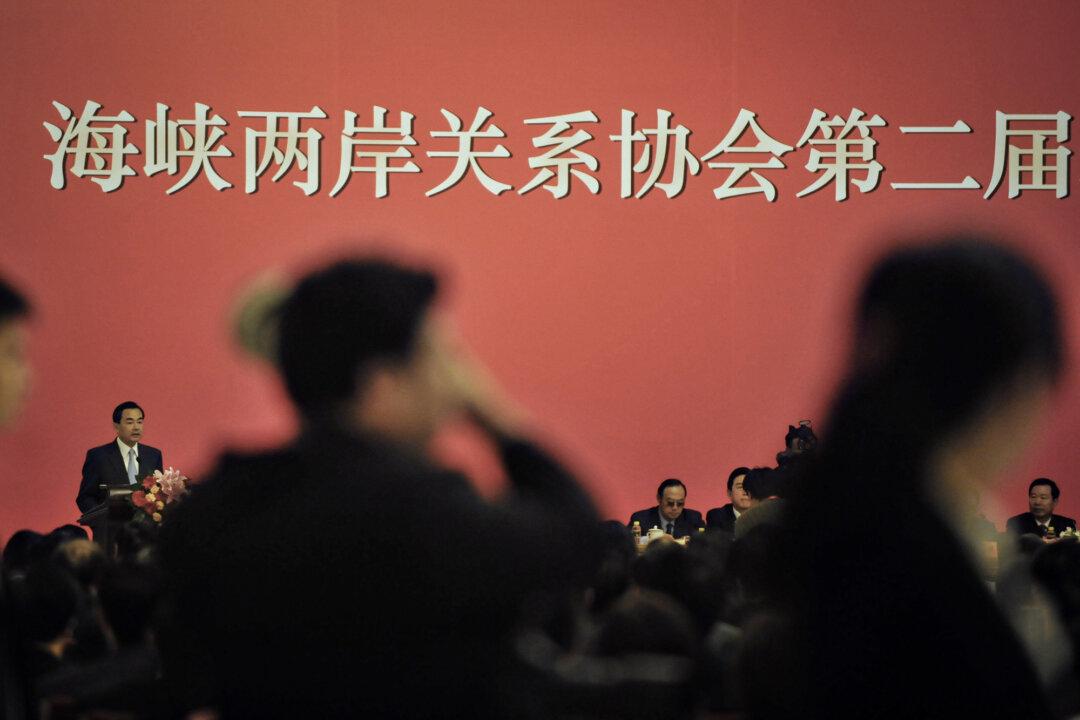
Wang Yi (L), head of China's Taiwan Affairs Office of the State Council, speaks during the second session of the cross-strait relationship governing council at the Great Hall of the People in Beijing on June 3, 2008. (Frederic J. Brown/AFP via Getty Images)
He has received death threats via email, an increasingly common tactic of regime-backed actors targeting the Chinese dissident community. Trolls comment on Wen’s videos, making personal attacks on him in simplified Chinese characters and using bots to amplify the posts.
Wen simply pins the most provocative comment on top.
“It’s just hilarious,” he said. “The comment may have 1,000 likes, but underneath, all the replies are negative.”
Chinese nationalists have posted clips of the documentary on Douyin, China’s version of TikTok, and lampooned him. Wen said he is proud of it. People who never heard of him may get curious and circumvent China’s censorship wall to check him out. And if he can make even a handful of people become “clearheaded,” he said, he will have succeeded.
Wen admitted to feeling tired but said he “just can’t let this go.”
“Just look at Hong Kong,” he said. “I don’t want Taiwan to become like that.”
Luo Ya and Fei Chen contributed to this report.