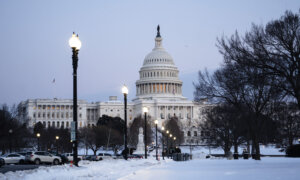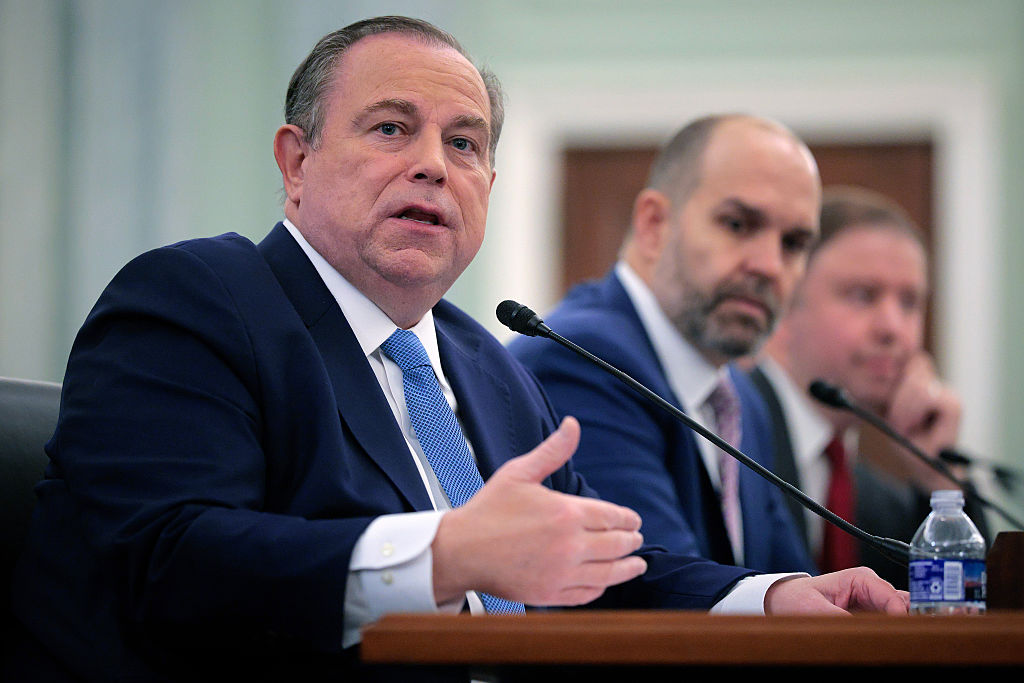

Television industry leaders appeared on Capitol Hill on Feb. 10, joining lawmakers in debating how a federal limit on station ownership impacts both competition and costs to consumers.
The Federal Communications Commission (FCC) is currently reviewing its “ownership cap,” which prohibits companies from owning stations that collectively reach more than 39 percent of all households with televisions.
During a hearing before the Senate Commerce Committee, Newsmax CEO Christopher Ruddy defended the cap and urged against further consolidation, as National Association of Broadcasters President Curtis LeGeyt described it as outdated.
The hearing underscored a central divide: whether broadcast consolidation is a necessary tool to survive a fragmented, tech-dominated media landscape—or a threat to local news, consumer costs, and democratic discourse.
The cap came under scrutiny after the Trump administration approved a merger between broadcasters TEGNA and Nexstar. Lawmakers and witnesses debated whether loosening the cap would help local broadcasters compete with Big Tech and streaming platforms or further consolidate media power and weaken local journalism.
FCC Chairman Brendan Carr said in a statement that he is for lifting the cap. He previously told a congressional subcommittee that the FCC is looking at whether only Congress has the authority to lift the cap.
Ruddy warned on Feb. 10 that further consolidation would reduce viewpoint diversity, merge local newsrooms, raise cable costs through retransmission fees, and allow a few companies—particularly Nexstar, which owns cable news outlet NewsNation—to control most local TV news. He argued that the cap was set by Congress and cannot be changed by the FCC without new legislation, and that consolidation historically has hollowed out local news rather than strengthened it.
“We need more independent media,“ he said. ”We need more competition, not less.”
Newsmax, which appeals to conservatives, has more viewers than NewsNation, which broadcasts both liberal and conservative views, yet the latter gets carried more than the former, Ruddy noted.
“Last year, Newsmax delivered five times the ratings of NewsNation, yet operators were forced not only to carry NewsNation, but to pay license fees higher than those paid to Newsmax.”
LeGeyt argued that ownership limits are outdated, apply only to broadcasters, and prevent them from achieving the scale needed to fund local news, emergency coverage, and access to major sports. He said that broadcasters now compete with unregulated tech and streaming giants that dominate advertising and viewership, and that consolidation can increase investment in local journalism.
“Ownership restrictions that apply only to broadcasters are no longer rational or sustainable,” he said.
Ranking Member Sen. Maria Cantwell (D-Wash.) emphasized the decline of local journalism, the role of Big Tech and AI in draining revenue from newsrooms, and the need to preserve competition and local voices.
“Changes to the cap do not address the real structural problem, and they risk reducing the diversity of local voices without solving the underlying problems of economics,” she said.
She expressed concerns about the Nexstar deal.
“A single company will control 265 stations capable of reaching 80 percent of all the television households. … That concerns me,” she said.
Cantwell added that, “In some cases, mergers might lead to more local news, but the evidence is that in many cases it goes the other way.”
Steven Waldman, president of the nonprofit Rebuild Local News, highlighted the sharp decline in local reporters and warned that AI would worsen the problem by using uncompensated local news content. He urged policymakers to evaluate ownership changes based on whether they increase or reduce the number of local journalists.
The $6.2 billion TEGNA-Nexstar merger has come under fire by critics who say that Nexstar would control a disproportionate share of the television news marketplace.
“The company’s proposed acquisition of Tegna is presumptively illegal because it would allow Nexstar to exceed national caps on station ownership, creating a media giant that would far outstrip its competitors,” six Democratic lawmakers wrote in a Dec. 15 letter to Carr and Assistant Attorney General Abigail Slater.
“The FCC should abandon its attempt to circumvent Congress to change broadcast ownership rules, and should refrain from issuing a waiver to give Nexstar and Tegna permission to disregard the cap.”
Nexstar has defended the deal.
“The initiatives being pursued by the Trump administration offer local broadcasters the opportunity to expand reach, level the playing field, and compete more effectively with the Big Tech and legacy Big Media companies that have unchecked reach and vast financial resources,” Nexstar CEO Perry Sook said in a statement when the deal was reached last August.