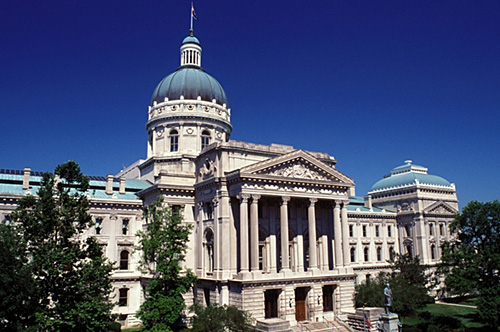
INDIANAPOLIS—The Indiana House will convene on Dec. 1, more than a month ahead of schedule, to consider redrawing the state’s congressional districts to favor Republican candidates.
The state Senate will convene on Dec. 8 to consider any proposal forwarded by the House, in a reversal of previously announced plans.
The early start came in response to a call by Indiana Gov. Mike Braun, who endorsed the mid-cycle redistricting plan in October and called on the General Assembly to take action.
President Donald Trump and Vice President JD Vance have urged Hoosier Republicans to move forward with redistricting, and emotions have run high among supporters and opponents of the plan.
Redistricting is normally conducted once every 10 years following the U.S. census. However, several states, both red and blue, either have redistricted mid-cycle or are considering it, in an effort to sway the balance of power in the U.S. House.
Here’s what to know as the Indiana House comes to order on Dec. 1.
House Republicans Favor Redistricting
Indiana House Speaker Todd Huston (R-Noblesville)
said on Nov. 19 that his chamber has the votes to pass redistricting and is ready to act. The GOP holds 70 of the 100 seats in the House.
Republicans have been considering the matter at least since August, when Vance made the first of two visits to Indiana to meet with GOP leaders.
Two of Indiana’s nine congressional districts are held by Democrats.
Republican Senators Divided
Indiana Senate President Pro Tempore Rodric Bray, a Republican, initially
declined to convene the Senate to consider redistricting, citing a lack of
support among members.
“Today, I’m announcing there are not enough votes to move that idea forward, and the Senate will not reconvene in December,” Bray said on Nov. 14.
Republicans hold 40 of the 50 Senate seats, but it appears a significant number of Republicans oppose the plan. A tie in the Senate is broken by the state’s Republican lieutenant governor.
Bray said Senate Republicans want their party to retain control of the U.S. House but don’t think mid-cycle redistricting is the way to do so.
“We would rather support efforts to elect a Republican in the existing [First] Congressional District, which has been trending Republican for the last several years and would give President Trump another Republican in Congress,” Bray said on Nov. 18.
Others, including state Sen. Travis Holdman, a Republican, cited constituent opinion as a deciding factor in opposing the effort.
“The message from my district has been clear—they do not support mid-cycle redistricting, and therefore I cannot support it,” Holdman said on Nov. 18.
Indiana’s First Congressional District lies in Northwest Indiana and is represented by Democrat Frank Mrvan. The state’s Seventh Congressional District centers on Indianapolis and is represented by Democrat André Carson.
Rising Political Pressure
Immediately after Bray announced that the Senate would not meet, Braun called on the Senate to take action.
“Our state senators need to do the right thing and show up to vote for fair maps. Hoosiers deserve to know where their elected officials stand on important issues,” Braun wrote on social media.
Trump upped the pressure days later, calling on the governor to produce results.
“I am working with Governor Mike Braun and other Indiana Republicans on picking up two Republican Congressional seats. The Governor, a good man, must produce on this, or he will be the only Governor, Republican or Democrat, who didn’t,” Trump wrote on social media on Nov. 18.
Reversing Course, Senate to Convene
Citing the unusual degree of attention and strife generated by the redistricting battle, Bray agreed to convene the Senate on Dec. 8 to “make a final decision” on any redistricting proposal passed by the House.
Public opinion has been running high on the matter for weeks.
Democrats organized a series of protests against the redistricting effort throughout the fall, including one headlined by Hoosier native and former Secretary of Transportation Pete Buttigieg.
“Indiana Republicans are being pressured by Washington Republicans to do something that they know in their hearts is wrong,” Buttigieg said on Sept. 18.
One poll indicated that 53 percent of registered voters opposed redistricting, compared with 34 percent favoring it.
Several Republican state senators were targeted by swatting and other threats of violence after publicly opposing redistricting.
Red, Blue States Redistricting
Both major parties have led redistricting efforts in states they control, and each appears to cast it as a response to unfair practices by the other.
Texas redistricted earlier this year and could gain five Republican congressional seats, although the effort is currently held up in court. That potential gain could be negated by California’s Nov. 4 ballot measure, which authorized redistricting with a possible gain of five Democratic seats.
While debating passage of California’s redistricting plan, dubbed the “Election Rigging Response Act,” California state Sen. Jerry McNerney said: “The president and the Texas Republicans are rigging the election. ... It is our duty to fight fire with fire.”
About Indiana’s redistricting effort, Braun said lawmakers needed to “ensure Hoosiers’ voices in Washington, D.C., are not diluted by the Democrats’ gerrymandering.”
Missouri and North Carolina each redistricted, potentially adding one Republican seat each. Utah was ordered to redistrict by a federal judge, which could result in a gain of one seat by Democrats.
Redistricting efforts have been initiated in Florida and have been considered in Colorado, Illinois, Maryland, and New York.
Louisiana’s redistricting effort has been stalled by a court challenge. Kansas, Nebraska, and New Hampshire have ruled out mid-cycle redistricting.
Indiana congressional maps are drawn by the General Assembly, subject to a gubernatorial veto. The maps are presented in the form of a bill, which is debated, can be amended, and is subject to public comment.
Both houses must pass the redistricting bill, which must then be signed by the governor to become law.