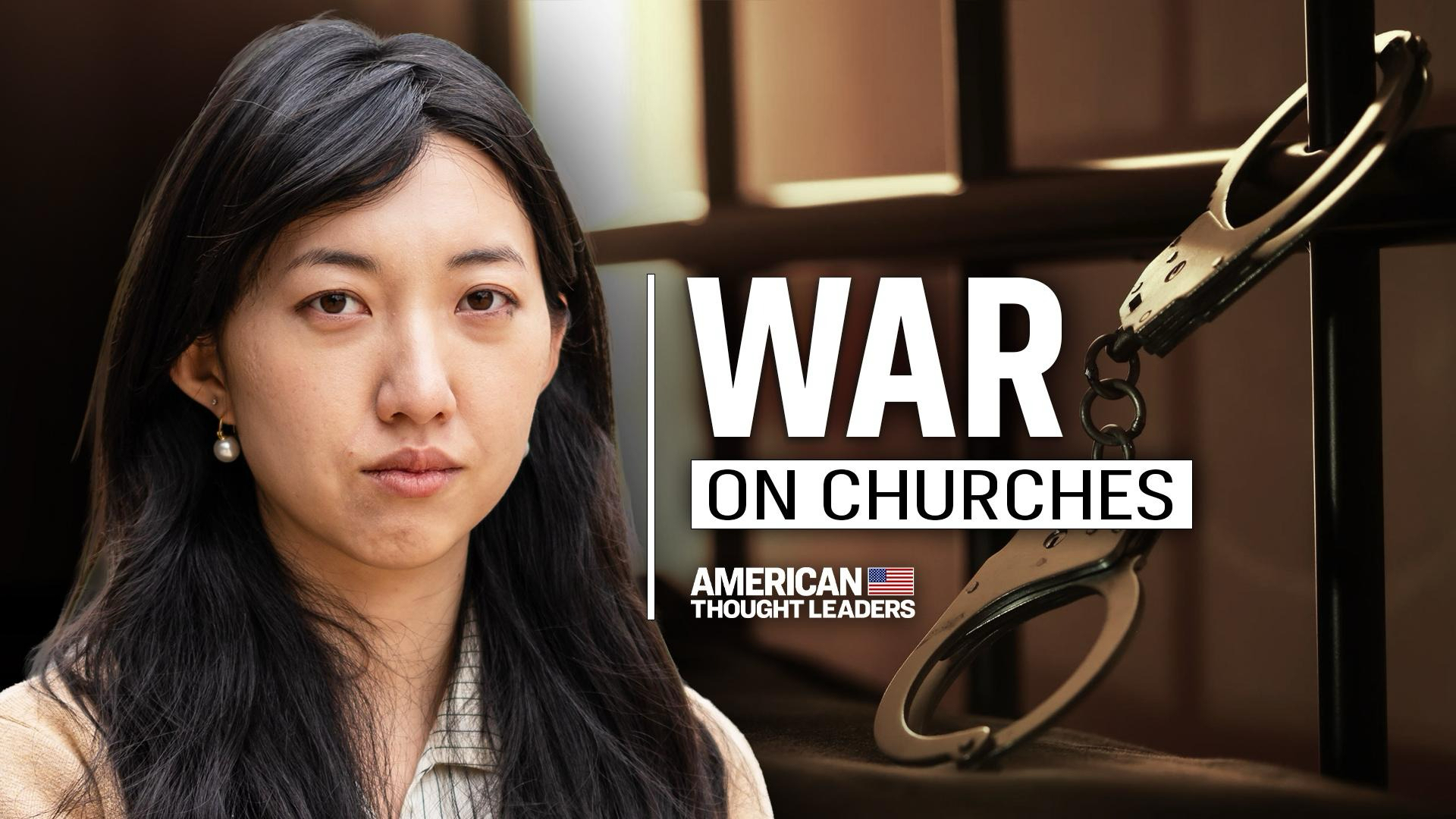

[RUSH TRANSCRIPT BELOW] In this episode, I sit down with Grace Jin Drexel, the daughter of detained Pastor Ezra Jin, the founder of one of China’s largest underground house-church networks.
Last October, Pastor Jin was arrested along with 27 other pastors and church leaders from Zion Church. It was one of the largest assaults on independent Christian congregations in China since the Cultural Revolution, said Drexel. She has since become a prominent voice speaking out against religious persecution in China.
State repression of Zion Church began in 2018 amid a broader wave of Communist Party efforts to subjugate faith communities, Drexel said.
“You saw the tearing down of crosses [and] putting portraits of Xi Jinping and Mao Zedong on church buildings,” she said.
Zion Church was deemed an illegal business operation, forcing them to shift to a hybrid online model of worship. Authorities also placed an exit ban on Pastor Jin.
“There’s so many parts of our lives that he has missed out on. He was not able to walk me down the aisle at my wedding. He was not able to attend my baby’s baptism,” Drexel said.
She sees her father’s detention as part of a new wave of persecution targeting not only her father’s church but also many other underground churches and religious groups as well. As in 2018, authorities are again installing pictures of Xi in churches again, sometimes even replacing crosses, to “showcase who is the true leader of the church,” she said.
Another sign of a new wave of suppression is the sentencing of Jimmy Lai, the 78-year-old founder of Apple Daily and a practicing Catholic. He was recently given 20 years in prison, which marks the longest sentence handed down to date under Beijing’s national security law.
Since Pastor Jin’s arrest, he has not been allowed any family visits, phone calls, or even letters from his loved ones. He is also suffering from severe Type 2 diabetes, and Drexel is deeply concerned about his wellbeing.
Views expressed in this video are opinions of the host and the guest, and do not necessarily reflect the views of The Epoch Times.
RUSH TRANSCRIPT
Jan Jekielek:
Grace Jin Drexel, such a pleasure to have you on American Thought Leaders.
Grace Jin Drexel:
Thank you so much for having me. And thank you so much for having me again.
Mr. Jekielek:
Well, we did a little short bit at the International Religious Freedom Summit, which seems to be very popular. In between that time, now, Jimmy Lai, of course, the owner of the former Apple Daily newspaper, has now been sentenced to 20 years. And I just wanted to hear your reaction, especially considering your father is currently incarcerated.
Ms. Drexel:
I’ve also just found out about the news like many people today. And I’ve met Sebastian Lai personally, and he is such a good advocate for his father as well as a family member of those who are detained in China. It’s just extremely sad, and my thoughts and prayers are with the Lai family as well. It’s truly, in some ways, scary to know that ultimately China does want. And we are just feeling the sadness and sometimes the scary nature of standing up for what we believe in.
Mr. Jekielek:
I don’t know what any of us were expecting, but a 20-year sentence feels like a long time for a 78-year-old man.
Ms. Drexel:
I agree with that. I don’t know what it would look like for the Lai family to sit through the sentencing. So again, my thoughts and prayers are with Sebastian and Claire and the whole team.
Mr. Jekielek:
So, I mean, you yourself haven’t seen your father for, I think it’s about seven years because of travel restrictions and so forth. So give me a picture. What is his status right now? What is the situation with him?
Ms. Drexel:
My father’s church in 2018 was officially shut down in Beijing. And since then, he has been under an exit ban from leaving China. Prior to that, my mother, my brothers, and I had moved to the U.S. with the blessing of the church so that we would not be collateral damage. And since then, because my father has been abandoned, it has not been safe for us to go back to China, so we have been living. We were able to communicate via Zoom and various online tools, but generally speaking, we haven’t seen him physically.
There are so many parts of our lives that he has missed out on; he was not able to walk me down the aisle at my wedding. He was not able to attend my baby’s baptism and all of these things. My brother was an elementary school student and is now about to graduate high school. And none of those events have been physically witnessed by my father since 2018. But in October of 2025, the church continued to grow.
So in October of 2025, the government detained my father along with initially close to 30 leaders of the church. Now 18 people, including my father, are still detained in China’s Guangxi province. And now it’s gotten even worse. We can’t even talk to him at all. We are not able to communicate with him directly, not even with letters or phone calls. The only communications we can have are through his lawyers, who might see him once a month or even less sometimes, depending on their schedule. So that’s where we are right now.
Mr. Jekielek:
Let’s take us back to October 10th, 2025. Clearly, you knew that there was something kind of in the works since 2018. This is the reason you left. But the church still flourished despite being somewhat restricted. Just explain to me how that changed and what happened on the 10th.
Ms. Drexel:
Let’s go back to 2018. That was part of a wave of general persecution against many Christian churches and many other religious organizations as well. In terms of Christians, you saw the tearing down of crosses, the putting up portraits of Xi Jinping and Mao on church buildings. You saw that with independent or house churches. Many times we heard about various raids every week, where pastors would be dragged out from their podiums, and tens of police would storm in. Anyone who tried to stop the taking away of the pastors was equally punished. That was the backdrop of the general trend of what was happening in China.
At that time, on September 9th, 2018, my father’s church was also shut down. Hundreds of police came to our church building that Sunday and threw everyone out, keeping my father inside for many hours. We weren’t able to communicate with him at that point. After a few hours, they released him, but everyone was heavily surveyed for several months. No one in Beijing would offer another meeting place for Zion Church. Zion Church was officially deemed an illegal business operation, etc.
After that, my father continued to want to minister to his congregation, so we started doing this online-offline hybrid model. We didn’t know where that was going to go, but in fact, in China, there was a policy where no one was able to leave their houses for months at a time, etc. So at that moment, Zion Church’s model of this online and offline approach was forced upon us. Meeting online because there was no physical location for us has become a new model and a new kind of revitalization of the church itself.
And so, because of that influence, I think in October, beginning in 2025 and now up to 2026, there is a new wave of persecution coming that is not just targeted at Zion Church, but at many churches and many other religious groups as well. And so, in that context, on October 10th, I found out that my father was detained along with 27 leaders of my father’s church at that point from all across the nation. Currently, we know that 18 of them are still detained.
Mr. Jekielek:
Now, I understand Zion Church. I mean, this was publicly done on the internet. You know, this is available. The authorities could watch it themselves, right? So there’s some kind of an attempt to... It might be difficult for people to understand. How is it possible that you were having church services online with the authorities watching, even after being shut down? And then, well, of course, we know what happened. But how did that work?
Ms. Drexel:
I think that my father’s church was always very open about our church gatherings. We assumed that we would be watched by authorities. And then, if they shut down an account, we just opened another account and then we said if there are spies, then we minister to them too and we welcome them to join in our Sunday services as well. We operated, like you said, very openly, and we are not against the government, so we didn’t say anything too political. We were just trying to worship like a normal church in the U.S. and the rest of the world. And so, we had nothing to hide. I think that, even with the charges that we are being charged with, it’s called illegal use of information online.
If you push them and you ask them what the illegal information that is being spread is, they can only point to, yes, the sermons and the worship music that is still available on YouTube, and you can go and check it out. It’s very much just like a normal church anywhere. So then you have to ask the question of why is that illegal in China, and what is it about this normal sermon and worship music that is illegal, and why? And I don’t want to be the one answering those questions in communist China.
Mr. Jekielek:
Well, but clearly you’ve thought about it, right? Like why? Why? Like what is here in America? But of course, we know that this video will certainly be viewed by some interested parties in communist China, positive people that are very supportive and people that are not. Why do you think that is?
Ms. Drexel:
What we’ve always heard whenever we bring up religious freedom and situations like my father’s church is that they will say there is religious freedom in China; all you have to do is join the government and register with the government. Then again, in a situation like this, they say, well, if you don’t break the law, if you join our channels, then you can do whatever you want.
But what most people don’t understand is that in order to join the channels, you have to get a special license, and then only licensed individuals can view it. All of that is then being monitored and censored, and if you don’t preach exactly what the Chinese Communist leadership wants you to preach, then you get your license revoked, etc. So again, you can say you have freedom, and yet by the very actions that you take, you are limiting sacred parts of your life.
These are sermons and worship songs; they’re not political things. They should be in the realm of the church and not in the realm of party officials. So, I think that in China, often what I feel is that they want to control everything, including the very intimate aspects of what you believe in. So for churches, it’s either you capitulate or you die. That’s the model.
Mr. Jekielek:
You capitulate or you die, but you seemed to, at least for a while, find some sort of way through it, right, but ultimately, it couldn’t last, I guess.
Ms. Drexel:
I think it was also a different era, perhaps, where China was seemingly more open, not just to Christianity, but there were various NGOs that were also on the ground starting up. In the early 2000s, there were a lot of foreign businesses that came in and many social groups that were started and such. And I think now we see that it’s not just the church that is being persecuted, but many of those social organizations are also all kicked out. Part of it, again, I think, is since Xi Jinping came into power, he’s held on to this battle of ideology. And that’s when we saw the concept of sinicization of religion.
I’ve been saying that ultimately, sinicization of religion is not about making religion more Chinese. You can see, Taoism is also being sinicized, and yet Taoism is as Chinese as it can get. Similarly, in Christianity, it’s no longer the situation where you had foreign missionaries who were preaching in Latin or using English Bibles, etc. It was a Chinese-translated Bible, Chinese pastors preaching in the Chinese language, very much grounded in Chinese theology and history and such, so it is already sinicized and at that point, they were just trying to partify, like make sure that you are under the control of the party.
You see that, like in September, I believe Xi Jinping also led a Politburo study on sinicization of religion, and that was a signal to many people that ideology is again being emphasized. That’s also why we saw the crackdown of Zion Church in October and many other churches in December, January, etc., as well.
Mr. Jekielek:
Fascinating. You said, you know, partified. I was thinking, Marxified, same idea. Why do you think you see these pictures of Xi Jinping put on churches in prominent places, sometimes replacing crosses and so forth? What is that about?
Ms. Drexel:
I honestly don’t know why. It’s funny because there are pictures of churches putting a cross in the middle and putting Xi Jinping’s portrait on one side and putting Mao Zedong’s picture on the other side. In Christian, like, story, you know that Jesus was crucified next to two, like, murderers or robbers. They were like, oh, those are the two thieves that got crucified next to Christ.
But objects aside, it’s a showcasing of who is the true leader of the church in a sacred building. Again, we believe as Christians that God is the head of the church and it’s the sole head of the church. We believe that there is one God and that we the first commandment is that thou shall have no other gods before me. So if we didn’t believe that, we wouldn’t be Christians in the first place.
And yet the party wants us to plant that and say that you can worship as long as you kneel down before me first, or that you have to get things approved by me. Your leadership has to be approved by me. Your sermons have to be approved by me. How many people are baptized has to be approved by me. Your sermons have to be approved by me. How many people are baptized has to be approved by me, etc., etc.
So you realize that the Holy Spirit, the church, the leadership, and the congregation don’t determine these spiritual realms. It is the party, again. with their atheist agenda that determines what the churches do. And I think that’s symbolized by a portrait of Xi Jinping and Mao Zedong in front of church buildings, etc.
Mr. Jekielek:
You know, one thing that comes to my mind as you’re talking about all this, I have to confess, I don’t read the Bible regularly, but I’m remembering a passage, actually, render unto Caesar what is Caesar’s and render unto God what is God’s. How does that apply here? I hope I got that right.
Ms. Drexel:
That was when the Pharisees were testing Jesus, and they gave him a coin. Christ said like, who does this look like, who’s on the portrait of the coin? It was Caesar, and he said, render unto Caesar what is Caesar’s. I think that Zion Church, like many of the underground or independent churches, we are not political. Even if they detained us, we’re not out there protesting on the streets. We’re not creating havoc. If you want to detain us, then detain us; we’re ready.
And yet, we say what you can’t take away is that we believe in God. He created heaven and earth, and he created you and me, and he sacrificed his life for us. And now I am a Christian, and we believe that like then, we believe that God is in control of my life. God is in control of my church, etc. And that’s all that we are asking about. And yet even that, even something that is so personal to you, is now seen as a threat or is now not allowed in China.
Mr. Jekielek:
I’ve been writing recently about the totalitarian nature of communism, not just Chinese communism, although specifically Chinese communism. And there is this need to control your thought, right? And so that it doesn’t necessarily mean that the person has to believe what you demand they believe, although that’s good, right, as long as you performatively accept it, right? And that’s very interesting, but what you’re doing is just not performatively accepting it. Even just simply saying God is the ultimate authority, and I don’t think the Communist Party likes that very much.
Ms. Drexel:
Yes. Since my father’s detention, I’ve been reading a lot about various other detained people in different Soviet or past China, etc. And one of the just incredible thought leaders, Natan Sharansky, would say that in the Soviet times, most people performed doublethink, in which you don’t even know if you believe in it or not, but you have to perform a certain way. And yes, like you said, I think many people in China would say, why don’t you just say that you accept Christianity this way? Just do that and there are many people who are able to form that type of doublespeak function in that type of way.
But I also think that again, like, I think for Christians, we see that this is not necessarily what he had tried to say, kneel down before me, before your god. Like King Nebuchadnezzar from Babylon has said that Daniel should kneel down before him and put him in front of their god, whom we believe is the true creator of heaven and earth. I think all that we are saying is that this is not a new phenomenon; many leaders have wanted people to worship them or to put them ahead of any of the other ideologies.
But again, this is an intimate belief system for some people. You don’t have to be a Christian. We’re not going out there forcing people to be Christian. But if you are a Christian, it is an intimate belief that we believe that God should be worshipped as the head. And there is no room for that in China.
Mr. Jekielek:
What are the conditions your father’s in? Out of curiosity, I just realized I wanted to know about that. What are you aware of, even though I know communication has been cut off now?
Ms. Drexel:
We only get very limited information. So with the bits and pieces that we’ve heard, it is a very crowded cell. It’s in a detention center and not even in a prison. So detention centers are technically not meant for you to stay there for a long time. So they don’t even have beds for you, and you’re just sleeping on the floor, potentially with some sort of a mat, or maybe not even that.
We heard that for the male detention center, there are rooms with close to 30 people in a room, but all of our leaders are in separate cells, so they can’t even talk to each other. We also heard that there aren’t even window panels in the cells, so when it rains or if it’s windy, all of that comes into the cells. And we, as family members, can’t even mail in letters or medication or even warm clothes or blankets to them. So we hear that they are shivering at night, and many of them have had arthritis flare-ups and all of these horrible medical conditions, and many of their medical conditions are not being addressed because family members are not able to give medication.
So it is really difficult to think through and imagine that my father is in that situation. And especially knowing that he is not in good health. My father has severe type 2 diabetes. So we are very concerned and worried for his health and hoping that he will be able to be released soon, especially because his health is failing fast.
Mr. Jekielek:
So you’ve had numerous conversations with various officials here in the U.S. I know you even came from, I don’t have to say who it was with, but just before this interview. So what has been the reaction? Do you feel there’s something they can do?
Ms. Drexel:
I am incredibly honored and just feel very supported by how many people in Washington and around the world have said that they have heard about my father’s situation and are in support and solidarity and praying for my father. Not just leaders here, but also church leaders, friends, and many people have told me that their parents from a different state went to church and mentioned my father’s situation. They would then text me and say, oh, like my mom from Kansas mentioned your dad and said, you know, Pastor Ezra Jin. And he’s like, yes, I actually work with his daughter.
So it’s been incredibly heartwarming to see that so many people in the U.S. and around the world who have never met my father are praying and caring about a persecuted Christian. I hope that there will be, ultimately I want my dad back. I want my dad to be able to be reunited with us in the U.S. and to meet his grandchildren. So many people are very sympathetic, and I hope and wish that we can somehow continue to build the pressure and tell China to release these individuals and let them worship freely and come to the U.S. to be reunited with their family members.
Mr. Jekielek:
So this, you feel like officials, let’s say U.S. officials, calling for this, you think that’s the most effective thing? Are there other things they can do as well?
Ms. Drexel:
I’m very new to this world as well, and I’ve never really, I mean, there are so many people that I know of who have also had their family members in detention, like the Lai family and the ones you mentioned in the beginning. So I don’t know what it would take for the Chinese government to function like a normal country, honestly, to just say that to allow people to worship freely, like what their constitution even allows their citizens to do. And that’s all that I was hoping for, that they would be able to be released. I don’t know what it will take for that to happen. I hope that they will hear the message from all across the world, that they will realize that it is in their best interest to just let them go.
Mr. Jekielek:
Have you encountered any, okay, the Chinese regime is known for what’s typically dubbed transnational repression, the targeting of family members or just Chinese in general in America, in other countries. Have you encountered any of this?
Ms. Drexel:
I think the Chinese want to intimidate people and they’re probably one of the countries that have the most amount of transnational repression cases that have been reported from around the world. And many of them are not even reported because people are afraid to speak out. And since I’ve been speaking out about my father’s case since October, my family and I have also been targeted and harassed by the Chinese government.
Specifically, my mom, who lives in the Chicago area, has been harassed by people on her phone. There were people impersonating federal agents, claiming that she had committed fraud, that she had to go back to China to clear her name, and that’s a very common tactic to kind of force people to voluntarily go back to China. We also saw, most recently, my mom’s tires were slashed inside her garage, but nothing else was taken, so it really is a fear tactic. My husband has been targeted as well with a lot of phishing expeditions and cyber attacks.
Mr. Jekielek:
They’re sending phishing emails to try to get him to give up his passwords and stuff like that.
Ms. Drexel:
Yes, and they’re very targeted. Even in Washington, D.C., I felt that I’ve been watched and followed, especially when I’m meeting people to talk about my father’s case, etc. So we now live um in a house surrounded by security cameras, and my husband sleeps with a metal bat next to his bedside, which is pretty ridiculous. I think that the fear is honestly pretty real. To know that China doesn’t want people to be talking about this. And for them, they would rather have us just quietly let whatever happens, happen.
But at this point, I also realize that China is not going to give my father a fair trial. And there is no such thing as a fair trial. So unless, and there is no such thing as a fair trial because his crime is not really a crime. Like they just made the law to do whatever they want. And so I think that I have to speak out for my father in order for him to come back to us and be able to join us in the U.S.
Mr. Jekielek:
You know, just speaking of phishing, you just reminded me of something I hadn’t thought of in a while. You know, years ago now, before we, you know, let’s just say put in some more sophisticated protections, I got someone forwarded me an email that looked like it was from myself. Oh wow, right? To someone trying to get information. I read the thing, and I was like, wow, this really could have been me that wrote this. Like, it looks, it’s in my voice, it seems a reasonable request, and it was a phish; it was a phishing expedition. So there is very, I was like, this is kind of unbelievable.
I can’t believe it, because a lot of the stuff you see kind of has what’s so-called Chinglish in it or whatever, like it doesn’t look very sophisticated, but this was so, you know, I fell for that. It’s very easy to fall for it because it’s just something about it that made the person say, did you really want me to answer this question? I was like, no, I really don’t. And you can see it’s not quite from my email, right? It’s a little bit of a different one. Anyway, there’s some very sophisticated operations, and that fear, I think, they also capitalize on the fear. What are you thinking right now?
Ms. Drexel:
Ultimately, they want us to be quiet and not to mention I am a mere individual, and yet I’m trying to expose what has happened in the second most powerful nation in the world. They have everything in their toolkit—just myself. And so, like, they have tons of people to craft an email to sound exactly like me and/or to have other creative ways to get me. It is a very fearful thing to think about, and I get, like a lot of activists and people before me have also been targeted, have also been subject to this type of fear. But yet again, what are my options? I have to get my father out. And so, with that, even with the fear, you’re kind of pushed to this position. I can’t do anything else but to keep speaking out.
Mr. Jekielek:
It’s terrible because they force you into this situation. I’m thinking about the Uyghur activist Rushan Abbas. I believe you know her as well. They took her sister, and she’s been disappeared, right, because of her vocal activism and trying to advocate for the Uyghur people, you know, they force you into making this terrible choice, right? Or, you know, what you do might make it worse for your father or your family member, or maybe better; it’s unclear, right? And so a lot of people will stay silent in that sort of situation because, you know, but maybe like, I don’t want to dig into this too much, but like, you’ve made a very deliberate decision to be vocal.
Why do you think this will work better than the other option? Of course, we don’t know, right? When we choose to speak out about important things. Your point is great, right? This is a very, whatever it is, it might be brittle, but it’s a very powerful regime with a lot of resources. So, you know, some people have literally told me this, right? So what’s the point? Yes, like what, how can you challenge such a leviathan, right?
Ms. Drexel:
And I think like you said it’s bizarre to have individuals having to do this type of a prisoner’s dilemma type of game and you have to figure it out. You don’t know how they’re thinking or how they’re judging what you do, and you’re trying to do the best that you can in every single situation, and each situation is unique and different. And I don’t know that what I’m doing is the best way and I’m constantly just hoping and praying that what I’m doing is like I’m just doing the best that I can. I think what I see is that there were many churches before my father’s arrest that have been detained, have been sentenced.
Many of them, many times, don’t have opportunities to speak out. They don’t have daughters in the U.S. who are American citizens who feel the freedom to just do whatever they want as Americans, as we should. And so oftentimes they don’t even have the ability to speak out, and yet they are still persecuted and yet they’re still sentenced for 15 years and such for, again, just holding on to their faith.
And so I didn’t ask for this; I didn’t come out to look for this; I was happy with my job and I was happy being just a normal person, and yet there is a point where you’re like, well, there are no other options either, and no one has tried it, so I might as well use this ability to speak out since I am able to speak out, unlike many people before me.
Mr. Jekielek:
If I may comment a little bit, that’s beautiful. And, you know, I have my own belief that truth-telling, yes, right, to the best of your ability, of course—we never have the grasp of the complete truth—and sometimes people mention, but the attempt at truth-telling, yes, speaking truth, it’s very powerful.
Ms. Drexel:
Exactly. I’m not creating anything that isn’t happening. I’m not exaggerating anything that isn’t happening. I’m merely stating the facts of what happened to my father. And so, like, what else can I do? And why is that not allowed for me to just speak and say what has already happened?
Mr. Jekielek:
I wish you the best of success.
Ms. Drexel:
Thank you so much.
Mr. Jekielek:
Maybe a final thought as we finish?
Ms. Drexel:
Again, I just feel extremely honored and privileged to have the opportunity to share my story. And thank you so much for giving me the platform. And I do just again want my father to be released and come to the U.S. and be with his family members and just be able to worship freely, like everyone in the free world. So thank you.
Mr. Jekielek:
Well, Grace Jin Drexel, it’s such a pleasure to have had you on. Thank you so much.
This interview has been partially edited for clarity and brevity.