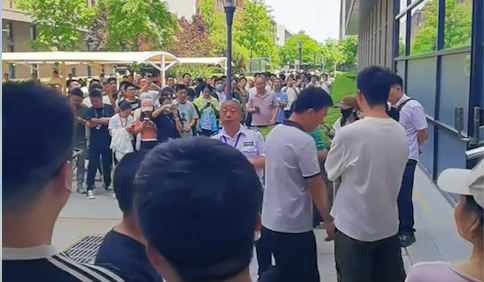

Hundreds of employees at a major Chinese technology company linked to Huawei staged a rare collective labor protest in the northwestern Chinese city of Xi’an this week, accusing management of using salary cuts, job transfers, and intensified performance reviews to pressure workers into resigning voluntarily.
The protest erupted on May 11 at the Xi’an offices of ChinaSoft International, one of China’s largest software and IT outsourcing firms, and a long-time contractor for Huawei.
Videos circulating online show large groups of employees confronting company representatives inside an office building while livestreaming the standoff on social media.
Workers demanded that the company either maintain their existing salaries and positions while they searched for new jobs or provide formal severance compensation in accordance with Chinese labor law.
“Our demands are very simple,” one employee said during the protest.
“Before the labor relationship officially ends, we should be allowed to continue interviewing and looking for work while keeping our original position and salary. What’s unreasonable about that?”
Another protester accused the company of trying to avoid legal compensation obligations by making working conditions intolerable.
Some protesters also criticized company management for refusing to engage in direct communication. In one video, an employee confronts staff members handling the dispute, saying repeated complaints had gone unanswered.
Workers Say Companies Using ‘Soft Layoffs’
Employees involved in the protest said the company had not formally announced layoffs. Instead, they alleged that management adopted what many Chinese workers describe as “soft layoff” tactics—reassigning workers to different posts, reducing salaries, tightening performance requirements, or relocating positions to pressure employees into quitting voluntarily.
Workers said some pregnant employees were also affected by the measures, a particularly sensitive issue under Chinese labor protections.
Founded in 2000 and headquartered in Beijing, ChinaSoft International provides software development and IT outsourcing services across industries, including telecommunications, finance, and government projects. The company is publicly listed in Hong Kong and has long maintained close business ties with Huawei.
The labor dispute comes as China’s technology sector faces mounting financial pressure amid slowing economic growth, weaker private-sector investment, and shrinking corporate budgets. Over the past two years, layoffs, salary reductions, and project cancellations have spread across China’s internet and software industries.
Two China-based observers spoke to The Epoch Times on condition of anonymity, or only using their surnames, out of fear of reprisal.
A Xi’an-based labor rights advocate surnamed Liu told the publication that many companies are increasingly outsourcing work while reducing direct employment costs.
“They can save money on social insurance and employee benefits this way,” Liu said. “A lot of workers come from poor mountainous regions with few opportunities. The regime turns a blind eye to these exploitative companies.”
China’s Tech Sector Faces Prolonged Retrenchment
A Chinese software engineer told The Epoch Times that many Chinese tech companies are attempting to reduce staff without formally carrying out layoffs that would require severance compensation.
“They create various excuses—relocating offices, transferring positions, increasing performance pressure, reducing salaries—until employees can no longer endure it and resign on their own,” the engineer said.
According to the engineer, outsourcing firms have been hit especially hard as upstream technology companies cut budgets and reduce contracts, squeezing already-thin profit margins.
“The downstream outsourcing companies are receiving fewer projects,” the engineer said.
“But companies still don’t want to provide proper compensation when reducing staff, so eventually workers begin protesting.”
Liu said that China’s local governments frequently tolerate such practices as long as companies continue to pay taxes and maintain headline employment numbers.
“The local government in Xi’an is effectively standing on the side of capital,” Liu said.
“As long as companies can still generate tax revenue and preserve employment statistics, the regime often ignores workers being pressured into resigning or having their pay reduced.”
He added that workers who file complaints through official government hotlines often receive little response, while reports of labor unrest have also surfaced in nearby cities.
As China’s economic slowdown deepens and corporate budgets tighten, disputes such as the Xi’an protest are becoming increasingly visible signs of strain in the country’s once-fast-growing technology sector.
Wang Xin contributed to this report.