
News
How a Tiny Insect Decimated Florida’s Citrus, and What Orchardists Are Doing About It
Comments
Link successfully copied
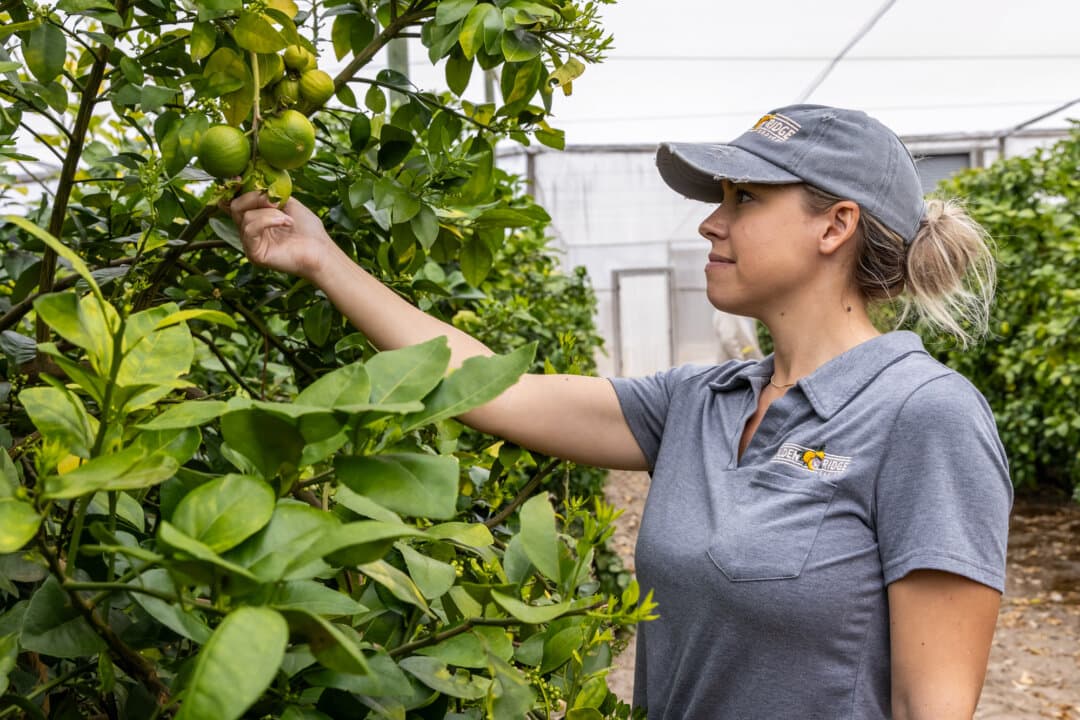
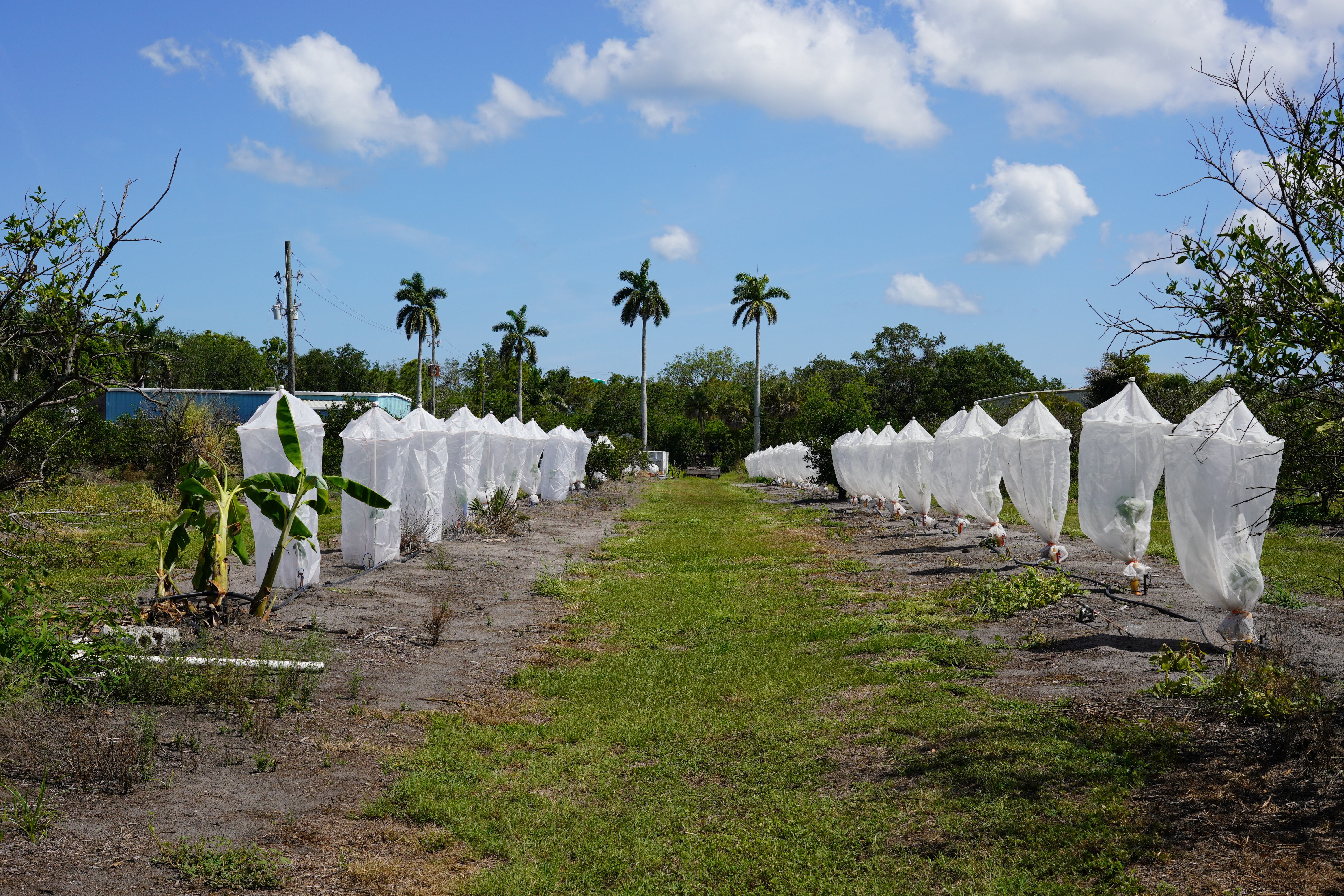
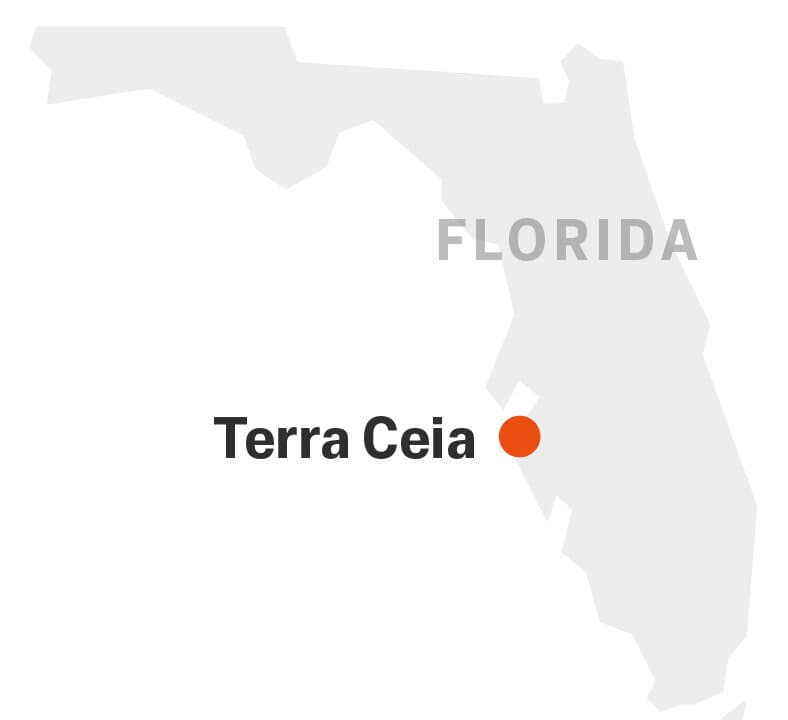
Family citrus farms are shown in Terra Ceia and Bartow, Fla., in the spring of 2026. Florida's citrus growers are looking to new methods to protect an industry that has been decimated by the Asian citrus psyllid. (Jacob Burg, Natasha Holt/The Epoch Times)
By Jacob Burg
6/7/2026Updated: 6/8/2026

TERRA CEIA, Fla.—Lifelong citrus farmer Sidney Tillett cut a path through a grove that has endured in his family for four generations, stopping his SUV between two rows of trees. On one side was a long plot of lush green saplings, covered with protective mesh bags tied to stakes in the ground. 


Directly on the other side, a row of petite orange trees with withering leaves were all battling a bacterial infection, caused by an invasive insect that has decimated the state’s orange industry in just two decades. 


“It’s a story of survival,” Tillett told The Epoch Times, remembering his father’s 25-foot-tall citrus trees that could sometimes produce 1,000 pounds of fruit in a single season.


Now, what trees survive are lucky if their canopies get half that size, or produce any fruit that can be sold at market. What was once 600 acres of citrus trees in the 1970s has now dwindled to five. 


The orange—Florida’s inextricable insignia that emblazons license plates, T-shirts, and bumper stickers from affluent coastal towns to rural farming communities—was once the state’s largest cash crop and positioned the Sunshine State as the country’s majority citrus producer.


Florida harvested a record 244 million boxes of oranges during the 1997–1998 season. This year, the Department of Agriculture estimates that Florida will produce only 12.2 million boxes, a stunning 95 percent drop in a little less than 30 years.


Occasional freezes, catastrophic hurricanes, and an on-and-off, decades-long battle with the citrus canker disease proved to be frustrating setbacks for many orange growers, but the destruction of Florida’s citrus industry kicked into high gear in 2005.


That was the year an invasive insect from China—which made its way to the United States through Mexico—introduced a disease that would ultimately decimate Florida’s citrus industry.


The Asian citrus psyllid feeds on citrus tree leaves, causing the plant to contract a bacterial infection known as huanglongbing, commonly called citrus greening.
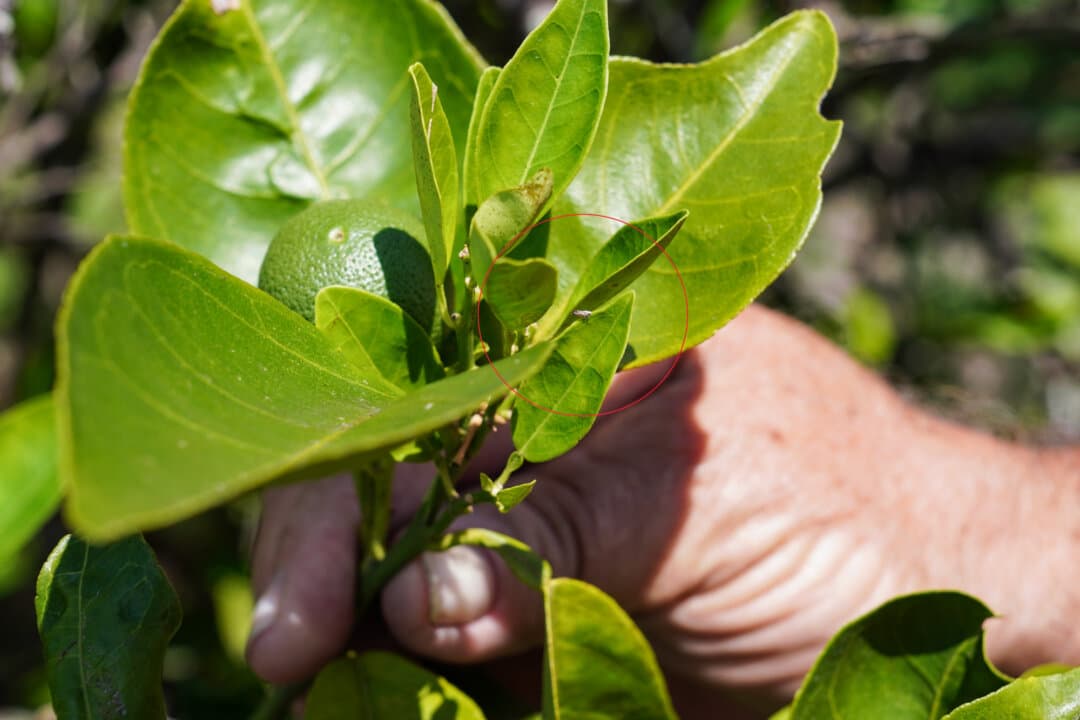
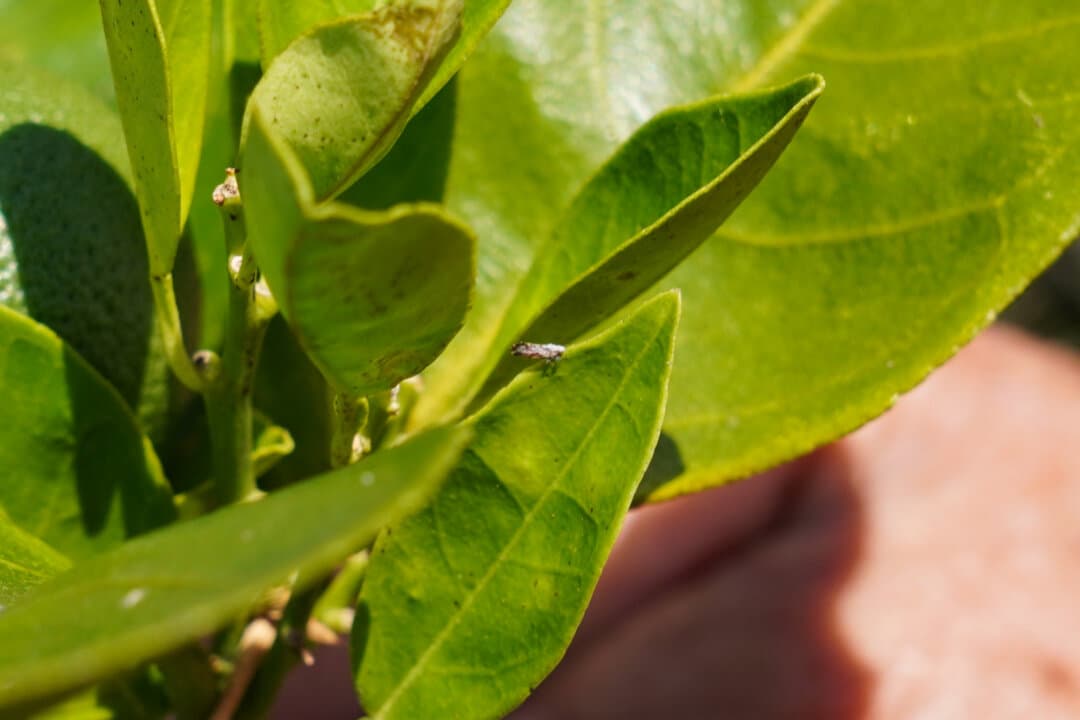
(Left) The Asian citrus psyllid, spreader of a bacterial infection known as citrus greening, can be seen on an orange tree at Sidney Tillett's farm in Terra Ceia, Fla., on May 21, 2026. The invasive insect has decimated the state’s orange industry in just two decades. (Right) An Asian citrus psyllid can be seen on an orange tree at Sidney Tillett's farm in Terra Ceia, Fla., on May 21, 2026. About the size of an aphid, the insect feeds on citrus tree leaves. (Jacob Burg/The Epoch Times)(Left) The Asian citrus psyllid, spreader of a bacterial infection known as citrus greening, can be seen on an orange tree at Sidney Tillett's farm in Terra Ceia, Fla., on May 21, 2026. The invasive insect has decimated the state’s orange industry in just two decades. (Right) An Asian citrus psyllid can be seen on an orange tree at Sidney Tillett's farm in Terra Ceia, Fla., on May 21, 2026. About the size of an aphid, the insect feeds on citrus tree leaves. (Jacob Burg/The Epoch Times)

(Left) The Asian citrus psyllid, spreader of a bacterial infection known as citrus greening, can be seen on an orange tree at Sidney Tillett's farm in Terra Ceia, Fla., on May 21, 2026. The invasive insect has decimated the state’s orange industry in just two decades. (Right) An Asian citrus psyllid can be seen on an orange tree at Sidney Tillett's farm in Terra Ceia, Fla., on May 21, 2026. About the size of an aphid, the insect feeds on citrus tree leaves. (Jacob Burg/The Epoch Times)

The disease causes rapid root loss, slowly draining the life from healthy trees as they try to absorb and retain nutrients. Oranges languish, struggling to reach full maturity and normal sugar composition—losing the sweet taste that made the fruit an in-demand crop worldwide. 


There is no known cure. And the effects extend far beyond the Sunshine State.


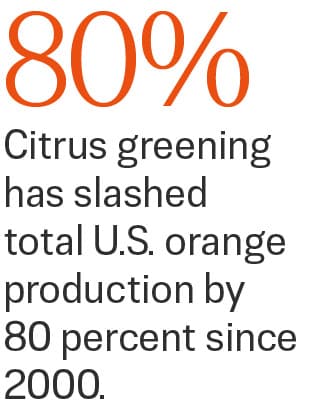
Citrus greening has slashed total U.S. orange production by 80 percent and grapefruit production by 88 percent since 2000, according to a report from the American Farm Bureau Federation. California has now overtaken Florida to become the United States’ largest citrus producer, and nations such as Egypt and South Africa now export more oranges worldwide.


But Florida citrus farmers are not giving up.
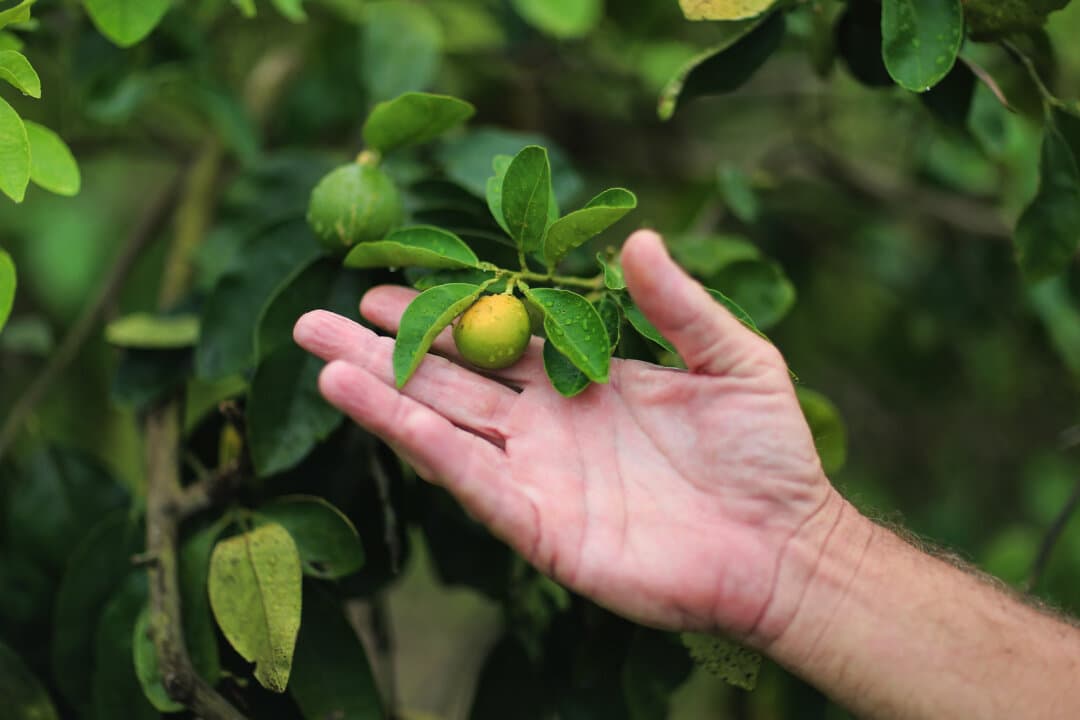
Guy Davies, an inspector of the Florida Division of Plant Industry, shows an orange with signs of citrus greening, in Fort Pierce, Fla., on May 13, 2013. The Asian citrus psyllid carries the bacterium causing the huanglongbing infection—known as citrus greening—from tree to tree. (Joe Raedle/Getty Images)

Guy Davies, an inspector of the Florida Division of Plant Industry, shows an orange with signs of citrus greening, in Fort Pierce, Fla., on May 13, 2013. The Asian citrus psyllid carries the bacterium causing the huanglongbing infection—known as citrus greening—from tree to tree. (Joe Raedle/Getty Images)

Recent studies by the University of Florida’s Citrus Research and Education Center have offered several paths for the industry to take.


Insecticides are a major component of citrus greening management, the center stated in an August 2025 production guide, but a specialized protective netting known as exclusion mesh “is currently the only tool that can fully prevent [Asian citrus psyllid] infestation in citrus.”


Farmers have covered young saplings with translucent mesh bags that tent the tree’s canopy to keep the Asian citrus psyllid out long enough for the tree to take hold and mature.
Meanwhile, light and moisture can pass through the cover’s fine mesh.


While effective at stopping immediate tree death—as many saplings are infected within the first six months—the bags have some limitations.


They allow citrus trees to produce quality fruit for at least 30 months after they’re planted, but the trees eventually begin to falter after the bags are removed two to three years later.
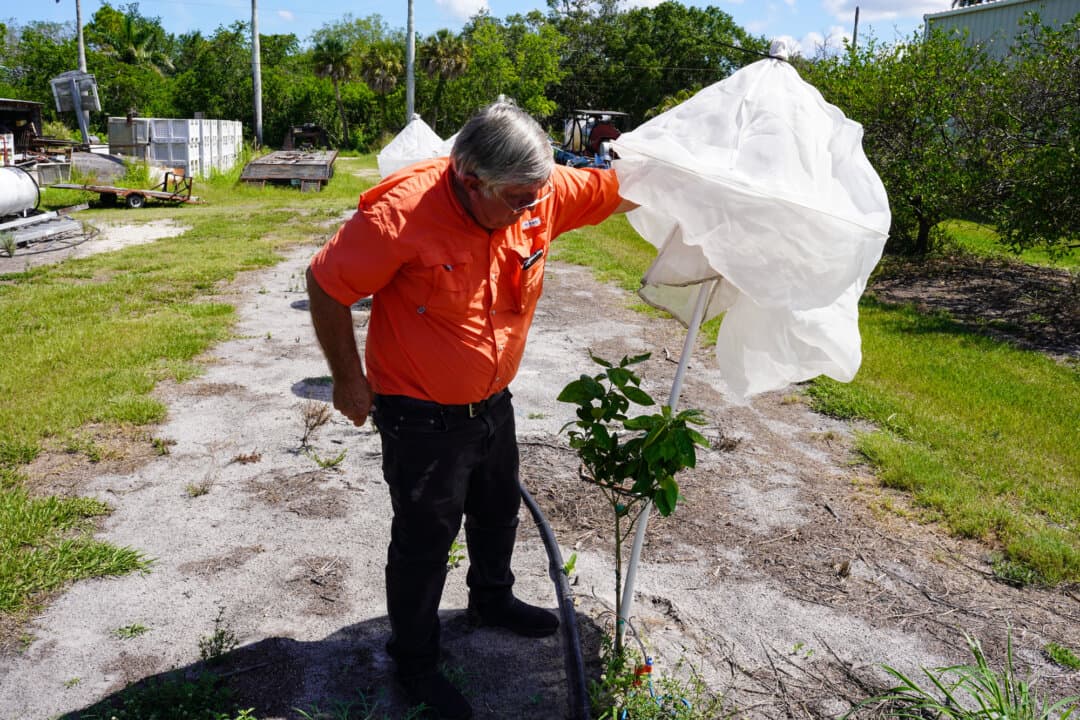
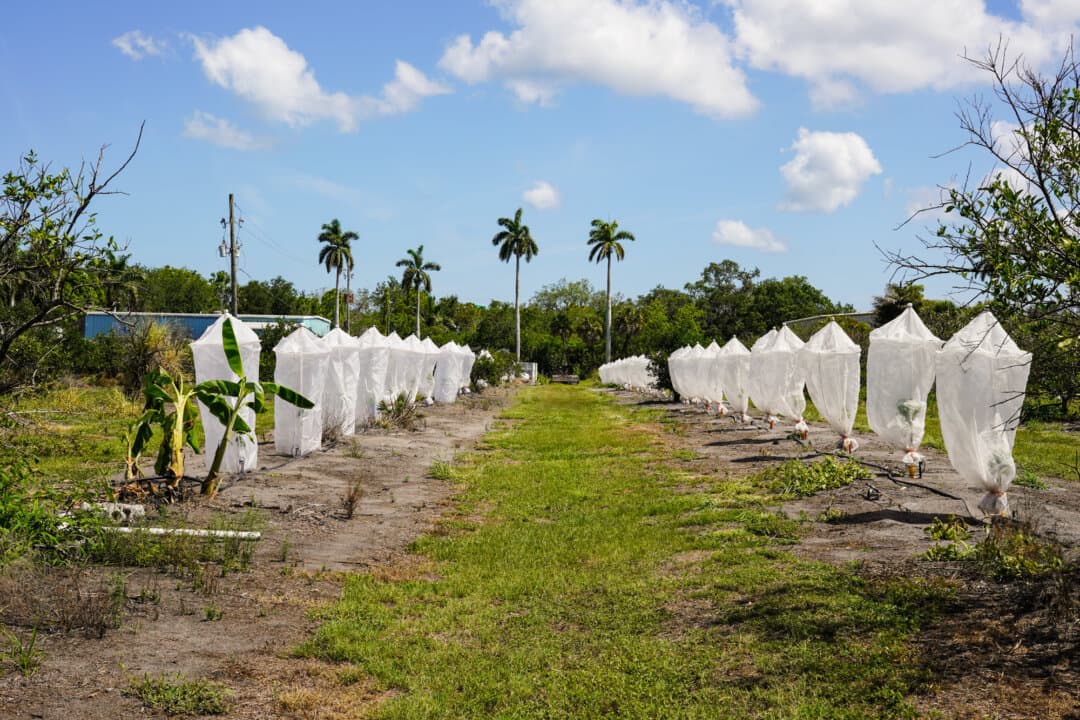
(Top) Lifelong citrus farmer Sidney Tillett lifts the protective mesh canopy from a young sapling at his farm in Terra Ceia, Fla., on May 21, 2026. Tillett's grove has been in his family for four generations. (Bottom) Two rows of citrus trees grow under protective mesh bags at Sidney Tillett’s grove next to his market, The Citrus Place, in Terra Ceia, Florida, on May 21, 2026. An already tough market is adding strain for citrus growers statewide. (Jacob Burg/The Epoch Times)

(Top) Lifelong citrus farmer Sidney Tillett lifts the protective mesh canopy from a young sapling at his farm in Terra Ceia, Fla., on May 21, 2026. Tillett's grove has been in his family for four generations. (Bottom) Two rows of citrus trees grow under protective mesh bags at Sidney Tillett’s grove next to his market, The Citrus Place, in Terra Ceia, Florida, on May 21, 2026. An already tough market is adding strain for citrus growers statewide. (Jacob Burg/The Epoch Times)

That’s why citrus farmers such as Katie and Shane Bevilacqua are trailblazing a different, even more radical approach to fighting citrus greening.
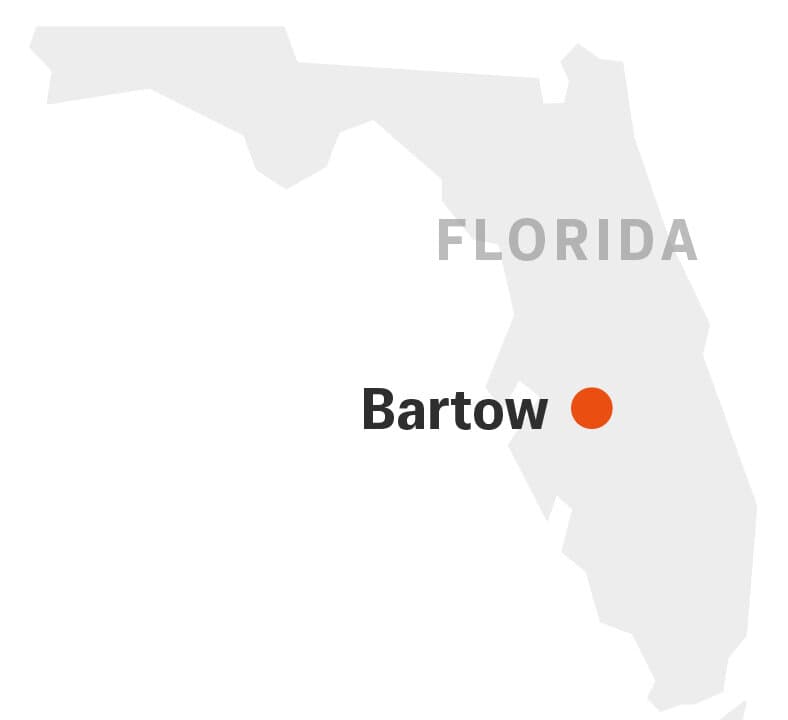
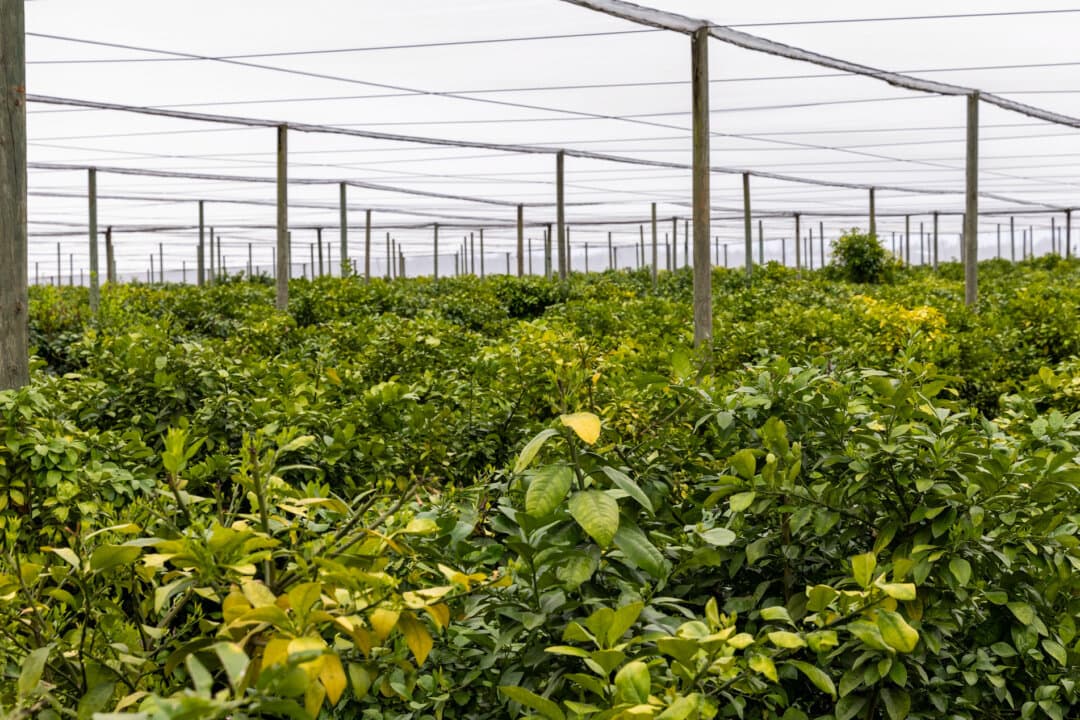
They have built massive permanent mesh tents over their nearly 750 acres of grapefruit trees at Golden Ridge Groves in Bartow, Florida, where customers can self-pick or buy bushels of fruit in the couple’s market. The tents are known as “citrus under protective screen” structures.


“It’s early, but it’s proving to keep the psyllid out, allow the tree to remain healthy, and put on the healthy crop and beautiful fruit that Florida has been known for for decades,” Shane Bevilacqua told The Epoch Times.


“Even if this could be our small contribution to keeping it going, we’re excited about that.”
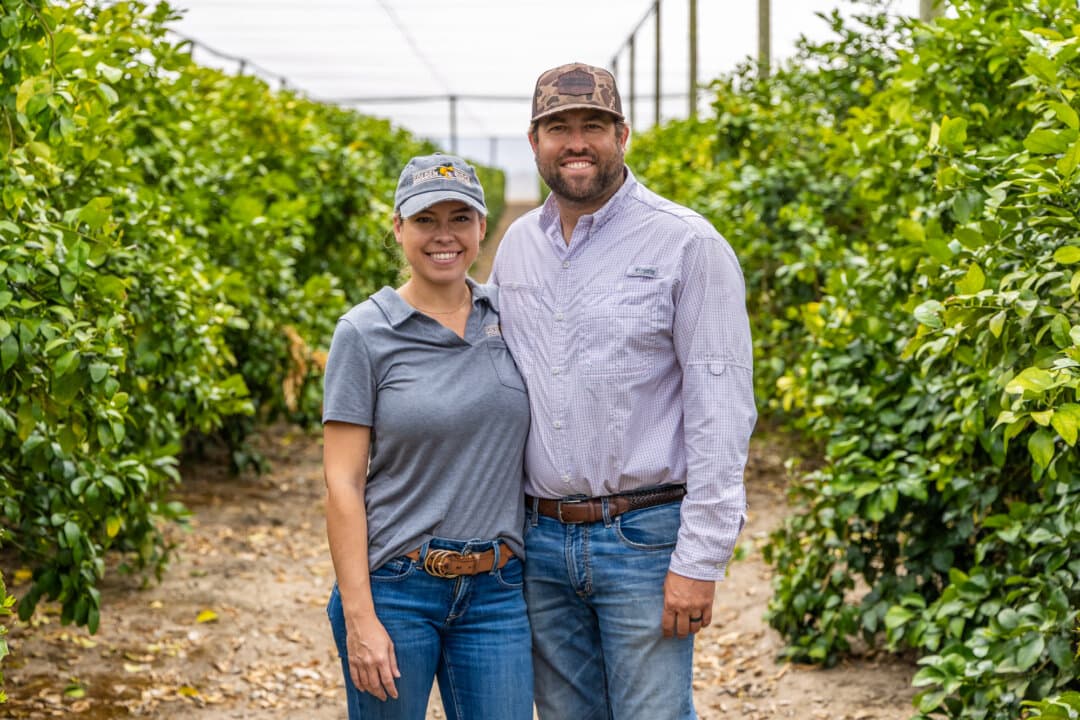
(Top) Katie and Shane Bevilacqua work together growing citrus at their farming operation, Golden Ridge Groves, in Bartow, Fla., on March 3, 2026. The couple are trailblazing a new approach to fighting citrus greening. (Bottom) Grapefruit grows under protective mesh at Golden Ridge Groves in Bartow, Fla., on March 3, 2026. The massive tents replace individual protective covers, which protect trees when they are young but not in later stages of growth. (Natasha Holt/The Epoch Times)

(Top) Katie and Shane Bevilacqua work together growing citrus at their farming operation, Golden Ridge Groves, in Bartow, Fla., on March 3, 2026. The couple are trailblazing a new approach to fighting citrus greening. (Bottom) Grapefruit grows under protective mesh at Golden Ridge Groves in Bartow, Fla., on March 3, 2026. The massive tents replace individual protective covers, which protect trees when they are young but not in later stages of growth. (Natasha Holt/The Epoch Times)

Road to Ruin

The near-total decimation of Florida’s citrus industry did not happen overnight. 


When officials first found citrus greening in the state in 2005, farmers had already battled irregular cold seasons with freezing temperatures that damaged their crops.
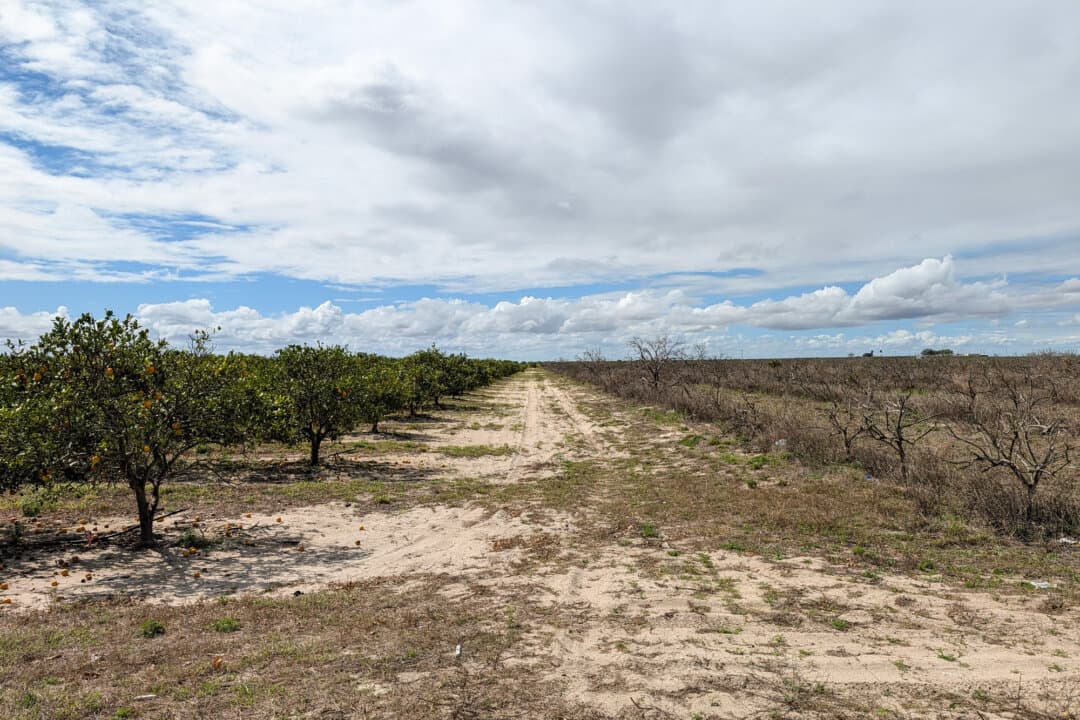
A plot of healthy orange trees is seen next to a large field of dead orange trees at a farm in Bartow, Florida, on March 3, 2026. Even before the recent energy cost hike, greening had already ballooned the price of growing oranges in Florida. (Jacob Burg/The Epoch Times)

A plot of healthy orange trees is seen next to a large field of dead orange trees at a farm in Bartow, Florida, on March 3, 2026. Even before the recent energy cost hike, greening had already ballooned the price of growing oranges in Florida. (Jacob Burg/The Epoch Times)

Citrus canker—a different but still harmful bacterial infection—arrived in Florida more than 100 years ago, and it was believed to be eradicated until subsequent outbreaks in the 1980s and ’90s.


Despite strong efforts to eradicate citrus canker, the historic 2004 and 2005 hurricane seasons spread the disease far and wide across the state. It was later found in Louisiana, Texas, and Alabama, but it is currently considered endemic in Florida. 


Those years would not see the end of hurricanes’ effects on Florida’s once famous orange market either, as the catastrophic Category 5 Hurricane Ian would buzz-saw through the center of the state in 2022, slicing through thousands of trees in its path.
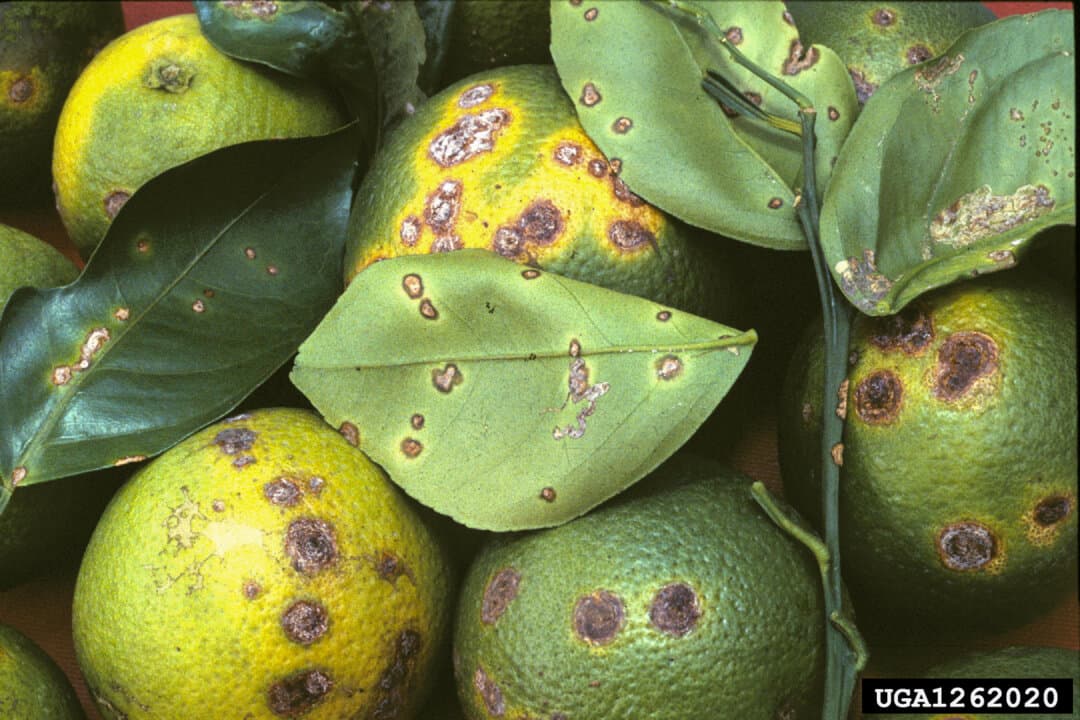
Fruit shows signs of citrus canker disease. The disease causes raised, corky lesions, making fruit unmarketable. (Timothy Schubert, CC BY 3.0 US)

Fruit shows signs of citrus canker disease. The disease causes raised, corky lesions, making fruit unmarketable. (Timothy Schubert, CC BY 3.0 US)

Then just two years later, two back-to-back major hurricanes—Helene first, then Milton—would slam into Florida in the course of less than two weeks, further devastating the state’s citrus crops.


Tillett lost a fifth of his grove during those storms, as the hammering winds blew over many of his younger trees.
But citrus greening, Tillett said, has been the biggest factor in so many multigenerational growers’ choice to leave the state’s cherished orange industry. 


“The groves fell into nonproduction. Everybody lost,” he said. “I mean, it’s hard to justify a citrus grove when you’re not making money.”
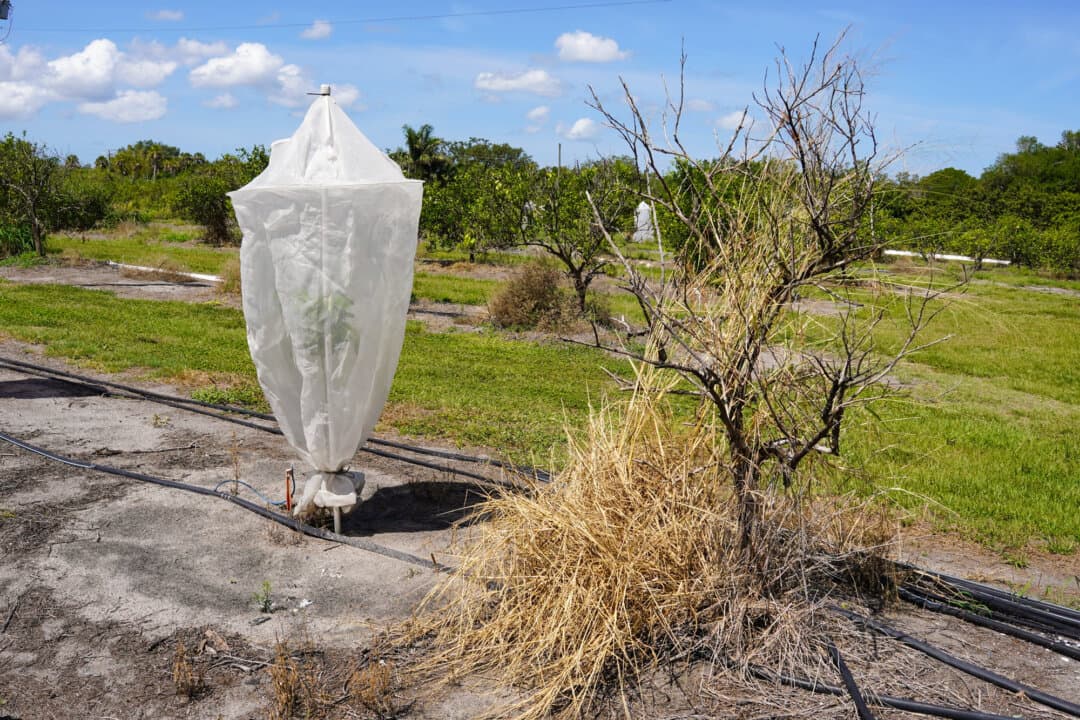
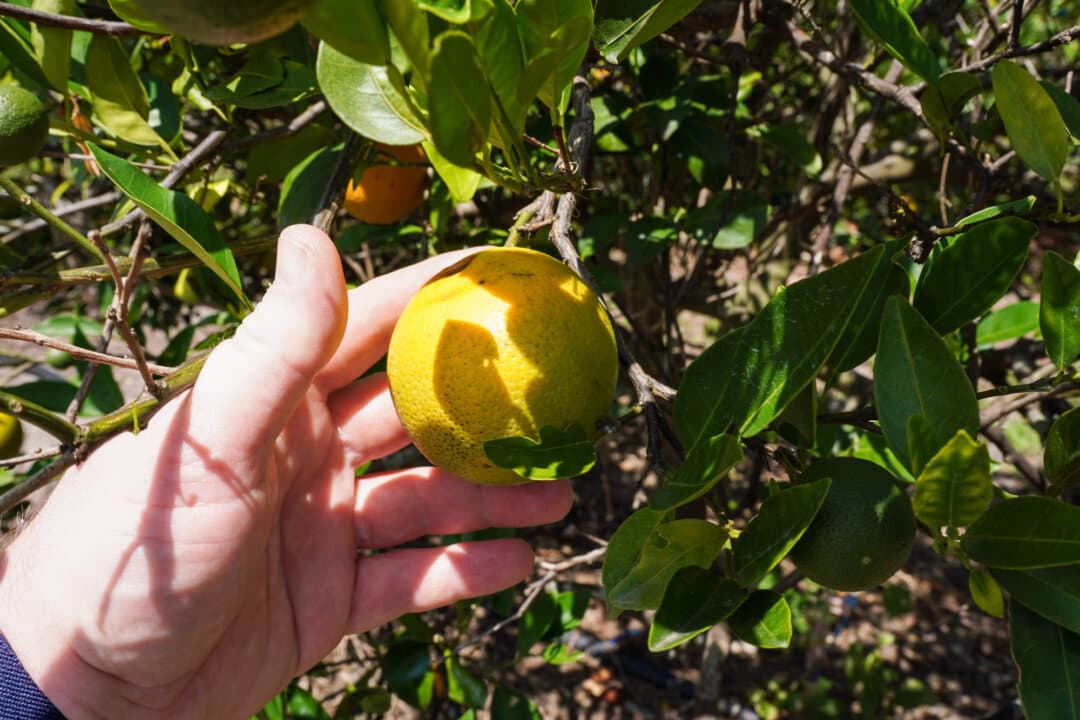
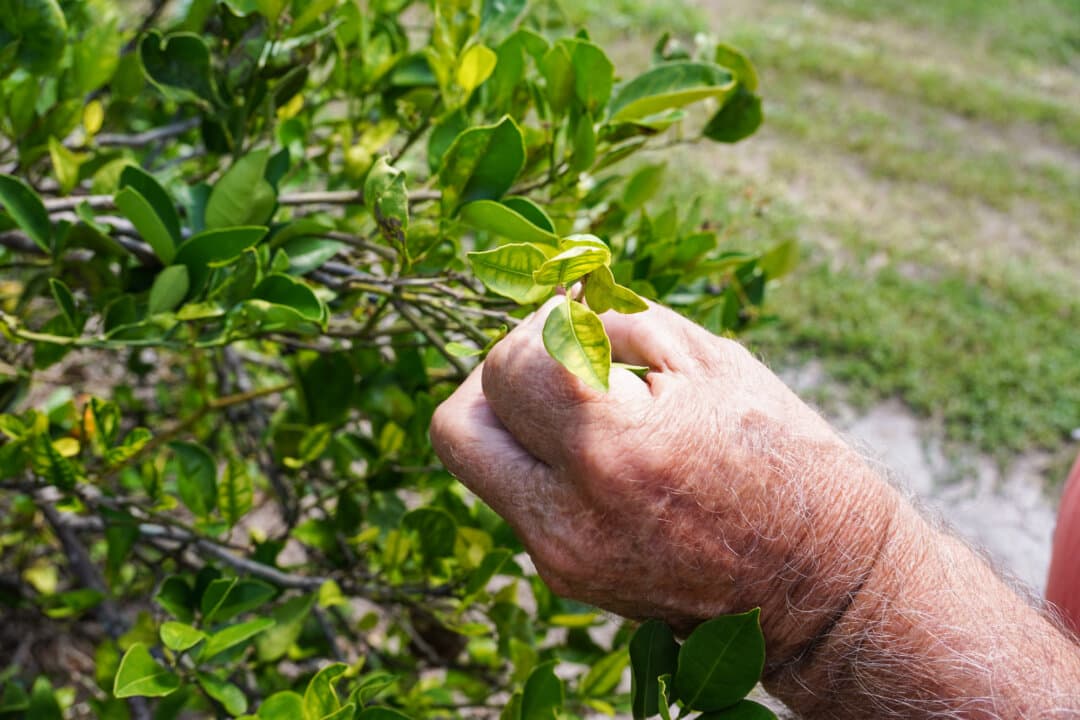
(Top) An orange sapling under a protective mesh cover grows next to an orange tree that succumbed to citrus greening, at the Tillett family farm, in Terra Ceia, Florida, on May 21, 2026. Citrus greening causes rapid root loss, draining the life from healthy trees as they struggle to absorb and retain nutrients. (Bottom Left) An orange growing on a tree impacted by citrus greening at the Tillett family farm in Terra Ceia, Florida, on May 21, 2026. What was once 600 acres of citrus trees in the 1970s has now dwindled to five. (Bottom Right) Lifelong farmer Sidney Tillett shows orange leaves that have grown asymmetrically due to citrus greening, with divots from Asian citrus psyllid bites, at his farm in Terra Ceia, Florida, on May 21, 2026. The destruction of Florida’s citrus industry kicked into high gear in 2005 when disease spread by the Asian citrus psyllid surfaced in the United States. (Jacob Burg/The Epoch Times)(Top) An orange sapling under a protective mesh cover grows next to an orange tree that succumbed to citrus greening, at the Tillett family farm, in Terra Ceia, Florida, on May 21, 2026. Citrus greening causes rapid root loss, draining the life from healthy trees as they struggle to absorb and retain nutrients. (Bottom Left) An orange growing on a tree impacted by citrus greening at the Tillett family farm in Terra Ceia, Florida, on May 21, 2026. What was once 600 acres of citrus trees in the 1970s has now dwindled to five. (Bottom Right) Lifelong farmer Sidney Tillett shows orange leaves that have grown asymmetrically due to citrus greening, with divots from Asian citrus psyllid bites, at his farm in Terra Ceia, Florida, on May 21, 2026. The destruction of Florida’s citrus industry kicked into high gear in 2005 when disease spread by the Asian citrus psyllid surfaced in the United States. (Jacob Burg/The Epoch Times)

(Top) An orange sapling under a protective mesh cover grows next to an orange tree that succumbed to citrus greening, at the Tillett family farm, in Terra Ceia, Florida, on May 21, 2026. Citrus greening causes rapid root loss, draining the life from healthy trees as they struggle to absorb and retain nutrients. (Bottom Left) An orange growing on a tree impacted by citrus greening at the Tillett family farm in Terra Ceia, Florida, on May 21, 2026. What was once 600 acres of citrus trees in the 1970s has now dwindled to five. (Bottom Right) Lifelong farmer Sidney Tillett shows orange leaves that have grown asymmetrically due to citrus greening, with divots from Asian citrus psyllid bites, at his farm in Terra Ceia, Florida, on May 21, 2026. The destruction of Florida’s citrus industry kicked into high gear in 2005 when disease spread by the Asian citrus psyllid surfaced in the United States. (Jacob Burg/The Epoch Times)

Economic Impact

With the costs of production inputs skyrocketing as oil and fertilizer prices remain high from the Iran war, an already tough citrus market is adding strain for many growers statewide.

But even before the recent energy cost hike, greening had ballooned the price of growing oranges in Florida.


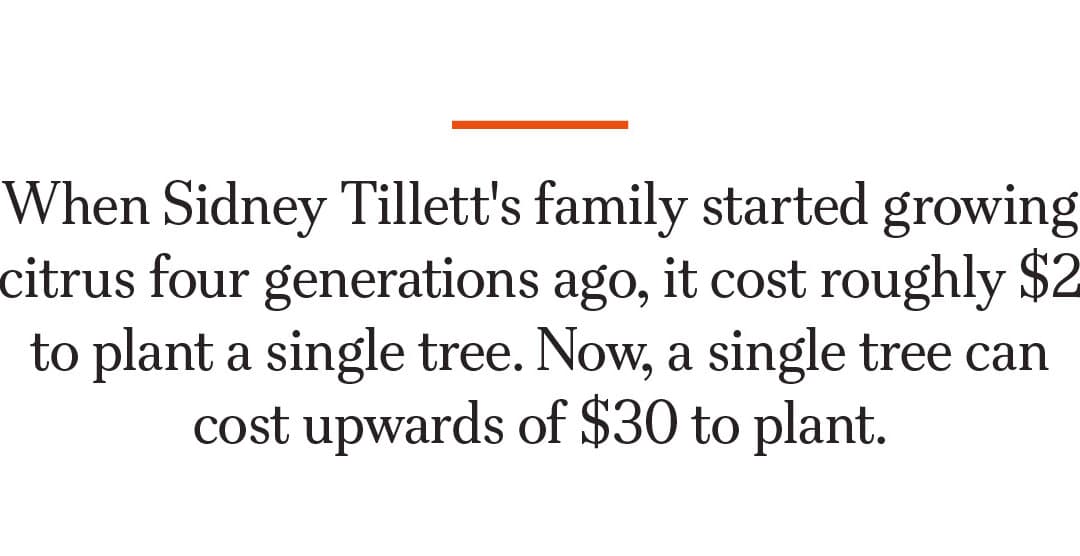
When his family started growing, Tillett said, it cost roughly $2 to plant a single tree. Now, inflation has increased the cost of the same tree to $10, and he must spend $10 for the protective mesh screen and another $10 for the ground stake it’s tied to. That means a single tree can cost upward of $30 to plant in the ground.
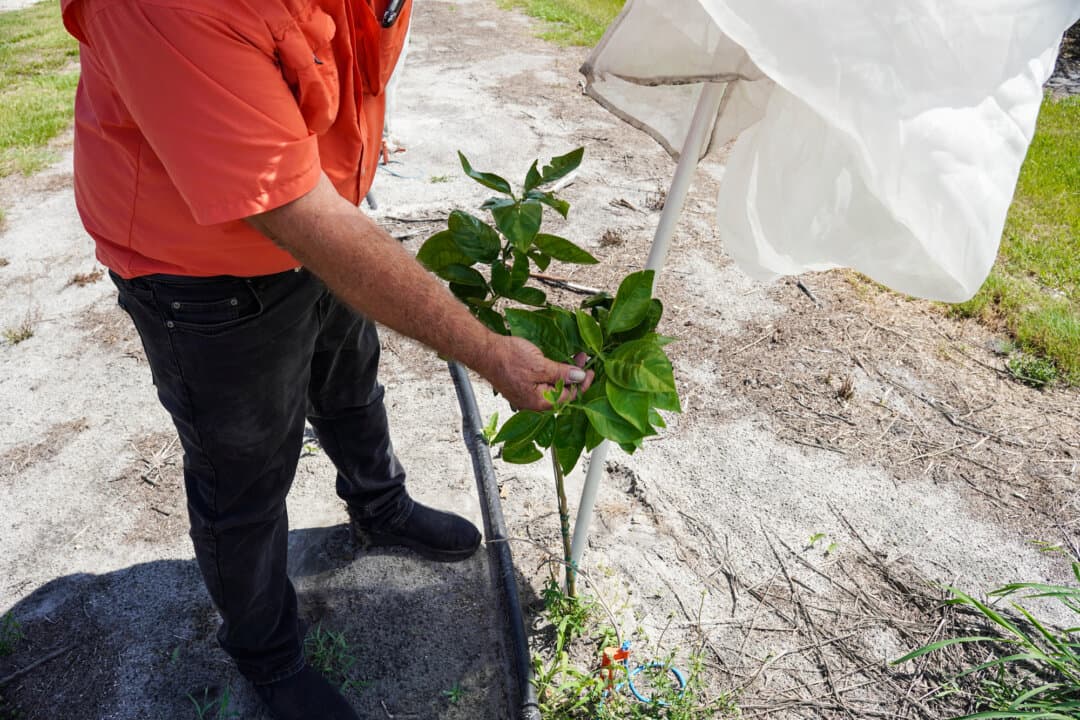
Lifelong citrus farmer Sidney Tillett lifts the protective mesh canopy from a young sapling at his farm in Terra Ceia, Florida, on May 21, 2026. Tillett recalls that 25-foot-tall citrus trees on the farm could sometimes produce 1,000 pounds of fruit in a single season. (Jacob Burg/The Epoch Times)

Lifelong citrus farmer Sidney Tillett lifts the protective mesh canopy from a young sapling at his farm in Terra Ceia, Florida, on May 21, 2026. Tillett recalls that 25-foot-tall citrus trees on the farm could sometimes produce 1,000 pounds of fruit in a single season. (Jacob Burg/The Epoch Times)

“Fruit costs have skyrocketed,” he said. “People used to come in and buy a bushel, and now they'll come in and buy two or three pieces of fruit.”


Decades ago, Tillett sold bushels of fruit for $23.75, which included shipping, he said. Now, that same bushel costs close to $200.


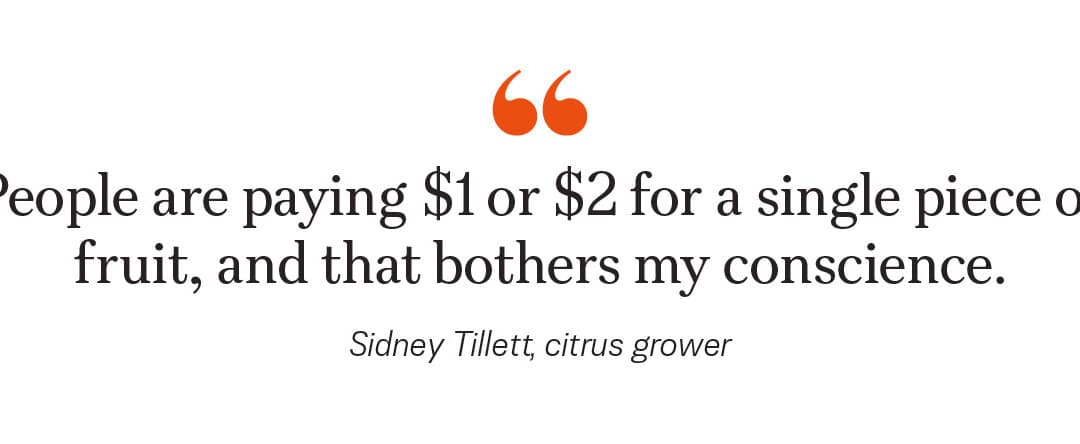
“People are paying $1 or $2 for a single piece of fruit, and that bothers my conscience,” Tillett said.


Citrus greening has also devastated his grove so much that all the fruit he sells in his groveside market, The Citrus Place, is sourced from other farmers in the state. He also squeezes the fruit in-house to make his popular orange juice.
“[Previously], there were times when I would juice five days a week to keep up with the demand, and now we juice about the equivalent of one day a week, because juice sales have gone down,” he said. “I don’t know why. I don’t know whether it’s the cost.”


Two and a half decades ago, the United States produced 45 percent of all orange juice worldwide, and Florida dominated the U.S. market. Today, that number has dwindled to 6 percent.


Tillett said he’s also no longer able to use the best possible fruit for his juices, as so many orange and grapefruit varieties “have disappeared completely” since citrus greening rocked the industry.
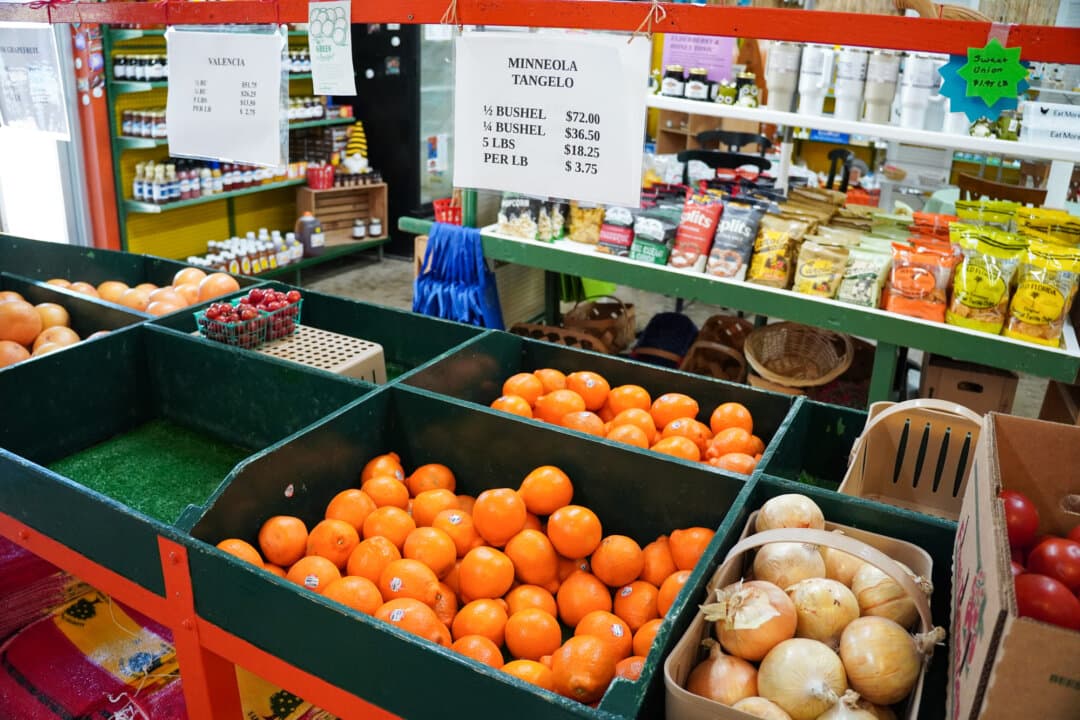
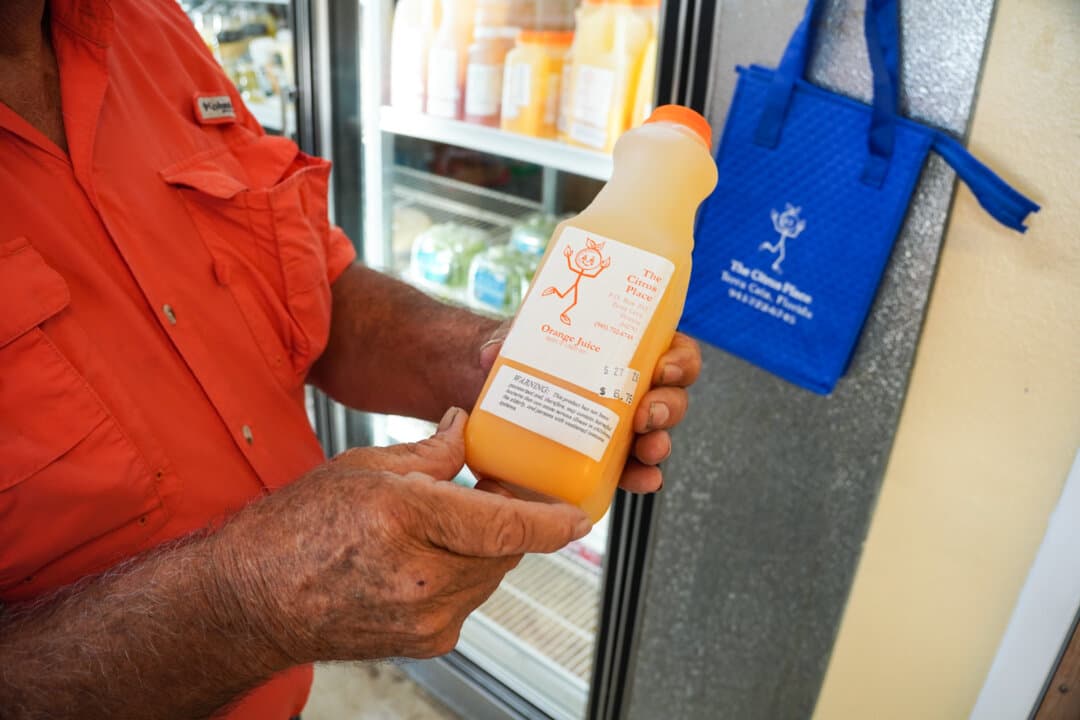
(Top) A bin of Minneola tangelos can be seen at The Citrus Place in Terra Ceia, Florida, on May 21, 2026. Because of devastation caused by citrus greening, the fruit sold in the market is sourced from other farmers in the state. (Bottom) Lifelong citrus farmer Sidney Tillett shows his popular fresh-squeezed orange juice at The Citrus Place in Terra Ceia, Florida, on May 21, 2026. The orange was once the state's largest cash crop. (Jacob Burg/The Epoch Times)

(Top) A bin of Minneola tangelos can be seen at The Citrus Place in Terra Ceia, Florida, on May 21, 2026. Because of devastation caused by citrus greening, the fruit sold in the market is sourced from other farmers in the state. (Bottom) Lifelong citrus farmer Sidney Tillett shows his popular fresh-squeezed orange juice at The Citrus Place in Terra Ceia, Florida, on May 21, 2026. The orange was once the state's largest cash crop. (Jacob Burg/The Epoch Times)

For a farm such as Golden Ridge Groves, with nearly 750 acres of trees, which is roughly 32.7 million square feet, the cost of installing protective screens can range between $49 million and $98 million.
But the Bevilacquas see it as a necessary solution, as short-term mesh covers attached to single trees only delay the infection.


“That’s the thing that’s so difficult about greening, it’s the reinfection over and over and over. The tree just can’t battle out of it,” Shane Bevilacqua said.

“We’re very optimistic about what we’re seeing. Will it be an industry-wide thing? Will it be a niche? I think only time will tell. But our family’s excited about it. It’s working for us.”
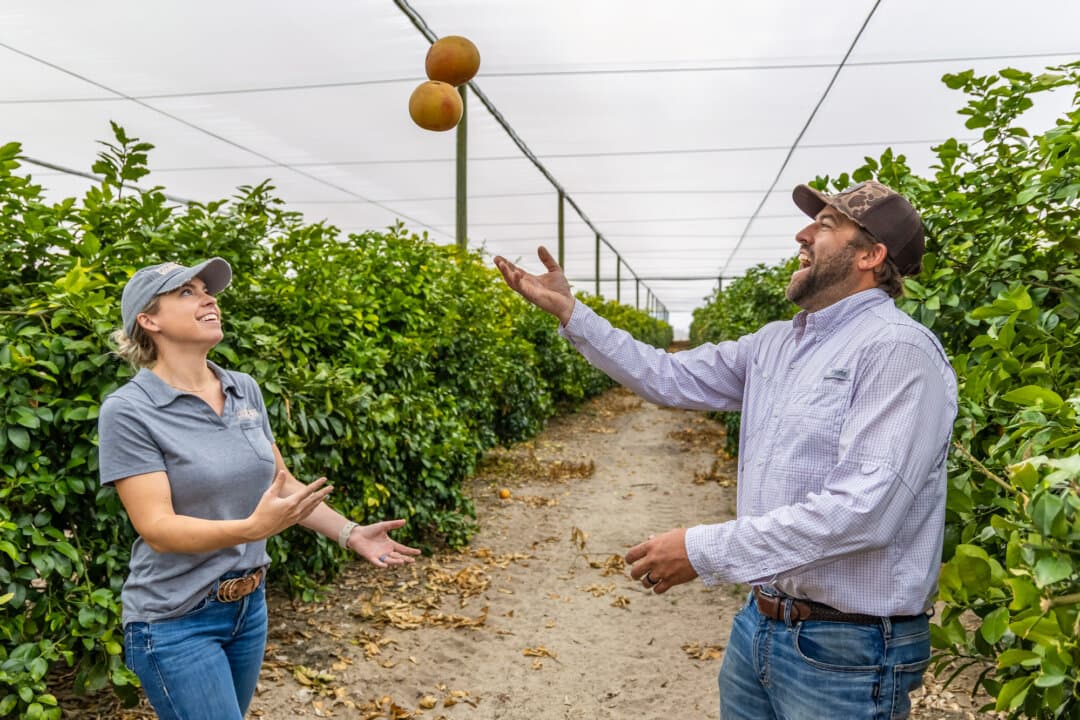
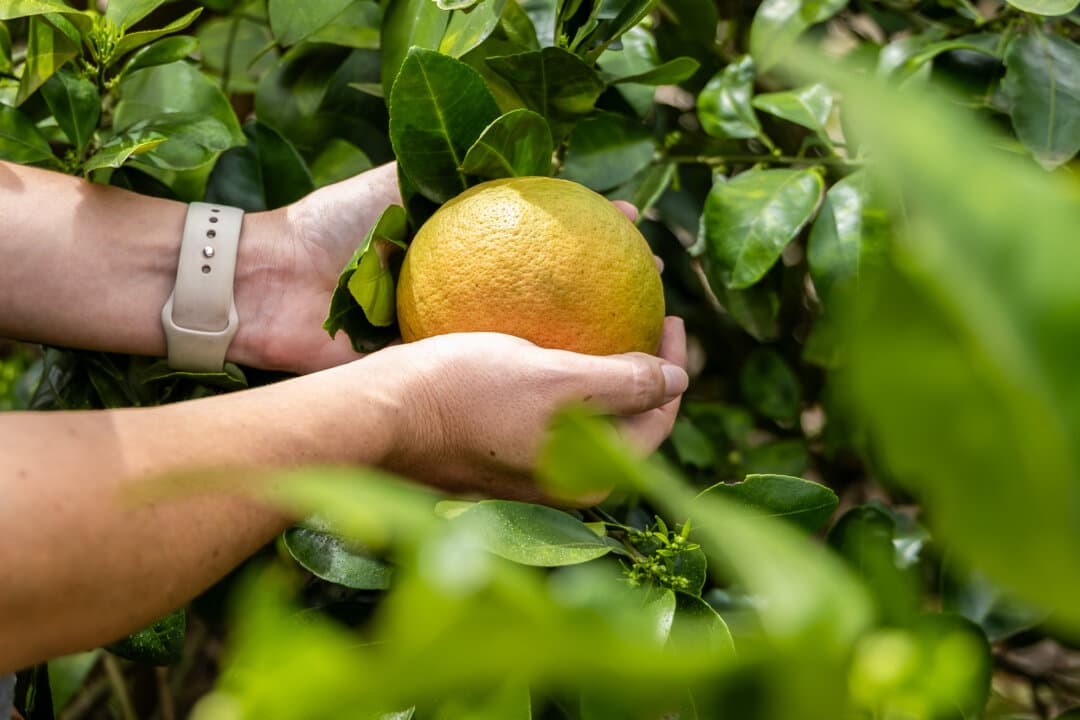
(Top) Katie and Shane Bevilacqua toss freshly picked grapefruit grown at their farm, Golden Ridge Groves, in Bartow, Fla., on March 3, 2026. The Bevilacquas have a public market nestled alongside berry fields where customers can pick their own baskets of fruit. (Bottom Left) Katie Bevilacqua inspects grapefruit grown at her farm, Golden Ridge Groves, in Bartow, Fla., on March 3, 2026. Citrus greening has slashed U.S. grapefruit production by 88 percent since 2000. (Bottom Right) Katie Bevilacqua inspects grapefruit grown at her farm, Golden Ridge Groves, in Bartow, Fla., on March 3, 2026. The Bevilacquas say they're optimistic that their new approach could save their trees from citrus greening. (Natasha Holt/The Epoch Times)(Top) Katie and Shane Bevilacqua toss freshly picked grapefruit grown at their farm, Golden Ridge Groves, in Bartow, Fla., on March 3, 2026. The Bevilacquas have a public market nestled alongside berry fields where customers can pick their own baskets of fruit. (Bottom Left) Katie Bevilacqua inspects grapefruit grown at her farm, Golden Ridge Groves, in Bartow, Fla., on March 3, 2026. Citrus greening has slashed U.S. grapefruit production by 88 percent since 2000. (Bottom Right) Katie Bevilacqua inspects grapefruit grown at her farm, Golden Ridge Groves, in Bartow, Fla., on March 3, 2026. The Bevilacquas say they're optimistic that their new approach could save their trees from citrus greening. (Natasha Holt/The Epoch Times)

(Top) Katie and Shane Bevilacqua toss freshly picked grapefruit grown at their farm, Golden Ridge Groves, in Bartow, Fla., on March 3, 2026. The Bevilacquas have a public market nestled alongside berry fields where customers can pick their own baskets of fruit. (Bottom Left) Katie Bevilacqua inspects grapefruit grown at her farm, Golden Ridge Groves, in Bartow, Fla., on March 3, 2026. Citrus greening has slashed U.S. grapefruit production by 88 percent since 2000. (Bottom Right) Katie Bevilacqua inspects grapefruit grown at her farm, Golden Ridge Groves, in Bartow, Fla., on March 3, 2026. The Bevilacquas say they're optimistic that their new approach could save their trees from citrus greening. (Natasha Holt/The Epoch Times)

The Industry’s Future

Because of the sheer cost of growing hundreds of acres of citrus under protective screen, the Citrus Research and Education Center is attempting to isolate and breed strains of citrus trees and root stock that are resistant to huanglongbing.


Although some commercial citrus varieties are tolerant to citrus greening, most are not resistant to the infection, and some that are tolerant may still struggle when infected, Tripti Vashisth, associate director for the center, told The Epoch Times.


And even if researchers find resilient varieties, they must first be tested in the field for several years, as Florida has considerably sandy soil that is low in nutrients, further exacerbating the root loss effect from citrus greening, she said.


Even then, it could potentially take three more years to get the tree into production, Vashisth said. Until that point, the goal is to “do whatever it takes to keep the trees productive,” she said.


Despite the setbacks and increased operational costs, some growers are not giving up.


Although Tillett no longer relies on his grove to supply fruit to The Citrus Place, the store is popular among vacationers who make it their first and last stop when driving down from the Tampa airport, before staying on Anna Maria Island or in Sarasota’s Siesta Key.


His ice cream is the store’s biggest seller. Customers flock to the orange and vanilla swirl, Tillett said.
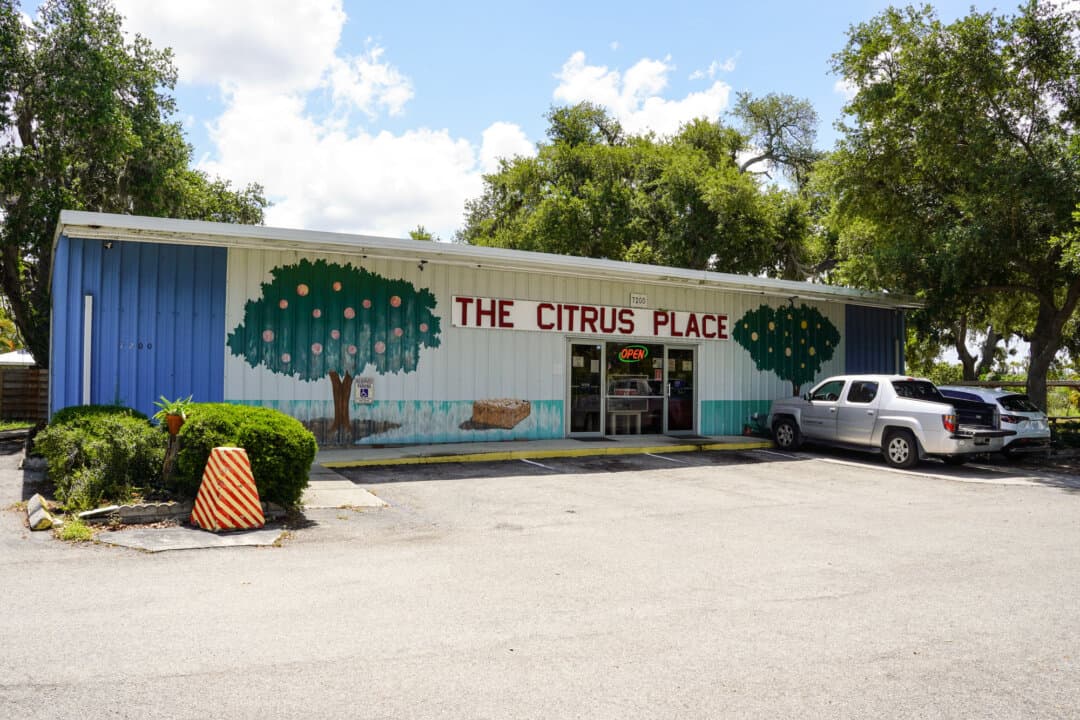
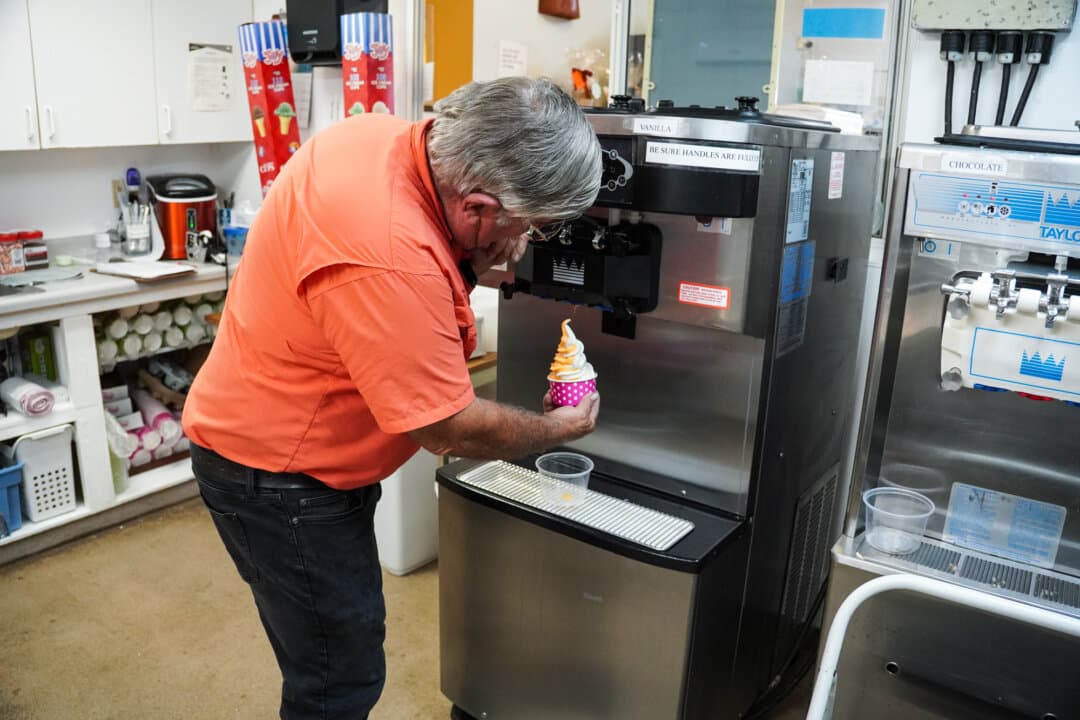
(Top) The Citrus Place, a fruit and produce market in Terra Ceia, Florida, on May 21, 2026. The store is popular among vacationers. (Bottom) Lifelong citrus farmer Sidney Tillett displays his homemade orange and vanilla swirl ice cream at The Citrus Place in Terra Ceia, Florida, on May 21, 2026. His ice cream is the store's biggest seller. (Jacob Burg/The Epoch Times)

(Top) The Citrus Place, a fruit and produce market in Terra Ceia, Florida, on May 21, 2026. The store is popular among vacationers. (Bottom) Lifelong citrus farmer Sidney Tillett displays his homemade orange and vanilla swirl ice cream at The Citrus Place in Terra Ceia, Florida, on May 21, 2026. His ice cream is the store's biggest seller. (Jacob Burg/The Epoch Times)

An hour inland from The Citrus Place, winding state roads pass fields of dead and decaying orange trees covered in yellowed weeds. 


You’ll know you’re near Golden Ridge Groves when you see the massive protective mesh structures standing tall over hundreds of acres of grapefruit trees. 


The Bevilacquas’ public market at their family farm near Bartow is nestled alongside berry fields where customers can pick their own baskets of fruit.


The store offers selections of fruit and produce, fresh juice, and sorbet made directly from the couple’s grapefruit grove. They also welcome school field trips, allowing children to see the process from seed to sale.
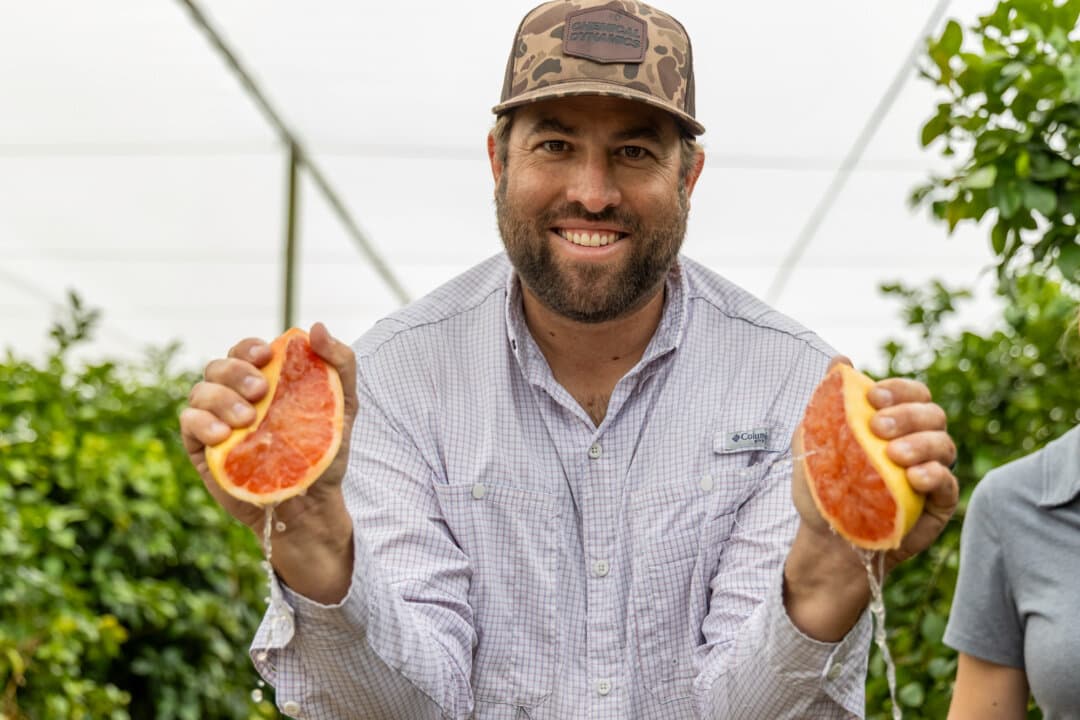
Shane Bevilacqua squeezes the halves of a sliced grapefruit to inspect the inside at Golden Ridge Groves in Bartow, Fla., on March 3, 2026. Large tent-like covers protect Bevilacqua's trees from the Asian citrus psyllid. (Natasha Holt /The Epoch Times)

Shane Bevilacqua squeezes the halves of a sliced grapefruit to inspect the inside at Golden Ridge Groves in Bartow, Fla., on March 3, 2026. Large tent-like covers protect Bevilacqua's trees from the Asian citrus psyllid. (Natasha Holt /The Epoch Times)

Standing underneath one of their protective structures, Shane Bevilacqua points to a tall, lush grapefruit tree that is likely weeks away from a full bloom.


“All of these are going to be flowers,” he said, pointing to the buds all over the tree stems. “The blossoms these grapefruit trees will have are going to be absolutely outstanding.”


Strong blooms mean healthy trees. Healthy trees mean a viable industry, even if it’s going to take time.


“There certainly is a future to Florida’s citrus industry,” Bevilacqua said.
Share This Article:
Jacob Burg reports on national politics, aerospace, and aviation for The Epoch Times. He previously covered sports, regional politics, and breaking news for the Sarasota Herald Tribune.