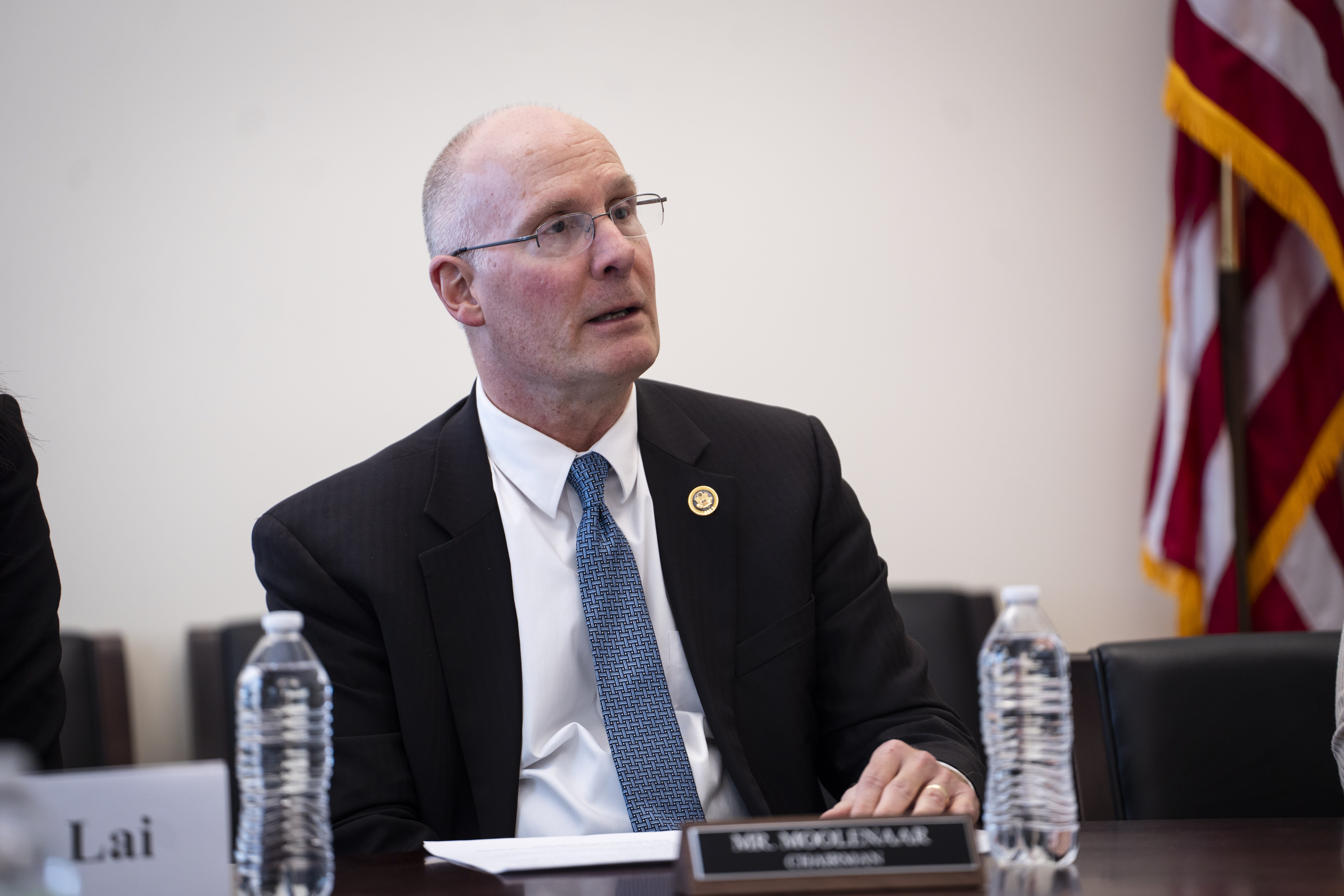

Two House lawmakers from Michigan have introduced legislation aimed at protecting the American auto industry and U.S. national security, specifically by barring Chinese-made internet-connected vehicles from U.S. roads.
Reps. John Moolenaar (R-Mich.) and Debbie Dingell (D-Mich.) on May 11 introduced the Connected Vehicle Security Act. The companion version of the legislation was introduced in the Senate last month by Sens. Bernie Moreno (R-Ohio) and Elissa Slotkin (D-Mich.).
Moolenaar is chairman of the House Select Committee on the Chinese Communist Party (CCP), and Dingell serves on the House Committee on Energy and Commerce.
“The American auto industry is vital for jobs, national security, and the future of America’s manufacturing base,” Moolenaar said in a statement on Monday.
“China cheats in every industry, and in autos it is overproducing vehicles and components, and selling them for cheap in hopes they will put our companies out of business,” he added, alleging that some Chinese automakers, including CATL and BYD, have used slave labor to undercut American wages.
“These companies should not be allowed to do business in America, and their products shouldn’t be in our cars or threatening our infrastructure.”
The Michigan-based “Detroit Three”—Ford Motor Company, General Motors, and Stellantis—welcomed the legislation upon its April introduction in the Senate.
Dingell said Beijing has propped up its auto industry via massive government subsidies, unfair trade practices, and slave labor.
“I am not interested in repeating the mistakes that hollowed out manufacturing communities across this country while politicians told workers globalization would somehow magically work itself out,” Dingell said in a statement on Monday.
“Auto workers are facing uncertainty, but I am certain about one thing: the future of the American auto industry must be built by American workers.”
The legislation would ban the import, sale, and operation of vehicles manufactured in China, Iran, North Korea, and Russia. Internet-connected vehicle information and communications technologies, including software, hardware, and data systems, from these nations would also be banned.
The ban on vehicles and software would take effect on January 1, 2027, while the hardware ban would follow on Jan. 1, 2030.
The legislation would also empower the Secretary of Commerce to “establish a declaration of conformity process, authorization and waiver procedures, and a binding ruling and advisory opinion mechanism for industry compliance,” according to the select committee.
Under the legislation, violators could face civil penalties of at least $1.5 million per offense.
The Connected Vehicle Security Act builds on actions taken by both the Trump and Biden administrations, according to the select committee.
A 2019 executive order issued by President Donald Trump declared a national emergency over foreign threats to the nation’s information and communications technology supply chain, providing the federal government with the authority to respond.
The Biden administration later relied on that authority to finalize regulations in January 2025 barring internet-connected vehicle software and hardware that was tied to China and Russia.
The legislation would codify and expand those protections into law.
The Washington-based Information Technology and Innovation Foundation applauded Moolenaar and Dingell for their effort.
“Congress is right to act before [Chinese automakers] gain a foothold in the U.S. market,” Stephen Ezell, the foundation’s vice president of global innovation policy, said in a statement on May 7, following the announcement of the legislation.
“Once China’s subsidized firms are embedded in the U.S. market, the economic and national security damage would be far harder to reverse—and it would not be limited to Detroit,” Ezell added. “It would ripple across the broader industrial base, weakening America’s manufacturing capacity, innovation ecosystem, and strategic resilience.”
On Monday, the China Passenger Car Association announced that car sales in China dropped 21.6 percent in April from a year earlier to 1.4 million vehicles. Meanwhile, Chinese exports of electric vehicles and plug-in hybrid vehicles increased 111.8 percent from a year earlier, surpassing an 80.2 percent increase in overall car exports.
In response to the Chinese data, Moreno warned in a May 11 post on X that the CCP has a very different motive for propping up its auto sector.
“The Chinese Communist Party did NOT create an auto industry for domestic consumption,“ he wrote. ”They created a mobile spying apparatus intent on simultaneously destroying the US auto industry and providing the CCP with unparalleled surveillance.”
Reuters contributed to this report.