Take away today’s screens and streaming services, travel back to the latter half of the 20th century, and you’d frequently find families gathered in front of the television, watching comedies like “I Love Lucy,” variety shows like “The Ed Sullivan Show” and “Hee-Haw,” dramas like “Dr. Kildare” and “Perry Mason,” and movie reruns.
In the 1930s and 1940s, evenings found Mom, Dad, the kids, and grandparents gathered round the radio, where they caught shows like “The Shadow,” “Fibber McGee and Molly,” “Lux Radio Theater,” and “Jack Benny.”
Jump back into the 19th century, and … what?
Do-It-Yourself Diversions
Not only was electronic entertainment missing, but, in most cases, so was electricity itself. With the exception of vaudeville shows, big city theaters, and club performances, if you wanted diversion in the evenings, you made it yourself.
Suppose it’s June 1890 in Front Royal, Virginia. You’d likely hear and see people sitting on the front porches of the houses clustered around downtown. The porches remain today, but people rarely use them. You might hear music, a piano or someone singing, but today most of the music comes from passing cars with their sound systems cranked up. Then as well, what with the larger families of that day, you’d have seen children together in the gloaming, laughing, chasing fireflies, or playing hide-and-seek in yards that today are as empty as the porches.
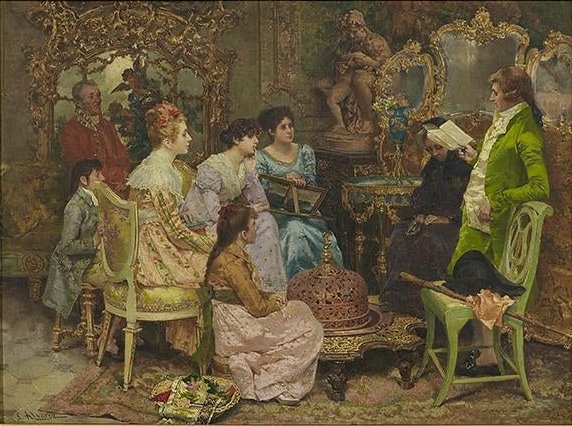
As darkness fell, you might peek through a window and see a family gathered in the parlor for a read-aloud.
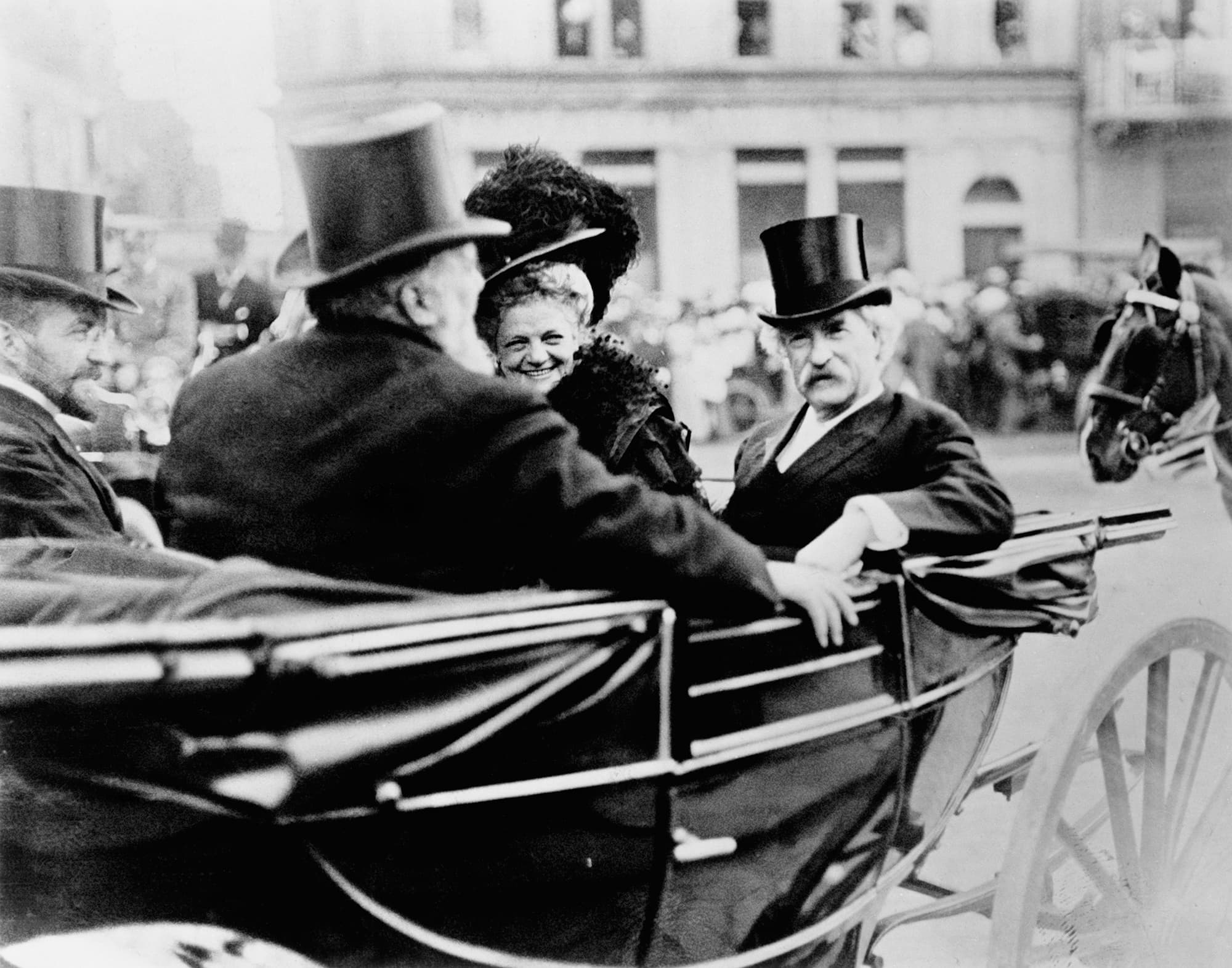
Mark Twain with friends in a carriage. (Fotosearch/Getty Images)
To families all across the United States, books in the 19th century were their radios and televisions, that is, their chief form of reliable entertainment from the outside world. Besides reading from the Bible, families enjoyed the comedy, pathos, and tragedy from stories by the likes of Charles Dickens, Walter Scott, and the home-grown Mark Twain. Adults and children might be living on a farm in Iowa, but with a strong reader, a working imagination, and a novel like “King Solomon’s Mines” or “Oliver Twist” could whisk listeners off exotic lands and people.
Then, there were the poets.
The Golden Age of Parlor Poetry
A clip on YouTube by “The Fireside Poets” begins:
“When Henry Wadsworth Longfellow turned 70, the United States celebrated with the fervor of a national holiday. Schools closed, speeches were made, and thousands of children marched in his honor. For nearly eighty years, the biggest mass media celebrities in America didn’t play sports or hold political office. They wrote poetry.”
With reading aloud as a major form of mass media in that era, this celebrity makes sense.
Families looking for entertainment found it in poetry that fit within certain parameters. They wanted rhyming lines and a rhythm as strong and regular as a pulse. These made for easy reading and recitation. They wanted verse that told a story or created a dramatic scene. They also wanted family-friendly poems, meaning those that imparted lessons in morality and truth and whose subject matter appealed to young and old alike. And, at this point in their history, Americans were eager to mark out their national identity, and many poets, seeking the same, were glad to oblige.
Longfellow was perhaps the most prominent of these makers of verse. Poems like “Paul Revere’s Ride,” “The Song of Hiawatha,” “The Village Blacksmith,” and “The Children’s Hour” all fit, and fit well, these criteria for family read-alouds. A brief look at the first lines of “Paul Revere’s Ride” fulfills all of the criteria:
Listen, my children, and you shall hear
Of the midnight ride of Paul Revere,
On the eighteenth of April, in Seventy-five;
Hardly a man is now alive
Who remembers that famous day and year.
Here is a solid beat, a historical figure, and a direct appeal to children.
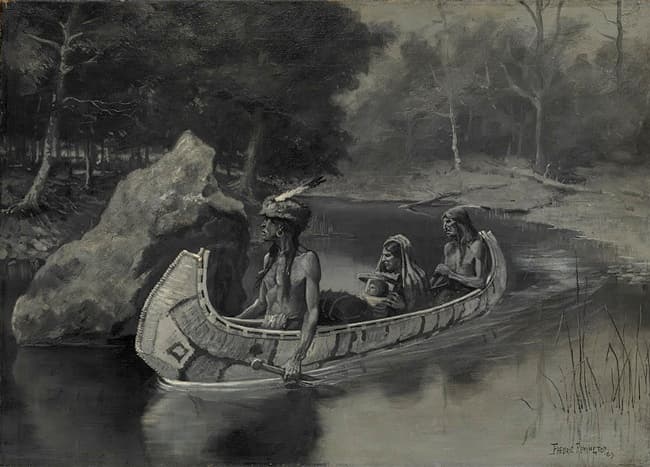
"Hiawatha's Friends," circa 1890, by Frederic Remington. (Public Domain)
“The Song of Hiawatha” illustrates even better the drumbeat rhythm that captivated hearthside listeners:
By the shores of Gitche Gumee,
By the shining Big-Sea-Water,
Stood the wigwam of Nokomis,
Daughter of the Moon, Nokomis.
Dark behind it rose the forest,
Rose the black and gloomy pine-trees,
Rose the firs with cones upon them;
Bright before it beat the water,
Beat the clear and sunny water,
Beat the shining Big-Sea-Water.
Sentiment was also a welcome guest to hearth and home. In his 1863 “The Children’s Hour,” Longfellow ends with this tribute of love to his daughters, comparing his study at the end of his workday with a castle stormed by the playful girls:
I have you fast in my fortress,
And will not let you depart,
But put you down into the dungeon
In the round-tower of my heart.
And there will I keep you forever,
Yes, forever and a day,
Till the walls shall crumble to ruin,
And moulder in dust away!
Fireside Bards Then and Now
Longfellow was one of five New Englanders who, because of their household popularity, were known as the Fireside Poets, or sometimes as the Schoolroom Poets because their rhythmic verse was often memorized in the classroom. William Cullen Bryant, John Greenleaf Whittier, Oliver Wendell Holmes, Sr., and James Russell Lowell were other members of this quintet, joined on some lists by Ralph Waldo Emerson.
In his 1888 book “Literature in School,” educator Horace Scudder wrote of these men, “They were born on American soil; they have breathed American air; they were nurtured on American ideas. They are Americans of Americans.”
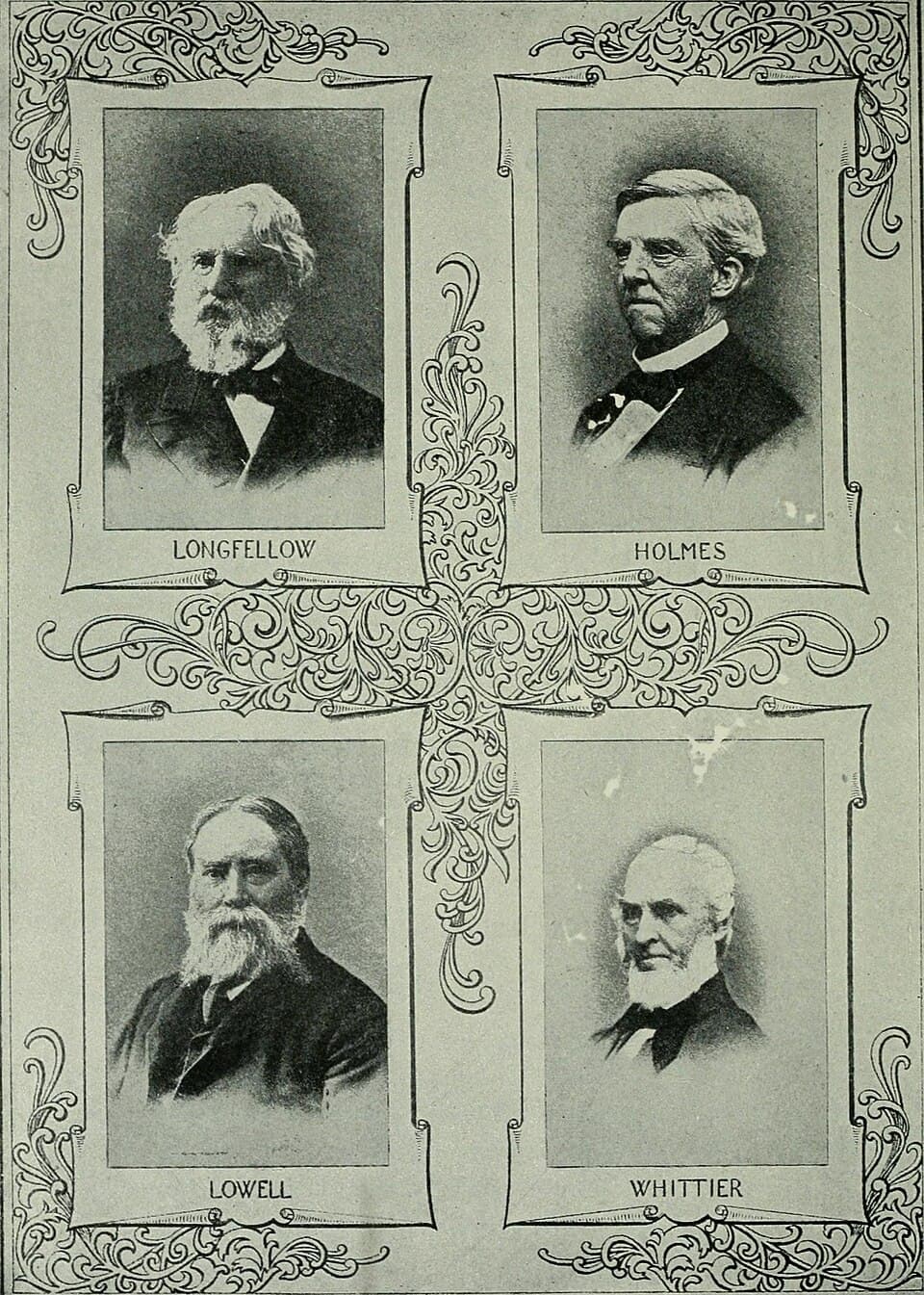
The "Schoolroom Poets" crafted rhyming verses with clear storylines, humor, and morals. Their works were commonly taught in schools. (Public Domain)
These were the most popular parlor poets, but there were many others, of course, whose verse entertained and enlightened American families. Poems like Thomas Buchanan Read’s dramatic “Sheridan’s Ride,” Ella Wheeler Wilcox’s character-building exhortations in verse like “Solitude” and “It Might Have Been,” and so many others were welcome houseguests. British poets—Alfred, Lord Tennyson, William Wordsworth, Robert and Elizabeth Browning, Rudyard Kipling, and more—were also given a place at the American hearth.
This cultural exchange was by no means one-sided. In 1943, on a car trip from what is now called Camp David back to Washington, Franklin Roosevelt pointed out Barbara Fritchie’s home in Frederick, Maryland to Winston Churchill. To the astonishment of Roosevelt, his wife Eleanor, and Harry Hopkins who directed New Deal relief programs, Churchill recited, in its entirely, John Greenleaf Whittier’s “Barbara Frietchie” (as Whittier spelled her name), which he’d memorized as a boy.
Changes in culture and technology moved Americans away from this pastime. Meanwhile, poetry itself tended to shift in focus from storytelling and structured lines to emphasizing feeling and free verse. Some poets, like Robert Service, Stephen Vincent Millay, and Robert Frost, continued the traditions of the earlier era well into the 20th century, but today it’s mostly poets 20th-century modernists who appear in anthologies and are taught in classrooms.
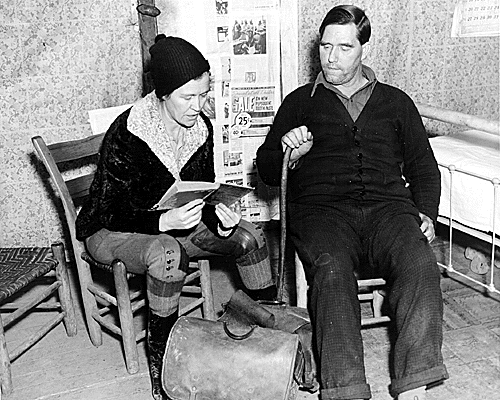
In 1938, a packhorse librarian reads to a man in the rural Kentucky mountains. Before widespread literacy, reading aloud was a crucial means of learning. (Public Domain)
Few of us would trade our electronic entertainments for a fireplace and a poem. Yet to make this an either-or proposition is create a false dilemma. We can go online and listen to recitations of any number of older poems, some of them quite moving, or we can always sit down with an actual book and share some poetry with our families and friends.
The fireside is optional.
What arts and culture topics would you like us to cover? Please email ideas or feedback to features@epochtimes.nyc.