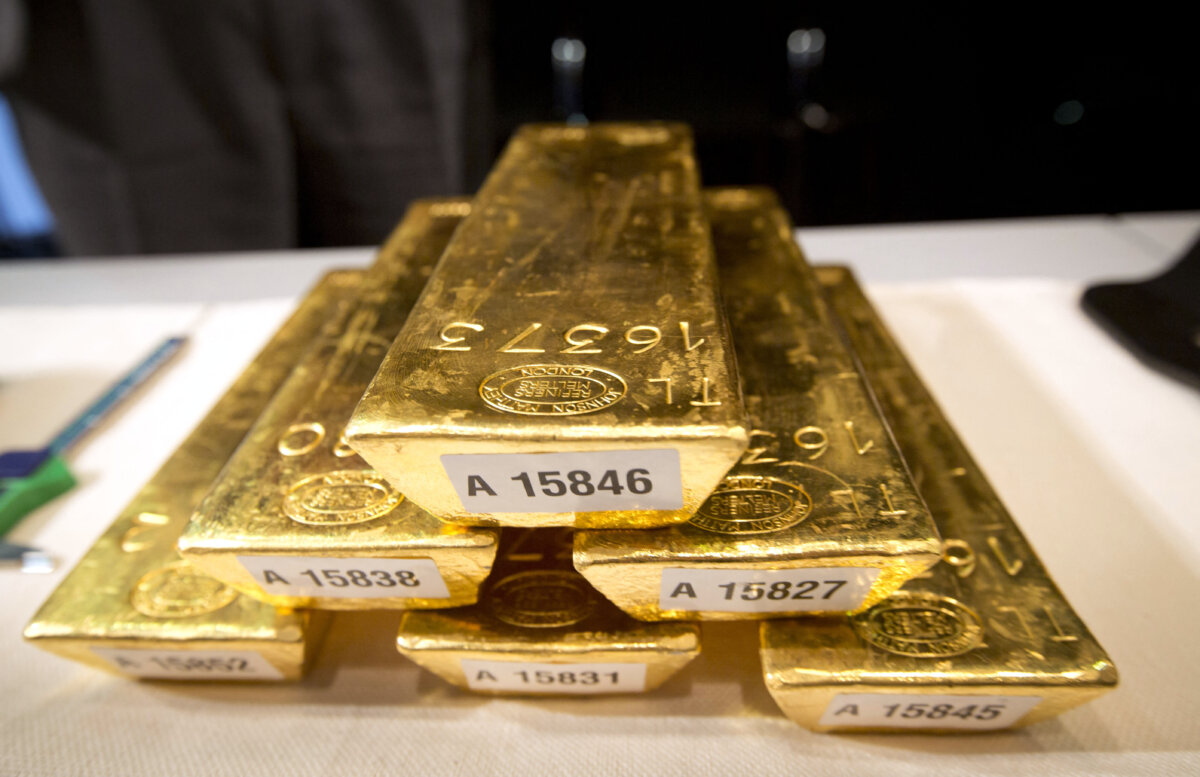

Gold prices suffered their sharpest single-session selloff since 2020, declining more than 5 percent on Oct. 21.
On the COMEX division of the New York Mercantile Exchange, gold futures fell by $231, or 5.3 percent, to a one-week low of $4,128.40 per ounce.
Despite the yellow metal’s selloff, prices are still up by more than 56 percent this year.
Silver, the sister commodity to gold, also suffered a significant drop. The white metal fell $3.49, or 6.8 percent, to $47.89 an ounce. Like gold, silver prices remain up almost 64 percent year to date.
Market watchers have been cautious during the precious metal’s meteoric ascent, with technical indicators pointing to an overbought situation.
While Joe Tigay, portfolio manager of the Rational Equity Armor Fund, has been optimistic about gold for years, the latest rally has been concerning to him.
“Everyone talks about how risky stocks are, how we’re in a bubble. But gold? Gold has become the ‘risk-free’ trade. Nobody questions whether it’s lofty,” Tigay said in a note emailed to The Epoch Times. “That’s precisely when you should question it.”
He pointed to enormous consumer demand for physical gold—in the United States and abroad—citing reports of Costco selling out of gold bars and coins in record time.
“When people line up in the streets to buy an asset, when the narrative becomes one-sided, when the trade gets this crowded—that’s your signal. I don’t care what the asset is. This is how manias end,” Tigay said.
For weeks, analysts have suggested the fierce appetite for gold had been driven by safe-haven demand, economic and geopolitical uncertainty, the government shutdown, and the Federal Reserve immersed in a rate-cutting cycle.
Lower U.S. Treasury yields have also supported gold’s ultra-bullish run since falling interest rates reduce the opportunity cost of holding non-yielding bullion. The benchmark 10-year yield fell below 4 percent on Oct. 21, and other long-term yields have also diminished.
In addition to traders booking profits, gold prices came under pressure from a strengthening U.S. dollar, which impacts the affordability of the metal for foreign investors.
The U.S. Dollar Index, a gauge of the buck against a weighted basket of currencies including the Japanese yen and British pound, inched closer to 99 by rising nearly 0.4 percent. Since reaching a bottom this past summer, the index has been attempting to pare its losses, but it is still down 9 percent this year.
The relative strength index—a momentum indicator indicating whether market conditions are overbought or oversold—suggests gold may have been oversold during the Tuesday session.
The next catalyst for gold could be this week’s inflation data.
Despite the government shutdown, now in its third week, the Bureau of Labor Statistics will release the September Consumer Price Index report on Oct. 24.
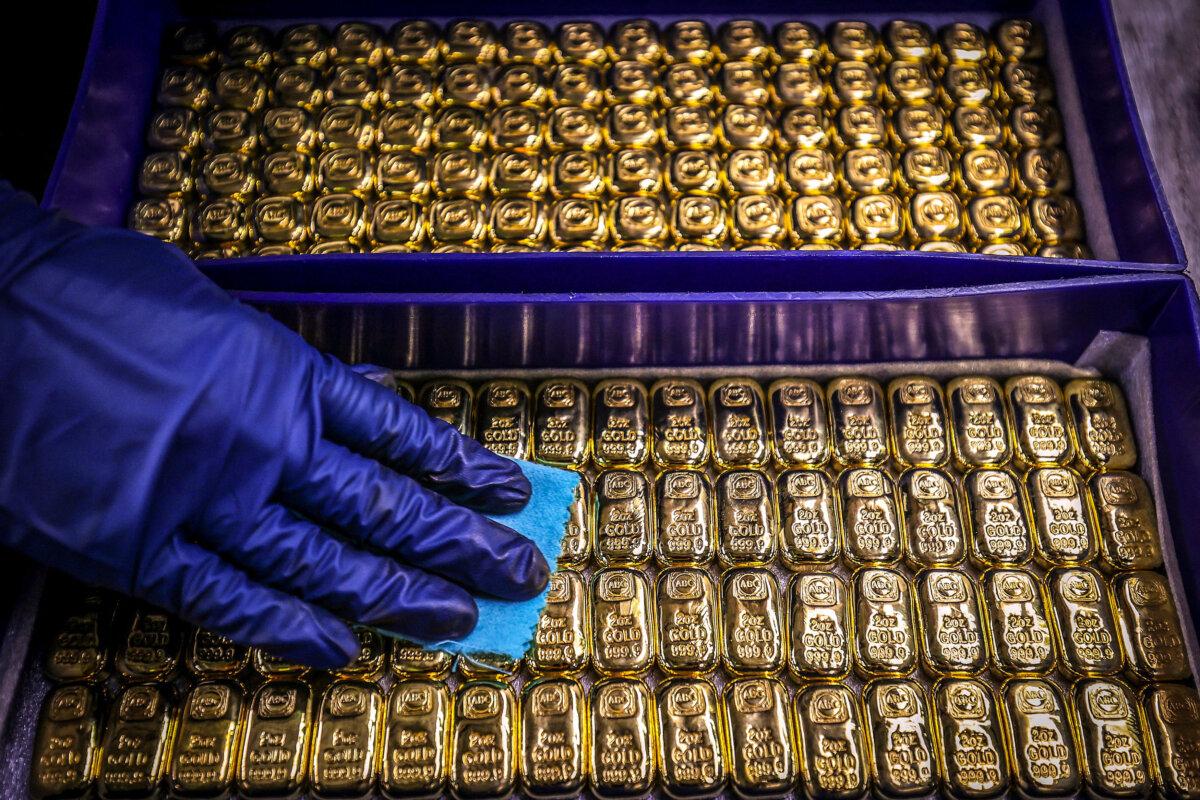
A worker polishes gold bullion bars at the ABC Refinery in Sydney on Aug. 5, 2020. (David Gray/AFP via Getty Images)
According to the Cleveland Fed’s Inflation Nowcasting model, the annual inflation rate is estimated to have risen to 3 percent for the first time since January. The regional central bank’s running estimate also indicates October inflation readings might be little changed.
Reading the Metal Tea Leaves
Looking ahead, 12-month forecasts suggest gold prices will stay firmly above $4,000. Silver, too, could hold the $50 threshold in the year ahead.
Patrick Casselman, commodity strategist at BNP Paribas Wealth Management, anticipated a correction on short-term profit-taking, prompting a downgraded view from “Positive” to “Neutral.”
Still, he maintained a long-term bullish stance for the metals market.
“But after the sharp rally, the market will probably have to consolidate and there will be some better entry opportunities,” Casselman said in an Oct. 20 note.
“In the longer term, we see further upside potential for gold and other precious metals due to tight supply and structurally increased investor interest. We adjust our 12-month price targets just above recent highs: gold at USD 4,400 (from USD 4,000) and silver at USD 55 (from USD 50).”
According to David Miller, senior portfolio manager and CIO at Catalyst Funds, the base case for gold is between $4,800 and $5,200 per ounce next year.
“With the first cut delivered and the dot plot pointing to additional easing through 2026, the macro setup of falling real rates + policy uncertainty is supportive,” Miller said in a recent note emailed to The Epoch Times.
JPMorgan Chase CEO Jamie Dimon is not a gold bug, but he has said it makes some “semi-rational” sense to own the yellow metal in investment portfolios.
“I’m not a gold buyer—it costs 4 percent to own it. But it could easily go to $5,000 or $10,000 in environments like this,” Dimon said at Fortune’s recent Most Powerful Women conference. “This is one of the few times in my life it’s semi-rational to have some in your portfolio.”
In other metal markets, copper futures dipped $0.07, or 1.4 percent, to $4.96 per pound. Platinum and palladium prices each fell about 7 percent to $1,536 and $1,438 an ounce, respectively.