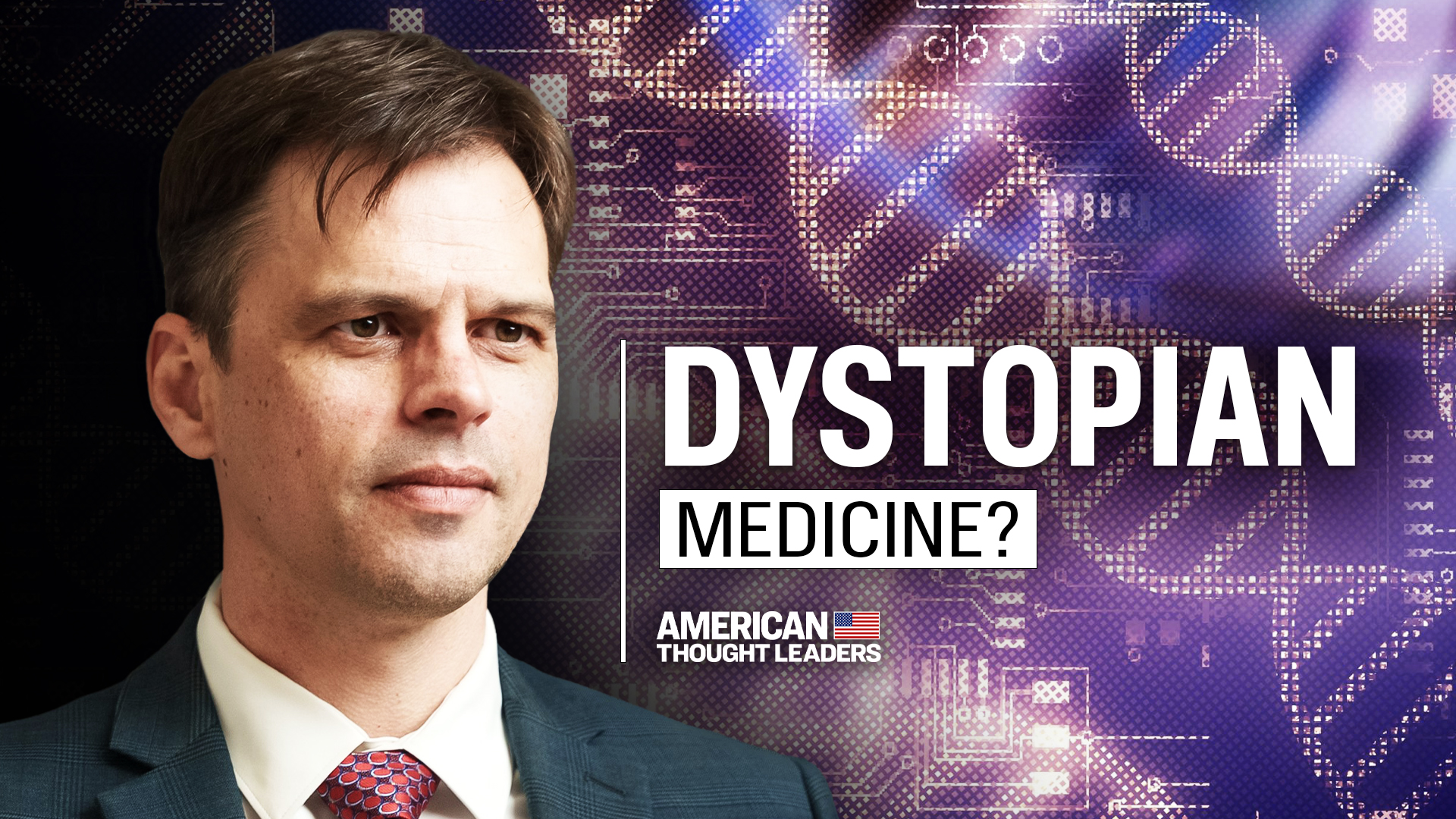
[RUSH TRANSCRIPT BELOW] Modern medicine is veering away from the traditional Hippocratic Oath that required physicians to do no harm and use their knowledge and skills solely for the purpose of healing the patient, says psychiatrist and bioethics expert Dr. Aaron Kheriaty.
Now, physicians are euthanizing patients, removing healthy organs in certain transgender-related surgeries, and injecting drugs for late-term abortions even when the mother’s life is not threatened.
Hippocratic principles are being superseded by utilitarian ethics that prioritize the “greater good” over the well-being and rights of individual patients, Kheriaty says. That’s fueling, for instance, the push to expand the dead-donor eligibility criteria for organ donations.
It’s also manifesting in the push to adopt technological advancements like germ-line gene editing that could be used to create “designer babies” or in vitro gametogenesis (IVG), a process that uses stem cells, such as those derived from skin cells, to create human eggs and sperm in a lab.
Earlier this year, an op-ed in the MIT Technology Review argued for the creation of “spare” human bodies called “bodyoids.” These would essentially be human bodies created in laboratories from human stem cells, but without brains or consciousness. Proponents say they would revolutionize medical research and drug testing and create an unlimited supply of organs.
It sounds like the stuff of science fiction. What are the true ethical implications? Is this really where we want medicine to go?
Kheriaty is the director of the bioethics and American democracy program at the Ethics and Public Policy Center and former director of the medical ethics program at UCI Health.
His latest book is titled “Making the Cut: How to Heal Modern Medicine.”
“The biggest advance [that] medicine needs to make is to accept the limits of medicine,” he says.
Views expressed in this video are opinions of the host and the guest, and do not necessarily reflect the views of The Epoch Times.
RUSH TRANSCRIPT
Jan Jekielek:
Dr. Aaron Kheriarty, so good to have you back on American Thought Leaders.
Dr. Aaron Kheriarty:
Always good to be with you, Jan.
Mr. Jekielek:
So in your new book, Making the Cut, you say, I was not prepared for what training to be a doctor would entail. I took little for granted in medical school, and for some time, I felt like a field anthropologist in some far-off village looking in on a foreign culture and studying the habits of the natives. What?
Dr. Kheriarty:
So I’ve always been something of both an insider and an outsider to medicine. And it may sound strange, but my book, Making the Cut, which is in part a memoir of my medical training in medical school, in part it’s a philosophy of medicine, and in part a critique of contemporary healthcare. But the medical narrative part, the stories of my training have value because I didn’t really take anything for granted when I went to medical school. As I said, I didn’t know what I was getting into. I had studied philosophy as an undergraduate and gotten my pre-med requirements.
But I went to medical school fairly naive as to how it was going to go and what I was going to expect. And pretty much everything there astonished me. I couldn’t believe the kinds of things that happened there and the kinds of things that we were allowed to do. If you stop and think about it, medical students are allowed to do things that in any other context would be considered criminal felonies, like carving up a dead body when we do dissection in a gross anatomy lab and basically take a cadaver, take a corpse, and dissect it down till there’s nothing left. I mean, we take it to pieces; we pull it apart.
But as they say in the chapter where I describe the gross anatomy lab, I never knew this person’s name, right? It’s an astonishing thing that we allow, and we allow it for good reason. That’s the best way to learn anatomy, which is obviously a necessary set of knowledge for physicians to have. And so the book, on the one hand, is a critique of many aspects of medical training. It’s a critique of contemporary healthcare and our healthcare systems. But it’s also a love story because, somewhat to my surprise, I—this also may sound strange to put it this way—but I really did fall in love with medicine during medical school.
And while I love medicine and while I have been able to see medicine done at its finest in a way that really serves the needs of the patients and accomplishes astonishing feats, life-saving feats, that makes it all the more kind of heartbreaking when I see institutional medicine going off the rails and veering from its mission. When you see something done really well, it makes it all the more painful and heartbreaking to see it done poorly. And so I think the book contains both elements. It’s a love story, but it’s also a heartbreaking love story because my lover has turned into a prostitute of late. That’s painful to watch.
Mr. Jekielek:
Well, I absolutely want to talk about, you know, the distinction between this, the medicine of trying to do the best for an individual patient versus the medicine of the greater good. Before we go there, though, you know, talking about, you know, kind of interesting and bizarre things you did. You talk about an amputation, a leg amputation that you were involved in. So tell me a little bit about that. It’s a very surreal experience.
Dr. Kheriarty:
So this is the opening of chapter five, and it’s just one of the many little vignettes and stories that I tell in the book to try to put the reader right there at the bedside or right there in the operating room and imagine what it’s like to do some of the really astonishing things that physicians do. We were doing a leg amputation because a person had developed gangrene from peripheral vascular disease, which is basically the tissue in the foot starts to die, and death cannot live in harmony and symbiosis with life. And so in some of these tragic cases, we have to actually amputate the leg.
This is an above-the-knee amputation, meaning most of the leg came off. My job was to hold the leg. And so I’m holding the leg until I’m just holding the leg. You know, the electric saw was buzzing, bits of bone were flying as we’re cutting through the person’s femur. And suddenly, much more quickly than I imagined what happened, the leg came off and was free in my hands. And it was heavier than I expected.
It was a very surreal experience holding a leg that just seconds before had been attached to this living person’s body. I didn’t quite know what to do with it at first. The nurse walked in with a big bag labeled biohazard. So I put the leg in the biohazard bag, and she took it out of the room. I closed the vignette by saying, I wonder what they do with those biohazards. That’s my introduction to the chapter on surgery.
The chapter is all about how surgeons traffic in body parts, especially transplantation surgeons, doing astonishing feats like taking out a cirrhotic liver and replacing it with a new, fresh, living, life-sustaining liver that was just taken from a person a few hours ago who died tragically in a motorcycle accident. So death for one patient contributes to life for another patient and raises all kinds of, I would argue, complex ethical and philosophical issues around the whole enterprise of transplantation that I try to explore in that chapter.
Mr. Jekielek:
You know, just very recently, as I’m doing research for my book on the forced organ harvesting industry in China right now, I learned of one case where a patient— you know, a verified case where a patient who had a—precisely this, a cirrhotic liver—within three days he was able to get a new, you know, perfectly functioning liver.
Dr. Kheriarty:
Of course, in China, we have the now well-documented forced organ harvesting system, which you know as much, if not more about than I do. Even in the West, where generally we’ve held to something called the dead donor rule, meaning before you take an unpaired organ, a life-sustaining organ, you could take a kidney from a living donor because they have two of them and they can survive without one of them, but a liver or the heart or the lungs and so forth, the person has to be dead. The person can’t be killed in the process of organ harvesting.
So we have laws in all 50 states upholding this so-called dead donor rule, which is, of course, absolutely necessary to maintain trust in the organ transplantation system. But there are people now not just quietly but even publicly in the pages of our newspapers pushing against the dead donor rule and saying, we could save more lives if someone is dying but not yet dead. Instead of waiting for them to die and sometimes waiting so long that the organs are no longer viable or no longer useful for transplantation, why not just end their lives sooner as part of the organ harvesting procedure and thereby save a greater number of lives in the end? This is the kind of utilitarian bioethics that I think is very dangerous. By utilitarian, I mean the greatest good for the greatest number and without any, you know, absolute prohibitions against certain practices.
Mr. Jekielek:
So I’ve been arguing recently that it’s our deep engagement with communist China in many areas but specifically in transplantation. You know, we train many of their transplant surgeons, many of whom are murderers in effect because they participate in the system. We sell all sorts of and manufacture and sell all sorts of materials that are used in the transplantation process. We have deep, deep connections in terms of research and funding. I’m learning more and more about how deep this goes. It’s kind of astonishing.
We had this vision some time ago; this was the Kissinger Doctrine that we were going to change China. It’s going to liberalize. It'll become like South Korea or Taiwan or something where it changes from an authoritarian regime. But it never did. They are totalitarian, and they stayed that way. In fact, you could argue they actually have changed us. And that’s how this softening of the dead donor rule is happening. I mean, never mind deciding that this dead donor rule doesn’t quite cut it itself.
Dr. Kheriarty:
I think that’s exactly right. It was a misunderstanding of the nature of the current regime in China and the Chinese Communist Party when we had these unrealistic hopes that by opening up trade with them and establishing better trade relationships that we were going to influence them more than they were going to influence us. I agree with you completely that the direction of influence has gone in the opposite direction. In fact, China has always seemed to be interested and willing to learn from Western technologies, but not necessarily from Western culture.
I think that the very same thing is happening when it comes to what you just described, especially with medicine and particularly with organ transplantation. They’re happy to use Western science and technology to learn how to do transplantation procedures. But rather than adopting the ethical system that is in place to try to put some boundaries on organ transplantation, they’ve just completely done it their own way. And doing it their own way means doing it without consent, forced organ harvesting, doing it in a way that either kills the person or doesn’t wait until they’re dead, and often doing it as a political tool to persecute minorities, as readers of The Epoch Times and listeners to your show know very well.
Mr. Jekielek:
It’s particular groups that are often targeted not because they’ve engaged in criminal behavior but because they’re somehow a challenge to the regime’s ideology. I could talk to you forever about these things, but let’s jump back to your book. And specifically, you struggle with all sorts of these questions. These are things I’ve been thinking about a lot in a whole range of contexts of this distinction between Hippocratic medicine, which is medicine where, you know, do no harm for the patient, do everything you can for that individual patient, vs. this greater good medicine where you kind of weigh the statistics and you say, well, maybe we can lose a few of these so we can help more of these. Yes, well, first of all, explain that distinction to me a little more, and then let’s talk through a few examples of how this manifests.
Dr. Kheriarty:
So the traditional Hippocratic view of medicine says that the doctor’s primary, and in some sense, only loyalty is to the vulnerable sick patient that comes to them for care. And illness is a universal affliction that can impact anyone, rich, poor, famous, obscure. It’s the great equalizer. And illness makes us vulnerable.
And when we’re vulnerable and we don’t have the internal resources or tools to heal ourselves, we usually go against our inclination to the emergency room or to the hospital or to the clinic and place ourselves under the care of someone who professes to heal. We’re accustomed to talk about any occupation as a profession, but in the ancient world, there were only four occupations that were considered professions: doctors, lawyers, teachers, and priests, the clergy. What do all four of these have in common?
All four of them are characterized by a relationship between a person who is in need of some service—teaching, healing, legal counsel, spiritual care—and a person who professes to provide that in order to help that individual patient and not for some ulterior purpose. So that’s a relationship that requires trust because one person is more vulnerable than the other person, right? If the doctor-patient relationship doesn’t go well, the patient stands to lose more than the physician, right? They could get worse. They could become more ill.
And so all of these professions had a tradition to try to encourage public trust in the profession as a whole by making a public promise before they engaged in their work. They were professions precisely because they professed an oath, promising to do certain things and to avoid doing other things. And of course, for physicians, that was the traditional Hippocratic oath, which said, I’m going to use all of my knowledge and skills always and only for the purpose of health and healing, and not for some other end. So I’m not going to use my knowledge and skills to kill. I’m not going to give a deadly drug, even if the patient asks for it.
That’s in the traditional Hippocratic oath. I’m not going to violate the patient’s confidentiality because that would undermine the trust that they have in me. And my loyalty is to the sick patient, regardless of who they are. And I have to treat all of them equally.
That is currently being undermined by another view of medicine that says, well, the tools of medical technology certainly can be used for healing, but guess what? They can be used for all kinds of other different things. You can use your knowledge of pharmacology and physiology to heal patients or to kill them, right?
And so we get the rise of doctor-assisted suicide and euthanasia. We get many physicians participating in capital punishment, so state-sanctioned killing. You can use your knowledge and skills of psychology or pharmacology to engage in torture of political prisoners, right? So this is why the American Medical Association [AMA] takes a position against those things because they undermine the trust that patients would have in medicine.
The AMA doesn’t say, as a member of the AMA, you have to politically be against capital punishment. You can believe whatever you want on this issue. But as a physician, you shouldn’t use your knowledge and skills as a physician to participate in capital punishment because the public needs to look at doctors and know this person is a healer. They’re not a killer. They’re not here to do something else.
So there’s this other view of medicine that pushes against that that says if something is technically feasible and the patient or a third party will pay for it and the doctor is capable of doing it, the doctor has to provide it. This can explain a lot of the controversies around what advocates call gender-affirming care, what I think more accurately should be called sex-rejecting procedures. Take a physiologically healthy person and start amputating body parts in order to give them the appearance of a person of the opposite sex. Well, this is not a healing enterprise. This is using medicine for some other technical purpose. This is not Hippocratic medicine.
An organ harvesting system that says the greatest good for the greatest number would approve of things like, we have a healthy child here, and they have healthy organs. And if we killed this child and harvested all of their organs, we could save the lives of five different people who are awaiting a heart, a lung, a kidney, and a liver transplant and are going to die. Otherwise, on a pure utilitarian, greater good calculus, that would be something that medicine might engage in or might approve of. That kind of thing may be happening in places like China, arguably.
Mr. Jekielek:
Well, so just you’re bringing me back to the topic that I’m obsessing over as I’m writing this book, you know, kind of as we speak, but, you know, precisely, it’s kind of almost like the logical conclusion. Because if you have a group of people like the Falun Gong or the Uyghurs, incarcerated in large quantities, dehumanized through propaganda and all sorts of other ways, and like, you know, why not? You know, these people aren’t really worth the same as other people. Why don’t we use them for, well, some saving lives, but also a lot of profit. And, you know, for elites, right, it’s really unlimited organs on demand forever, right?
Dr. Kheriarty:
Historically, the classic example of this is, of course, what happened in Germany in the 1920s and 1930s. And by the way, it began happening even before the Nazis came to power, the adoption of the eugenics ideology. And I like to remind people that eugenics did not start in Germany. Eugenics ideology started in the United Kingdom, in the United States.
So in the United States, 27 out of the 50 states in the early 1900s adopted laws where people could be forcibly sterilized to prevent the wrong kind of people, quote-unquote, from reproducing. And of course, you know, women, racial minorities, and impoverished individuals were disproportionately represented among the people who were forcibly sterilized. Famous Supreme Court case that, by the way, has never been overturned. The laws that it upheld have been reversed.
But with Buck v. Bell in 1927, the famous American jurist Oliver Wendell Holmes, who in the majority ruling said the principle that allows for forced vaccination is, “wide enough to cover the cutting of the fallopian tubes.” And then the famous line in the Supreme Court ruling, three generations of imbeciles are enough. In other words, if we take these people who are cognitively disabled or, you know, impoverished or have what we think are criminal tendencies or whatever, and we forcibly sterilize them, somehow we can purge society of these undesirables.
So it’s the dehumanizing of people that began in this country. And Hitler looked to the laws in the United States for the forced sterilization laws in Germany. And then the Germans took it the next step with their so-called T4 euthanasia program. And they started not only forcibly sterilizing mentally and physically disabled individuals, but forcibly killing them as well.
The first gas chambers in Nazi Germany were not located in concentration camps. They were located in psychiatric hospitals. And the first people who were gassed were not ethnic minorities like Jews. They were cognitively and mentally disabled patients in these hospitals, and all of those deaths were signed off on by physicians.
So the medical enterprise in Germany was complicit with the state-sponsored eugenics program, and it was built on an ideology of the greater good rather than the traditional Hippocratic medicine which says, my job is to treat this vulnerable individual patient who has equal dignity to any other person. There was this idea that, again, started in the 1920s and before the Nazis came to power, that the job of medicine was to treat the social organism. There was this metaphor of the Volk, the society as a whole, being healthy or sick.
And so if society as a whole is healthy or sick, some members of society are kind of a cancer on the social organism or the body politic because they’re not contributing economically or because they’re disabled in some way and they’re a drain on the system. Well, what does a physician do with a cancer? He carves it out and gets rid of it in order to preserve the health of the organism as a whole. So this metaphor took hold in the mind of a German physician, which made them prone to and open to the Nazi ideology when it came to power.
And then that led, of course, to all the horrible atrocities that we heard about in the concentration camps with unconsented experiments on concentration camp prisoners, which eventually led to the Nuremberg Code in the wake of World War II to try to put a stop to all of this. And of course, the first principle in the Nuremberg Code is the principle of informed consent, which we’ve seen over the last few years we’ve tossed overboard in favor of forced vaccination during the COVID pandemic.
They’ve obviously tossed the principle of informed consent overboard if we’re talking about forced organ harvesting in China. So in, Making the Cut, one of the arguments I make is the need to maintain the traditional Hippocratic ethic of medicine, where the doctor-patient relationship is at the center of the medical enterprise. And to violate that is to take us down a path that’s going to lead to some very dark places.
Mr. Jekielek:
What this actually reminds me of is this very infamous statement, if you want to make an omelet, you have to break a few eggs, right? Like that’s really, and that’s, of course, Joseph Stalin, you know, all for the greater good, ostensibly, right? Is there any scenario where it’s possible to think that way from an ethical perspective in medicine or actually, frankly, in organizing a society? Like, I’ve been thinking about these things for obvious reasons, but I think I kind of believed in the greater good way of thinking, you know, going back 10 years.
Dr. Kheriarty:
If you practice good Hippocratic medicine, that will give us the highest likelihood of leading to the greater good. But that will be a downstream consequence of adhering to sound ethical principles when it comes to the care of individuals. So the idea of trying to contribute to the greater good or to the common good, to a good that all of us participate in, that’s maybe more than the sum of our individual goods. I believe there is some validity to that concept. But the question is, how do we contribute to that in medicine?
And I think the best chance of achieving something close to that is to adhere to traditional Hippocratic principles of using my knowledge and skills always and only for the purpose of healing, doing whatever I can to minimize harm. There’s always risks in medicine, but we do our best to minimize those risks. Treating each individual patient as a person equal in dignity and human rights, regardless of extraneous factors that have nothing to do with their illness. And I think within medical ethics, the place in which people are most prone to a utilitarian calculus would be disaster medicine, where the demand for a particular intervention exceeds the supply.
So you have an earthquake or a pandemic or some natural disaster that floods the hospital with more patients than the hospital can care for. And you have, let’s say, a limited number of ventilators. How do you allocate those ventilators? Well, there may be a place for thinking about that in terms of utilitarian calculus.
But still, the question boils down to how do we do the most good for the most number of individual patients with the limited resources that we have? And you have to think through triage medicine, I think, in those terms, which doesn’t really require adopting a utilitarian or greater good ideology. More often than not, if you do that, that leads to discriminatory practices.
So rather than treating according to medical need and who’s most likely to benefit from the ventilator, who’s most likely to survive if we give them one of our limited number of ventilators, then we start thinking about factors like how valuable this person is to society and should we prioritize the treating of important people over the treating of impoverished or marginalized people. And I think that’s a very dangerous path to go down. Those factors should not play a role in making these kinds of medical decisions.
Mr. Jekielek:
So there’s been a ton of technological innovation that is basically being used in medicine. Again, in the organ industry, you have ECMO [extracorporeal membrane oxygenation], for example. That replaces the heart and lungs, used for various types of surgeries and stuff, but also could keep a body warm a bit longer and more organs can be transplanted. I’ve been thinking a lot about these technologies, but overall, there’s been this kind of scenario of diminishing returns of these technologies.
Dr. Kheriarty:
I think that is correct.
Mr. Jekielek:
Why is that? And how does this utilitarian view play out?
Dr. Kheriarty:
Certainly, medical technology can be a very good thing, and it can contribute to the advance of medicine. But if we look to technology to solve all of our problems within healthcare, we’re going to continue getting diminishing returns precisely because at the center of healthcare, as I said earlier, is not a novel technology or a novel medication or procedure or intervention. It’s a relationship between someone who professes to use their knowledge and skills for healing and someone who’s made vulnerable by illness, and the more we get away from the centrality of the doctor-patient relationship, the less effective we’re going to be at healing.
And one of the things I describe in Making the Cut, which is subtitled, How to Heal Modern Medicine, which suggests that contemporary health care is sick in some way, is that with the advent of new technologies, but also with the advent of what I call a managerialist regime in medicine, we have a system now where, and by managerialism, I mean the ideology that everything can and should be controlled by the experts from the top down, right?
And that this produces a kind of homogenizing system where everyone gets the same thing. It produces a kind of industrialized healthcare system that is more concerned with efficiently moving, shuffling people through the machinery of the hospital, rather than actually tailoring the care to their individual needs. And this is not producing good outcomes.
You mentioned diminishing returns. We’re spending twice as much on health care in the United States as any other nation, and we’re barely breaking the top 50 of developed nations in terms of health outcomes. So we’re not getting a good return on our investment. We have to ask the question of why that is. And I try to explore that question in the later chapters of the book.
But one of the problems is this excessive centralization, this managerialist ideology, where physicians are more and more constrained. And we lack the ability to tailor treatments to the needs of individual patients. We lack appropriate, what I call discretionary latitude, appropriate elbow room, right, to adjust the recipe that we’re given to actually fit the patient who’s sitting in front of us, who’s going to be unique because every human body is different and every patient is different and everyone’s history and social context is different. And all of those things impact their illness, how they respond to the illness, and the possibility of recovering from illness.
And so medicine has moved away from that into a kind of industrialized system where everyone gets the same thing. I call it turnstile medicine. It’s modeled on Disneyland. Disneyland is designed by engineers for efficient people moving. Get as many people through the rides on any given day as possible, as many people through the food lines and the bathroom lines as possible. Move them through the system.
Well, hospitals function according to the same logic. So under the Affordable Care Act, we have bundled payments for different interventions. So you get a fixed amount of money for a hip replacement, right? So if you happen to be a patient who has a complication from your hip replacement surgery or is just not recovering according to the, you know, the statistical average, you begin to be resented by this hospital system that is obsessively focused on what administrators call throughput—get them in, get the procedure done, get them out—because if there’s any complications, we’re losing money, and patients begin to feel this.
They begin to feel that my care is not being tailored to my individual needs. My doctor, instead of having a face-to-face conversation with me, is sitting over here staring at a computer screen asking me a series of questions dictated by external managers that have nothing to do with my chief complaint. And I leave that encounter feeling unheard, uncared for, and very often unhealed.
So what I argue in the later chapters of Making the Cut is that we need to move away from this centralized system of control and allow different experiments and decentralized health care delivery to develop. And I give a few examples of that, of things that are being tried right now in that regard. But I think the general thrust needs to be toward decentralization, toward helping patients take back responsibility for their own health and healing. Medicine obviously has a role. I’m a physician. I treat patients. I sometimes need the care of a physician myself, and that’s very valuable when you need it.
But there’s a lot more that people could be doing on their own that doesn’t require them to be continuously processed through this industrial-scale health care system that we’ve developed in the United States. And by the way, it matters very little where the top-down managerialist control is coming from—a government in a government-run health care system or from corporate conglomerates in a system like the one that we have now, where large corporations are gobbling up local clinics and local hospitals and taking control of health care delivery.
Mr. Jekielek:
How does this fit into something you point out, which is that the number three cause of death right now in America is iatrogenic? So basically, medical intervention is the number three cause of death. I mean, how does that work?
Dr. Kheriarty:
So ironically, one of the things that comes out of my analysis is that the biggest advance medicine needs to make is to accept the limits of medicine. And if we don’t accept the limits of medicine and we over-intervene, we end up doing more harm than good. And all the way back in the 1970s, there was a very prophetic writer, Ivan Illich, who I quote extensively toward the end of the book, who made this argument in a book called Medical Nemesis that once any industry, and he uses medicine as his example in this book, grows to a certain size, by the very nature of its size and scope and control over our lives, it ends up not only not achieving its intended purpose, which is health and healing, but actually undermining that purpose. I think he makes a strong case for that.
He saw it coming 50 years ago, but what he saw coming is now manifested in a much more obvious way. And we have the statistics, as you mentioned, on iatrogenic disease and iatrogenic harms, harms that are done and come as a consequence of medical interventions themselves. So not only do we need decentralization of health care, but we need to place reasonable limits on health care interventions because too much health care actually, ironically and paradoxically, ends up undermining our health and our ability to live a healthy lifestyle and pursue the things that will address the kinds of problems that we’re facing today.
So medicine is very good at dealing with acute trauma and acute illness. So if, God forbid, you know, tomorrow you get hit by a truck, go to the nearest emergency room, let the trauma surgeon patch you back together. We’re very good at doing that.
We’re not very effective at treating chronic illnesses, as has been pointed out by many people today in the medical freedom movement and the Make America Healthy Again movement. We’re failing when it comes to chronic disease; medicine is not only not curing or alleviating these chronic illnesses, in some respects it may be contributing to them and making the problem worse and making us more and more dependent on a system that’s not actually working.
So how do we get out of that sort of doom loop? I have a chapter on death and dying. And in that chapter, I argue that death is the horizon against which medicine is practiced. And if physicians see death as the final enemy to be conquered, we’re going to lose in every case. In spite of all the amazing new medical technology, the human mortality rate continues to hold steady at 100 percent.
So we’re all going to die of something. And a medicine that cannot accept that is a medicine that’s going to end up harming people toward the end of life rather than helping them to live their last days well. And of course, there are many people today who are laboring under the delusion that science and medicine can solve the problem of death.
The transhumanist movement is probably the most extreme example of this, but there are proposals within mainstream medical science and mainstream medical research of radical life extension and solving the problem of aging and death. I certainly want to help older people live healthier lives and live out a normal human lifespan with as much vigor and health and functionality as they can. That’s a good and legitimate goal of medicine.
But the idea of making people live forever, I think, is a mistake. I think it’s going to come back to bite us, come back to haunt us. And in fact, it’s a kind of religious aspiration that we can somehow be saved from the problem of human mortality by science and technology, I think, is an illusion. And if medicine adopts that illusion, it’s going to end up doing a lot more harm than good.
Mr. Jekielek:
So let’s talk about some technologies that have been developed kind of in the direction of what you just discussed. One is, you know, I’m very aware that the doctor who created the so-called CRISPR [clustered regularly interspaced short palindromic repeats] babies, gene-edited children, is out of jail in communist China. The lab is back up and running. I’m not exactly clear what he’s working on. But again, there’s a lot, let’s just say there’s a lot less regulation for things that people are interested in over there. And then you have something you’ve been writing about, which is bodyoids, which is, I mean, I’m going to let you explain.
Dr. Kheriarty:
Sure. So we have gene editing, two types of gene editing, one much less ethically controversial, one much more problematic. So I can take out your bone marrow and using gene editing, reprogram your bone marrow to fight cancer cells for the cancer that you’re afflicted with and re-transplant your bone your your gene-edited bone marrow back into you and hope that that fights the cancer, and that can be analyzed according to the way we analyze traditional medical interventions because we look at the risks, we look at the benefits, we look at the alternatives, and you give informed consent as to whether or not you want to try that procedure to treat your cancer. And if that doesn’t go well, you’re the only person who’s going to be harmed by that. And at least you’ve taken on those risks knowingly and you’ve given consent.
There’s a different type of gene editing, which is what you described a moment ago with the doctor in China, which is editing either gametes, either sperm or eggs, or more commonly editing a human embryo that’s created by an IVF in a lab. And when you do that and you bring that person to birth and that person eventually reaches reproductive age, whatever changes we’ve introduced into their genes are now also in their own gametes, in their own sperm and eggs, meaning they’re going to be passed on to subsequent generations.
So if we make a mistake in that regard, if there are unintended consequences, first of all, they may not manifest until decades later. And second of all, they’re going to be passed on to that person’s descendants and their descendants down through the generations. So it’s going to be very hard to put the genie back in the bottle if we mess things up in that regard. So that’s so-called germline gene editing, which to my mind is a very dangerous enterprise.
First of all, because none of those subsequent generations can consent to being part of this experiment and to the changes that were introduced. And second of all, because if we make mistakes, it’s going to be very hard to undo them. Now, there’s a proposal that was put forward by some Stanford biologists and ethicists in the MIT Technology Review. And I just wrote a response to it. It was published in First Things, just reprinted yesterday in The Free Press about this idea of creating bodyoids.
Now I should say this hasn’t been done yet, but essentially they argue we’re almost there with the technology to create human beings that would be born without brains, without a central nervous system, but would otherwise have a functioning, physiologically healthy body and healthy organs. And by creating these so-called bodyoids, we would have a supply of living human bodies that could be experimented upon without impunity because these people argue they wouldn’t actually be human.
So the original title of my article was Zombie Bioethics, because this is not the first time we’ve contemplated an undead living organism that appears to be human but is not because it’s brainless. This is a staple of science fiction and horror films. So the creation of these kinds of zombie-like entities that could be experimented upon with impunity, whose organs could be harvested willy-nilly without their consent because presumably they would have no cognition and they would be incapable of giving consent.
By the way, according to our brain death criteria, these people would already be dead because they have no functional brain activity, even though their heart is beating, they’re breathing, and they’re undergoing normal development; they look alive in all other respects. And I argue that rather than creating some sort of human-like non-human species, we would be creating simply profoundly disabled human beings.
It would be analogous to the creation of individuals who have an affliction called anencephaly, where they’re born without a cerebral cortex. They have some deep brain functioning that allows them to stay alive for a few days. But clearly, these are not alien entities that we can do anything we want to. They’re human beings with a very profound life-limiting disability.
Mr. Jekielek:
That we created.
Dr. Kheriarty:
Yes, but in the case of anencephaly, we care for whatever foreshortened life these poor babies have, but we don’t create them on purpose. And this proposal is precisely to set out, using gene editing technology, and these authors argue we would also need artificial wombs to do this. Technically speaking, we wouldn’t need artificial wombs to do this. They could be gestated by a woman and given birth to these entities in a normal way.
But presumably for these ethical innovators, the idea of a woman giving birth to an entity that they argue is not human is just too gruesome to contemplate. So yeah, they say using gene editing technology, we could deliberately set out to create these kinds of what I argue are simply profoundly disabled human beings that we can do anything we want with, and so that we can kill them with impunity.
Mr. Jekielek:
For the greater good.
Dr. Kheriarty:
Naturally, for the greater good. Yes, unlimited supply of organs, unlimited supply of human bodies that we could run medical experiments on, unlimited supply of tissue that we could use for experimentation. So on the one hand, they’re arguing, well, they’re not really human; therefore, we can do all these things to them.
On the other hand, they’re interested in them precisely because of how very human they are, that their heart and their lungs and their kidneys behave exactly like human hearts, lungs, and kidneys, which is why they would be so useful for experiments, even more useful than using animals for experiments. So they’re talking out of both sides of their mouth.
On the one hand, we want them because they are so very human. On the other hand, we want to do whatever we want to them because they’re not really human, because they lack human cognition, they lack higher intellectual functioning, and they lack the ability to do things that normal human beings can do.
Mr. Jekielek:
Just to go back to the germline gene editing for a moment, I mean, this is being seriously contemplated.
Dr. Kheriarty:
Yes.
Mr. Jekielek:
Because, you know, you can, for example, remove all sorts of genetic diseases and just sort of guarantee, and, you know, in China, of course, the extreme, they’re building, they want to build a super soldier and all this kind of stuff. They’re working very hard on that, as I understand it.
Dr. Kheriarty:
Sure. I mean, the other distinction that’s useful ethically when thinking about gene editing, besides the somatic gene editing of just one individual, is that we can analyze that according to traditional ethical principles and germline gene editing. The other distinction is between using gene editing for therapy to treat disease and using it for so-called purposes of human enhancement—to make people bigger, faster, stronger, smarter—to create, you know, the Chinese super soldier and what have you. And that line is also being very much blurred.
In fact, the twins that were created by that Chinese researcher, the gene editing was not done to treat a known genetic condition that they were afflicted with. It was an enhancement that was done, ironically, to supposedly make them less prone to acquiring the HIV virus. So it was tinkering with their immune systems to try to diminish the possibility of acquiring HIV.
Mr. Jekielek:
But they’re basically a living experiment.
Dr. Kheriarty:
That’s right. A living, unconsented experiment in this case in human enhancement.
Mr. Jekielek:
It’s a brave new world.
Dr. Kheriarty:
Here we are. The latest iteration and the latest use for gene editing technology has to do with the creation of artificial gametes, or what technically is called IVG [in vitro gametogenesis]. Most people have heard of IVF [in vitro fertilization], creating an embryo in a lab in a petri dish. IVG involves reprogramming adult human skin cells, let’s say, to become gametes, either sperm or eggs. What does this pretend? This has been done in mice and other mammals for a number of years; up until a few weeks ago, it had not yet been done in humans.
But some researchers at Oregon Health & Science University recently announced that they had used artificial gametes, artificial eggs in this case, to create human embryos. Most of those human embryos had genetic problems associated with them, but a few of them looked like they might be viable. They were killed at the blastocyst stage around day nine. And the people who are doing this say there’s a lot of technical kinks to work out. There’s a lot of genetic anomalies and problems with the embryos that we created. So this is not yet ready for use in human beings. But there are scientists that are continuing to work on it.
So what would artificial gametes potentially open up? Well, they would open up the possibility of using skin cells from a man to create ovum, to create eggs, so that two men could have a genetically related child. So the possibility of same-sex reproduction, two men or two women having a genetically related child. Advocates of this technology have also talked about and written about the idea of what they call multiplex parenting.
Let’s say you have four people of whatever sex, let’s say two men and two women, that want to have a genetically related child who’s related to all four of them. You use IVF or artificial gametes from one pair of that four to create an embryo. You do the same thing with the other pair of that four to create another embryo. You extract embryonic stem cells from those two embryos, destroy those embryos, take those skin cells, and use IVG to create gametes, sperm and eggs, which you combine to create yet a third embryo, and then you bring that third embryo to birth. You now have an embryo that’s genetically related to all four of those people.
Technically, those people are the embryo’s genetic grandparents, but the embryo’s parents or the person, if that embryo is implanted and brought to birth, that person’s parents are embryos that were created and destroyed in a laboratory. So a radical remaking of the idea of families is one possibility. There are other strange possibilities as well. Let’s say you’re the maid at a hotel where a famous movie star like Tom Cruise or Brad Pitt is staying.
Mr. Jekielek:
You can get a hair follicle.
Dr. Kheriarty:
Exactly. You want to have their baby, but you fail to seduce them the old-fashioned way. So you know you just go to the pillow and scrape off the skin cells of the hair follicle, take them to your rogue IVG clinic, create the famous movie star’s sperm, undergo IVF, and have the person’s baby without their knowledge and certainly without their consent. So this technology is very, very radical.
And I think if we’re thinking about sort of brave new world possibilities and eugenics possibilities, just to return to our earlier theme, you know, we now have IVF combined with pre-implantation genetic testing, where embryos are tested not only to eliminate disease but also for desirable traits. And the quote-unquote most fit or most desirable, whatever it is, bigger, faster, stronger, blonde hair, blue eyes, no genetic diseases, is implanted and brought to birth, and the other quote-unquote undesirable embryos are destroyed. The rate-limiting step with that process now is the egg harvesting procedure.
So in any round of IVF, which is for the woman an invasive procedure involving hormones to hyperstimulate her ovaries, harvesting of eggs, which is a procedure that has its own medical risks associated with it. It’s kind of difficult to undergo. And maybe in any given round of IVF, we could get a half a dozen embryos, six or eight. Well, with IVG, with artificial gametes, if we’re creating eggs from sperm cells, it’s very easy to create hundreds, if not thousands, of embryos that can then undergo genetic testing.
So, so-called embryo farming, the idea of creating just vast untold amounts of human life in its earliest stages of development in order to genetically alter and/or select those that we see as most fit, is a real possibility with this new technology. So a kind of return of eugenics that’s not necessarily going to be government-controlled and top-down. It might be consumer-driven eugenics, just parents wanting the best for their children and not being able to resist the promise of these kinds of technologies.
Mr. Jekielek:
Well, and for intelligence, right?
Dr. Kheriarty:
Exactly.
Mr. Jekielek:
I mean, that’s very, could be very tempting. You want to give your kids a leg up in the world. And I mean, profound, profound implications. And, you know, and then of course, there’s the question of, you know, are these embryos alive? And I don’t think that question has been solved.
Dr. Kheriarty:
Certainly, there’s no general social consensus on the answer to that question. My own view is that this is a human being in the earliest stages of its development. It’s what I was at that stage of my development. It’s what you were at that stage of your development. You have a fully formed human organism at conception.
And it might not look like you. It might not look like me. But it looks like what a one-day-old human being looks like or what a nine-day-old human being looks like. And it has all the full complement of genetic material and the interdirected ability to grow and develop into a fetus and an infant and a toddler and an adolescent and an adult.
And I think there’s no sharp break in that continuum where we could say, you know, at this stage of embryonic development, this is just a piece of biological material that we can discard or do anything we want with. And at that later stage of prenatal development, it’s something that requires respect and regard. I think the only real hard dividing line is that of conception.
And if we start pushing on this, we’re going to get mission creep. We’re going to get that line to continue to move to later and later stages of development because there are things that we want to do to some human organisms. As the advocates of bodyoids have shown us, there are some things that we want to do without having to answer any difficult ethical questions. And I think that’s a very dangerous precedent to set.
Mr. Jekielek:
And again, it’s all for the greater good.
Dr. Kheriarty:
Naturally.
Mr. Jekielek:
Aaron, this has been a fascinating conversation. I’m going to have to get you back to talk more about some of these, you know, kind of profound ethical questions that we’re facing in the brave new world, again, for lack of a better term. A final thought as we finish?
Dr. Kheriarty:
So my final thought is I think we have to resist the ideology of inevitability that says these things are coming. There’s nothing that we can do to direct them. There’s nothing we can do to stop them. And we shouldn’t even try to regulate them. I think human beings have to take back the idea that we can steer the ship of science and technology. We can make decisions about what we’re going to put our resources into, what we’re going to invest in. And there’s no reason to just lay supinely, lay flat, and let these things steamroll us and remake society without input from everyone.
I don’t think these are decisions that should be left to the so-called experts. I think every human being has a stake in the future of medicine and biotechnology. Every human being has a stake in not only how to reform our healthcare system in the ways that I try to advocate for in making the cut, but also in directing the use of science and technology to try to make human life better. And the danger, if we just allow people with financial interests or ideological interests to be the ones in control of where this technology goes, is not only that it will not enhance human life, but it has the ability to actually undermine human dignity and human flourishing.
So it’s possible that science and technology and medicine certainly can have a positive humanizing effect on us, but it’s also possible, if it’s misused and misdirected, to have a dehumanizing effect. And so everyone has a stake in these questions. And they shouldn’t be cowed by doctors and scientists who tell them, you don’t know what you’re talking about. Just leave it to us. We’re going to decide where these things are going. I think this is a conversation that all of us, society as a whole, needs to have collectively.
Mr. Jekielek:
Dr. Aaron Kheriaty, it’s such a pleasure to have you on the show.
Dr. Kheriarty:
Thank you, Jan.
This interview has been partially edited for clarity and brevity.