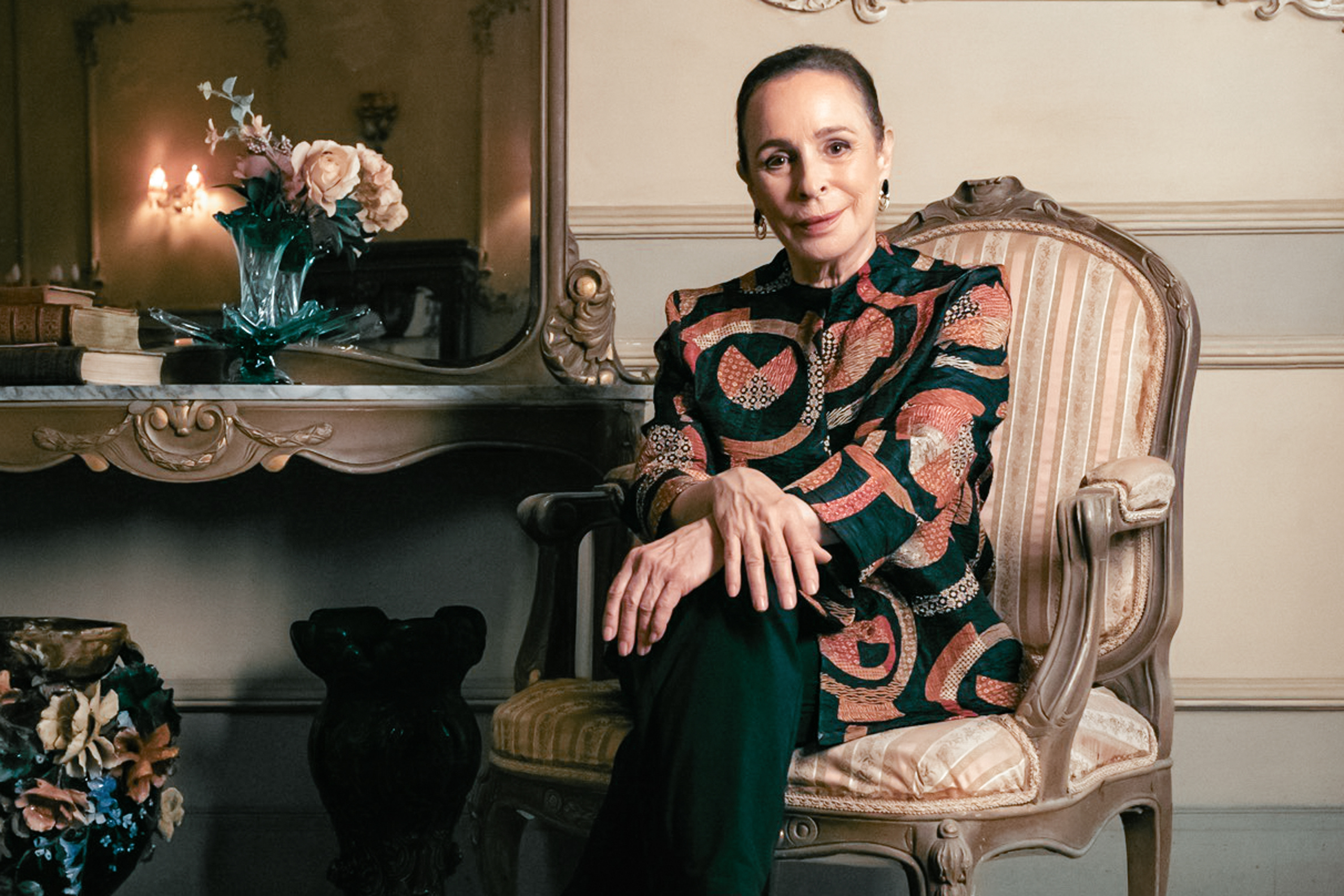

Alina Fernández Revuelta, daughter of former Cuban leader Fidel Castro, has strongly criticized the communist regime her father launched in 1959, stating that Cuba is overdue for a new government.
She fled Havana in 1993 at the age of 37 and settled in Miami, living a modest life much like that of other Cuban exiles.
Born in 1956, Fernández grew up in post‑revolution Havana, as part of the privileged revolutionary elite. Yet from a young age, she became aware of the realities of communism and later emerged as one of the most outspoken critics of her father’s rule, which she described as oppressive.
“For me, it’s been time for a regime change since the late ‘80s,” Fernández said in an exclusive interview with The Epoch Times.
“At the time Fidel Castro died, we were all thinking [his regime] had come to an end, because it was a very personalized and paternalist ... narcissistic government. ... But it survived.”
Fernández is the daughter of Castro and Havana socialite Natalia Revuelta, who had an affair in the mid-1950s while both were married to others. She grew up with her mother and stepfather, and did not learn that Castro was her biological father until age 10.
She said she still feels haunted by memories from her past. She refers to Castro by name rather than as her father.
Why She Left Cuba
From about the age of 9 or 10, Fernández began to understand what communism and revolution truly meant. It started with something called “voluntary work.”
“I went to my mother to say, ‘I don’t want to go to the voluntary work,’” Fernández recalled. “She said, ‘No, you have to.’”
Under the regime, Cubans, including children, had to participate in unpaid voluntary work to support the state-run economy. Most of the work involved farming, especially harvesting sugar.
“So I discovered that in Cuba, voluntary meant mandatory,” she said.
For her, it was an early lesson in how language can be manipulated by communists to serve the system.
The Mariel crisis in 1980 marked a turning point for her. The Mariel boatlift, as it was also known, was a large-scale exodus from Cuba.
It began after a standoff at the Peruvian Embassy in Havana, where more than 10,000 Cubans asked for asylum because of the economic crisis. In response, Castro opened the port of Mariel to allow people to leave.
From April to October 1980, roughly 125,000 Cubans fled to the United States from Mariel Harbor.
The regime called those leaving names such as gusanos (worms) and traitors. They also organized mobs to intimidate and harass people as they left.
Witnessing this made Fernández question the regime even more. “And for me, [it] was a very, very harsh turning point to see that people were treated that way officially. It killed me,” she said.
The Escape
When Fernández had the opportunity to escape, she chose to leave first, leaving her daughter behind because she had no other option. She escaped using the passport of a Spanish tourist who agreed to assist her.
She first traveled to Spain and was then granted political asylum in the United States by the U.S. Embassy in Madrid. On Dec. 21, 1993, she arrived in Atlanta.
A few days later, Rev. Jesse Jackson visited Cuba and got Castro’s approval for his granddaughter’s release, which Fernández described as “divine intervention.” Shortly after, she and her daughter were reunited in the United States.
In 2014, Fernández went back to Havana for the first time in 21 years. She received permission from Cuban authorities to visit her mother, who was seriously ill in the hospital.
She has not returned to the island since then, but, like many Cuban Americans, she hopes to visit when the regime falls.
—Emel Akan; Stacy Robinson
BLANCHE REPLACES BONDI
After President Donald Trump on Thursday announced the departure of Pam Bondi as his attorney general, his former personal attorney, Todd Blanche, was named to replace her as the head of the Department of Justice (DOJ).
Blanche was involved in Trump’s criminal defense effort in his 2024 New York trial. Later, he was tasked with handling the release of files related to sex offender Jeffrey Epstein.
Following the president’s announcement on Truth Social, Blanche wrote that he believed Bondi led the DOJ with “strength and conviction and I’m grateful for her leadership and friendship.”
“Thank you to President Trump for the trust and the opportunity to serve as Acting Attorney General,” he wrote in a post on X shortly after Trump made his statement.
“We will continue backing the blue, enforcing the law, and doing everything in our power to keep America safe.”
Led DOJ Epstein Files Release
As deputy attorney general, Blanche led the DOJ’s task force that handled the release of files related Epstein and accomplice Ghislaine Maxwell.
Last year, he announced the release of more than 3 million pages of documents, including photos and videos, in response to Congress passing the “Epstein Files Transparency Act.”
As the files were being released, starting in December 2025, Blanche defended the DOJ’s work and said that a significant amount of effort was needed to redact the names of victims who were included in the documents before they could be released to the public.
Several members of Congress, including Reps. Ro Khanna (D-Calif.) and Thomas Massie (R-Ky.), had accused the department of slow-walking the files’ release.
In February, Blanche indicated that there would be no new charges in connection with the Epstein files.
“I can’t talk about any investigations, but I will say the following, which is that in July, the Department of Justice said that we had reviewed the files, the Epstein files, and there was nothing in there that allowed us to prosecute anybody,” Blanche said at the time.
Noting the photos that were released in the tranche of files, he said that some of them are “horrible,” but it “doesn’t allow us necessarily to prosecute somebody.”
Served as Trump Attorney
Prior to being tapped as deputy attorney general under Bondi, Blanche had worked as Trump’s personal attorney and notably was involved in his defense in the 2024 New York jury trial.
As an attorney, Blanche also represented former New York City Mayor Rudy Giuliani, Trump 2016 campaign manager Paul Manafort, and Boris Epshteyn, who is currently the senior counsel to Trump.
After Trump’s win in the presidential election, Blanche was nominated by Trump to be his deputy attorney general. He was later confirmed in a 52–46 Senate vote in March 2025.
Fired Interim US Attorneys
In several instances earlier this year, Blanche was the DOJ official to confirm that multiple U.S. attorneys who were appointed by courts were terminated just hours after they were named.
On Feb. 20, he announced the firing of James Hundley on social media shortly after he was unanimously chosen by judges to replace former Trump lawyer Lindsey Halligan as interim U.S. attorney for the Eastern District of Virginia.
“EDVA judges do not pick our U.S. Attorney. POTUS does. James Hundley, you’re fired!” Blanche said in a post on X, referring to the Eastern District of Virginia and president.
—Jack Phillips; Stacy Robinson
BOOKMARKS
Donald Trump is putting a 100 percent tariff on imported pharmaceutical drugs from companies that refuse to offer better prices, and shift some production to the United States. Exceptions were made for countries that have already negotiated deals, including the European Union, Switzerland, Japan, South Korea, and the United Kingdom.
Health Secretary Robert F. Kennedy Jr. says the United States will spend $144 million on research to remove microplastics from the human body. “We are not dealing with a distant or theoretical risk, we are dealing with a measurable and growing presence inside the human body,” Kennedy said during a news conference on Thursday.
Sam’s Club, the global membership-only warehouse club is raising its annual membership costs by $10 effective May 1. Some customers were ok with the price hike, but others said on social media that they would cancel.
Calls to U.S. poison centers about kava, a drug found in drinks marketed as an alternative to alcohol, are on the rise, after having previously dropped off. “We are now experiencing an increase in calls again as new kava products enter the market, including products mixed with other substances such as kratom that can cause adverse interactions,” Dr. Chris Holstege, director of the Blue Ridge Poison Center, said in a statement.
The Trump administration received final approval for its ballroom project from the National Capital Planning Commission on Thursday. The agency went ahead with its vote two days after U.S. District Judge Richard Leon’s ruling halting construction until the administration got clearance from Congress.
—Stacy Robinson