
The Federal Reserve’s favored inflation metric cooled slightly at the start of 2026, but the widely watched gauge stayed firmly above the central bank’s 2 percent target.
January’s annual Personal Consumption Expenditure (PCE) Price Index eased to 2.8 percent from 2.9 percent in December, according to Bureau of Economic Analysis data released on March 13.
Economists had forecast a reading of 2.9 percent.
Twelve-month core PCE inflation, which excludes food and energy due to their volatility, ticked up to 3.1 percent from 3 percent in the previous month. This was in line with the consensus forecast.
On a monthly basis, PCE and core PCE rose 0.3 percent and 0.4 percent, respectively.
Additionally, supercore inflation—core services excluding house—climbed to 3.5 percent year-over-year, the fastest jump since February 2025.
Monetary policymakers emphasize PCE over the Consumer Price Index for several reasons. In the PCE measurement, weights are updated more frequently, a broader range of goods and services are covered, and consumer substitutions are considered.
In addition to inflation, the bureau reported that personal income rose 0.4 percent, below the market forecast of 0.5 percent. Personal spending jumped 0.4 percent, above the 0.3 percent projection.
Monetary Policy Path
The Federal Reserve has kept interest rates unchanged to kick off the year, following three straight quarter-point cuts late last year. Officials have been reluctant to unwind restrictive monetary policy because inflation remains firmly above the institution’s 2 percent goal.
The war in Iran adds a fresh wrinkle to the central bank’s plans as the conflict is expected to exacerbate price pressures in the March and potentially April inflation reports.
Global energy markets have rocketed since the joint U.S.–Israeli operation in the Middle East began.
Oil prices have been on a roller coaster ride this week. After topping $115 per barrel on March 9, prices have retreated amid various measures taken by the United States and other countries worldwide.
The International Energy Agency announced member nations would release a record 400 million barrels of oil from emergency reserves. The U.S. Department of Energy also confirmed that it would inject 172 million barrels to help calm down global energy markets.
This is in addition to other tactics the United States has implemented, including offering guaranteed political risk insurance and temporarily lifting sanctions on Russian oil already at sea.
A barrel of West Texas Intermediate—the U.S. benchmark for oil prices—declined about 2 percent during the March 13 trading session to around $94 on the New York Mercantile Exchange.
The rule of thumb for economists is that every $10 increase in oil contributes about 0.2 percentage points to inflation.
Officials at the Cleveland Federal Reserve have already raised their March CPI and PCE forecasts.

Federal Reserve Chair Jerome Powell speaks at a news conference following the Federal Open Market Committee (FOMC) meeting in Washington on Oct. 29, 2025. (Madalina Kilroy/The Epoch Times)
The annual inflation rate is expected to reach 2.9 percent in next month’s CPI report, up from the current level of 2.4 percent. The 12-month PCE inflation rate could return above 3 percent.
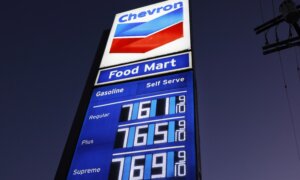
Meanwhile, since oil accounts for half the cost of gasoline, motorists are feeling the pain at the pump, which could weigh on broader consumption trends in the wider economic environment.
An average gallon of gasoline has surged 69 cents in the past month to $3.63, according to the American Automobile Association.
Prior to the war in Iran, the Federal Reserve was widely expected to keep interest rates unchanged in the current range of 3.5 percent to 3.75 percent at the March meeting.
Underlying inflation pressures and the Iranian conflict could force officials to leave policy changes on hold.
Summary of Economic Projections
Market watchers will keep an eye on the Summary of Economic Projections, a periodic survey of officials’ economic and policy expectations. December’s dot-plot—a visual representation of the survey—had penciled in one 25-basis-point reduction.
James Egelhof, chief U.S. economist at BNP Paribas, anticipates the Federal Open Market Committee will sharply raise its inflation forecasts, reflecting higher oil prices. Interest rate projections could remain stable.
“We think most FOMC participants will revise their policy views slowly in response to the war, in part due to the high level of uncertainty but largely because policy battle lines within the committee had become so dug-in and strongly held, but this is a close call for us,” Egelholf said in a March 12 research note.
Traders have pushed out the next quarter-point rate cut to September, according to futures market data from the CME FedWatch Tool.
But the dual mandate—price stability and maximum employment—is under threat simultaneously.
The economy unexpectedly lost 92,000 jobs in February, missing economists’ estimate of a 59,000 gain. The unemployment rate also edged higher to 4.4 percent.
This is leaving the institution between a rock and a hard place. The Fed can lower interest rates to support the labor market, but it may also bolster inflation. Or it can keep interest rates elevated to fight inflation, but risk a further deterioration of employment conditions.
Another fresh layer of uncertainty is economic growth.
The fourth-quarter GDP rose 0.7 percent, down from the first reading of 1.4 percent and firmly lower than the 4.4 percent expansion registered in the third quarter.