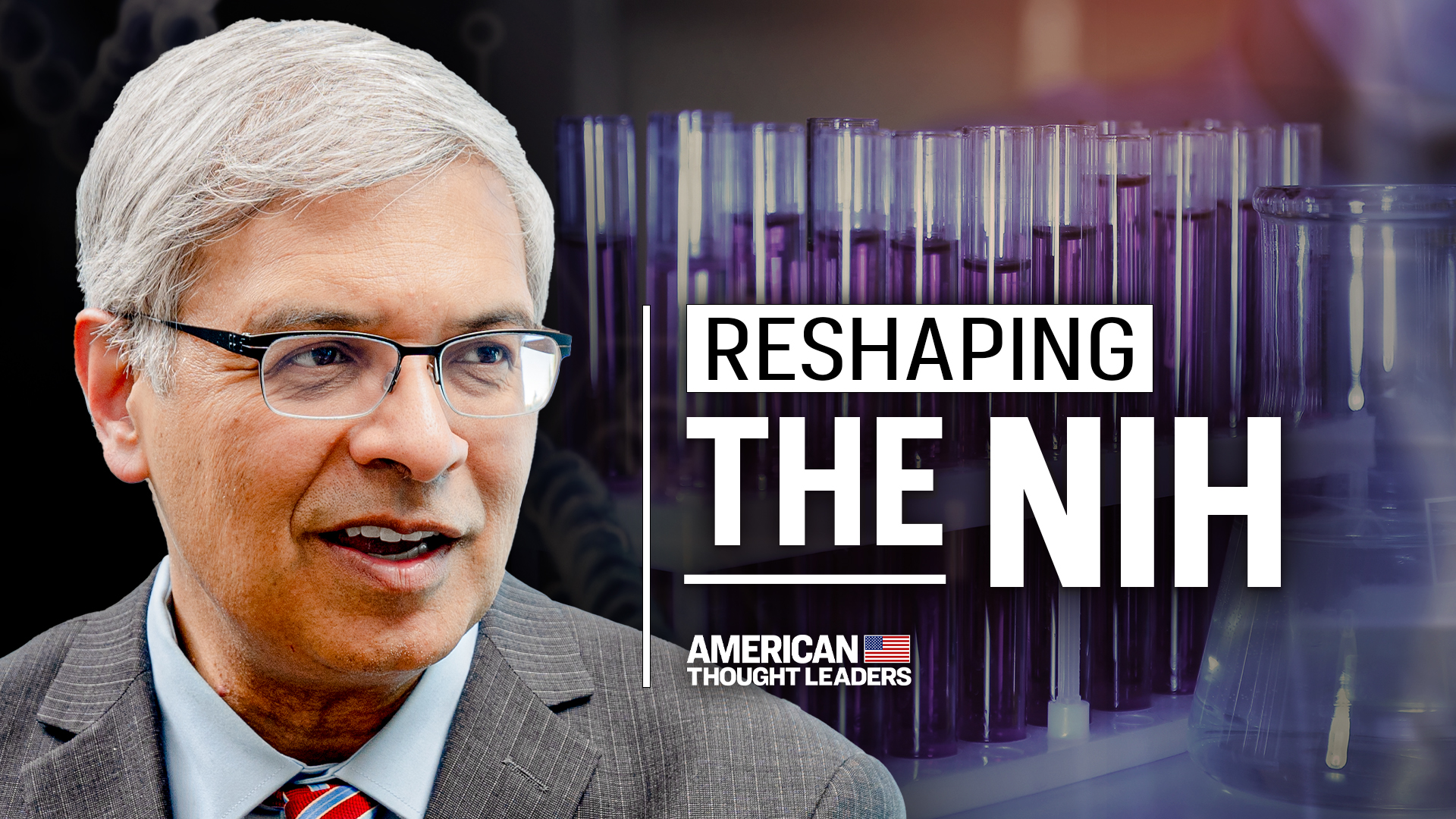

[RUSH TRANSCRIPT BELOW] In this no-holds-barred interview, Dr. Jay Bhattacharya, director of the National Institutes of Health, breaks down how the world’s largest public funder of biomedical research is changing under his leadership.
Bhattacharya, a former professor of Stanford University, public health expert, and coauthor of the anti-lockdown Great Barrington Declaration, was sworn in as director of the NIH in April last year.
With an annual budget of almost $50 billion, the NIH sets the direction of research at universities, medical centers, and research institutes across America.
It encompasses 27 institutes and centers that cover different areas of health and employ some 20,000 people. One of those is the National Institute of Allergy and Infectious Diseases, which was headed by Dr. Anthony Fauci for nearly 40 years.
The NIH, Bhattacharya told me, “really hasn’t had a change in leadership in decades. ... We’ve had new directors, but the fundamental structure and direction of the NIH has been basically the same until last year.”
Bhattacharya says his top priority is to end the practice of “funding the scientific enterprise for the sake of funding science” and ensure that NIH-funded scientific research actually produces better health outcomes for the American people. The goal should be improvements in health and longevity, not just more scientific papers, he says.
During our interview, we covered a lot of ground, including:
-Has the NIH completely stopped funding gain-of-function research?
-Is the NIH continuing to fund research with China?
-How has funding for international research institutes been restructured?
-Has the NIH stopped funding all research grants related to diversity, equity, and inclusion initiatives?
-What is being done to reverse the politicization of science?
-What is the NIH doing to help those who suffered injuries from the mandated COVID-19 mRNA vaccines?
-What can the NIH do to alleviate the massive replication crisis in research?
-How does he view the controversy surrounding vaccines and autism? Is the NIH looking into potential links?
-How is the NIH restructuring the allocation of funding?
What America needs, Bhattacharya told me, is a “second scientific revolution,” saying: “The NIH has the capacity to induce that second scientific revolution. That’s what I’m going to work toward for the next few years.”
Views expressed in this video are opinions of the host and the guest, and do not necessarily reflect the views of The Epoch Times.
RUSH TRANSCRIPT
Jan Jekielek:
Dr. Jay Bhattacharya, it is such a pleasure to have you on American Thought Leaders.
Dr. Jay Bhattacharya:
Nice to be here, Jan.
Mr. Jekielek:
Thank you for taking the time to sit down for an interview where we both agreed no questions would be off the table. There are a lot of thoughts out there about what’s happening at the NIH [National Institutes of Health], what’s doing well, and what’s going poorly. I wanted to go through the roster and try to understand. Let’s start here. How has the NIH changed? What have been the big positive changes at the NIH this year?
Dr. Bhattacharya:
Well, you know the NIH really hasn’t had a change in leadership in decades. I mean, we’ve had new directors, but the fundamental structure and direction of the NIH has been basically the same until last year. Just in the past year, we’ve made tremendous changes in how we oversee biosafety, for instance, and in what kinds of things we fund, like the direction toward actually solving the chronic disease crisis in this country. How we evaluate whether we’re successful has fundamentally changed.
We’re no longer just focused on having research that publishes papers; we want those ideas to translate into better results for Americans in terms of their health and outcomes. The intellectual risks that we’re willing to take on topic after topic, and then removing the politicization of science that existed, I think, for some decades before. On topic after topic after topic, we’ve made tremendous advances. And really, I’m grateful that you allow me to tell that story.
Mr. Jekielek:
Well, you mentioned a whole bunch of things here, and each of them deserves a bit of attention. But let’s talk about this politicization of science, because this is something we’ve talked about numerous times in the past. You’re saying that’s actually changed. I’m not sure everyone understands or necessarily even believes that. What’s changed?
Dr. Bhattacharya:
So over, let’s say, the last 15 to 20 years, the NIH incorporated into its agenda things that I can only characterize as political agendas rather than scientific agendas. Probably the most prominent example of this is DEI [diversity, equity, and inclusion]. A chunk of the NIH portfolio went to projects that were focused on achieving some social objective rather than the health mission that we actually have. Every single NIH employee had to write what I can only call a loyalty oath to DEI principles. They were sometimes evaluated based on their sort of sufficient devotion to the cause.
The NIH funds both research inside and outside the NIH. If you’re a researcher outside the NIH, the ticket to getting relatively easy extra funds was to promise to do DEI research. And in looking at it, Jan, much of that research had no real scientific basis at all. I don’t even characterize it as science, right? So I'll give you an example of the kind of things that we’ve worked very hard to deprioritize within the NIH.
Consider a project that says we’re going to look at— we’re going to ask the question: structural racism is the root reason why African Americans have worse hypertension results or something, right? That’s a hypothesis. The problem with that hypothesis is that there’s no way to test it. If structural racism is the cause, then what control group can you have to test the idea that it’s true?
And even worse than that is that none of that actually translated over to better health for anybody, much less for African Americans. Those are political agendas that don’t belong in a science agency. And so what I’ve done is I’ve ordered the NIH, its funding apparatus, to focus, because we absolutely have a mission to improve the health of everybody, including minority populations. When you have a project that is being proposed, first it has to be very clear; it actually has to be science; everything has to be well defined.
And then second, it actually has to have some chance of improving the health of some population or some people. I’ve seen all kinds of nonsense, Jan, talking about how we’re not taking into account differences between people of different races or men and women. That’s all nonsense. If it’s scientifically important, we absolutely want to consider it, but the project has to be real science and potentially actionable in terms of improving health for people.
Mr. Jekielek:
Basically, you’re saying that there were kind of ideological or political projects that were getting NIH funding. I mean, that sort of summarizes the—
Dr. Bhattacharya:
Yes, so for instance, if you had an existing NIH project, maybe it’s some good science in some area, at the end of the year, the NIH would often have some money left over. And so what would happen is the NIH program officers would go to the people who were doing these projects—sometimes often good science—and say, well, look, we have some money left over. If you propose a diversity supplement, meaning essentially some DEI add-on that wasn’t actually good science, then you can get access to extra money for your research. It was basically a waste of taxpayer money that had no chance of improving the health of anybody. And so we’ve gotten rid of all of that.
Mr. Jekielek:
One example that I’m thinking of that was not necessarily race-specific, but particular, is the use of vitamin D supplementation for black American populations. Like with COVID, if you had high vitamin D levels, you would be able to kind of deal with it and not get catastrophically sick or at a much higher rate and so forth, right? But this was actually harder for black Americans because the vitamin D isn’t, because of the color of the skin, isn’t kind of—
Dr. Bhattacharya:
Well, I’m also brown too. So it’s a little hard for me to get sufficient vitamin D levels.
Mr. Jekielek:
Right, but that would be an example of something that’s race-oriented somehow that would make sense to study, right? I guess that’s what I’m saying. You’re not saying that there shouldn’t be any studies that have to do with race or ethnicity.
Dr. Bhattacharya:
Let me put it in a very clean way, right? So the NIH’s mission is to fund research that improves the health and longevity of people. And that means everybody. Specifically, it means minority populations. And of course, if you’re going to do good science, you need to account for why some populations have worse health than others. So we’re absolutely continuing to fund that kind of science because that kind of science has a chance of improving the health of everybody, including minority populations. What we’re not going to do is fund ideological projects.
Now, the courts, we tried to get to stop to sort of end all of these projects in the old portfolio. And the courts have forced us to restore some of them. But going forward, what we’ve said is that we made clear what the priorities are. So the scientists of the country understand that if they want NIH support, they need to propose projects that will have the chance of improving the health of people rather than achieving some ideological end that should not belong at the NIH.
Mr. Jekielek:
Before we continue, right, you mentioned what the mission of the NIH was or is. Just explain to me what the NIH should be doing. Like, what is its core function? I think there’s a lot of misunderstanding around this.
Dr. Bhattacharya:
People really do misunderstand this. Like a lot of people think the NIH runs public health in this country. In part, I can understand why, because during the pandemic, Tony Fauci, who was the leader of the National Institute of Allergy and Infectious Diseases, a part of the NIH, seemed like the face of American public health. But in fact, the NIH is not an agency that makes decisions or policies about public health directly. The mission of the NIH is to fund research, the biomedical research enterprise of this country, that has as its focus the improvement of health and longevity of the American people.
Now, that means, if you think about where life expectancy has been over the last decade and a half, it’s been flatlined. In fact, it collapsed during the pandemic, but life expectancy as of Today is only a tiny bit higher than it was in the United States in 2010. Fifteen years of no life expectancy improvements, and you have tremendous chronic disease problems. The NIH has funded research, real excellent research that has advanced our biological knowledge and genetics and cancer and a whole bunch of things, but that has not translated over for the typical American to better health. In that sense, it is not achieving its mission.
But the focus of the NIH then is on funding research, setting the research agenda. It’s the single largest agency for public funding of biomedical research in the world. Eighty-five percent of all biomedical research funding worldwide, including public biomedical research funding worldwide, not including pharma, is for the NIH.
Mr. Jekielek:
You’re just reminding me of something. Of course, there are a lot of people that are very excited about getting access to this giant pot of cash, right? And something that you talked about in a recent interview was looking more carefully at cooperations with China, specifically under the auspices of the Chinese Communist Party [CCP], which is, of course, what all Chinese institutions are. Can you just comment a little bit on that for me?
Dr. Bhattacharya:
Sure. I think we have to be very careful about how we fund research relationships with China, especially post-pandemic, where it seems pretty clear to me that the NIH in particular funded research in collaboration with China that was actually quite dangerous and may indeed have led to the pandemic. We have to be very, very careful about that.
I think for the past two decades, maybe two-and-a-half decades, the NIH and the United States had a relationship with China that was, especially from 2000 to 2010, much more friendly. The U.S. invested in the Chinese biomedical research enterprise. Almost every single top Chinese biomedical research scientist was funded in some part by the NIH. Many were trained in the United States. So we invested heavily in that.
Post-pandemic, and especially given the geopolitical circumstances we are in now, it looks, in retrospect, like it wasn’t all that wise an investment. And at the same time, there are legitimate reasons to worry about industrial spying and a whole host of other concerns related to that. As a country, we have a legitimate interest in protecting our investments in the biomedical research enterprise.
There’s a real look inside the Trump administration now; we will just focus now on making sure that we don’t invest in countries of concern in the way we had, including China, and that our investments in foreign research collaborations are audited well, overseen well, and serve the interests of the American people. It’s really important that people understand that this doesn’t mean we’re pulling back from the rest of the world.
Research requires international collaboration. There are scientists in Europe, in South America, and all over the world who are legitimate scientists, and research collaborations with American scientists would produce better advances than if you didn’t have those research collaborations. Science is a worldwide enterprise.
At the same time, the way that we interact with these and support these relationships needs to be much more secure than it has been. And that’s something that actually is a big success over the last year. We’ve reset our relationships with the rest of the world, our scientific relations with the rest of the world, at least as far as biomedicine goes, so that we can have those collaborations without the worry that we’re going to produce another Wuhan.
Mr. Jekielek:
Well, so flesh that out: how you’ve made this reset. That’s fascinating. I mean, you’re saying across the board.
Dr. Bhattacharya:
Yes. So the traditional way the NIH has funded research collaborations across the world is that the NIH will fund a domestic researcher or some domestic institution. That domestic institution then will issue a sub-award to some foreign institution. And the collaboration, essentially, the money flows from the NIH to the domestic institution, then to the foreign institution. The domestic institution has had the sort of obligation to oversee and audit the foreign institution.
So in the case of Wuhan, what happened was that the NIH funded an agency or an organization called EcoHealth Alliance. EcoHealth Alliance had a sub-award relationship with the Wuhan Institute of Virology. And when all of the pandemic happened and the NIH had an interest in getting the lab notebooks of what exactly was studied in Wuhan, the EcoHealth Alliance essentially delayed reporting at all about what it knew had happened and then ultimately said, oh, well, we don’t control the Wuhan Institute of Virology. We can’t get the lab notebooks. That is an unacceptable structure.
If American taxpayer dollars are going to go to some foreign institution, then we should be confident that we, the Americans, have an auditing relationship that allows us to get access to the kinds of things that we normally have access to for a domestic institution that we fund. Which will never happen in communist China, just for the record, right? Well, I mean, any place where that can’t happen, we’re not going to fund them, right? We’re not going to fund those research relationships.
So what we did is we put a new sub-project system in place, replacing the old sub-award system with a sub-project system. So now you can have the domestic institution and the foreign institution have a research relationship; that’s fine. But if the NIH is funding, then both of them have to have direct auditing relationships with the NIH. And so then the NIH can shut off money to the foreign institutions if they’re not cooperating and can conduct audits; they have to have that structure. It’s called a sub-project system. It’s one of the first things that I ordered when I first got in.
And so, when there are these foreign collaborations, in addition to making sure that the auditing system and auditing structure are right so we can oversee it more safely, I also put in two new requirements for these collaborations. One is that if you’re going to do work outside the United States, you have to justify it by showing that that work would be much more expensive or prohibitive to do in the U.S. than it is outside. For instance, there are some diseases and conditions that are much more prevalent outside the U.S. and easier to study outside the U.S. That would be a reason why you would want to study them.
But then, two, the knowledge gained actually would need to benefit Americans. Of course, the knowledge gained may benefit the whole world, but it has to at least benefit Americans as well since it’s American taxpayer dollars going toward it. So that’s the new way that we’re dealing with the world. We encourage foreign collaboration, but in a safer, auditable way, in a way where it’s justified to do the work abroad rather than in the United States and with an output, research output, that can be reasonably expected to benefit Americans.
Mr. Jekielek:
So, just to comment on the Chinese situation, which I’m very familiar with for a whole lot of reasons, there’s a doctrine of civil-military fusion, which is one of the top priorities of Xi Jinping and his regime, which guarantees that any type of research with military potential is explored in the institution, because there’s no institution within China that’s independent of the Communist Party. They’re all either directly working under their auspices or co-optable at a moment’s notice as necessary.
It’s very interesting what you’re describing because I’m wondering, given what you’ve just described, will it be possible to do any research with Chinese entities? Because I just don’t see any Chinese institution legitimately saying, I’m going to give you audit access. Why? Because they'll say, well, sorry, we can’t do that. It’s a state secret. It goes against our laws. It goes against our rules.
Dr. Bhattacharya:
If that’s what we hear from them, we won’t allow that research to happen.
Mr. Jekielek:
Well, but they could also kind of lie and pretend that they’re going to give you audit access, collect the cash, do some research, and then give you fake books afterwards. This has happened. This is not theoretical.
Dr. Bhattacharya:
I can’t say how much I can say, but I think this is something that is of intense interest to the Trump administration. It’s not just the NIH, but all across the government to make sure that the way we interact with China does not leave the United States vulnerable to that kind of manipulation, intellectual property theft, and so on. If it’s not possible to have the criteria that I mentioned earlier for research projects with Chinese institutions, then we won’t have those research projects.
Mr. Jekielek:
I mean, and I don’t want to beat a dead horse here, but it’s of great interest to me what you just said because, you know, I’m kind of advocating for ending research collaborations in the transplant industry because of this, what I call killed to order situation, the title of the book I’m just coming out with. But what you’re describing, the structure already exists to, you know, unless, you know, presumably unless institutions can demonstrate they’re not doing something like, you know, on-demand organ sourcing from prisoners of conscience, you probably wouldn’t continue with those research collaborations.
Dr. Bhattacharya:
It’s like basic bioethics that we are not followed by. The institutions that are proposed for collaboration, that we will not collaborate with them. I mean, the institutions have to have the kind of standards that Americans expect for human subjects protection, for human rights. As far as the research is concerned, we’ve structured the requirements for foreign collaboration so that if you have an institution like you’re describing, it would be very difficult for them to get support from the United States, or at least from the NIH.
Mr. Jekielek:
Not wanting to beat a dead horse, but the Nature article, they have said that the NIH is ending almost all international collaborations. I think that was the headline.
Dr. Bhattacharya:
Last year at some point. It was ridiculous. I was working on designing this policy about resetting how we oversee foreign collaborations. And then you have this Nature piece, as you say, Jan, in a top journal, highly prestigious, actually funded in large part by user fees for research papers published by the Chinese researchers. And they’re falsely reporting that we’re ending all foreign collaborations. It was absolutely astonishing.
I think a lot of scientists across the world, and certainly in the United States, get their news from places like Nature and Science about what’s happening in the scientific world. And to see this absolute falsehood propagated as if it were true, when in fact what we’re trying to do is a thoughtful reset of our interactions with the rest of the world in a way that allows those collaborations to happen safely while protecting the interests of Americans, was astonishing to me.
I still can’t wrap my mind around it. I also used to admire Nature and Science magazines as top scientific journals that had a devotion. for the truth. But what I’ve seen is, at least in their news reporting, I’ve seen none of that devotion to the truth.
Mr. Jekielek:
So they didn’t ask you for a comment for that piece?
Dr. Bhattacharya:
It was published without any comment from me.
Mr. Jekielek:
One of the things that you mentioned at the beginning of the interview was talking about how to move away from research for just research’s sake, but research that will actually have results within the mission, if I understood, of the NIH as you’ve described it now. So how is that actually manifesting?
Dr. Bhattacharya:
I think some scientists and some people think about the NIH as an engine for publishing scientific papers. Like I fund a researcher and I evaluate that researcher on, are they successful by, did they write a paper in Science or Nature or Cell or the New England Journal of Medicine or something, right? But that is not actually the measure of productivity we care about, right?
The measure of productivity we care about is, did the funding for that researcher result in scientific ideas that advance the field where they’re in, new important directions? Did it lead to better health or cures, treatments, longer life for people with conditions that afflict people all across the country? There are real health problems in higher rates of diabetes, higher rates of mortality from a whole host of conditions, chronic conditions that we’ve, you know, that even if they don’t kill you, they end up making your life much worse. And we need to solve those problems. We need to address those problems.
And the NIH research then should be evaluated based on how well they do in solving those problems? Like how well do they contribute to solving those problems? One of the things that I’m most excited about, again, has been underreported, is how we allow the NIH to be a complicated institution. There are 27 centers and institutes focused on all different parts of human health. There’s a national health...
Mr. Jekielek:
NIAID would have been one of those.
Dr. Bhattacharya:
Yes. NIAID, National Institute of Allergy and Infectious Diseases, NHLBI, National Heart, Lung, and Blood Institute, NCI, National Cancer Institute, all of these are part of the NIH, right? A huge, huge organization with lots and lots of institutes focused on different aspects of human health. Now, the way that many of these research institutes make funding decisions, we get 100,000 applications every year from scientists around the world, but mostly in the United States, applying for money from the NIH.
And we can fund 8, 10, 12,000 of them, new ones a year. Typically, these projects last multiple years, maybe four or five years. So we have, as a whole, I think we fund 50,000 to 60,000 total projects, but 10,000, let’s say 8 to 10,000, 8 to 12,000 new ones every single year. Okay, So 100,000 applications a year, and we’ve got to pick 8,000 to 10,000 of them. The way that this happens—
Mr. Jekielek:
That’s a high hit rate, actually. I want to apply to NIH. 8 to 10 percent.
Dr. Bhattacharya:
One in 10.
Mr. Jekielek:
It feels high to me.
Dr. Bhattacharya:
I was a scientist myself before I was an NIH director, and it doesn’t feel high for research. Anyway, the point is that we have an obligation to pick the very best projects. And the question is, how do you do that? Well, the way you do that is, to start anyway, you have to have scientific review, peer review of these 100,000 applications. So tens of thousands of researchers across the country volunteer their time to review the 100,000 applications. They’re called study sections.
I used to be a member of a study section for decades, actually. And it’s kind of grinding work. You have to review the thing and then give it a rating. The way we used to ask the reviewers to rate it would be on five criteria: How important is the area? How significant is the project? Is the project innovative? How strong are the methods of the project? How good is the investigator? And then finally, how good is the institution?
And then there'd be an overall score that, it turns out, correlated very strongly with the methods, how good the methods are, much less strongly with how innovative the ideas were. The NIH over the last decades has become much more hidebound and conservative in the set of projects they would fund, much less. I did a scientific project a few years back where I estimated how old the ideas in NIH-funded research were.
The way you do that, just to talk very quickly, is you can look at all of the published research that’s published in 1940, get all of the words in it, then look at all the same things in 1941, subtract out all the 1940 words and phrases, and you’re left with all the new words, ideas that were introduced in 1941, 1942, 1943, and 1944. Then you go back to all the papers and you ask how old the ideas are in every single paper.
And so with that method, what we found was that in the 1980s, typical NIH-funded research was funding ideas that were like zero, one, or two years old. In 2000, then the 2000s teens, seven or eight years old. The focus was on can the project succeed rather than if it succeeded, would it revolutionize your field? And what happens is then you get all the peer reviewers to give their scores.
There’s an overall score, which correlates heavily with methods, and then the Institutes get to choose among the projects that they could fund that come. In which they are going to fund, they would have a pay line, many of them, and the pay line would say, okay, if we have such and so much money, we'll fund all of the top-scoring projects above the pay line, and then everything below gets not funded. The problem with that is that if the score correlates very heavily with the methods and not very heavily with innovation, then you’re underfunding highly innovative projects.
So I put a system in where we get rid of pay lines. Instead, the institutes have an obligation to look at all of the information from the peer review and then make decisions about the portfolio of projects they fund, where the evaluation of how well the institute and the institute directors are doing is based on whether the portfolio as a whole succeeds, rather than whether each and every single project succeeds, right? So I don’t care if you fund 50 projects and 49 of them fail, and the 50th cures type 2 diabetes; that’s a successful portfolio.
If every single project succeeds and all you get is a thousand papers published, but no improvement in human health, I don’t care. I don’t want that. I’m much more interested in allowing the institutes to take intellectual risks, to swing for the fences, to solve the chronic disease problems of this country, and reverse the life expectancy flatlining. Big, big difference from how we used to evaluate research.
Mr. Jekielek:
I mean, that’s absolutely fascinating. And it, again, sort of highlights how you set up incentive structures, which dramatically alters how, let’s say, bureaucracies function. It sounds like this is a pretty massive bureaucracy you’re describing. I’m fully beginning to grasp, as you’re describing, how many of these, you know, you’re funding 10,000 new research projects a year. Wow, that’s massive, right?
Dr. Bhattacharya:
Yes, it is massive. I mean, it’s not—no single human being can oversee or be familiar with every single piece of it. It’s not humanly possible. That’s why you have the structure. It’s a bureaucracy. But the way you make cultural change happen in a bureaucracy is by shifting the incentives around and painting a clear vision of where we expect the bureaucracy to be. A lot of amazing people work at the NIH. You just need to set the incentives right, and then over time, the right things will happen.
Mr. Jekielek:
So we started talking about gain-of-function research, and this is sort of a popular topic when it comes to Dr. Jay Bhattacharya. You know, there’s a kind of commitment; this administration, your administration, came into power with an agenda to end gain-of-function research. So for starters, where are we at with that?
Dr. Bhattacharya:
We made a lot of progress, and the White House is still working on a formal policy. But actually, can I back up just to set the stage for this? So there are a few things. One is, what is gain-of-function research? And why would anyone want to do it? I think that is important to understand. And then second, how should you regulate it so that dangerous projects that have the risk of catastrophic harm to human populations never happen? So let’s do that in stages.
First, gain-of-function research by itself is not necessarily bad. Dangerous gain-of-function research is necessarily bad. It sounds like I’m making too fine a point of distinction, but let me just give you an example. Human insulin, which is used to treat diabetes, is often produced by taking a bacterium and then giving it a gene that allows it to produce insulin. You cook the bacterium up, and it produces insulin. That’s a gain of function; that bacterium doesn’t usually produce insulin, but the genetic manipulation makes it able to produce insulin.
Mr. Jekielek:
Right. And now you can create large amounts of insulin for use.
Dr. Bhattacharya:
Inexpensively, right? So that’s completely legitimate. And we don’t want to get rid of that, right? Because diabetics depend on having the availability of insulin. On the other hand, going into the bat caves of southern China, bringing a virus that never previously infected any human, or maybe one or two at most, bringing it into a lab in a huge city in China with poor biosafety protocols, and then manipulating it to make it more transmissible among humans, well, that’s a gain-of-function.
That’s a dangerous gain of function that should never be supported, should never be done, right? So there’s a distinction between gain-of-function and dangerous gain of function. That’s really important to know. We want to make it so that there’s never any support or interest in doing that kind of dangerous work ever again.
That’s the policy of the administration. The president signed an executive order in, I think, April or May, I think it was, of 2020, where he said that the policy is, and I wholeheartedly support that policy. I think that is a very, very wise policy. The question is, how do you implement it? And how do you create the incentive so that this sort of research doesn’t happen again?
So let me go backwards again, because I’m sure people who are listening are asking, why on earth would anyone support such a research program in the first place? Bringing the viruses out of the bat caves and so on? It arose out of a utopian vision by certain scientists that we could prevent all pandemics if we are allowed to do this kind of research.
The idea was, now going back probably two decades, and certainly a decade-and-a half-ago, if we can go out into the wild places, capture every single virus or pathogen that’s out there, bring it into the lab, and then test it to see if they have some chance of infecting humans. If they’re close in evolutionary space, so they have a chance of making a leap into humans, then we should prepare in advance for all of them that are close.
But how do you tell if they’re close? Well, you do that by making the viruses or the pathogens more pathogenic, seeing if they infect human cells by making them more pathogenic. How much manipulation do you have to do before they infect human cells? If it’s only a little, then we should prepare for that. If it takes a lot or it’s not possible, then you can just ignore it. It’s essentially a triaging kind of operation.
First, butterfly collecting all the pathogens of the world, trillions and trillions, not possible to do all of them, but you can certainly pay people to make a good start. And then after you’ve identified which ones are most likely to make the leap, you prepare countermeasures in advance—vaccines, antivirals, and so on. Stockpile them, even though that virus has never made a leap into humans at that point in the project, right?
So the vaccines you prepare will never have been tested against humans. The countermeasures you prepare will never have been tested in humans for efficacy against the pathogen. Sounds like a great business model. It is a great business model, or was. But if it ever does happen to make a leap into humans, the irony is that evolution is very difficult to predict.
I know you have the evolution of biology experience. You can tell me this firsthand. What that means is that when it makes the leap, the countermeasures that you prepared against an earlier version of the virus may have nothing; they have no efficacy whatsoever against the virus that makes the leap, the actual leap. It’s a foolish playbook, a utopian playbook. But that was the justification for doing this dangerous gain of function.
Mr. Jekielek:
Well, a number of scientists I’ve spoken with have basically believed that this explanation that you just offered is more just like a cover for actually doing bioweapons research.
Dr. Bhattacharya:
So much of this work is dual use, the term of art, right? The U.S. is a signatory to the bioweapons convention, the U.S. does not do offensive bioweapons research, but other countries, who knows? This research, as we found out during the pandemic, can backfire very, very easily, where even just doing research on these pathogens can end up hurting your own country. And the idea that you need this for biodefense, well, if the biodefense effort ends up hurting your own country also, that also makes little sense.
It’s pretend biodefense because you’re producing countermeasures for a thing that may not actually, when it makes the leap, have anything to do with what you prepared for. And so either way, it’s an agenda that doesn’t deserve support. And yet for the last two-and-a-half decades, large parts of the Western world, the Chinese government, and others have wholeheartedly jumped onto this idea that we could prevent all pandemics using this utopian vision.
Mr. Jekielek:
I mean, this is fascinating. And so, you know, it makes you wonder, you mentioned before how this sub-granting system worked, right? That basically EcoHealth Alliance got a grant and then EcoHealth Alliance offered money to the Wuhan Institute of Virology through this sub-granting process. And I guess I keep sort of thinking to myself, I have some theories about this, but how is it that the NIH ended up funding what’s obviously a military lab because of the civil-military fusion doctrine and to insert fuel and cure and cleavage sites into bat viruses to make it highly transmissible to human beings, right? Like, that’s what I’m so how does that happen?
Dr. Bhattacharya:
It just happened because the civilian justification for it was this utopian plan to end all pandemics. In 2011, Francis Collins, the head of the NIH at the time, and Tony Fauci wrote an op-ed, I think it was in the Washington Post, essentially arguing that this kind of research program was warranted, even if it had the risk of causing a pandemic, because the knowledge gained would have been worth it. A flu virus risk worth taking, was the title of their op-ed. They justified that kind of research program based on this utopian vision. It’s hard to justify.
Actually, can we go back just a second? Because you asked a question earlier that I think is really important to understand. How do you regulate dangerous gain-of-function? What is dangerous gain-of-function? How do you regulate it? The analogy I like to use is, again, to nuclear weapons, nuclear power. If you go back into the early 40s, you had a physicist named Enrico Fermi who launched the nuclear age by starting the first nuclear chain reaction on the squash court at the University of Chicago. It’s a true story.
But before he did that, he did a calculation of what was the probability that this chain reaction would engulf the world as soon as he launched it, right? And he’s a great mathematician as well as a great physicist. The probability is pretty close to zero. Then he did the experiment. That’s the right framework for thinking about how to regulate dangerous gain-of-function.
Mr. Jekielek:
I just want to comment on this, right? Because it’s kind of an amusing thing to, I mean, a deeply troubling and amusing thing to think that, you know, he actually thought, you know, it’s possible that this chain reaction will just go on forever and basically create the end of the world. Let me explore the likelihood of that. Yes, just, I don’t want to build on this too much, but that’s just, it’s just, wow.
Dr. Bhattacharya:
Well, I mean, science is very, very powerful. There are things that actually can cause catastrophic, I mean, like I think COVID demonstrated to the whole entire world the power of science gone wrong. So you have to be careful. You have to regulate. Science for science’s sake, without any controls, potentially poses an existential risk to the world.
And so you need a regulatory structure with incentives in place that make sure of a notion of what that risk is. Like someone has to do a calculation of whether there is a positive probability of the experiment engulfing the world, you know, like Enrico Fermi did. And then you have to hold that person or those institutions responsible if they don’t report it up, if they don’t do that calculation, if they falsify that calculation.
And then second, you have to make sure that there’s an independent body checking that calculation. And if at any stage you find that someone’s proposing an experiment to do something that engulfs the world, then you just say, no, you’re not going to fund it. You’re not allowed to do it. And so that’s the basic philosophy.
So if a researcher says, oh gosh, I’m going to go to the bat caves of China and pull out a virus and then make it more transmissible, then they are going to be responsible for doing a calculation. What’s the probability of causing a worldwide pandemic? The institution where they’re working, the university or lab, is also going to be responsible for doing that calculation. Then when the NIH receives that proposal or other agencies within the United States government receive that proposal, they’re also going to be required to decide whether there’s any chance.
Finally, it’s going to go to a third-party board that’s filled with experts whose job it is to do the calculation Enrico Fermi did, right, and then decide. The previous way that the NIH and the U.S. government regulated this kind of work was a sham. There was a board populated not just by the NIH but by other parts of the government.
But the process for sending proposals to that board for that evaluation was a complete sham. I think in the history of it, I think three or four projects between 2017 and 2024 never got sent up for evaluation. And certainly the project to tinker with the coronavirus, they never got sent up. That meant the problem was not the board itself, but the process for creating incentives to do that calculation at the institutional level, at the investigator level, and at the funding agency level.
The new project, the other thing that they did is they would have lists of pathogens that are known to cause human harm: Ebola, MERS [Middle East Respiratory Syndrome]. And if you’re working on something on the list, then there would be some chance of getting it sent up. But the virus that causes COVID, if it was a result of this dangerous gain-of-function experiment, when it was pulled out of the bat cave in China, it was never on any list. You need a calculation, a risk calculation, not a list-based calculation. And so the White House is working on a policy, I think, that solves all of this.
In the meantime, we have paused 40-some grants of projects that to us look like they should go to the board. I’m not saying all of those 40 are dangerous gain-of-function. The designation dangerous gain-of-function should be made by the independent board. But while we’re waiting for the policy, I don’t want to fund a project that has any risk at all of causing catastrophic harm. So we’ve sort of erred on the side of pausing projects until the new policy comes in place.
Mr. Jekielek:
So bottom line, when it comes to dangerous gain-of-function research as you’ve now defined it, is there any chance that the NIH is supporting any of it anywhere at this point in your mind?
Dr. Bhattacharya:
I think, no. The answer is no. We’ve done a pretty comprehensive review. Now, if it’s possible that there’s somebody somewhere who has defied my orders about this, and if we do, we'll come down hard on them, but that is as my understanding is that we’ve done everything we possibly can, gone above and beyond so that even projects that are probably not dangerous gain of function, if there’s any chance of it being dangerous gain of function, we paused while we’re waiting for the final White House policy to come up.
By the way, Jan, much of this has been really, really fundamentally misreported. It’s been quite frustrating, actually, by outlets that don’t seem to have any understanding whatsoever about the policymaking process, the need for incentives, the need for the incentives to be right. It’s not just, I can say I need to ban all dangerous gain of function, but there’s no structures in place to enforce it, to put penalties in place for people and institutions that don’t abide by it. Nothing will come of it, right? The key thing is that the structures and incentives, and that’s what we, the U.S. government, have been working on the last several months.
Mr. Jekielek:
Yes, but what about other agencies? And so this is the other question: like something like gain of function, it’s not obviously purely an NIH thing. I can think of, you know, other agencies which it directly affects. And so, like, how do we—and of course, the White House does have a, you know, executive order around this, obviously. So I’m just, how does that work? Because there are so many different agencies, so many different players. Can’t something slip through?
Dr. Bhattacharya:
Right. Well, that’s why you need a White House policy. And that’s why you need a comprehensive policy that’s uniformly applied across the federal government. It’s not just anything, as you say, Jan. And that’s exactly what the White House and the Office of Science andTechnology Policy [OSTP] have been working on: a comprehensive policy with buy-in from every single part of the federal government. And I mean, I’ve just never been in government before last year.
But I'll tell you, it’s slow and frustrating to make sure that everyone’s at the table, and everyone understands what’s going on. But it’s actually been heartening to watch. I think there is a lot of goodwill across the federal government to make sure that we don’t fund any of this kind of work anywhere, a desire to abide by the president’s executive order. Because we saw what happened during COVID. Nobody wants that to happen again. We just need to have the structures and incentives in place so it doesn’t.
Mr. Jekielek:
Now, we were talking about the politicization of science, and it’s just something I’m remembering here. You know, one of the things that sort of shocked me to the core early in the pandemic, probably changed me actually, I think, was this proximal origins paper that was published in a Nature subjournal by, you know, a number of incredibly successful scientists, like a famous scientist. And the paper basically said this is absolutely a natural origin. It makes no sense to consider a lab origin. I feel like there haven’t been really major consequences of something like this, which was kind of life-changing for so many millions of people.
Dr. Bhattacharya:
Yes. I mean, I think that paper absolutely did alter the public conversation about the possibility of a lab leak as a potential reason for the cause of the pandemic. And people who were legitimately concerned about the lab leak hypothesis essentially got smeared, marginalized, and censored at scale because of that paper. And sort of like the dominoes, it tipped over. And if you go look at the emails, FOIA [Freedom of Information Act] emails, publicly available now, from some of the authors of that paper, they were actually skeptical that it wasn’t a lab leak. They thought it might be a lab leak.
Mr. Jekielek:
Right. Exactly.
Dr. Bhattacharya:
They were misrepresenting themselves as well as the scientific evidence. You had top scientific officials from around the world, leaders of the funding agencies like Jeremy Farrar of the Wellcome Trust, Francis Collins, Tony Fauci, and a whole host of others who lent their support to this effort. Many of them didn’t put their names on the paper; essentially, they were ghost authors. The whole episode is a dark moment in the history of science. We'll look back on it that way. The publishing agency that published it is going to have a black mark on its record forever.
A lot of the mystique of Nature or Science or whatever comes from a real track record of publishing really important advances in science, identifying them, propagating them to the public so people would know about them, and then allowing them to build on those advances. The reputation, though, is forever going to be scarred by this essentially embracing a cover-up of the possibility of a lab leak for something so consequential as COVID, which affected the lives of literally every single human being on earth negatively.
Mr. Jekielek:
It’s just, you know, it’s just kind of sad. One would think that at least they could retract it or something like this at this point.
Dr. Bhattacharya:
They still have not. But even the retraction wouldn’t be enough, right? I mean, so what? Everyone knows it; most everyone understands that it’s false, that it was a cover-up. At this point, in this late stage, if they retract, there needs to be fundamental reform in how scientists can communicate with each other. This idea that you can have a trusted gatekeeper, an editor of Science or an editor of Nature, who gets to decide what science is worth listening to—they send it to some peer reviewers that are anonymous. The peer reviewers themselves are never published.
Therefore, because it’s published in Science or Nature, it is assumed to be true, and everyone must agree that it’s true, which is ridiculous. The whole structure needs to be changed. Specifically, the way that we decide what scientific ideas are true and false needs to be reoriented more toward reality rather than what we’ve had for the last few decades.
Mr. Jekielek:
So exactly in this vein, you’re kind of leading into one of the things I really do want to talk about. This is something that your peer back at Stanford, Professor John Ioannidis, pointed out through a whole lot of work: there’s this quote-unquote replication crisis in science where someone finds a result and someone else tries to replicate it, which is essentially the basis of science, right? You have to be able to replicate a finding, and then it becomes real, as opposed to an aberration or something.
In many cases, it just doesn’t exist. It’s a foundational issue. I mean, it’s almost hard to fathom for the layperson like myself looking in, thinking how do we even get stuff done if there’s—if I forget what the numbers are—but some huge portion of papers are simply not replicable, meaning that the findings are not good or not useful, even from the perspective of advancing the scientific understanding of things.
Dr. Bhattacharya:
Professor Ioannidis wrote a paper in 2005 with the title, Why Most Published Biomedical Research Findings Are False. The reasoning is not because of fraud or anything like that. It’s because science is hard, and the publication structures that we have in place do not do a good job of distinguishing true from false. You said that replication is the core basis of deciding what’s true in science. That’s an epistemological position that I completely agree with.
Epistemology is the study of knowledge, right? So how do we know what we know? But the reality is how we know what we know now in science isn’t related to replication. It’s related to whether you are published in a top peer-reviewed journal. That’s what determines truth, sociologically; that determines truth in science. That’s the structural problem.
Mr. Jekielek:
One would hope there would be a strong correlation there, right?
Dr. Bhattacharya:
That’s the problem. There isn’t. Since John published that paper in 2005, 2006, there have been empirical evaluations in field after field after field, looking at some of the top published papers in peer-reviewed journals, like cancer biology, psychology, and neurobiology. What they find is that when they attempt to replicate these top peer-reviewed published papers, 40, 50, 60, 70, 80 percent of those papers do not replicate, or the effect size is much larger than the replication finds. Or the methods aren’t described clearly enough, so no replication is even possible. The data isn’t shared.
There are a whole host of findings that give empirical bite to John’s theoretical observation that the standards we use for truth in science are too lax. And of course, then there’s also the twin problem of if you have a negative result, you won’t publish it. It’s not interesting. Replication studies don’t get published.
Mr. Jekielek:
But also, it also makes it, from everything you’ve told me before, less likely you'll get funded again, so that’s something you’re going to avoid, right?
Dr. Bhattacharya:
Well, so it’s analogous in some ways to the situation that existed prior to the first scientific revolution. The first scientific revolution—the epistemological power was in the hands of high ecclesiastical authorities to determine physical truth, right? The sociological understanding was physically true. Do the moons of Jupiter move? It was in the hands of essentially the Vatican. The first scientific revolution took that power to determine physical truth out of the hands of this high authority and put it in the hands of people with telescopes.
The situation today is analogous. You have the power to determine truth being decided by a relatively small number of powerful journal editors, cartels, if you will. And what needs to happen is a second scientific revolution where that power is displaced from there to the hands of people who do replication work, essentially democratization of science or the ability to decide what’s true or false in science. The NIH has the capacity to induce that second scientific revolution. That’s going to work toward the next few, this year. There are three major things that I think need to get done.
So first, we need to start funding and supporting people who do replication in clever ways. And it’s not just replication narrowly of like already published papers, but you know reproduction for reproducibility, right? So for instance, if I approach your problem in a different way, do I get a similar answer? Does the result you have generalize? If you have a replication study that fails to replicate, that doesn’t mean the first study was bad, necessarily. It’s just a reason to investigate why the replication fails. It advances science, right?
And this point’s a really important thing. We should be thinking about this as science is a collaborative thing. And the solution is to improve that collaboration across scientists. Because it’s, like I said, the democratization of science. Rather than as a policing thing, where we’re going to find your, oh, you published a paper? I’m going to force you to retract it because you were wrong. It’s not a policing thing. It shouldn’t be anyway.
So we have to fund replication, but let the scientific community decide which scientific projects are worthy of replication, need to be replicated. Sort of the rate-limiting step ideas. The government shouldn’t decide what needs to get replicated. Scientists themselves should. If there’s a really, really important idea, if it’s true, science will move in one direction. If it’s false, science will move in another direction. Well, those rate-limiting step ideas are the ones that ought to be replicated. And we‘ll fund scientists to do that. We’ll create a cadre of scientists to do that.
Second, you have to have a place to publish your replication studies. Right now, scientific journals will not publish replication studies generally. They'll just reject them out of hand for the most part. Nature will reject them out of hand for the most part. And so you have to have a place where you can publish them. And that’s something the NIH can do within the National Library of Medicine.
We can stand up a journal where you can deposit your replication work. There has to be limited gatekeeping for that journal, right? So the author of the study being replicated can’t say no. But there should be peer review, and it should be open so people can see the scientific discussion that’s happening around that paper and that replication effort. And you have to tie those replication studies to the scientific literature itself.
So when you do a search for a paper, it pops up; there should be a replication button. You click the replication button, there’s an AI summary of the related replication work, and you can click and see each paper itself and decide for yourself whether you believe the result or not. It changes the locus of power to decide what’s true away from journal editors and top journals to replication, to sort of a scientist looking at the same thing. And it'll fundamentally transform science. Just that one replication button will transform science.
And then finally, you have to start measuring because what we want is, we want scientists to collaborate with one another. People should be looking over their shoulder, worried they’re going to be replicated. They should want to be replicated because no one’s going to believe them unless their work is subject to replication. It’s actually an honor to have someone attempt to replicate.
Mr. Jekielek:
It means it’s relevant and important, your work.
Dr. Bhattacharya:
Exactly. And so right now, people view it as a threat. It’s because you don’t reward people for good, sort of good pro-social behavior by scientists. What do I mean by pro-social behavior? Do you share your data? Do you share your code, your tissue samples? Do you write your papers in a way that invites replication, with methods so clear, no secret sauce, the methods are so clear that anyone can try to do the replication themselves?
Are your papers even subject to replication? All of these should be measured, and this is something I’m working on at the NIH, at the scientist level, at the institution level, and so that institutions that are good at that kind of sort of scientific behavior will be rewarded. If you measure it, it'll happen.
Mr. Jekielek:
So one of the things that I’ve been hearing about a lot, right, is that you’re basically cutting a whole bunch of funding to some of these institutions, maybe for the reasons that you’ve been describing here. So just what is the status of granting, right? Clearly, there’s been change. Are a lot of grants being canceled?
Dr. Bhattacharya:
The short answer is that last year, Congress gave us something like $48 billion for funding. And every single dollar of that went to funding research. Funding has not been cut. It’s just a false narrative that has somehow, again, been propagated by places like Science and Nature and their news organizations. What has happened is that the set of people who are receiving the support may be different than before.
So we’re not funding DEI grants. We’ve tried to fund newer ideas, like more innovative ideas, and that means that many different people will get the grants who would otherwise not be used to getting grants. There is a big priority in mind to make sure that we fund early career scientists.
For the last two decades, three decades, the NIH has funded researchers who are older and older. The age at which you get your first large grant from the NIH has gone from your mid-30s in the 1980s to your mid-40s today. But it is also the case that a lot of the newest ideas, the most innovative ideas, come from early career researchers. And so it is a huge priority of mine to make sure we fund them.
Mr. Jekielek:
So basically it is changing. You’re saying you haven’t cut funding, but you’ve redirected funding substantially.
Dr. Bhattacharya:
Yes. We’ve redirected funding toward the priorities I’ve been talking about. The thing is that people aren’t used to change in this space. And the most powerful scientists, who are the ones most used to getting funding over and over again, are complaining that there’s uncertainty about this. And so you hear people in Science and Nature, again, you see these stories about how a whole bunch of American scientists are leaving the country.
It’s ridiculous, like you have a couple of anecdotes. There’s still the fact that the NIH is the number one funder of public biomedical research in the world. Eighty-five percent of all public research funding for biomedicine comes from the NIH, including foundations and investments by foreign nations.
I just saw a story about how Macron, the president of France, bragged that he is going to fund a 30 million euro program to attract 40 scientists. I mean, 30 million euros is a tiny, tiny fraction of what the NIH spends on scientists. The United States is still the very best place in the world to do science and certainly the best place in the world to do biomedicine.
All of these stories are essentially political stories. They’re exaggerating because they are upset that the priorities, which have changed, are no longer just to fund the scientific enterprise for the sake of funding science. Instead, now it’s funding the scientific enterprise to produce better outcomes and health for the American people.
Mr. Jekielek:
And from what I’ve seen, more money is also going to the non-elite institutions or the kind of non-top Ivy League?
Dr. Bhattacharya:
Well, I would love to have that happen. There needs to be some fundamental changes in the way that we fund the institutions for that to happen. And that’s something I want to work with Congress to make happen. I think the top 20 programs receive somewhere between a third and a half of our extramural funding every year. I mean, it’s a pretty substantial fraction concentrated in a few places. That needs to change.
One of the things I’ve been doing the last year is traveling around the country, visiting scientific institutions in the middle of the country. I’ve been to the University of Alabama. I’ve been to the University of Oklahoma. I’ve been to Kansas. I’ve been to, you know, a whole bunch of places. And what I found is that there are scientists there that are invested in science, making bio hubs, kind of like what we have in Massachusetts or Boston, available everywhere. And yet they have difficulty getting that funding.
Mr. Jekielek:
What is a bio hub?
Dr. Bhattacharya:
It’s like a concentration of companies and researchers and others focused on certain areas of biomedicine, right? So often there’s pharmaceutical company investment in them, but also a thick research enterprise, often funded by NIH money. So what they want is, and they’re poised to do it, but they have difficulty getting NIH money for that purpose.
And I'll tell you what’s the real root problem here. So we have these programs to try to direct money to them, but they’re important programs like the Institution Development Award [IDeA] program, but they don’t change the fundamental economic dynamic that leads to an underinvestment in research at these research institutions.
So the dynamic is this: if you want to win facility support for your facility, the way the NIH works, you have to have researchers there that can win NIH grants with their project ideas, brilliant researchers that can win the competition. And then attached to that money, you'll get some what’s called indirect costs, which are supposed to go to funding for indirect costs. Yes, so the direct costs are for the projects themselves, and then attached to it, if you win, you get the indirect costs. The indirect costs are supposed to fund the facilities, the lab, the square footage of lab space, the cryo-electron microscopes, or whatever equipment you need.
Mr. Jekielek:
Okay, let me just jump in. You’re talking here about a number of these elite institutions being really unhappy about the change in the indirect cost structure because they’re losing a bunch of overhead money that they would be getting. This is what you’re talking about?
Dr. Bhattacharya:
Well, there was a proposal put out early in the administration to lower the indirect cost recovery rate. That was enjoined by the courts. This is related to that problem, but the root problem isn’t the money. The root problem is the concentration of where we send our resources to support facilities, right? So that indirect cost, what it’s supposed to do is pay for the upkeep of lab space and all this other stuff, right? But it’s attached to winning grants.
If you don’t have amazing scientists who can win the grants, you’re not going to get the facility support. But in order to attract excellent scientists to your institution, you have to have excellent facilities. You see the problem, right? It’s a kind of catch-22 that guarantees that our funding from the NIH is going to be concentrated in relatively few institutions. I think the whole state of Florida gets roughly the same amount as what Stanford University gets from the NIH.
So what I want to work on is essentially to introduce market competition for the indirect costs, the facility support. Cut the link between the indirects and the direct. Scientists will still compete with each other for their support for their ideas. But the institutions themselves will compete with other institutions for the facility support.
We already do this for some things like the National Cancer Institute, Center of Excellence designation, and the clinical translational programs. There’s institutional competition. We should broaden the range of institutional competition. And the key thing is to introduce essentially market elements for that competition. So that if one institution can provide a square foot of lab space more inexpensively than another institution, they'll have a leg up in winning the institutional support, right? And then allow researchers to take their grant money and go where the facilities are.
Like I’m telling you, I’ve heard from young researchers across the country who tell me they have difficulty getting a square foot of lab space to do their research in some of the top institutions because it’s just crowded. Imagine that they were, you know, like in college sports now, there’s this name, image, likeness thing where the institutions compete for excellent players, right, through the portal.
Imagine a portal like that for scientists instead of for sports stars, where the institutions that have won the institutional support for lab space compete for the scientists to come there and do their work. It would democratize science. Actually, what it would do is unleash scientific ingenuity across the country. And it would also combat the problem of scientific groupthink. If you have a few hubs with only a few places where all the NIH-funded scientists are, they tend to think alike. If you have it geographically dispersed, you have less of a problem with that.
Mr. Jekielek:
I mean, fascinating. Absolutely. You know, something that just strikes me, actually. So one of the kind of big criticisms of how we ended up getting our policy so wrong around the COVID pandemic, right, is the too much influence of large pharmaceutical companies. I mean, I’m oversimplifying a little bit, but that’s too much because some of their money goes into the system. There are these kind of revolving doors between people who are working for the NIH and then going to pharma and going back.
Dr. Bhattacharya:
Well, it’s more FDA [U.S. Food and Drug Administration]. NIH is less of that.
Mr. Jekielek:
Okay. That’s good to know. I mean, I’m talking as someone who’s not an expert in this realm. But there are also all these NIH scientists getting royalties, for example, which would incentivize them to keep using certain types of products that might not be as good as other things that could be funded. Just this whole kind of world of financial incentives that might go against all these amazing things that you’re talking about. Is this being addressed? And if so, how?
Dr. Bhattacharya:
Yes. I am also very concerned about this. The key thing is transparency. So I think if you have an idea that comes out of the NIH, and then a pharmaceutical company uses that idea to make a product that improves health outcomes or cures some disease, that’s not a bad thing in and of itself.
Mr. Jekielek:
No, it sounds like a great thing.
Dr. Bhattacharya:
The bad thing is when you have researchers who have conflicts of interest and don’t report them; people don’t know about them, right? Because transparency then, I think, once you understand what the funding structures are for any particular researcher, well, then you understand what the conflicts of interest are. So you can better evaluate what they’re saying.
Just because there’s funding from a pharmaceutical company doesn’t mean that the science is bad; that’s not how it works. But you do want to understand when you are reading some piece of research: was it funded by a pharmaceutical company? Was the research funded by a pharmaceutical company or other entities, including the NIH?
Let me just step back just a bit. For doctors in this country, there’s a website. You can go and type your doctor’s name into it, and then you can find every single dollar they got from pharmaceutical companies over the last 10 years. I’m not sure exactly the time frame, but like for 10 years. Every single dollar.
Did they go to a pharmaceutical company dinner or lunch? Did they get a grant or some sort of stipend from pharmaceutical companies? It’s all reported for every doctor in the country. There should be something similar for researchers. And that’s something I’m working toward. That transparency, I think, will help solve the problem you’re addressing.
Mr. Jekielek:
Fascinating. You know, one of the problems that we had during the pandemic, as I’m thinking about this, is that the powers that be were very determined to deploy a technology that was, let’s say, not ready for market would be a nice way of putting it, you know, based on the research that I’ve seen. And I’m talking about specifically this, you know, mRNA type gene therapy slash vaccination. What safeguards exist to prevent something like that from happening? And maybe around this specific technology also?
Dr. Bhattacharya:
Well, so of course, the NIH does not approve or not approve products for market. We fund research. It’s not doing surveillance of the safety of those. That surveillance is in the hands of the FDA and the CDC [Centers for Disease Control and Prevention]. It’s not recommending anyone take or not take those products. Again, that generally is in the hands of the CDC. The NIH is not, in that sense, policing or possessing that kind of public health power. What we do is we fund research, right? And that research, how it gets used, may depend on other parts of the government.
And, you know, I think with Marty Makary, who’s a fantastic FDA commissioner and a good friend of mine, I have full confidence that they’re reforming to make sure that the kinds of problems that led to that experience with the mRNA vaccinations are in the process of being addressed, not just for that, but more broadly, while at the same time allowing new products that are innovative to still be approved when they actually are safe and effective. I think that kind of reform is happening, but that’s in the power of the FDA, not in the power of the NIH.
Mr. Jekielek:
What about the fact that there was such a mass vaccination campaign of a product that tens of thousands, hundreds of thousands of people were injured in this process? What work is the NIH doing in terms of research to somehow help these people? Because just from my own experience, my wife and I made a film about this, right? These people were, even though in some cases they were supported a bit by, mostly just gaslit and told, no, your issue doesn’t exist, right? So how are you approaching this?
Dr. Bhattacharya:
Well, you’re absolutely right. A lot of the patients who were vaccine-injured were gaslit, with people pretending as if they didn’t get injured or that somehow their symptoms were all in their head or something. Actually, this is part of a broader phenomenon where you have patients with conditions that are poorly understood, where the medical system will gaslight them. They can tell you it’s a psychological issue. rather than a physical issue.
It’s going to make you think that you’re crazy because you have symptoms that you just, you know, you know you have, but you can’t convince anyone else to do anything about it. Vaccine injury is one of them, long COVID, ME-CFS [Myalgic encephalomyelitis/chronic fatigue syndrome], chronic Lyme disease, a whole host of these conditions where it just fits a very similar pattern.
The key underlying thing is that there isn’t excellent science to guide decision-making for clinicians or anybody else, for patients. And I’ve made sure that people know at the NIH that I’m very interested in investing in answers for patients for all of those: vaccine injury, long COVID, ME-CFS, chronic Lyme. We need to get better answers.
The gaslighting happens because, you know, if you’re, let’s say you’re a doctor and you see a patient and you have no idea what’s causing their condition, right? Because the scientific literature doesn’t have an answer. You’re going to be, unless you’re an amazing doctor who’s really good at, you know, sort of being honest and compassionate, you’re going to want to move on to the next patient.
And it’s really, really unfortunate. The answer is to get good answers, right? So invest in research on treatments, on underlying physiological causes, basic biological knowledge, so that those patients actually can, the doctors and the caregivers for those patients will treat them correctly.
Mr. Jekielek:
So, but is NIH doing this for people that have been COVID vaccine-injured? That’s a huge number of people, relatively?
Dr. Bhattacharya:
We have investments in that. And we’re going to have more investments in that as we start this year. For all of those conditions, I think patients deserve an answer. And I’m definitely interested in finding them. I would love to know myself. Even like autism. Take that, for example.
We’ve invested a tremendous amount of money in trying to understand the etiology of autism because there are millions of families around the country that have children that they would love to be able to help, but we don’t really have great answers for the cause and how to sort of reverse whatever problems there are.
And of course, there’s a whole range, for autism, there’s a whole range of phenotypes ranging from very, very severe autism to much milder. And so you can have different answers and different biology. We need to have better science underlying all of these conditions. And that’s something I’m investing in to make sure that the next generation of folks who have these conditions will have better answers provided to them.
Mr. Jekielek:
You know, just come to think of it, I remember watching moments from a hearing that you were at, and these are, you know, very, just to be fair, extremely high-pressure moments where someone’s trying to get you to say something that you'll regret later. But I believe you said that, you know, you’re unaware of a situation where a single vaccine causes autism. I believe that’s something that you said, and I just wanted to give you an opportunity to just talk about this question because I’ve seen, I’ve looked at a bunch of literature now. I feel like there’s a link, right? And again, I’m not an expert.
Dr. Bhattacharya:
I don’t agree. I’ve read parts of this literature also, right? So let me just start from the step backwards just a bit. We have this huge increase in autism prevalence. In my reading of the scientific literature, I’ve seen several, many different hypotheses for why this has gone up. Every time I talk to somebody who’s an expert in the area, they give me yet another hypothesis.
Mr. Jekielek:
Well, again, it’s likely a combination of factors, right?
Dr. Bhattacharya:
Yes, and it’s very different, because it’s obviously a very heterogeneous condition where there are some kids who are very nonverbal, with a very clear biomedical underlying condition that is causing it, probably environmentally induced with some genetic susceptibility. I don’t know. It’s really very complicated. And then there are kids who are high functioning, verbal, maybe have some social awkwardness, but otherwise are integrated into society well, right?
And so the biology there is going to be very different, right? And I'll tell you, I don’t know the answer. I don’t understand how people can so confidently say they know what the answer is for a biological condition that is so heterogeneous and has so many different hypotheses. That’s the way I’ve been approaching it.
Now, on the question of vaccines and autism, there has been some research in some areas that I—so for instance, the measles vaccine, the MMR vaccine, and autism, there are, I believe, high-quality studies. Now people will argue with me; it’s fine. I‘ll grant that there may be problems with the studies that I’ll say, but to my eye, for the MMR vaccine, there are honest attempts to try to ask whether MMR vaccination causes autism. And they fail to find a link for the kind of study that I think is plausible or high quality.
Now, again, if people disagree, then I'd say, well, let’s fund the next study that advances on it. For other vaccines, there actually isn’t this kind of rich literature. When people ask, do vaccines cause autism? I think it’s a poorly formed question. The question is, do our particular vaccines, do they cause autism one at a time? And then also we have a whole schedule where we give lots of vaccines over certain periods of time and different delays and different schedules, right?
Mr. Jekielek:
And these cocktails have not been studied at all.
Dr. Bhattacharya:
Well, it’s very difficult. There’s like a two-to-the-end problem. If you end vaccines, you’re giving, there’s two-to-the-end impossible combinations. And it’s really difficult to study something where you have that many different combinations. It’s a scientifically challenging problem, and that’s hard to study. In fact, in my understanding, that’s not something that has been addressed. So, do vaccines cause autism, is a poorly formed question. Do I believe that we know that there are some vaccines that cause autism?
The answer is, I don’t think that’s true. Do we know for a fact that every single vaccine in combination that is given doesn’t cause autism? Also, I don’t know that we know that. So, I mean, these are things that are worthy of research. And it’s something, actually, like generally, it’s not like it’s become a taboo thing to do, but it really should just be a research agenda.
I believe very strongly that based on the balance of risks and benefits, that some of the infectious diseases that we are vaccinating against—most of them, in fact, all of them—that we’re recommending vaccination against are important to vaccinate against because the infectious diseases themselves, I know, cause problems. Now, it may be that for some kids, different kinds of susceptibility in different areas, there’s going to be some risks, and you have to take that into account. And so there should be a sort of shared decision-making kind of thing for vaccinations.
Mr. Jekielek:
Right, as indeed has been the, you know, the sort of direction the administration has taken.
Dr. Bhattacharya:
Yes, like there’s very few—like most European countries, these vaccination decisions are not mandated. Instead, they’re shared decision-making with the public, essentially trusting public health, because public health isn’t trying to force you to do something, which is give you what’s known or not known. I think that, to me, is the right paradigm for thinking about vaccination.
I do believe, I guess I said, for the measles vaccine is a good example. This is vital. I believe that most kids getting the measles vaccine would be a good thing for their health. Does that mean I want to force anyone to get this if they don’t want it? No, the answer is no. I think it should be shared decision-making and allow people to make decisions.
Mr. Jekielek:
Does it somehow reduce the efficacy if people make the choice for their kids to not do it for the overall population? Because this is like, this is what I understand to be the kind of issue, right? That we’ve had this kind of odd white lie culture where you’re supposed to believe that you know there are no problems with vaccines at all and then you know then people will you know get basically make sure their kids are vaccinated. But if they knew that there’s even a very small chance of a problem, they might not do it. And that wouldn’t be right.
Dr. Bhattacharya:
Well, it turns on a scientific question, right? Does the vaccine that you’re considering reduce or eliminate the risk of your getting and spreading that disease? So for the measles vaccine, you get that measles vaccine. You’re not going to get measles, very likely; there may be some very, very rare exceptions, and you’re not going to spread measles. So getting the vaccine will have benefits for others, this herd immunity. Same thing with some other vaccines.
But with other vaccines, you don’t have that. Like with the COVID vaccine, you got the COVID vaccine, you could still get COVID, and you could still spread COVID. And so you have two different situations, one where there is a public benefit and one where there isn’t.
Mr. Jekielek:
But the question is, when not getting it, does that have a negative public...
Dr. Bhattacharya:
Well, I mean, again, it depends on a scientific question. Does the vaccine stop you from getting and spreading the disease it’s designed to protect you against, right? So for measles, yes, if you’re not getting it, you are now at risk of getting and spreading measles. With the COVID vaccine, no, you’re equally at risk of getting it. You’re roughly equal. I mean, there’s no appreciable long-term benefit in terms of reducing the probability of getting COVID or spreading COVID. And so it’s just a scientific question to answer that question.
But that doesn’t mean that the right way to deal with vaccination is mandates, right? So I repeat, most European countries do not have vaccine mandates, even for the measles vaccine. And nevertheless, they have relatively high uptake of the measles vaccine. Why is that? It’s because the public trusts the public health authorities to do the right thing, not to coerce them, not to lie to them, not to induce them to do things that they wouldn’t otherwise want to do, but trusts the public to make the right decisions with good advice from their doctors for their kids. I think to me, that’s the right way public health ought to be conducted.
And yet you’re absolutely right, Jan. A lot of public health has been, well, you must, if you don’t do this, we’re going to lie to you about what the benefits and harms are. We’re going to suppress and censor people who raise questions. American public health has essentially earned distrust. I think that’s the situation we’re in. And now do we have answers, just to be blunt, do I have answers to all of these questions? And the answer is no.
The job of the NIH is to fund research. On those so that we get answers for people to the questions that they have, even if some people think that the questions are already settled. If there’s a lot of the population that doesn’t agree, then in my view, the right, respectful thing to do is to, rather than just censor them or argue with them or marginalize them, provide better scientific answers to the questions that they have.
Mr. Jekielek:
And possibly discover that you’re wrong.
Dr. Bhattacharya:
Yes, right.
Mr. Jekielek:
Thank you for taking the time to, you know, there’s a whole host of other questions that I want to ask you, but I think maybe I‘ll save them; maybe you’ll come back. Hopefully, you'll come back for another go sometime in the future. But in the meantime, a final thought as we finish here is just kind of where we’re at and where we’re heading with the NIH.
Dr. Bhattacharya:
Well, I think that it’s a brand new NIH in so many ways. And I have always loved the NIH before, even with its problems. It served as the engine for biomedical scientific discovery that led to cures. Almost every single piece of knowledge that doctors use now to manage patients has NIH investments over the last century somewhere at the heart of it. But I think sometime in the last couple of decades, the NIH became much more of a staid institution, not willing to take intellectual risks.
But on the other hand, it was willing to take risks on dangerous gain of function and other utopian agendas, social agendas like DEI, that it had no business really engaging in. I think the NIH now, under my leadership, under President Trump’s leadership, and with Secretary Kennedy looking over, is focused on actually addressing the chronic health problems of this country, reversing the flatlining of life expectancy, and making good on its mission, which I think everyone should get behind. Research that improves the health and longevity of the American people, and in fact, the whole world.
Mr. Jekielek:
And just as a kind of a pin in that, I guess, is just that I remember you were popularizing this idea recently that research done by the NIH showed that, you know, ADHD [Attention-deficit/hyperactivity disorder] can be dealt with with better sleep. I mean, basically, that’s what I saw, which sounds attractive and hopefully is the case, right?
Dr. Bhattacharya:
Yes, that was a kind of interesting, it’s just this is just a new result that just popped up on, and I find research shows that the way that some drugs like that are used to treat ADHD work previously was thought to hit attention centers in the brain and make you more attentive, but in fact, what they do is hit wakefulness centers.
Now, the next step from that is, and that’s something that needs more research, but like is, well, for some kids, why give the drug at all if maybe you could instead have better sleep and then you get the wakefulness centers more naturally sort of in the right state rather than with the drug? It’s not affecting attention centers of the brain as was previously thought. That’s the result. Really interesting biological results with potential practical implications that do need more research to follow up.
Mr. Jekielek:
Well, Dr. Jay Bhattacharya, it’s such a pleasure to have had you on.
Dr. Bhattacharya:
Thank you, Jan. So good to talk.
This interview was partially edited for clarity and brevity.