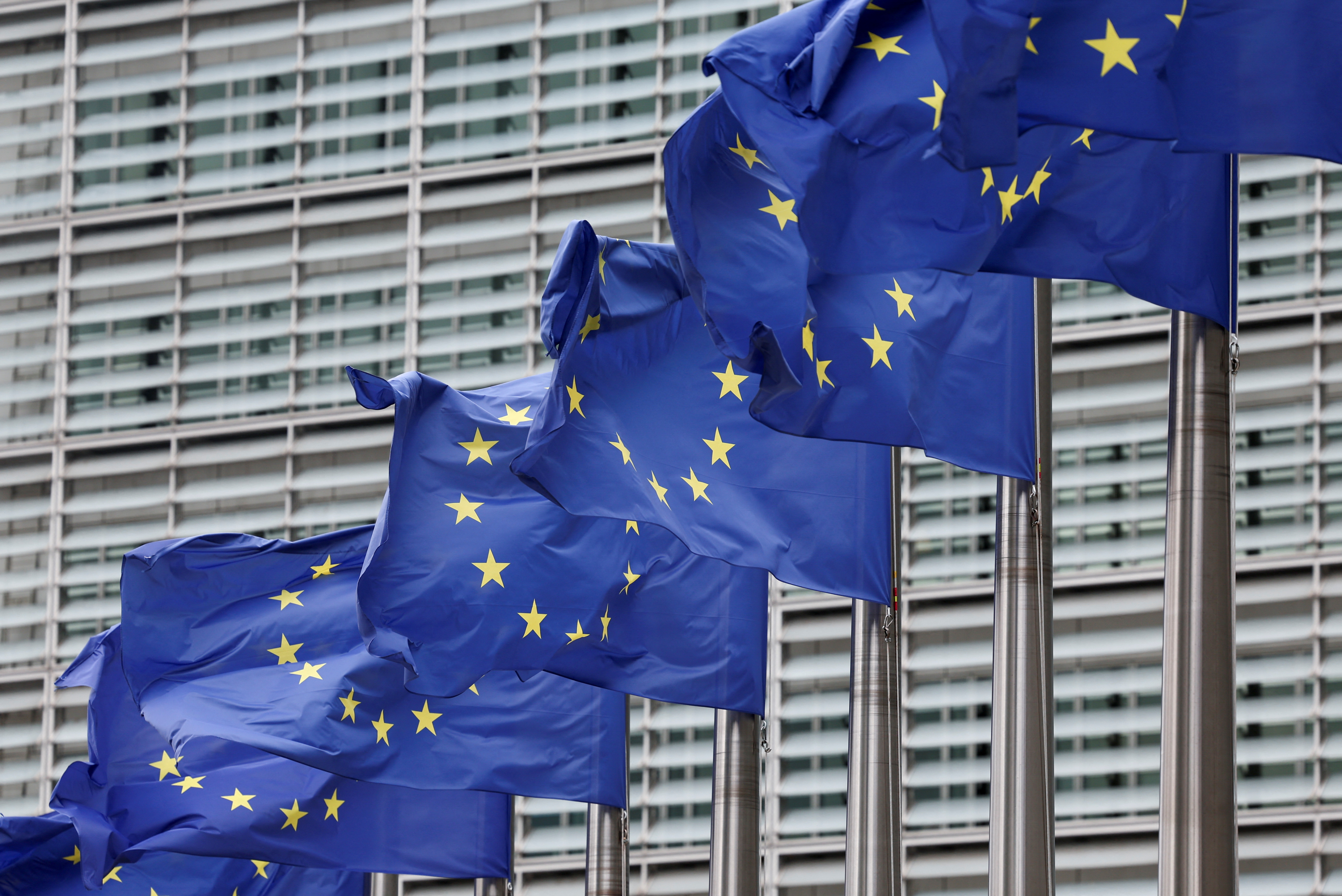

European leaders expressed outrage on Tuesday and Wednesday after the U.S. State Department designated five European nationals—including former European Commissioner Thierry Breton—as anti-free speech activists to be blocked from entering the United States.
On Dec. 23, U.S. Secretary of State Marco Rubio announced the State Department had taken action against five individuals he described as “agents of the global censorship-industrial complex.”
The U.S. government action will prevent Breton and four other European nationals from being able to enter the United States.
“We strongly condemn the U.S. decision to impose travel restrictions on five European individuals, including former Commissioner Thierry Breton,” the European Commission said in a Tuesday statement following Rubio’s announcement.
The U.S. government action came, in part, as a response to the European Union’s Digital Services Act (DSA), which requires large tech platforms to account for their content moderation decisions, including the steps they take to remove content deemed to be hateful or deceptive.
Earlier this month, the European Commission issued its first fine for DSA violations: a $141 million fine against social media platform X.
In their fine decision, the commission said X’s blue check account verification methodology was deceptive because users can pay for the checkmark without the platform actually verifying the identity of the user. The European Commission also faulted X for not providing enough information about its advertisements on its platform and for hindering access to data about the platform.
The office of the U.S. Trade Representative warned that a U.S. government response would follow the EU’s fine against X.
Detailing the U.S. government’s action in a series of X posts on Tuesday, Under Secretary of State for Public Diplomacy Sarah B. Rogers described Breton as “a mastermind of the Digital Services Act.”
In his response on Tuesday, Breton asserted a connection between his U.S. entry ban and “McCarthyism,” referencing the late U.S. Sen. Joe McCarthy’s efforts to investigate and blacklist suspected communists in the United States in the late 1940s and 1950s.
Further in his defense, Breton wrote on X that 90 percent of the democratically elected members of the European Parliament voted for the DSA, and the EU’s 27 member nations unanimously approved the legislation.
“To our American friends: ‘Censorship is not where you think it is,’” Breton wrote.
In another X post on Wednesday, European Commission Vice President for Industrial Strategy Stéphane Séjourné said Breton “acted in the general European interest, faithful to the mandate given by the voters in 2019.”
“No sanction will silence the sovereignty of the European peoples. Total solidarity with him and all Europeans concerned,” Séjourné added.
Other Europeans Sanctioned
The other four individuals targeted with U.S. entry bans are Imran Ahmed, CEO of the Center for Countering Digital Hate; Clare Melford, who helps run an organization called the Global Disinformation Index; and Anna-Lena von Hodenberg and Josephine Ballon, who co-lead a German organization called HateAid.
In her series of social media posts on Tuesday, Rogers said the Center for Countering Digital Hate led efforts to deplatform numerous Americans, including current Health and Human Services Secretary Robert F. Kennedy.
X also filed a lawsuit against Ahmed’s organization in 2023, alleging the center led a “scare campaign to drive away advertisers” from the social media platform. A federal judge in the Northern District of California dismissed X’s lawsuit, but an appeal remains before the Ninth Circuit Court.
Addressing the entry ban decision against Melford, Rogers said her organization received U.S. taxpayer funding “to exhort censorship and blacklisting of American speech and press.”
Following the entry ban against Ahmed and Melford, who are both British nationals, a UK government spokesperson said, “While every country has the right to set its own visa rules, we support the laws and institutions which are working to keep the internet free from the most harmful content.”
In her social media posts, Rogers described Ballon and von Hodenberg’s organization, HateAid, as having been founded “to counter conservative groups.”
Rogers said HateAid also routinely presses social media platforms for proprietary information in a bid “to help it censor more.”
“Hodenberg cited threat of ‘disinformation’ from ‘right-wing extremists’ online in upcoming U.S. and EU elections when circulating a petition for the DSA to become more strongly enforced to allow data access for ‘researchers,’” Rogers wrote.
Responding to the actions taken against two citizens from his country, German Foreign Minister Johann Wadephul wrote on X that “the entry bans imposed by the U.S., including those against the chairpersons of #HateAid, are unacceptable.”
Reuters contributed to this report.