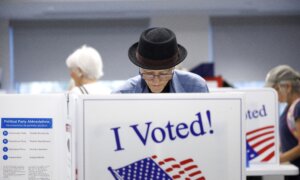

A federal appeals panel on Sept. 21 sided with Republicans seeking to use Missouri’s 2025 congressional map in the Nov. 3 midterm elections, the same lines that were used in the Aug. 4 primaries.
The ruling does not necessarily mean the 2025 map, which gives Republicans a 7–1 advantage over Democrats, will appear on the ballot. County clerks have already begun sending military and overseas ballots under the 2022 map.
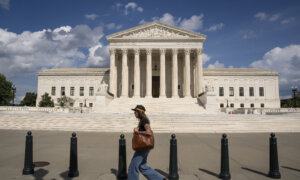
A Sept. 10 U.S. Supreme Court stay still blocks U.S. District Judge Stephen Clark’s temporary restraining order, which says that only the 2025 map may be used. When it was issued, the justices’ stay had the effect of keeping in place the 2022 map, which gives Republicans a 6–2 edge.
On Sept. 21, a three-judge panel of the U.S. Court of Appeals for the Eighth Circuit affirmed Clark. The panel ordered Clark to enter a permanent injunction barring Missouri Secretary of State Denny Hoskins from using any congressional map other than the one the Legislature approved in 2025.
The panel administratively stayed that injunction until 5 p.m. Central Time on Sept. 28 to give the other side the opportunity to appeal to the U.S. Supreme Court.
Without a stay, Hoskins and local election authorities would be forced to immediately begin implementing the 2025 map before the Supreme Court decides any appeal, the panel said.
“This court holds that Missouri’s current plan to use the 2022 map in the November 2026 general election violates the [U.S.] Constitution,” the panel said. “Only use of the 2025 map complies with the Constitution and federal law.”
“The Constitution does not permit Missouri to use a different congressional district map in the November 2026 general election than it used in the August 2026 primary election,” the panel said.
U.S. Circuit Judge David Stras dissented in part.
He said the panel should not have decided which map Missouri uses. Advocacy group People Not Politicians, which was appealing Clark’s temporary restraining order, already prevailed in its referendum fight in state court, so it no longer had a stake in this federal appeal, Stras said.
The judge said he would have dismissed the group’s appeal for lack of standing, even though he agreed the map switch may violate Article 1, Section 2, of the U.S. Constitution, which establishes the fundamental rules governing the U.S. House of Representatives.
A short time later, Clark issued the injunction, as the panel had required.
The new decision is expected to be appealed to the U.S. Supreme Court.
The dispute goes back to last year.
Missouri Gov. Mike Kehoe, a Republican, signed HB 1, the bill authorizing the 2025 map, in September 2025 after the Republican-controlled Legislature approved it. Days before the bill was to take effect in December 2025, People Not Politicians filed with Hoskins more than 300,000 signatures on a petition challenging the map.
On Aug. 4, the same day primary elections based on the 2025 map were held, Hoskins denied the group’s request to place HB 1 on the ballot for the Nov. 3 general elections. He rejected arguments that when the petition signature count reached a certain point, HB 1 was suspended pending a referendum vote.
Hoskins said that despite the state constitution’s provision that legislation be frozen when enough signatures have been gathered, the U.S. Constitution’s Elections Clause gives the Legislature the power to prescribe congressional election rules. On that basis, he concluded that the referendum violated the U.S. Constitution and had no legal force.
On Sept. 3, the Missouri Supreme Court ruled unanimously that the petition was valid, so HB 1 never became law. This meant the state would have to use the 2022 map on Nov. 3. The court also ordered that the referendum question be placed on the November ballot. A yes vote means the 2025 map will be used in 2028, while a no vote means the 2022 map will continue to be used.
On Sept. 10, after the U.S. Supreme Court blocked Clark’s order, Missouri officials gave up their legal fight and agreed to use the 2022 map in the Nov. 3 general elections. The change of position came after the Missouri Supreme Court found Hoskins in contempt for moving forward with the 2025 map.
Hoskins agreed to follow the state high court’s ruling and use the 2022 map. The court then ruled that he had purged himself of the contempt by changing course and would not be punished.
The Eighth Circuit panel heard from attorneys on Sept. 17.
The judges and attorneys struggled to interpret the brief U.S. Supreme Court ruling that had the effect of keeping the 2022 map in place but provided no helpful guidance to lower courts because no reasoning was provided.
U.S. Circuit Judge James Loken said that to him the ruling implied a sense of urgency.
“It’s on our plate, and I think the Supreme Court has said ‘get to it,’” he said during the hearing.