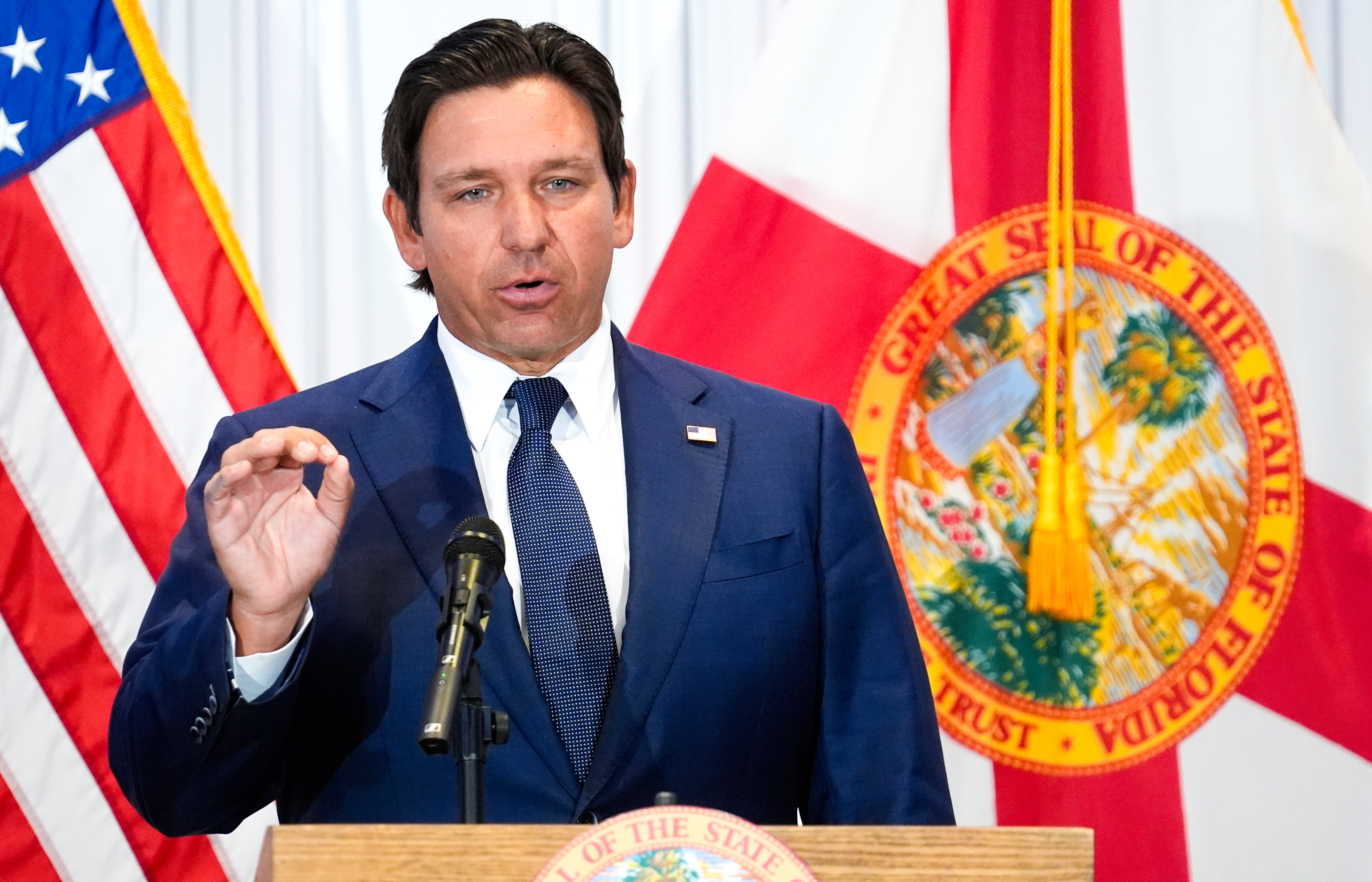

As the dust settled from Nov. 3’s midterm election, Florida Gov. Ron DeSantis told reporters that it would be several years before Republicans would regain the political control they won two years ago, and they ultimately had only themselves to blame.
“The Democrats will likely go into January with 56 U.S. Senate seats and as much as 258 U.S. House seats,” he said on Nov. 4.
“Not only is that going to totally change the dynamic of the next two years to the detriment, of course, of President Trump, this is going to last far beyond just two years.”
He described the previous night’s results as “the political equivalent of a meteor strike,” and as being “close to an extinction-level event” for the GOP in several parts of the country.
In Washington, the governor predicted the next two years would see the Democratic majorities “attempt to throw a lot of sand in the gears of the inner workings of the administration,” preventing any further appointments or confirmations.
He said he expects Democrats to launch a slew of investigative committees into members of the administration.
Looking ahead to the 2028 election, he said Republicans were not going to be able to retake the Senate, nor did he think it was likely that they would retake the House of Representatives.
“This is really going to have an impact two years, four years, six years, maybe even longer before Republicans could exercise unified control in Washington again,” he said.
Out of the 10 largest states in the Union, Florida was the only one that emerged from the midterms with its GOP control intact, from the governor and attorney general to the majorities in the state House and state Senate, albeit losing some seats to Democrats. The Sunshine State went into Nov. 3 with 20 out of 28 congressional seats held by Republicans, and those 20 seats are expected to remain, though The Associated Press has yet to officially call four Republican-led races and one Democrat-led race as of 1:20 p.m. ET on Nov. 4.
Republican Ashley Moody also retained her seat in the Senate.
Elsewhere, DeSantis specifically lamented his party’s historic loss in Texas, which saw a Senate seat, the governorship, the attorney general, and four Supreme Court Justices go blue. He expressed concern about the party’s future nationally, specifically if Texas was lost as an electoral anchor.
“If you go over the whole generation, no one holds a candle on the Republican side to the Lone Star State,” he said. “And yet, not only did they lose a very highly publicized U.S. Senate race, they lost everything.”
Ultimately, though, he said the election results were votes against Republicans in Washington, rather than votes for Democratic policies; it was not a win for progressive policies, as much as it was a rejection of the GOP’s status quo, which happened to leave Democrats as beneficiaries. He said that nationwide, some conservative matters such as tax cuts and voter ID measures were in demand from voters.
DeSantis criticized Republicans in Washington and Tallahassee for not capitalizing on key issues. Those ranged from releasing the Epstein files and forbidding elected officials from trading stocks while in office, to tech issues like how to handle data centers and flock cameras, and what he called “kitchen table issues” like gas prices, mortgage rates, and grocery prices. He also specifically chastised state House Republicans for not passing a proposed AI Bill of Rights.
“You know, four years ago we were in the peak woke era,” he said. “It alienated a lot of people, rightfully so. It alienated me. So we were fighting back against that. Well, now the issues are different, and Republicans, it seemed like on some of the ads I was seeing with how much money they were spending, they really were fighting yesterday’s battles.”
DeSantis said that there were circumstances where Florida’s Republican majority could have fallen the way of Texas, and he told reporters he had warned Republican candidates that their races were going to be close.
While President Donald Trump won the Sunshine State by 13 percentage points, DeSantis told Republican candidates that “the line of scrimmage has moved 10 points in the Democrats’ direction” and that they were going into races determined by single digits; any hopes of seeing the victorious windfalls of 2022 were in vain.
He also said Florida’s Democratic voters had “the best turnout they’ve ever had in the modern history of Florida,” outperforming Republicans in overall percentage turnout.
But the Sunshine State held its line. The reason, according to DeSantis, is twofold. The first is the performance record posted under his eight years of leadership.
“We’ve built up a record of achievement,” he said. “We’ve earned trust from a number of our voters that even in the worst situation that you can imagine politically, we were able to hold the line and prevent the worst from happening here.”
A second reason appeared to be that during that time, the number of Florida Republicans grew significantly and, in this case, sufficiently, to outnumber Florida’s Democrats, he said. DeSantis also credited a homestead property tax amendment for getting Republican voters out to vote.
“Florida shows how you can build a coalition, not only to convert on all your promises in good times, but also to withstand the bad times,” he said.
As he prepares to leave office, his question for Florida is whether the state’s conservative leaders will be able to continue to build up its “firewall” to buck the blue trends seen on Nov. 3 and take its leadership to the next level.