
The first of the nine fatalities in the Nov. 1 Learjet crash in Palm Beach County, Florida, was identified as 20-year-old Nathalia Gadelha Filgueiras.
The National Transportation Safety Board (NTSB) held a press conference on Nov. 2, along with local and county authorities. The NTSB confirmed there were two pilots and seven passengers on board the Learjet 60 private jet, but declined to identify them.
Palm Beach County Administrator and Incident Commander, Joseph Abruzzo, said the medical examiner’s office was handling that and they were not permitted to talk about it at that time.
“They’re involved in collection and assessment right now,” he said. “There’s going to be some DNA that needs to be matched. It’s a lengthy process, so I wouldn’t assume anything right away.”
One new injury was confirmed. An unnamed man who was in a vehicle leaving the adjacent impact area at the time of the crash suffered a leg injury. He was due to be interviewed by NTSB.
Filgueiras’s identity was confirmed independently to the New York Post by her mother, Camila, and her stepfather. Filgueiras was from Palm Beach County, and a graduate of West Boca Raton High School. She earned her private pilot’s license in 2023 when she was 17 years old. She was featured in local media at the time for having earned her pilot’s license before her driver’s license.
A private pilot’s license is a basic-level license that allows an individual to fly single-engine propeller planes below the clouds. Those wanting to go higher and faster in larger aircraft must continue their training to earn higher-level certifications. Continuing her education through American Flyers, she went on to earn her commercial pilot’s license, multi-engine certification, instrument flight certification—meaning she could fly in and above the clouds—and became a certified flight instructor.
Filgueiras’s family said it was her voice that could be heard talking to Air Traffic Control in the lead-up to the crash.
According to the NTSB, the flight took off from Austin Bergstrom International Airport at 10:37 a.m. ET, and was headed to North Eleuthera, Bahamas.
At about 12:47 p.m., the flight crew told Air Traffic Control in Miami that they were flying at 35,000 feet. The outside temperature was -53 degrees Fahrenheit; they had moderate turbulence with altitude deviations of about 700 feet, and they were encountering light clear ice. Very soon after, the crew told Air Traffic Control they were picking up precipitation and requested to climb to 37,000 feet. That request was approved. But less than 30 seconds after that, the crew transmitted their sudden descent with a mayday call.
At about 12:48 p.m., the NTSB confirmed a transmission that said “we are in an overspeed condition, descending,” with the rest deemed unintelligible.
“Subsequent communications described that the airplane was descending rapidly, and gave an altitude callout,” NTSB member Tom Chapman told reporters. “Sadly, all aboard were lost.”
It is unclear what role Filgueiras played beyond communicating with Air Traffic Control.
“Our indication early here from aircraft maintenance records is that a cockpit voice recorder was installed on this aircraft,” Chapman said later in the press conference. “What we don’t know is whether that recorder was still on board.”
Meteorologists noted that at the same time a convective storm cell was rapidly growing right in the plane’s flight path. That storm cell rose 17,000 feet in 25 minutes, topping out at more than 40,000 feet high just as the flight crew reported ice and turbulence. That cell was part of an ongoing torrential rain event for Southeast Florida, which has already delivered more than 21 inches of rain to areas of Brevard County, according to local WESH 2 NEWS meteorologist Eric Burris.
Chapman was joined at the press conference by the NTSB’s investigator in charge, Timothy Monville. They both said they would not be determining a cause of the crash at the scene, nor would they speculate the cause.
“The weather conditions are a major focus of the investigation,” Chapman said. “You all saw what the weather was like here at the surface. What we have to determine is what the weather conditions were like at altitude. They were at about 35,000 feet, and that’s still something that has to be determined.”
However, they already saw the reports of ice and turbulence as factors that may have played into the crash, and were looking into who held more responsibility in dealing with weather concerns—the flight crew or Air Traffic Control, which ultimately determines flight path and cruising altitude.
“That’s one of the factual details of how this transpired is exactly what we’re trying to determine, and that’s one of the questions that will have to be sorted out in this, in terms of who knew what and when and what actions were taken and whether those actions were appropriate,” Chapman said.
The officials also said there was significant evidence that the jet began breaking up before impact. The debris field was estimated to be around a half-mile in size, and the NTSB asked those who found any debris to leave it where they found it and report it.
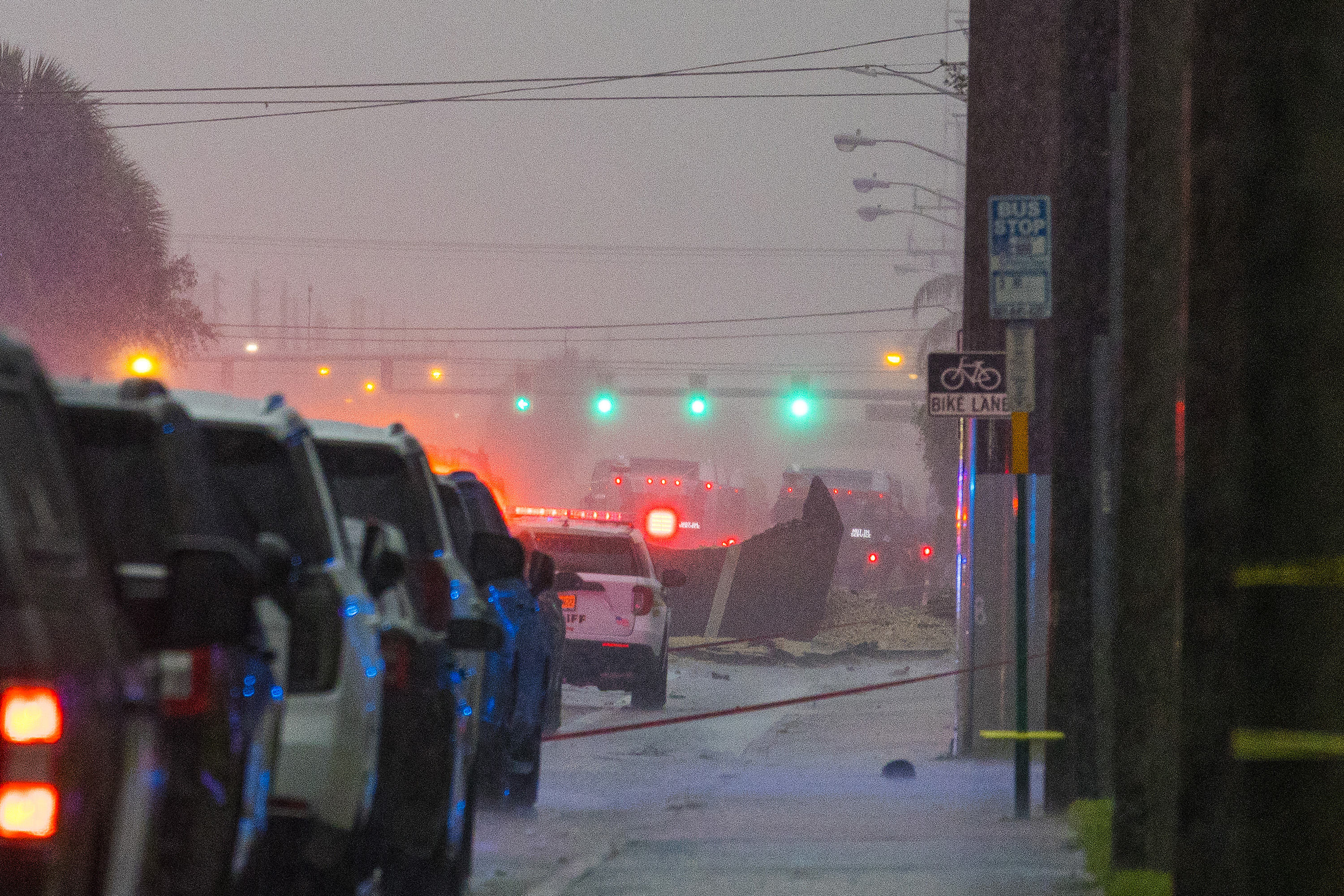
The impact site features a crater along Military Trail near the entrance of a mobile home park and a strip mall, requiring hundreds of people to be evacuated to temporary shelters and the extended closure of that stretch of roadway.
County officials cited the need to preserve the crime scene and ensure people’s safety, specifically stating the need to test the street’s stability after the impact.
No timeline could be given for when the roadway would be cleared and residents could go home. The stormy weather deposited water in the crater, which authorities said could further delay the investigation.