
DALLAS—Defense attorneys in the North Texas Antifa trial questioned whether an Alvarado police officer would have been shot in the neck if he had kept his gun holstered during a protest that turned violent.
Defense attorneys also laid the groundwork to exclude guns, body armor, and anti-government paraphernalia found in backpacks at the scene by accusing officers of illegally searching their clients’ backpacks, as the first week of the trial drew to a close on Feb. 27.
The Fort Worth trial is expected to last three weeks.
Members of Antifa, short for “anti-fascist,” have not faced terrorism-related charges until now, although they have been involved in organized protests across the country that have at times turned violent.
Antifa is modeled after a group that worked as the violent arm of the Communist Party in Germany in the 1930s. Some symbols from the original group are still used by the movement today, such as the logo and the raised-fist salute.
The trial follows President Donald Trump’s executive order on Sept. 22, 2025, designating Antifa as a domestic terrorist organization.
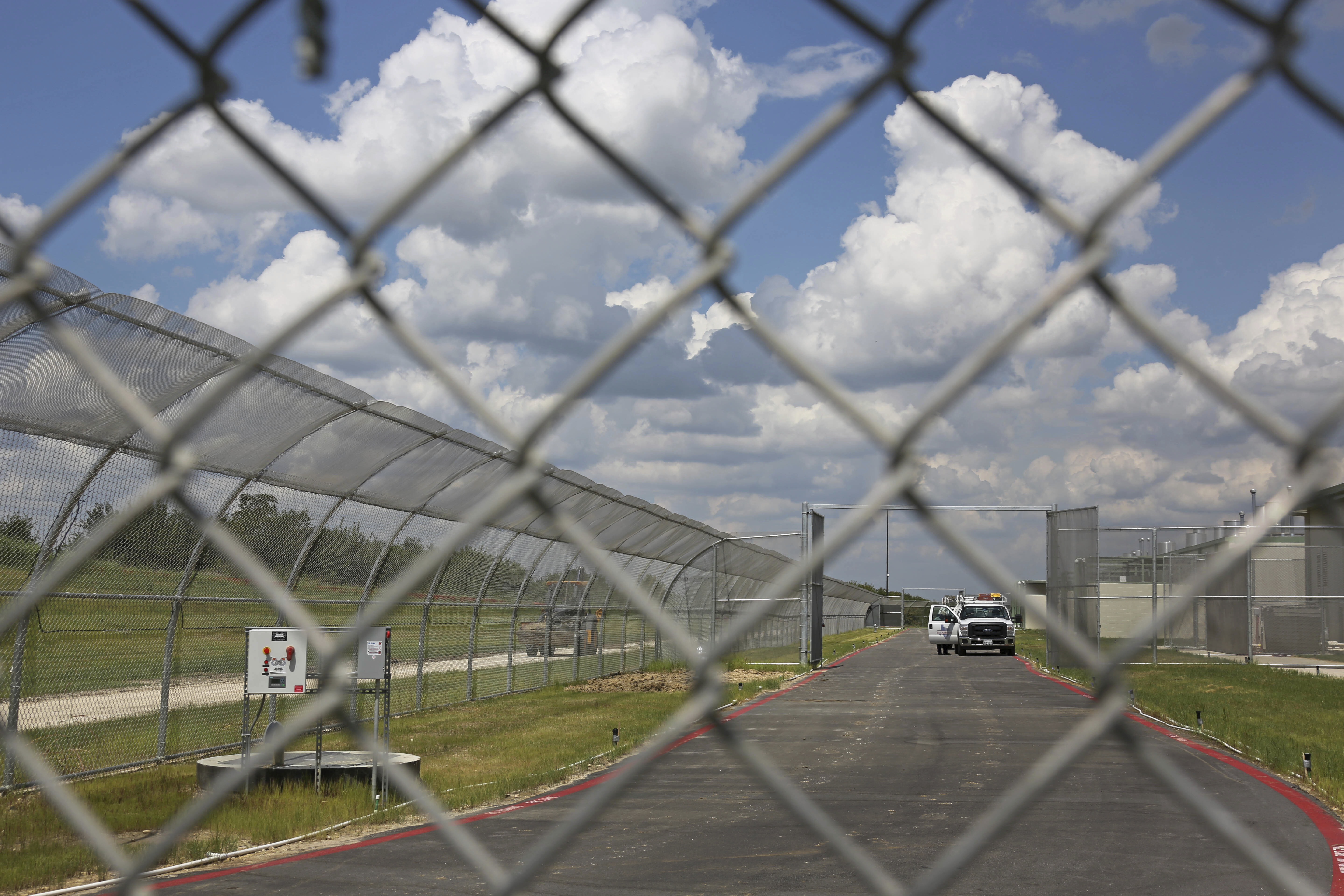
In the landmark case, the government claims that an Antifa cell launched a coordinated attack against the Prairieland Detention Center housing illegal immigrants outside Dallas on July 4, 2025, during which one officer was shot.
‘Almost an Ambush’
Defense attorneys have described the incident as a “noise protest” with fireworks and a bullhorn to show support for detainees inside the U.S. Immigration and Customs Enforcement (ICE) detention facility.
Detention facility officers testified that they investigated the loud noises outside the detention building on the night of July 4 and told black-clad protesters to leave.
The detention officers, who were unarmed, started running toward the parking lot after hearing loud popping noises. They saw a police car heading toward them and noticed two people dressed in black. As the police vehicle pulled up, one of the detention officers yelled to the police officer and pointed at the figures, including one who was running.
Gunfire erupted within seconds after Lt. Thomas Gross of the Alvarado police got out of his vehicle, and he was struck in the neck. The detention officers, who were in fear for their lives, took cover, and one made it back into the facility.
During the trial, defense attorneys accused Gross of drawing his gun as an alleged Antifa member ran away. They questioned law enforcement witnesses about whether it was proper for an officer to pull his gun on someone fleeing and potentially shoot the person in the back.
Defense attorneys pointed out that shots were fired at the lieutenant only after he pulled his weapon and that the two other detention facility officers weren’t harmed.
Assistant U.S. Attorney Shawn Smith told the jury during opening arguments that defendant Benjamin Song allegedly shot 11 times at police and detention officers until his rifle jammed.
Song then allegedly hid in nearby woods for 24 hours. The prosecution said that Song confessed to the shooting and that cooperating witnesses who have already pleaded guilty to charges associated with the riot would corroborate that assertion.
Billy James Hill Jr., an investigator with the Texas Rangers, testified that it was not unreasonable for Gross to draw his firearm in the chaotic scene that was unfolding, which included the black-clad individual running.
“It’s out of nowhere,” Hill said. “It was almost an ambush situation for Lt. Gross.”
The bullet exited the other side of Gross’s neck and lodged in his body armor, according to testimony. The wounded officer fell but managed to fire off three shots. He was taken to the hospital, where he was treated and released.
Potential government witnesses include Nathan Baumann, 20; Joy Gibson, 30; Seth Sikes, 22; Lynette Sharp, 57; and John Thomas, 32. Each entered guilty pleas to one count of providing material support to terrorists during their federal court hearing.
‘Don’t Talk’
During the first week of trial, which ended on Feb. 27, government witnesses described finding a large cache of weapons, body armor, medical kits to treat gunshot wounds, and anti-government stickers in backpacks and vehicles belonging to the defendants.
The stickers had slogans such as “Make America not exist again,” and “We don’t want revenge, we want reform,” according to the prosecution.
The nine defendants on trial have pleaded not guilty.
Cameron Arnold (also known as Autumn Hill), Zachary Evetts, Bradford Morris (also known as Meagan Morris), Maricela Rueda, and Song face the most serious charges: attempted murder, discharging a firearm during a crime of violence, and providing material support to terrorists.
The other defendants, facing lesser charges, are Savanna Batten, Elizabeth Soto, Ines Soto, and Daniel Rolando Sanchez-Estrada.
During the trial this week, law enforcement witnesses described seeing a group of five people dressed in black casually walking down the road near the ICE facility after the lieutenant was shot.
Officers responding to the scene initially thought they might be pedestrians who had been told to vacate the area, then stopped them for questioning, according to Alvarado police officer Jerimiah Zapata.
The five people were cooperative until law enforcement began searching three black backpacks, Zapata said.
Zapata said defendant Ines Soto, who was carrying one of the backpacks, warned the rest of the group to keep quiet.
“Everyone, don’t say anything. Don’t talk,” Soto could be heard saying as the prosecution played police body camera video.
Other defendants can be heard on the video saying, “I do not consent to a search.”
Johnson County Sheriff’s Deputy Karl Parsons testified that he was shocked after he searched the minivan driven by Morris that was pulled over as it was leaving the scene.
Parsons said he saw Morris dressed in all black tactical-style clothing and saw a loaded pistol on the floor.
Morris allegedly told Johnson County Detective William Reilly that he had just met the other people involved in the incident online and didn’t know their names.
Deputies testified they found other AR-15-style rifles and at least four magazines holding 25 to 30 rounds each in the back of the vehicle, along with body armor.
Parsons can be heard on body camera audio using several expletives after finding the gear while talking to another officer about what looked like a targeted hit on the ICE detention center.
“It appeared to be a targeted terror attack on the facility,” he said.
Correction: A previous version of this article misspelled the name of Johnson County Detective William Reilly. The Epoch Times regrets the error.