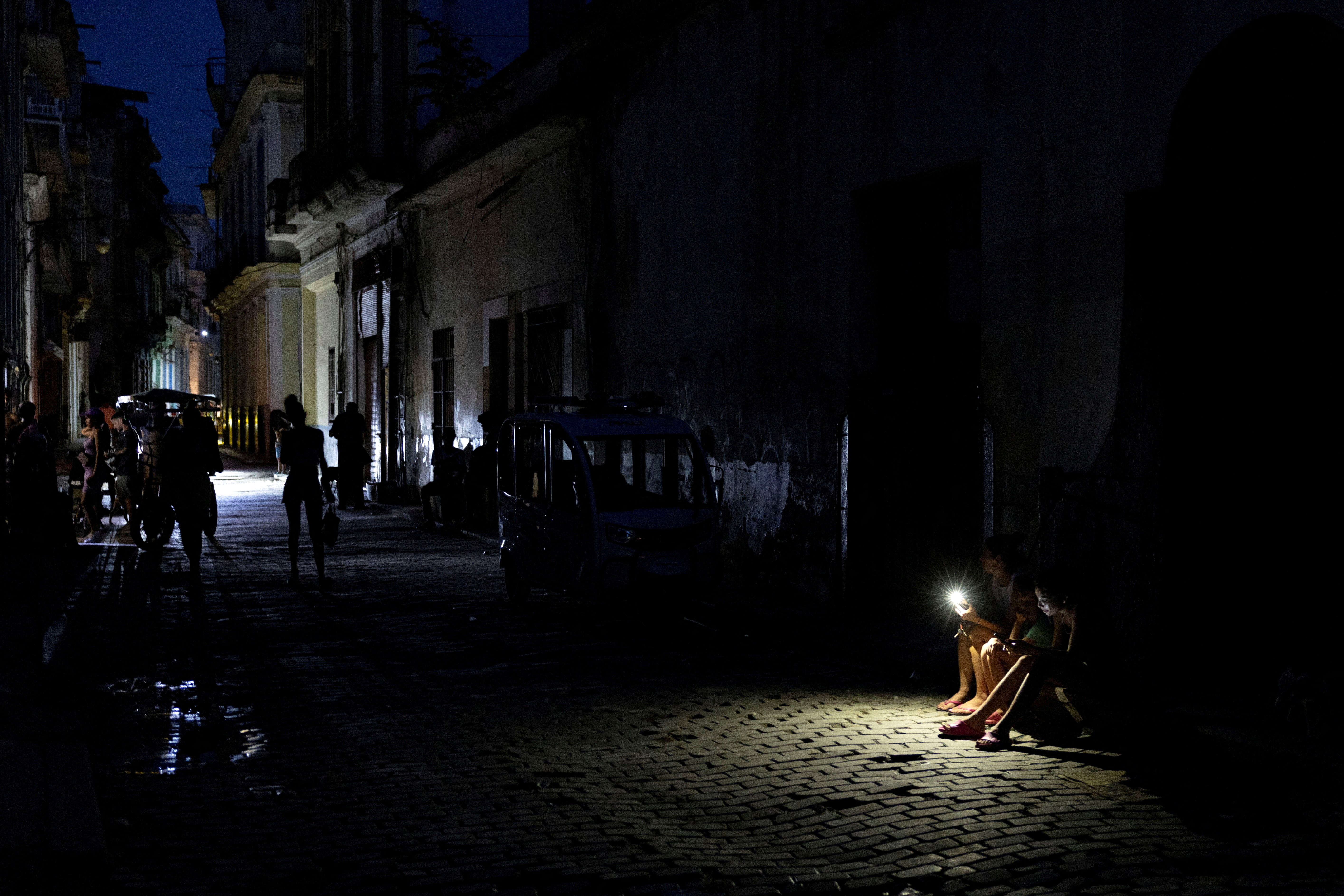

Cuba’s failing power grid suffered a total collapse in the early afternoon of Sept. 18, leaving the country of 10 million people without power, according to the U.S. Embassy in Havana.
Cuba’s Electrical Union later reported that the collapse was triggered by the failure of high-voltage transmission lines in central Cuba.
The Electrical Union also blamed unstable weather conditions as an aggravating factor, according to independent Spanish-language news site CiberCuba.com, which maintains a daily blackout dashboard.
There were also reports of cellphone and internet outages.
Power had returned to a handful of scattered neighborhoods in Havana by late evening, primarily around hospitals and water pumping stations, but much of the city remained completely dark under cloudy skies and rain.
More than 30 hours later, in an update just after 8 p.m. ET on Sept. 19, the Electrical Union stated that the system had been restored “throughout the country.”
However, that didn’t mean that power was restored to all customers, as demand continued to exceed the electricity available in the system. Cuban authorities used temporary rolling blackouts in different regions of Cuba to prevent the total collapse of the power grid.
“Cuba’s electrical grid is increasingly unstable, and there have been multiple nationwide power outages in the past few months,” the U.S. Embassy warned in a Sept. 18 statement on X. “ The electrical system remains vulnerable, and additional regular outages have been occurring more frequently and for longer periods. Scheduled power cuts occur daily, and unscheduled outages persist throughout Cuba.”
It urged those in Cuba to keep their mobile phones and portable battery banks charged and have access to flashlights and spare batteries.
The embassy also recommended that people stock up on nonperishable food and water and have alternative methods for accessing medical needs that require power or refrigeration.
8th Major Grid Failure
This was the eighth major failure of Cuba’s power grid this year. Cubans have become accustomed to long hours, or even days, without power, even when the national power grid is working.
The grid collapsed nationwide multiple times in August, July, and March. Rolling blackouts have since spanned 30 hours or more across most of the country. Regional outages are common.
Many exhausted residents of Havana were already without power when the Sept. 18 blackout hit.
“Yesterday, I'd gone without power for 24 hours. They turned the lights on for an hour, and then the grid collapsed,” said Frank Lorenzo, a 23-year-old Havana resident.
Hours before the outage on Sept. 18, the Cuban Ministry of Energy and Mines stated that forecasts for peak energy demand for the day stood at 3,210 megawatts (MW) but only 1,233 MW in generation was available.
“If the forecasted conditions persist, an impact of 2,007 MW is projected during this period,” it stated of the 1,977 MW deficit.
Michigan’s population of 10 million, close to Cuba’s population, has a much higher peak summer load of 21,000 MW because supply to customers isn’t withheld.
A Failing State
Cuba’s aging power generation system has been under severe strain from lack of maintenance and investment to replace outdated infrastructure.
According to state newspaper Granma, Cuba’s largest thermoelectric plant, the Antonio Guiteras in Matanzas, has experienced at least 17 outages so far this year, and no major maintenance has been completed since 2010.
The regime has yet to respond to calls to address the years-long economic and energy crisis, marked by food, medicine, and fuel shortages, as well as frequent blackouts.
In official statements, Havana has blamed external factors, most recently in January, when the United States ended the Cuban regime’s supply of subsidized Venezuelan oil and announced tariffs for any country selling oil to Cuba.
The Trump administration stated that the economic pressure on the regime was to force negotiations for a return of the island to democracy, including allowing exiled Cubans to return for a fair election. It said the pressure was in support of the Cuban people, who had been protesting en masse over deteriorating conditions on the communist-ruled island.
The U.S. Treasury stated that it would look favorably on licenses to resell Venezuelan-origin oil in Cuba for private-sector, commercial, and humanitarian use. Deals benefiting Cuba’s military, intelligence services, or other government institutions would not qualify, it noted.
U.S. Secretary of State Marco Rubio said in March that Cuba’s grid has long been unreliable due to years of neglect by the regime.
“They were having blackouts last year,” he said. “They’re having blackouts because they have equipment from the 1950s in their grid that they’ve never maintained and never upgraded, because they’re incompetent.”
Rubio’s parents emigrated from Cuba to the United States in the 1950s.
Throughout the crisis, the United States has offered to provide Cuban people with direct humanitarian assistance, which it says Havana has been blocking because of its conditions that the aid be delivered through independent groups and not the regime.
On Sept. 4, the U.S. Embassy in Cuba issued a health alert warning to Americans about gastrointestinal illnesses caused by a rise in pathogens such as E. coli, norovirus, and Shigella due to the frequent water and energy grid collapses.
Jacki Thrapp and Reuters contributed to this report.