The American past is filled with men and women whose deeds and words deserve celebration. Renaissance Man Ben Franklin, author of the Declaration of Independence Tom Jefferson, escaped slave and abolitionist Harriet Tubman, poet extraordinaire Emily Dickinson, inventor Tom Edison, astronaut Neil Armstrong: That’s hardly a thimbleful of the Americans who influenced the course of their nation’s history and that of the world’s.
Some of these people became legends in their lifetime or immediately following their deaths, storied figures with one foot in history, and the other in the realm of fable and myth. “Father of His Country” George Washington, “Honest Abe” Lincoln, “King of Rock and Roll” Elvis Presley, and “Little Sure Shot” Annie Oakley captured the American imagination like few others.
Though less well-known, one man deserves a place in this Valhalla of heroes. His grit and courage in the face of solitude, danger, and nature’s punishments seem as unreal to most of us today as they did to many of his contemporaries.
Time to meet John Colter (circa 1775–1812), America’s first mountain man.
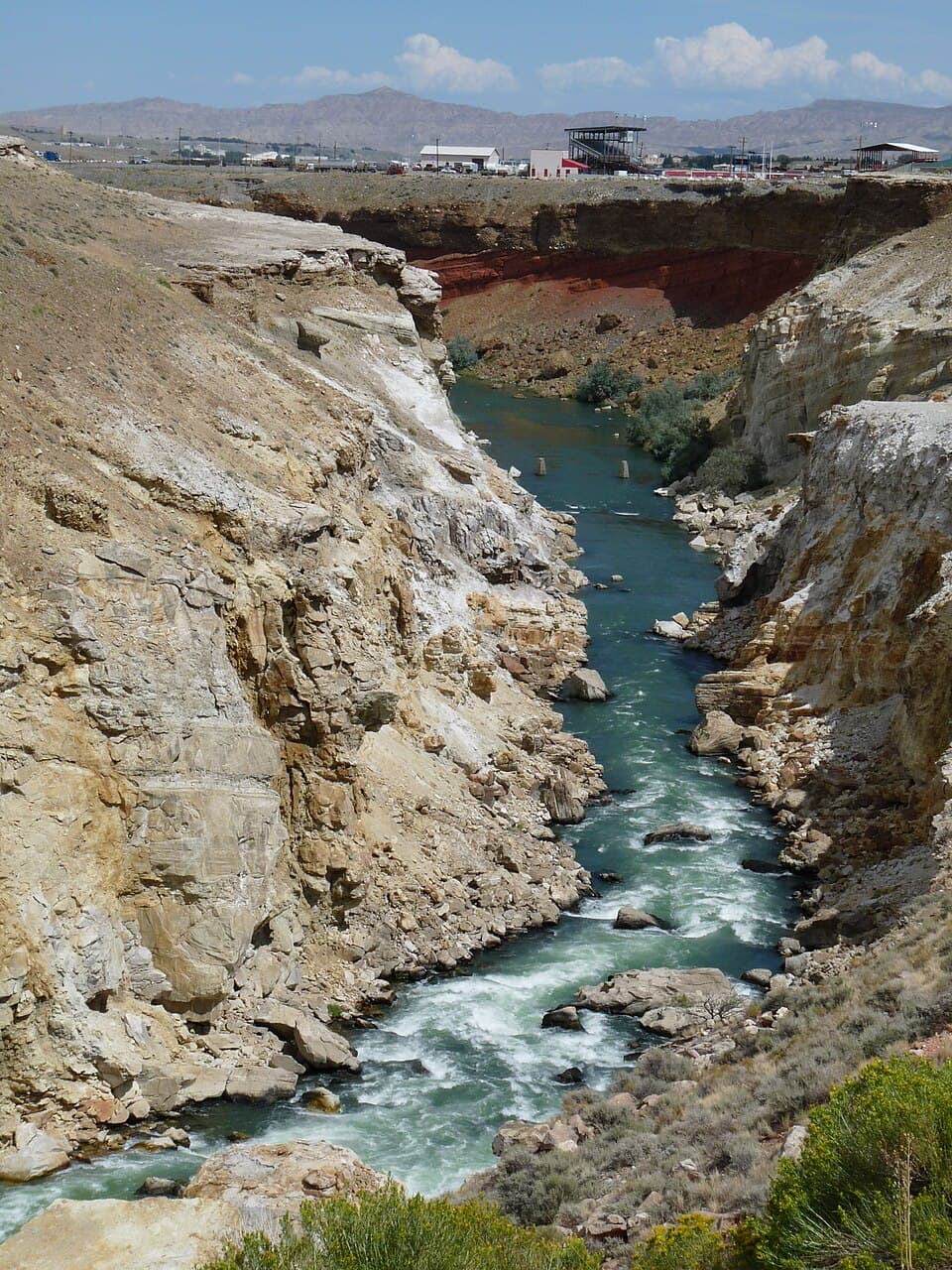
"Colter's Hell" was discovered by mountain man John Colter in 1807 along the Shoshone River near Cody, Wyo. (Public Domain)
Crossing the Continent
Because of the age and circumstances in which he lived, Colter’s exploits have come to us secondhand, from a few formal documents and from accounts of his travels and trials he shared with others. Parts of his past are murky and sometimes, in the details, contradictory, but these snippets of history add up to a man whose adventures seem more suited to a Hollywood film than to real life.
Born around 1775 near Stuarts Draft, Virginia, John Colter left the family farm at some point and moved to present-day Kentucky. There, on Oct. 15, 1803, he enlisted in the Corps of Discovery, the Lewis and Clark expedition preparing to cross the continent. At 5 feet 10 inches tall and no stranger to the wilderness, as he would demonstrate time and again, Colter would prove an invaluable asset to this company of explorers.
But first he required an education in obedience and prudence. On New Year’s Eve in 1803, Colter, along with some other men, ignored orders, visited a whiskey shop, and got drunk. Later, he may have threatened to shoot a certain Sergeant Ordway, who had command of the men when both Lewis and Clark were absent. A trial was held in March 1804, and while no written record of that court exists, we know that Colter was allowed to remain with the expedition after he promised to mend his rowdy ways, a promise he kept.
He certainly contributed to the Corps’ success thereafter. He proved himself a skilled hunter with a talent for communicating through sign language with the Native Americans they encountered on their westward trek. In their book, “Gloomy Terrors and Hidden Fires,” biographers Robert Anglin and Larry Morris tell readers:
“[Colter] could hear the slightest noise made in the forest at a great distance and … was always disturbed by any noise he could not account for. He knew the ways of every bird and animal in the woods, and was familiar with the sounds and cries made by them.”
In her article “John Colter: America’s Intrepid Mountain Man,” Jane Gilvary wrote that “Colter left an indelible mark on Lewis and Clark who trusted him to find safe routes through mountain passes, retrieve lost or stolen horses, and judiciously manage conflicts with Indians.”
The Lone Hunter Alone
Colter’s association with the Corps ended unexpectedly on the journey back to St. Louis when the expedition encountered two trappers, Forrest Hancock and Joseph Dickson. Intrigued by their talk of going to the Yellowstone, Colter sought permission to leave the expedition, which Lewis and Clark granted. Along with the other men, they “wished Colter every Suckcess.”
The partnership of these three men proved unsuccessful, and Colter was on his way to St. Louis by canoe when he met and joined a party of men headed by Manuel Lisa, a fur trader of Spanish descent whose companions included some of Colter’s former comrades from the Corps. After establishing a small fort near the Bighorn River, Lisa dispatched four men in different directions to inform Native Americans of their presence, in part to encourage them to bring in furs for trade.
Colter struck out on his own. He traveled approximately hundreds, if not a 1,000, miles on this solo expedition, encountering tribes and sights that no one of European descent had ever seen. A contemporary of Colter’s, and an acute observer and participant in frontier life, Missouri lawyer and writer Henry Brackenridge wrote, “This man, with a pack of thirty pounds weight, his gun and some ammunition, went upwards of five hundred miles to the Crow nation; gave them information, and proceeded from them to several other tribes.” He also recorded that though wounded in the leg during a skirmish between the Crow and Blackfeet tribes, Colter returned to Lisa’s camp “entirely alone, and without assistance.”
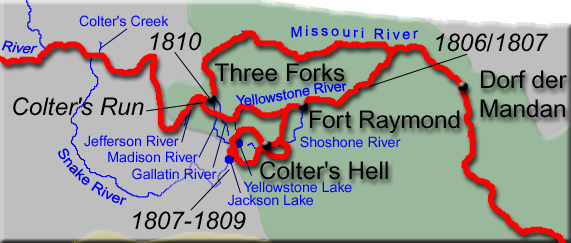
While on this long march through the wilderness, Colter discovered a geothermal ground of hot springs and a tar pit near today’s Cody, Wyoming. Though many disbelieved his story, later expeditions confirmed his report, and some people still call the area “Colter’s Hell.”
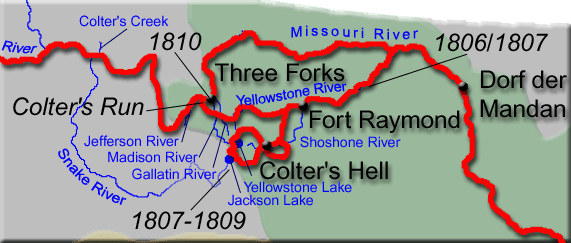
This detailed map traces John Colter's historic expeditions and travels across the American West between 1806 and 1810, and highlights key locations such as his famous escape—"Colter's Run—from Blackfeet warriors. (Benutzer:Pandat/<a href="https://commons.wikimedia.org/wiki/File:Karte_Detail_John_Colter.png">CC BY-SA 3.0</a>)
Run for Your Life
In 1808, Colter and another ex-member of the Corps, John Potts, were on a trapping expedition on the Jefferson River when suddenly they found themselves facing several hundred hostile Blackfeet. The Indians commanded them to paddle their canoe to shore, where an altercation between Potts and several Blackfeet resulted in him shooting one of the warriors. As Colter later described, Potts instantly became a target, struck with so many arrows that “he was made a riddle of.”
Colter was stripped naked, with some of the Blackfeet intending to use him for target practice, when a chief interfered and asked Colter if he could run fast. Colter, knowing what was about to happen, lied and said that he was slow afoot, whereupon the chieftain led him into the prairie several hundred yards away and released him. The watching Indians gave a war whoop, and the hunt began, with the Blackfeet streaming across the prairie after their quarry.
Here, John Colter’s reputation became legendary. He ran toward the Jefferson Fork, some six miles away, and ran so fast and hard that after several miles blood was streaming from his nostrils and mouth. He ran barefoot across rough terrain that included prickly pears and cactus, which pierced his flesh. He ran until he had outdistanced all the braves but one.
A quick glance over his shoulder told Colter this man would catch him. Making a snap decision, he stopped abruptly, whirled around, and raised his arms over his head. His pursuer, startled by this tactic, and perhaps by the blood now coating Colter’s torso, stopped, tripped, and fell, his spear breaking in the sand. Colter snatched up the weapon, drove it into the man’s body, grabbed the broken spear and the blanket the Indian wore, and ran on. When he reached the Madison River, he dove into the water and swam to a jumble of logs and driftwood, ducked inside it, and hid there for the rest of the day while the Blackfeet searched for him.
With only the blanket taken from the warrior he’d killed, Colter faced a 200-mile journey to the nearest fort. For 11 days—one report puts the number at seven—he walked, surviving on an edible breadroot called the prairie turnip, and stumbled into Fort Raymond. In his 1846 memoir, militia general and fur trader Thomas James recorded his interview with Colter, then wrote of his arrival, “His beard was long, his face and whole body were thin and emaciated by hunger, and his limbs and feet swollen and sore. The company at the Fort did not recognize him in this dismal plight until he had made himself known.”
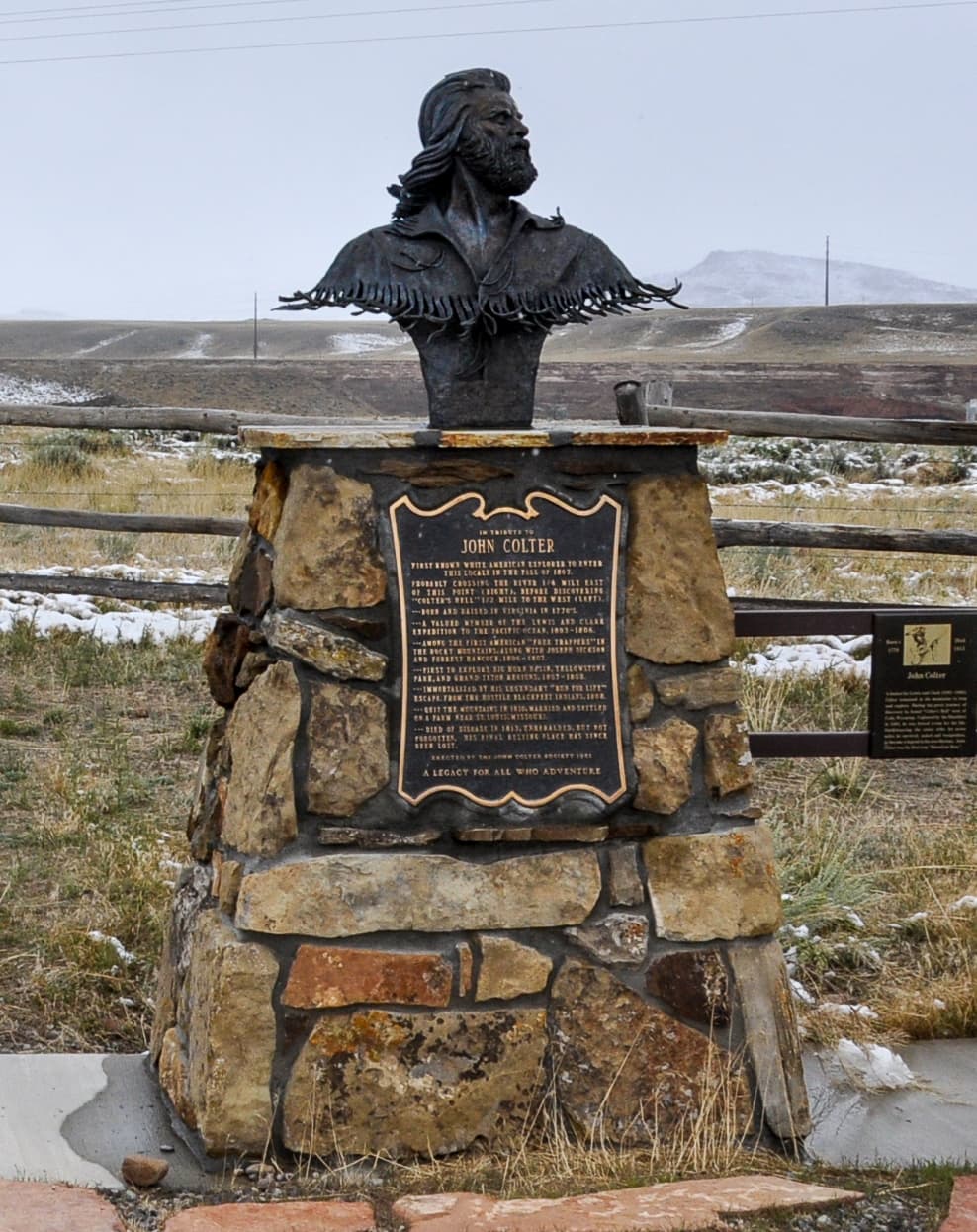
Located at Old Trail Town in Cody, Wyo., this monument honors John Colter, the famous frontiersman and member of the Lewis and Clark Expedition. (Paul Hermans/<a href="https://commons.wikimedia.org/wiki/File:Cody_-_Old_Trail_Town_-_John_Colter_11-09-2014.jpg">CC BY-SA 4.0</a>)
Home Is the Hunter, Home From the Hill
Discrepancies occur in this story, with James’s account, for instance, having Colter hiding in a beaver lodge rather than in a tumbledown raft of driftwood. Nevertheless, “Colter’s Run” remains one of the most incredible American stories of grit and resilience.
After this race against death, Colter returned to trapping one more time and again encountered the warring Blackfeet. According to James, during this escape from death, Colter vowed before God that if he lived he would never return to the frontier. He made good on that oath at once by returning to Missouri, where one of his neighbors was the elderly Daniel Boone. There, he married a woman known only as Sally, or Sarah, and they had a son, Hiram. Colter died in his late 30s of an unrecorded disease.
Of Colter and his run, James wrote, “The whole affair is a fine example of the quick and ready thoughtfulness and presence of mind in a desperate situation, and the power of endurance, which characterize the western pioneer.”
What arts and culture topics would you like us to cover? Please email ideas or feedback to features@epochtimes.nyc.