
In 1800, French immigrant and entrepreneur Eleuthère Irénée du Pont de Nemours estimated that only four in a thousand Americans were illiterate. Written as a defense of the Constitution, “The Federalist Papers” would likely challenge and even baffle many college students today, but in 1787 and 1788, these essays were aimed at the common reader. In 1774, Jacob Duché, chaplain of the Continental Congress whose later pleas for peace with Britain branded him a traitor, wrote that of his fellow Americans, “almost every man is a reader.”
This high level of fluency in reading and writing resulted from a free-market hodgepodge of schools and academies and from a fervent desire among parents to see that their children received an education. The great majority of these pupils first learned to read and cipher at home and received a further dose of learning in a local school.
These schools ran from New England’s “petty schools,” which we would call elementary schools, to the so-called field schools in the South, where a played-out piece of land might serve as the property for a schoolhouse. Churches often made room for students and teachers; “dame schools” were operated by older unmarried women who applied a quick whack with finger and thimble to the skull of a misbehaving student; tutors instructed small classes in private homes.
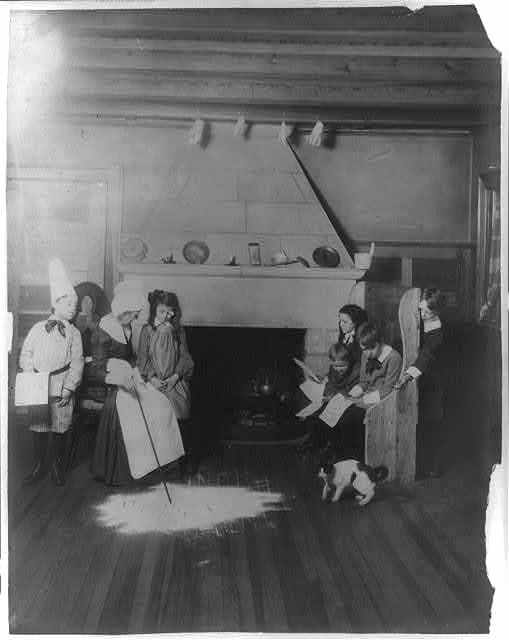
A colonial dame's school in America. The image depicts a tableaux. Library of Congress. (Public Domain)
At the top of the heap of this laissez-faire system of education were the more elite classical schools.
Standards of Excellence: The Colleges
“When any scholar is able to understand Tully, or such like classical Latine author extempore, and make and speak true Latine verse and prose, suo et aiunt Marti; and decline perfectly the paradignes of nounes and berbes in the Greek Tongue: let him then, and not before, be capable of admission into the College.”
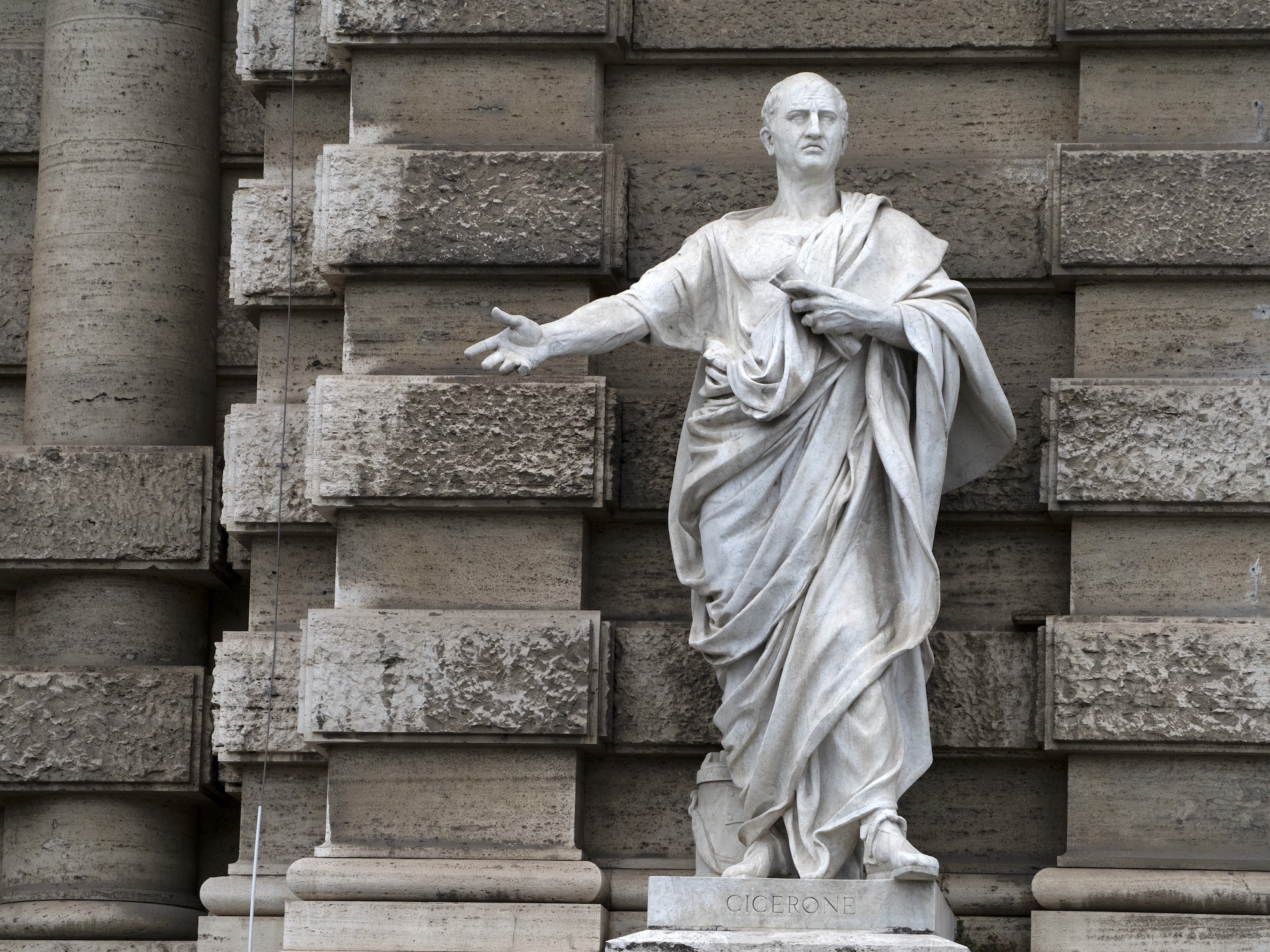
In the 1640s, and afterward, this singular sentence constituted the sole requirement for admission to Harvard College. Tully refers to Marcus Tullius Cicero, often called “Master Tully” by classicists of the day. “Extempore” basically means when called upon at any time, “suo et aiunt Marti” translates as by one’s own effort, and “berbes” is verbs.
This rule of admission initially appeared in a 1643 London publication, “New England’s First Fruits.” Along with it were two other rules that applied once the student entered, both relating to biblical studies: that “every student be plainly and earnestly pressed to consider well, that the maine end of his life and studies, is to know God and Jesus Christ which is eternall life.”
Familiarity with the Bible would have come naturally to most young men seeking admission to Harvard, Yale, Princeton, or Virginia’s William & Mary. Great numbers of Americans, both rich and poor, learned to read from that book, and this practice continued into the 19th century, as we see from the often-cited example of Abraham Lincoln and his earliest exposure to print.
The requirements regarding classical literature were a different matter altogether. Moreover, they were not unique to Harvard but were standard fare. Classicist and teacher Martin Cothran wrote:
“When Alexander Hamilton entered King’s College (now Columbia University) in 1774, he was expected to have a mastery of arithmetic and Greek and Latin grammar, be able to read three orations from Cicero and Vergil’s Aeneid in the original Latin, and be able to translate the first ten chapters of the Gospel of John from Greek into Latin.”
Read Cicero? Translate chapters of Scripture from Greek to Latin? Where would anyone in the colonies attain the skills to fulfill these requirements?
Prep Schools and the Classics
As it happened, many ministers, lawyers, and gentlemen who had attended schools and universities in Britain were adept in classical languages, along with the biblical studies, history, and literature that constituted some of the other pillars of a classical education. These men spread their learning throughout the colonies and, in doing so, would one day create the makers of the Declaration of Independence and the Constitution.
Some of these scholars set up classical academies. Founded in 1635, just 15 years after the arrival of the Pilgrims, Boston Latin School made Greek and Latin the core of its curriculum; it’s the oldest existing school in the United States. Other academies like New Haven’s Hopkins School (1660) and Philadelphia’s William Penn Charter School (1689) followed suit and remain in operation today.
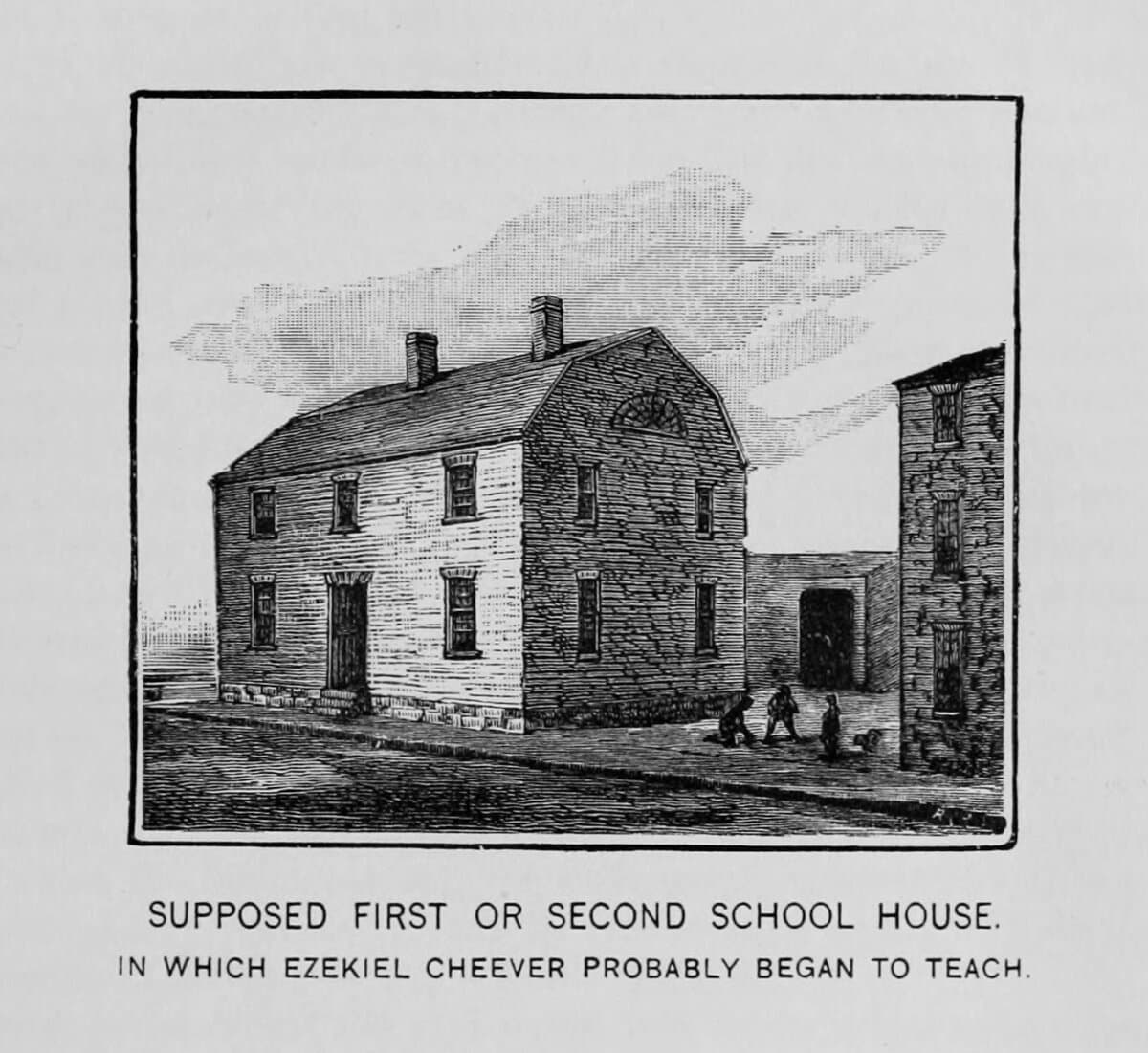
Ezekiel Cheever was an early headmaster of the Boston Latin School. He taught for 70 years, the last 38 as master of the school. A formal single-story was the school's first permanent home from 1745 to 1812. (Public Domain)
Other, more temporary schools also brought the gifts of Greek and Latin to the young. Following the death of his father, for instance, 15-year-old Thomas Jefferson, along with a few other students, boarded and studied with Rev. James Maury and his family near Charlottesville, Virginia.
Founding Father George Wythe, who taught law at William & Mary, taught and mentored Jefferson and others who impacted American history. In addition, Wythe, who had received the great part of his academic prowess from his mother—one of those rare females of the day blessed with a fine education—operated a small classical school in his home in Williamsburg.
William White, a historian of more than 50 years standing with the Colonial Williamsburg Foundation, shared an account of a day in the life of these boys provided by Littleton Tazewell, one of Wythe’s students:
“At sunrise, the student presented himself at the door of Wythe’s study. This sunrise session was devoted to the study of Greek. The master browsed his library and randomly picked a text, handed it to the student and bade him read. As the student read, Wythe (without the benefit of any other text) elaborated on grammar, word definition and historical context. At the conclusion of the lesson, the student was excused to have his breakfast. At noon, the boy returned for a two-hour lesson in Latin structured much the same as the morning’s Greek lesson. After a break, the student returned at 4 o’clock to focus on mathematics (taught using French texts) as well as lessons to address the works of English authors, the character of leaders and public affairs.”
That the study of Greek and Latin had an impact on the shaping of American government and the Revolution that brought it into being is beyond debate. Both Wythe and his most famous student, Jefferson, put their names to the Declaration of Independence. Five other signers, including Samuel Adams, had attended Boston Latin School, though Benjamin Franklin never graduated as he was forced to withdraw because of family finances. Other signatories who were graduates of Harvard, Yale, or William & Mary would have also known Latin and Greek.
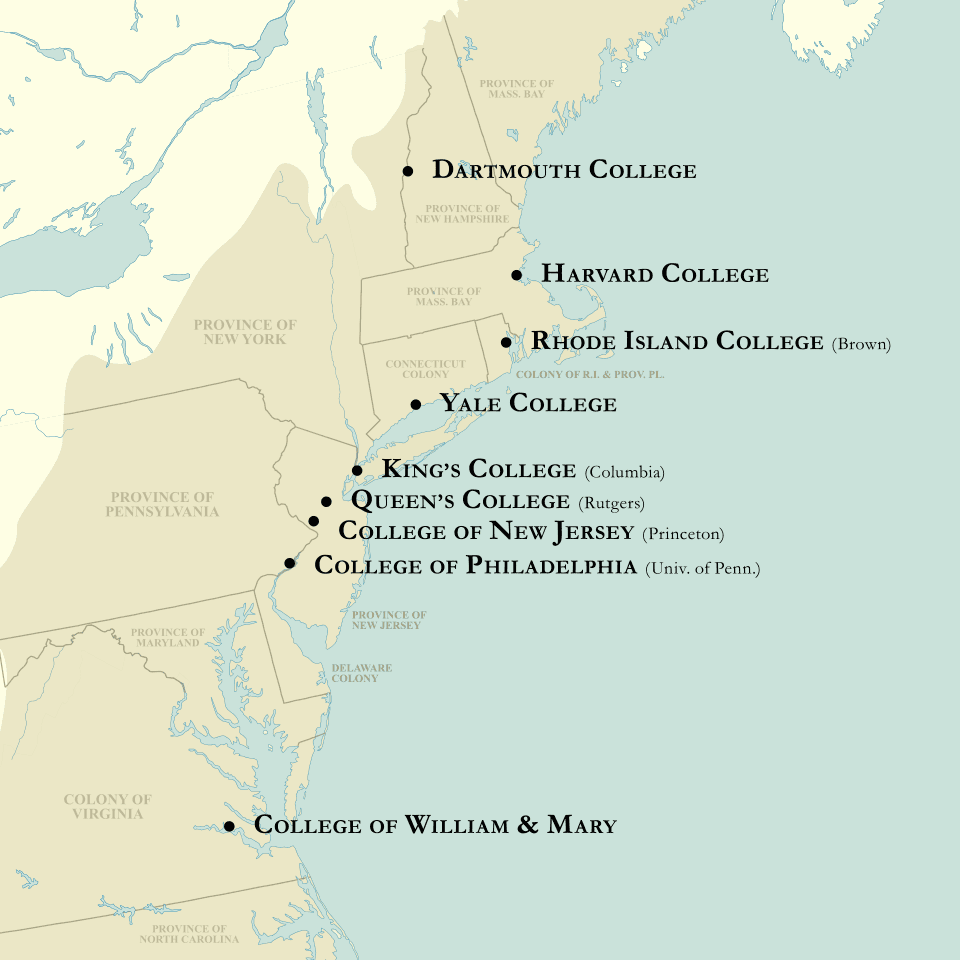
Map of the nine colonial colleges. (<a href="https://commons.wikimedia.org/wiki/User:Filetime">Filetime</a>/<a href="https://creativecommons.org/licenses/by-sa/4.0/">CC BY-SA 4.0</a>)
This same education left its mark for decades after America entered the 19th century. With the exception of George Washington, for instance, who nursed a lifelong regret over his own lack of a classical education, the next five presidents were classically educated.
Lessons Well-Learned
What counted most, of course, was not the learning of Greek and Latin for its own sake, but the authors and books these Americans studied and discussed. The subject matter of their learning led them deep into the past, where they read historians like Plutarch and Tacitus and teachers of morality, rhetoric, and politics like Cicero. From the works of such writers, they took lessons in liberty and virtue, key elements in the establishment of a republic.
Moreover, these classical classrooms, whether conducted in a schoolhouse or a parlor, included in their curriculum math, natural science, history, philosophy, and literature. Such a rich education gave students treasures from the past and present with which to shape the future.
In his article “The Classical Education of the Founders,” classicist Christian Kopff includes this observation by American professor Clinton Rossiter (1917–1970):
“It is easy to smile at the dull, rigid, crabbed methods that prevailed in colonial colleges, but if we judge the vineyards by the fruit they brought forth, we must acknowledge them a fertile ground of learning, science, reason, and liberty. They may not have taught young men enough useful knowledge, but they did teach them—in their own tradition-ridden way—to think, communicate, and lead. ... The roll call of Harvard and William and Mary men in the Revolution should be evidence enough that Latin, logic, and metaphysics were a rich fertilizer in the cultivation of reason, virtue, honor, and love of liberty.”
Indicative of their appreciation for this special education and its effects on the republic was this line in a letter to Dr. Benjamin Rush, another signer of the Declaration, from John Adams: “I should as soon think of closing all my window shutters to enable me to see as of banishing the Classicks to improve Republican ideas.”
Consequently, on this special Fourth of July, in keeping with the occasion and with the Founders’ schooling, perhaps we should raise a glass and toast America with “Ad maiora!” which from Latin translates as “to greater things!”
What arts and culture topics would you like us to cover? Please email ideas or feedback to features@epochtimes.nyc.