
Commentary
While Chinese leader Xi Jinping portrays China as a Middle East peacemaker, state-linked companies have supplied Iran with air-defense equipment and satellite imagery through a relationship sustained by a sanctions-bypassing oil-for-goods barter system.
Iranian Foreign Minister Abbas Araghchi’s meeting with Chinese Foreign Minister Wang Yi in Beijing on Sept. 16 marked his second visit to China since the U.S.–Israel conflict with Iran began in late February.
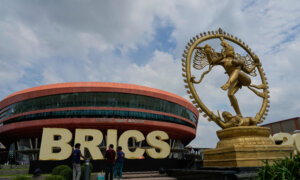
The visit followed Xi’s call during the BRICS summit in New Delhi earlier that week for the bloc to serve as a peacemaker in the Middle East. Xi proposed a four-point de-escalation framework centered on peaceful coexistence, respect for sovereignty, adherence to international law, and the balance between development and security.
Xi’s peacemaking overtures seem particularly ironic in light of recent revelations that China supplied Iran with air-defense equipment. U.S. officials have also linked imagery obtained from Chinese commercial satellite companies to a deadly Iranian strike on American forces in July. They said Iran obtained high-resolution satellite images of Muwaffaq Salti Air Base in Jordan from Chinese sources before and after its July 17 missile strike on the base.
The strike killed three U.S. Army soldiers: 1st Lt. Tyler James Feehan, Pvt. Isabella Gonzales, and Sgt. Angel S. Rampersad, and wounded four others. It was one of three missile attacks on the base within 24 hours. U.S. officials did not identify the Chinese company or companies that supplied the imagery in this instance and stopped short of accusing China of direct involvement.
Of the three companies U.S. officials identified as providing satellite imagery to Tehran, one has documented ties to the People’s Liberation Army (PLA), while all three have ties to the Chinese Communist Party (CCP).
The U.S. Air Force’s China Aerospace Studies Institute describes Chang Guang Satellite Technology Co. as a “military-civil fusion company” and a joint venture between the Chinese Academy of Sciences and the Jilin provincial government whose products are used by the PLA. The company also maintains a Communist Party Committee, established in 2018, and reported on its website that 53 percent of its employees were party members.
The other two companies, MizarVision, also known as Meentropy Technology of Hangzhou, and The Earth Eye, are nominally private. However, the CCP closely regulates the satellite-imaging sector under its military-civil fusion policy.
China’s National Intelligence Law obligates companies to cooperate with state intelligence work upon demand. According to the U.S. Department of Homeland Security, Beijing laws compel Chinese companies to provide data and other relevant information to the CCP.
China’s Company Law also permits the CCP to embed party organizations within companies, providing a formal channel into corporate decision-making. Chinese state media has described these organizations as “playing a leadership role” and “discussing and deciding on major issues” within an enterprise. Under this legal structure, any CCP claim of plausible deniability collapses.
The State Department had designated all three companies on May 8. It said MizarVision published open-source imagery detailing U.S. military activity during Operation Epic Fury; The Earth Eye provided satellite imagery to Iran during the operation; and Chang Guang collected imagery of U.S. and allied military facilities at Iran’s request.
The designation also stated that Chang Guang had previously provided satellite imagery to the U.S.-designated Houthis for targeting U.S. military assets. The company was first sanctioned on Dec. 12, 2023, under Executive Order 14024.
The Treasury Department concurrently designated 10 entities and individuals for enabling Iran’s military to acquire weapons and raw materials used in its unmanned aerial vehicle and ballistic missile programs. These sanctions were announced roughly two months before the July 17 strike on Muwaffaq Salti Air Base.
Iran obtained at least some of the Chinese military technology described above through an oil-for-goods barter system designed to bypass sanctions. The mechanism converts revenue from Iranian oil sales into credits for Chinese imports without transferring money through the international banking system. This arrangement has been in place since at least 2021, and an estimated $2 billion to $2.5 billion flowed through it over the past year.
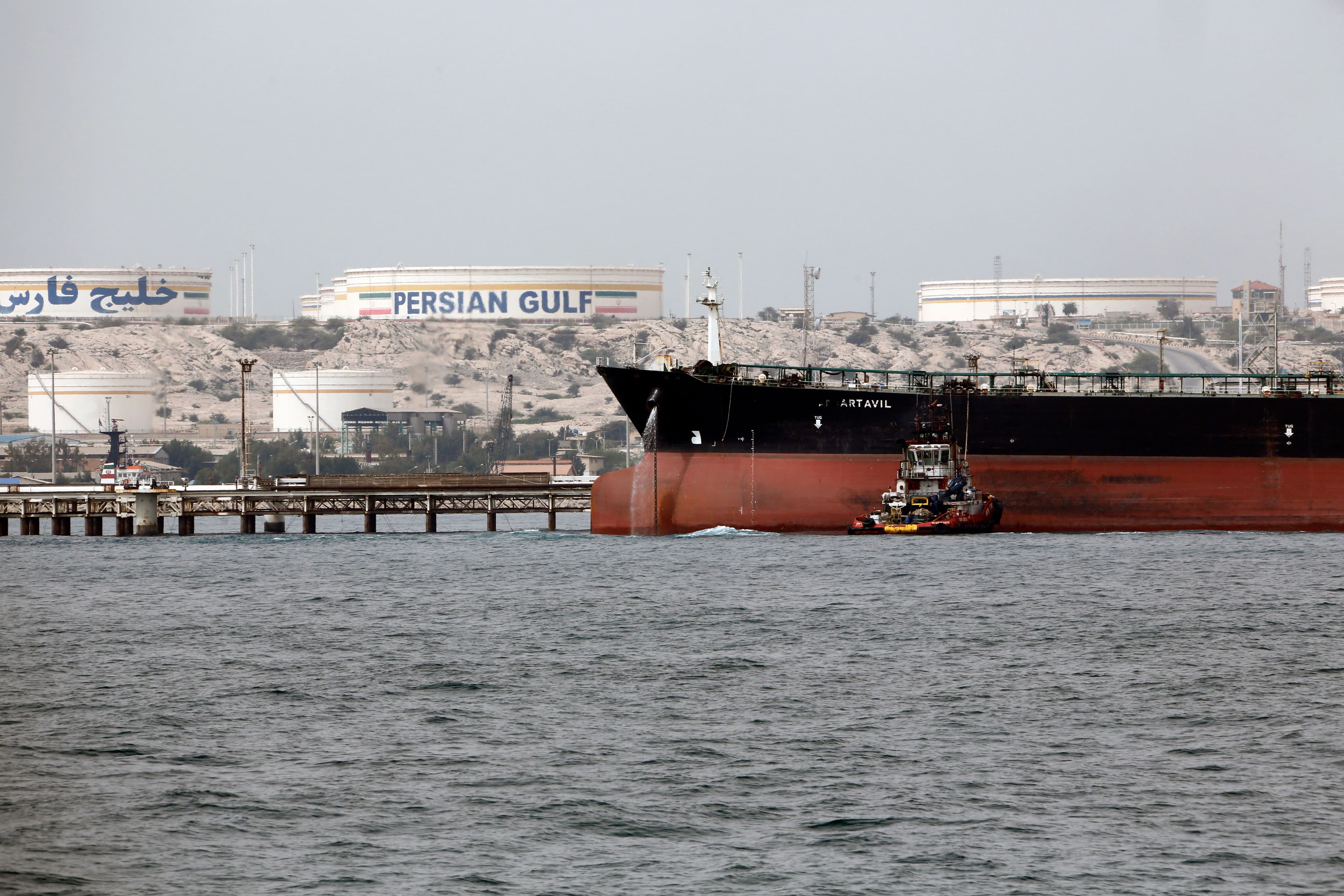
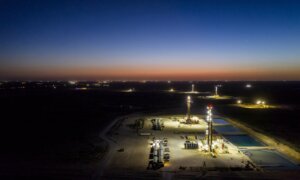
An Iranian tanker docking at the platform of the oil facility in Khark Island, on the shore of the Gulf, on March 12, 2017. (Atta Kenare/AFP via Getty Images)
Iran has used the barter system to acquire medicine, vehicles, and communications equipment. It has also financed contracts worth millions of dollars for Chinese air-defense equipment over the previous year.
Reuters reported that roughly 70 percent of the Iranian oil proceeds are directed toward Chinese-built infrastructure projects in Iran. The remainder flows through a special-purpose vehicle that pays Chinese suppliers.
The vehicle is managed by an entity acting on behalf of China’s Ministry of Commerce and another linked to Iran’s central bank. Reuters identified Zhuhai Zhenrong, a Chinese state-owned oil trader already under U.S. sanctions over its alleged dealings with Iran, as a party acting on the Chinese side.
A company called ChuXin also plays a central role in the system, but Reuters found no record of it in Chinese corporate registries. It is possible that ChuXin exists only as an internal ledger name rather than as a registered company.
Reuters also found no ownership records for the Hong Kong-registered companies linked to Iran’s national oil company and China’s Zhuhai Zhenrong. Their registered addresses correspond to the offices of corporate secretarial-services companies. A financial channel with no discoverable legal registration or ownership records cannot be sanctioned, subpoenaed, or traced to the individuals who control it.
The Chinese foreign ministry told Reuters that it was “not familiar with the situation” and that China “has consistently opposed unilateral sanctions that have no basis in international law and have not been authorized by the United Nations Security Council.”
The response denies awareness of the specific arrangement used to transfer military technology, while separately asserting that the U.S. sanctions lack a legal basis. The CCP, therefore, appears to believe that it is within its rights to purchase Iranian oil.