
Commentary
The Chinese Communist Party’s repression of Tibetan religion extends beyond its borders, reaching the point of sanctioning Czech President Petr Pavel for meeting His Holiness the Dalai Lama in India.
August highlighted worsening Europe–China tensions across trade, diplomacy, and security. Beijing retaliated against European Union sanctions on two Chinese financial institutions by targeting two Lithuanian banks and extending anti-subsidy and anti-dumping probes on European goods.
British and allied intelligence uncovered Chinese cyberattacks on critical infrastructure linked to the earlier Salt Typhoon hack that targeted U.S. leaders.
London delayed approval of China’s proposed “super embassy” over espionage concerns, while the Chinese Communist Party (CCP) blocked reconstruction of the UK Embassy in Beijing.
Germany accelerated its “de-risking” strategy by cutting reliance on Chinese rare earth magnets, expanding recycling, and partnering with Canada on raw materials.
Europe’s tensions with Beijing were already running high amid sanctions disputes, cyber threats, supply-chain vulnerabilities, and diplomatic clashes. In July, the CCP announced that it would suspend engagement with Czech President Petr Pavel after he met with the Dalai Lama in India, calling the encounter a provocation that undermined China’s sovereignty.
The Czech government insisted that the meeting was private and urged Beijing to treat it as such. Tensions between the two countries were already high due to Prague’s criticism of China’s human rights record, the Czech Republic’s closer ties with Taiwan, and allegations of Chinese cyberattacks on Czech institutions.
The Dalai Lama also has a special connection to the Czech Republic through his friendship with Vaclav Havel, the country’s first post-communist president.
In July, when the Dalai Lama turned 90, the CCP criticized India because Prime Minister Narendra Modi and other officials sent him birthday greetings. It also admonished the United States for U.S. Secretary of State Marco Rubio’s message to His Holiness. Notably, in its rebukes of world leaders, Beijing used the term “Xizang” rather than Tibet, an attempt to erase history and weaken international support for religious and cultural freedom.
Beijing reiterated its stance that the Dalai Lama is a political exile engaged in separatist activities and urged India to honor its commitments on Tibet, act with caution, and stop interfering in China’s “internal affairs.” Of course, one must ask how the actions of world leaders outside China qualify as an internal matter. In fact, one could argue whether events within Tibet itself are truly “internal,” given that the CCP illegally invaded and annexed the country in 1950.
Furthermore, when it suits the CCP, it violates the sovereignty of other nations by spying on Chinese and Taiwanese nationals and exporting religious repression. Last month, Guan Yin Citta Dharma Door, a global Buddhist group, became the focus of an espionage case when a Chinese-born woman was charged with reckless foreign interference for allegedly reporting on the group’s Australian chapters to Chinese intelligence. The case has raised concerns that Chinese authorities use religious and cultural organizations to monitor the Chinese diaspora and to suppress religious freedom abroad.
In an interview with The Epoch Times, Yalkun Uluyol, a China researcher at Human Rights Watch, explained that repression abroad also targets Uyghurs, Tibetans, and Inner Mongolians, whose family members at home are harassed to deter political activity.
“Authorities even pressure diaspora members to provide information about one another,” he said.
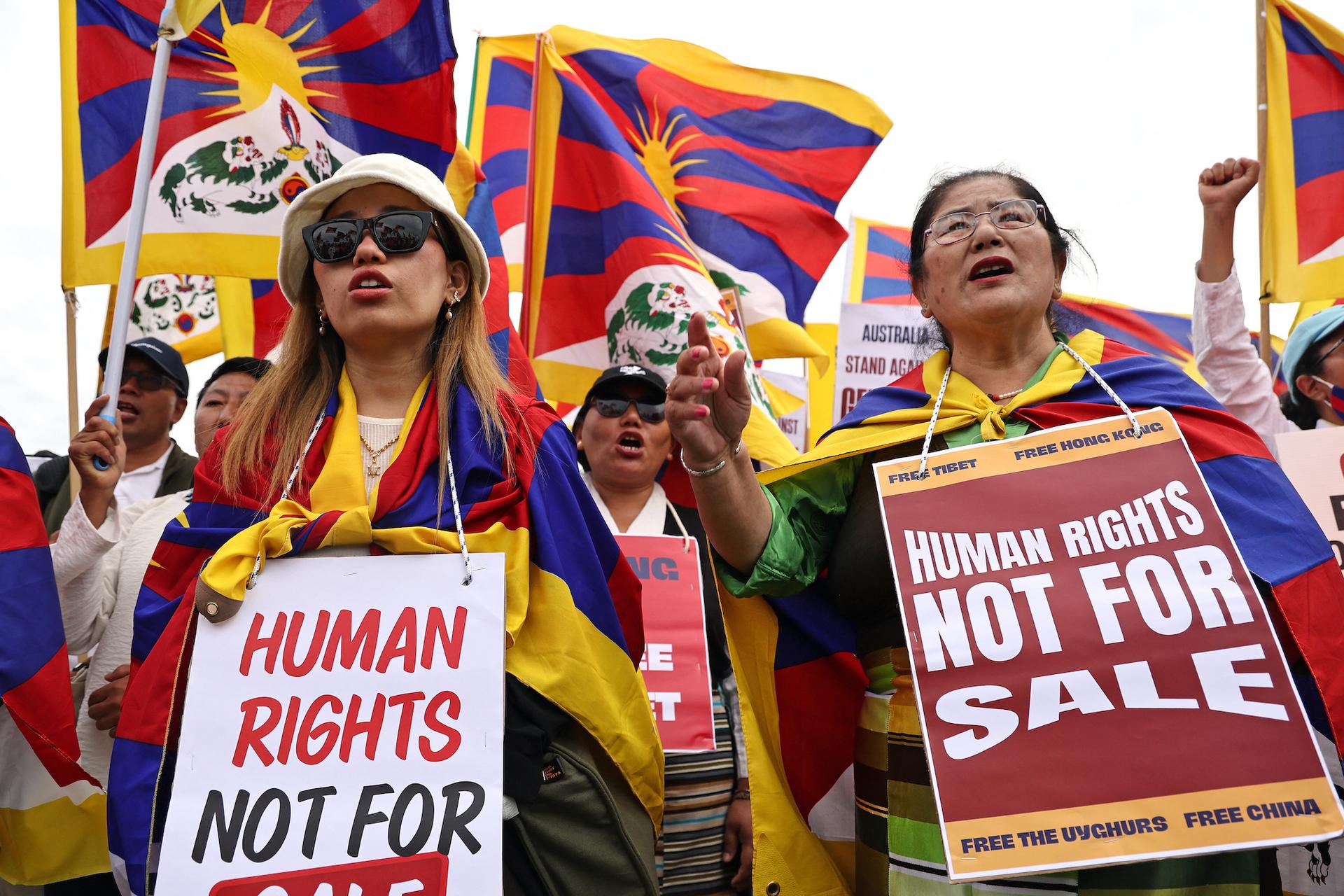
Members of the Australian Tibetan community hold flags and placards as they protest at a rally organized by the Alliance for Victims of the Chinese Communist Regime outside Parliament House in Canberra, Australia, on March 20, 2024. (David Gray/AFP via Getty Images)
Uluyol explained that under CCP rule, there is no independent civil society, nor freedom of expression, assembly, or religion in Tibet.
“Beijing’s assimilationist policies leave no room to exercise basic rights, preserve traditional ways of life, or embrace Tibetan culture, identity, and language,” he said.
One example is the accelerated forced relocation of rural villagers and herders, which has devastated Tibetan communities and eroded their culture.
Since 2021, dozens of Tibetans have been arrested for politically motivated phone or internet offenses.
According to Uluyol, “even possessing a photo of the Dalai Lama or expressing pro-Tibetan sentiments is considered ‘banned content.’ Contacting people abroad can bring harsh punishment, including prison sentences of up to 20 years.”
Since 2009, at least 160 Tibetans have self-immolated in protest against Chinese rule. Among the most serious forms of repression is the CCP’s demand to control the reincarnation of high-ranking monks and lamas. For this reason, on his 90th birthday, the Dalai Lama declared that the search for his reincarnated successor must take place in the “free world,” outside China. Beijing rejects this, insisting that it alone has the authority to appoint Tibet’s next spiritual leader and plans to install a rival Dalai Lama.
Uluyol also raised the case of the missing Panchen Lama. In 1995, Chinese authorities kidnapped the 11th Panchen Lama, Gendun Choki Nyima, and his parents, an act widely condemned as a blatant attack on religious freedom. Historically, the Panchen Lama and Dalai Lama have played key roles in recognizing each other’s successors.
As the 14th Dalai Lama may soon pass away, the question of succession and the future of Tibetan Buddhism is becoming increasingly urgent, with Beijing attempting to impose legitimacy on its own state-appointed Panchen Lama.
Tibetans in exile depend heavily on the global goodwill the Dalai Lama has personally cultivated. The CCP appears to believe that his death would resolve the “Tibet issue.” Yet his passing may trigger greater instability, particularly if the CCP attempts to legitimize its own choice for his reincarnation.
The Dalai Lama’s “middle way” sought autonomy within China rather than full independence, a stance some Tibetans criticize as too conciliatory, preferring to revive the independence struggle. For Beijing, succession is a strategic matter. For Tibetans, it is existential, representing the preservation of their religion, cultural identity, and even their survival as a people.
Decades of repression and coercion have failed to secure Tibetan loyalty to the CCP and may only deepen resistance, strengthening the struggle for independence.