
Commentary
Declining investment flows into China announce a marked wariness about the country’s economic prospects. Investor concerns are certainly understandable.
In addition to Beijing’s trade “war” with the United States and to a lesser extent with Europe and Japan, China faces major domestic economic and financial problems—the severe and ongoing property crisis only one of them.
Still, the foreign verdict is not completely negative. Aware of the size of China’s economy and its other sources of strength, foreign investors have nonetheless expanded their filings to do business in China, no doubt as a hedge should economic matters improve, leaving the initiative with Beijing to find ways to cope with the trade tensions and improve its management of China’s domestic economy.
The data are clear enough. As of October, the most recent month for which statistics are available, direct foreign investment into China came in at some 11.8 billion yuan ($1.7 billion). That flow is about 10 percent below October 2024 levels.
The cumulative flow so far in 2025 is running some 10.3 percent below year-ago levels. Although the pace of decline has abated somewhat from earlier this year, this latest reading continues a picture of steep decline that has persisted uninterrupted since the spring of 2023.
While this downturn raises considerable alarm over China’s economic and business climate, the world’s business community has not entirely walked away from China. Though significantly slowing the flow of investment funds, foreign companies so far in 2025 have actually increased their registrations to do business in China. The October figure of 53,782 registrations of new foreign investment enterprises stands almost 15 percent above year-ago levels.
Such registrations are needed to set up an enterprise in China. They can reflect past investment flows, in which case the money has already gone into China, or preparation for additional or new flows at some future date. In either case, they involve less risk at the margin than do new direct investment flows.
Rather than contradict the negative judgment implicit in the falloff in direct investment flow, this growth in registrations suggests that foreigners, while cutting their risk, are setting themselves up for greater involvement should the economic and business climate in China show better prospects.
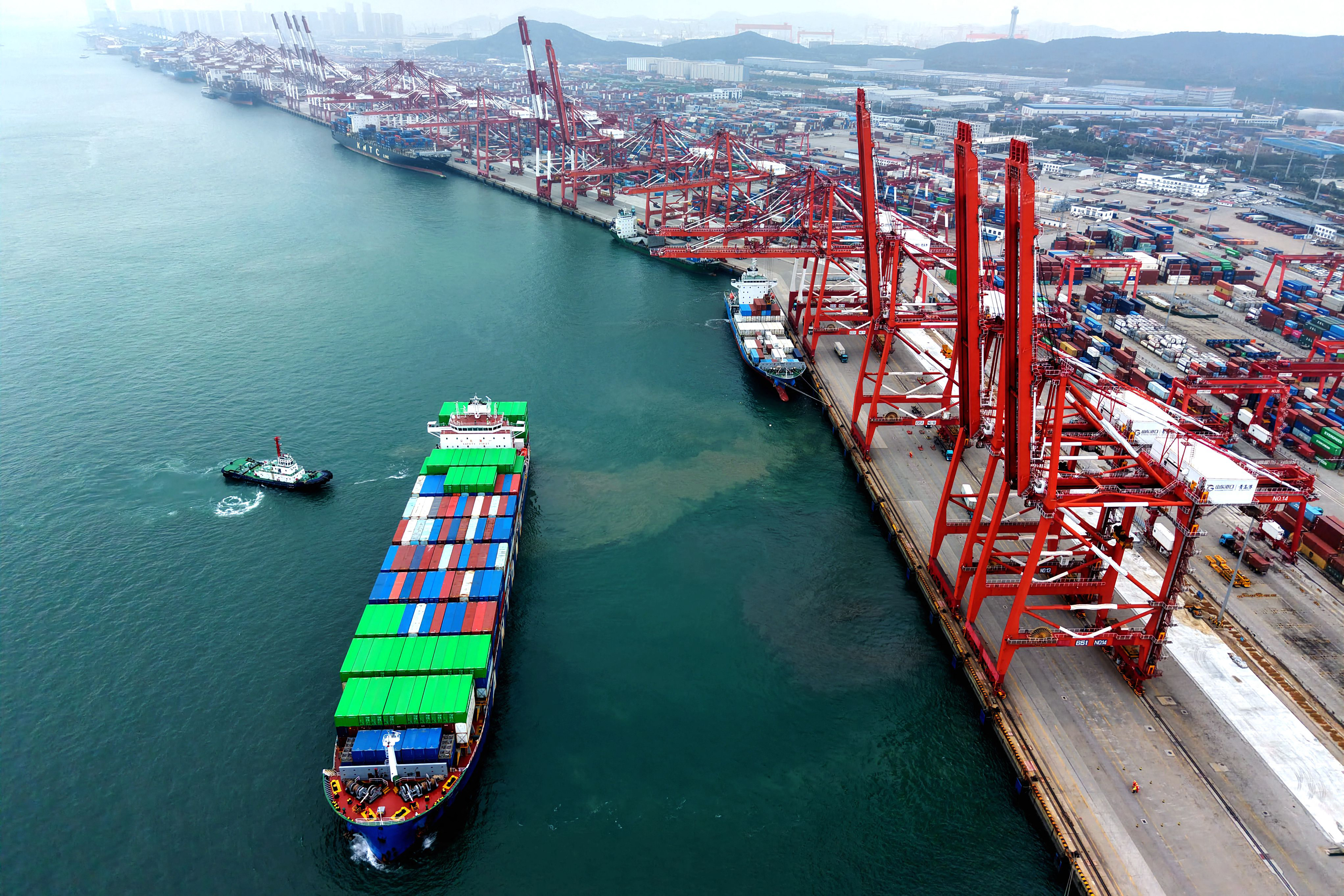
It would ignore the obvious not to see much of this foreign wariness as a reflection of the unsettled state of China trade. High tariffs and port fees imposed by Washington on Chinese goods have left big questions about what, until recently, was China’s largest and most lucrative export market.
And though Washington has led the anti-Chinese charge, the United States is not alone in turning on China trade. The European Union, the UK, and Japan have all taken steps to limit China trade, especially in the important area of electric vehicles.
But trade tensions are not the only factor. Foreign investors can see that China’s economy has slowed because of domestic troubles as well. Even less encouraging is that Beijing has hardly covered itself in glory in its handling of these problems.
The property crisis that began in 2021 continues, creating a steep downturn in a sector that, for decades, had served China as a powerful growth engine. Real estate and homebuilding declines have hit the finances of Chinese households hard and so limited the spur to growth that otherwise might have come from domestic consumer spending.
The property crisis has also revealed the precarious nature of local government finances and the adverse implications that has for growth prospects. Worse still is Beijing’s seeming inability to address any of these severe economic and financial problems adequately.
This array of considerations shows in the mix of investment flows. U.S., European, and Japanese investment flows have fallen off steeply, offset only partly by a step up in investment flows from elsewhere in Asia and from the Middle East, most notably from the United Arab Emirates, which increased its direct investment flows to China by almost 50 percent in the past year.
What is also telling is that most of the investment flows have focused on services—financial, legal, consulting, and accounting—indicating that these investment monies are not betting on trade or even manufacturing, as they once did, but rather on the maturing of China’s economy.
Because the trade picture clearly will not improve any time soon, what investment flows there are, if they are betting on anything, are looking to Beijing to solve its domestic economic problems. If Beijing can do that, even only in part, the flows should revive and reinforce the economic effect of any policy solution. If policy fails, as it has to date, these flows will likely fall off still more steeply and exacerbate the remaining problems for Chinese policy and China’s economy.