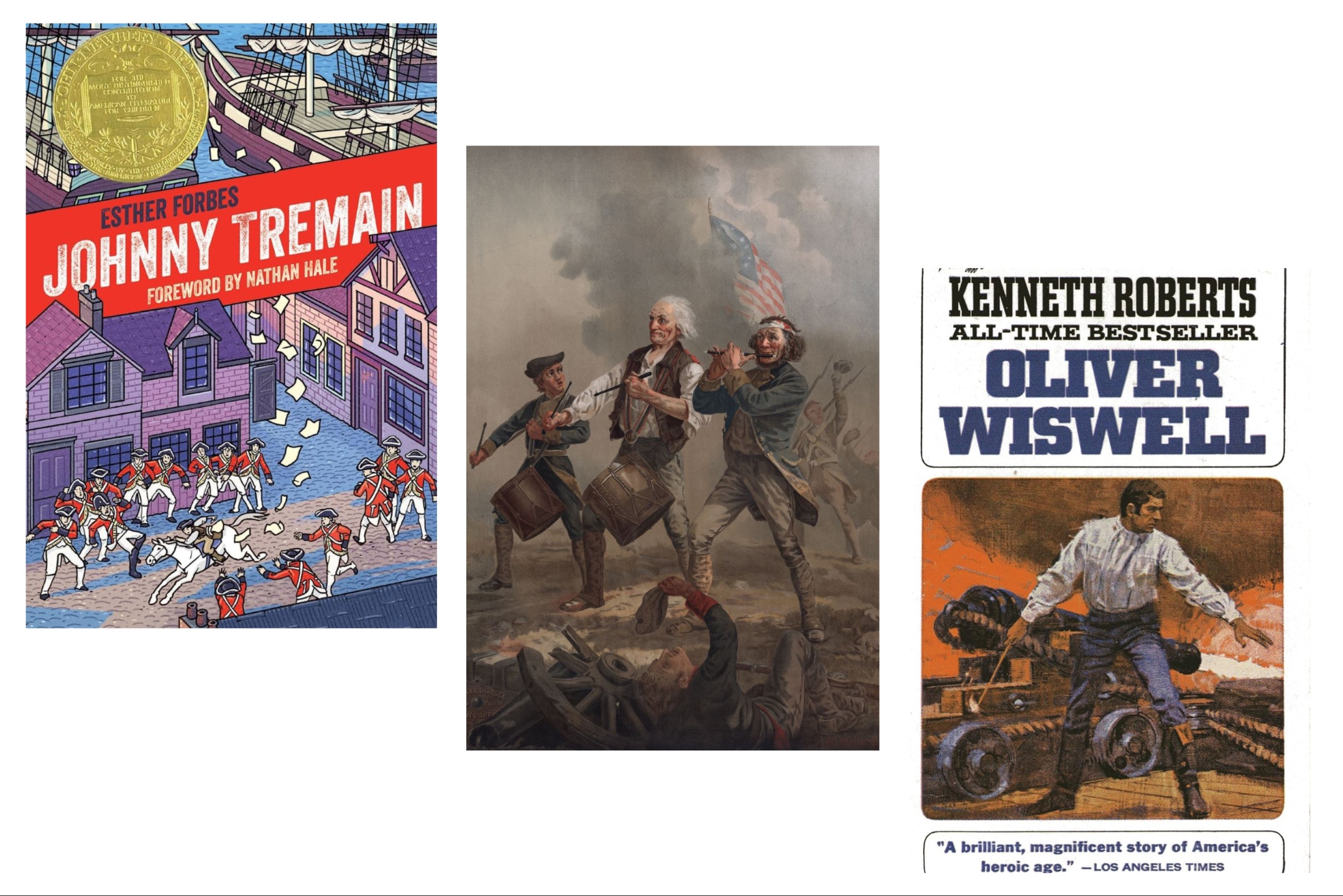

Writers Kenneth Roberts (1885–1957) and Esther Forbes (1891–1967) were contemporaries who had much in common. Both were New Englanders born and bred, with roots reaching back to Colonial America. Both won the Pulitzer Prize, Roberts winning a Special Citation just before his death, Forbes in 1943 for “Paul Revere and the World He Lived In.”
Both were diligent researchers who received help from loved ones, Roberts from his wife Anna, Forbes from her mother Harriette. Both were gifted with the ability to bring America’s colonial period and the American Revolution vividly alive via paper and print.
But there the commonalities end.
Against the Grain
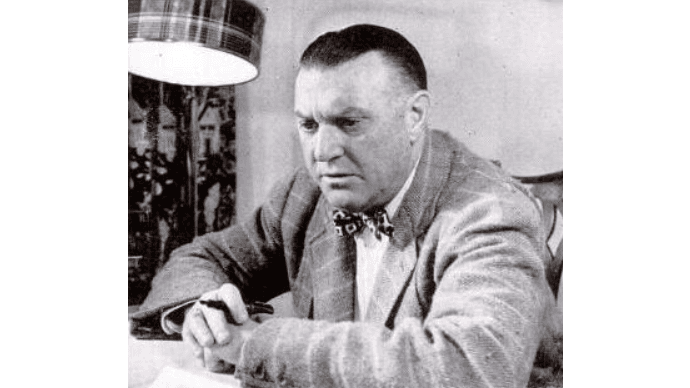
The author, journalist, and researcher Kenneth Roberts. (Public Domain)
Roberts was a contrarian.
In “The Kenneth Roberts Reader,” writer and good friend Ben Ames Williams spends the greater part of his introduction addressing Roberts’s eccentricities and often ill-tempered behavior. “He is easily aroused to furious indignation, and by what appears to be a law of inverse proportions, he is most violent about the little things, least violent about the big ones.”
A Republican, Roberts is said to have glued dimes to the oyster shells he used for ashtrays so that he could squash out his cigarettes in President Franklin Roosevelt’s face. History teacher Harry Gratwick described him as “a frequently cranky New Englander … who generated controversy all through his life.” Of Roberts’s wife Anna, who typed his manuscripts over and over again, and who managed the purse strings during their pasta and oatmeal years, Gratwick wrote “she must have been a saint.”
This tendency to play the gadfly is mirrored in some of Roberts’s work. His first novel, “Arundel,” takes us back to the fall and winter of 1775 and the American attempt to take Quebec from the British. Already well-known for his role in the successful capture of Ticonderoga earlier that year, Benedict Arnold served co-leader in this expedition north. The campaign to take the war into Canada failed miserably, but Roberts gives Arnold his due and depicts him not as a traitor, but as the hero he was at that time.
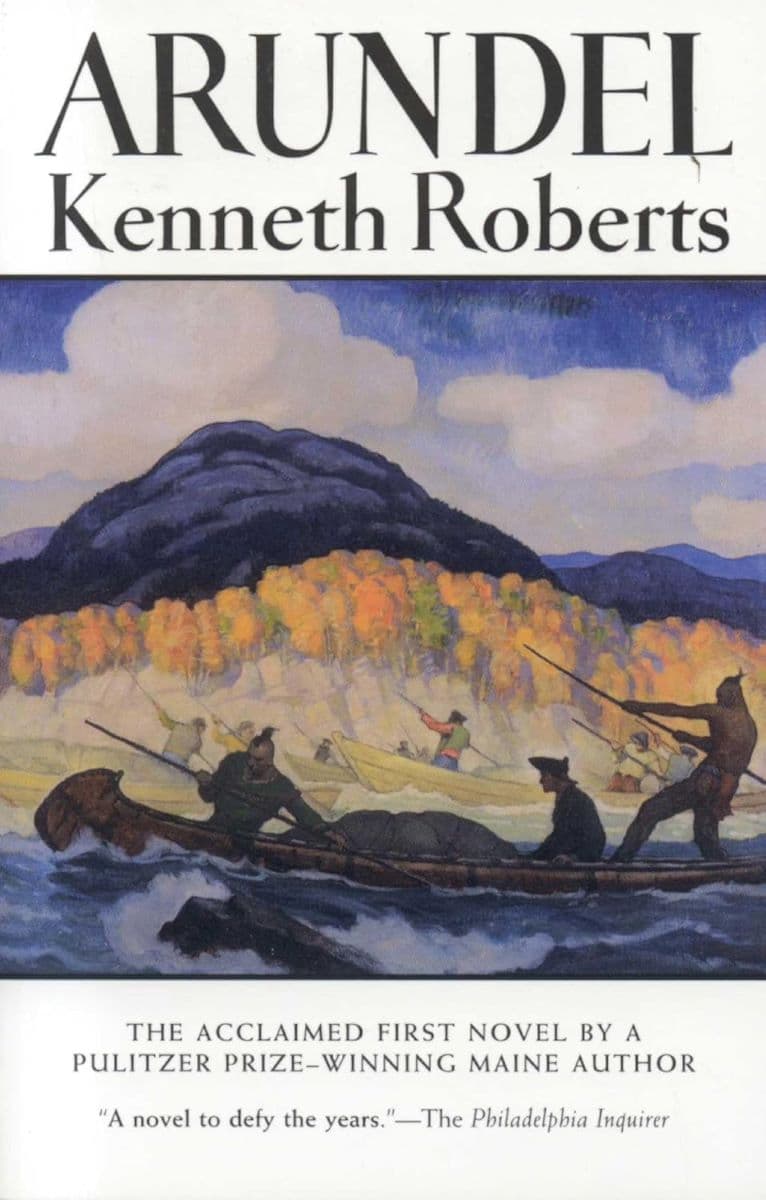
A classic from Pulitzer Prize-winning author Kenneth Roberts. This is the 1995 edition published by Down East Books.
In its run against popular prejudice, “Oliver Wiswell” takes a giant step beyond this positive picture of Arnold. Wiswell is a Boston Loyalist, suspicious of the American liberty committees and the violent mobs demanding separation from Britain and King George. This long but fast-paced story of the “other side” during the Revolution opens with Wiswell helping a tar-and-feather victim escape such a mob. Roberts than recreates the American Revolution from beginning to end, but with an entirely new fictional perspective, giving readers a Loyalist pair of glasses through which to see and even sympathize with those Americans who stood opposed to the break with Britain.
A Cat and a Combination of Virtues
Because of the many nonfiction articles he wrote and his semi-autobiography “I Wanted to Write,” we know a great deal about the personality of Roberts the man. We know less about Forbes. She performed poorly in school—she struggled her entire life with spelling and was likely dyslectic—though she wrote stories from an early age. Here, she demonstrated a rare creative bent in her writing, so much so that one of her teachers once accused her of plagiarism. Deeply embarrassed by such misguided criticism, she took to telling or reading her stories to the family cat. One of these “cat-told tales” brought her first magazine acceptance along with a check for $25.
In 1920, encouraged by her family, she submitted a short story, “Break-Neck Hill,” for publication and won a place of honor in that year’s O. Henry Memorial Award Prize Stories collection. From that time on, she devoted herself to her writing. She married an attorney, Albert Hoskins, in 1926, the same year that her first novel, “O Genteel Lady!” appeared. After their divorce in 1933, Forbes lived with her mother and some of her siblings in her hometown of Worcester, where she continued to write, doing research with her mother’s help at the American Antiquarian Society. In 1960, she became the first woman elected to the Society, with one member writing to her: “Only your combination of virtues could have broken the barrier.”
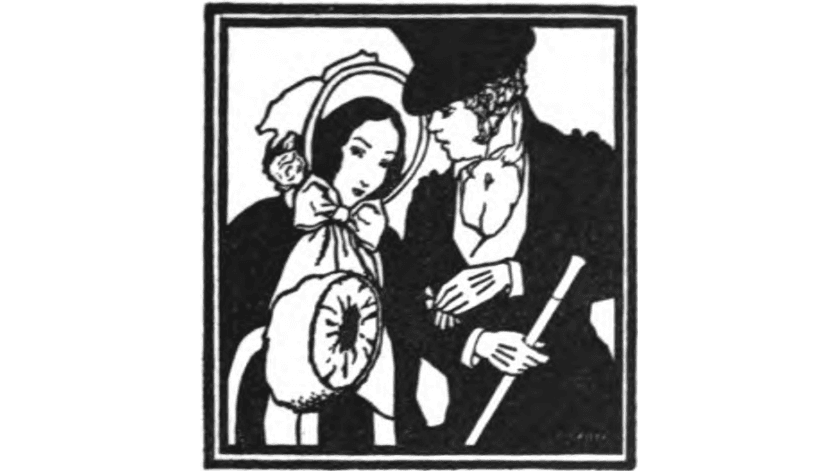
The title illustration of "O Genteel Lady!" (Public Domain)
While her “Paul Revere” book remains a classic, her young adult novel “Johnny Tremain” became her greatest and most popular literary monument. Featuring a large cast of characters, including historic figures like Revere, Samuel Adams, and Joseph Warren, Forbes’ story focuses on a boy who comes of age during the tumultuous years leading up to the Battles of Lexington Green and Concord. Consequently, readers view events like the Boston Tea Party through the eyes and understanding of a teenager, a young man, one hand burned by molten silver in the silversmith shop where he worked, struggling to find his place in society.
In 1944, “Johnny Tremain” won the prestigious Newbery Medal for children’s literature and has never gone out of print. One of the best-selling young adult books of the 20th century, it remains a popular read today.
Beauty and the Best
In a humorous essay, “Thank You, Esther Forbes,” writer George Saunders recollects his third-grade classroom in a Catholic school, where the nun he has a crush on, Sister Lynette, lends him a copy of “Johnny Tremain.” Saunders writes of that special moment: “‘I think you can handle this,’ Sister had said as she handed me the book (she'd checked it out of the library), but what I heard was: ‘Only you, George, in this entire moronic class, can handle this. There is a spark in you, and it is that spark that keeps me from fleeing back to Kansas.’”
The boy carries the book everywhere, a mark of his intelligence and his love for its lender. Not only does he handle “Johnny Tremain,” he masters it—or rather, as good books do to the young, it masters him. Forbes’s language sings to him—“On rocky islands gulls woke”—with such power that it “made the invented world almost unbearably real, each sentence serving as a kind of proof.” As the imaginative young will do, Saunders takes to copying Johnny Tremain, walking through the schoolyard at recess with one hand in his coat pocket as if it was damaged, “trying to get through the entire period without uncrippling [himself].”
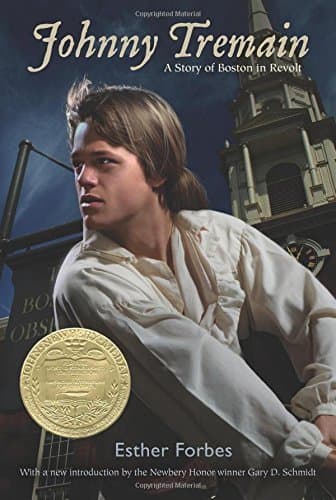
"Johnny Tremain" is still a popular book among young readers today.
Here are Saunders’s final words of tribute to Forbes and her “Johnny Tremain,” which serves as good an explanation as any for the book’s long life and popularity:
“Forbes was my first model of beautiful compression. She did for me what one writer can do for another: awoke a love for sentences. Behind her prose I sensed the loving hand of an involved human maker. Her thirst for direct, original language seemed like a religion of sorts, a method of orientation, and a comfort, in all countries and weathers, in happiness and sadness, in sickness and in health. Reading ‘Johnny Tremain,’ I felt a premonition that immersion in language would enrich and bring purpose to my life, which has turned out to be true.”
Roberts’s sentences shine as well, but with a different brilliance. His prose drops readers back into the 18th century but without the intrusion of that century’s lengthy stiff sentences or unfamiliar vocabulary. Here, for instance, is the first paragraph of “Oliver Wiswell” with its echoes of 18th-century style: “My father, Seaton Wiswell of Milton and Boston, was an attorney. Daniel Dulaney, greatest of American lawyers, once wrote that he was as richly endowed with foresight as were the majority of his generation with hindsight.”
Moreover, bring together all his books, and Roberts manufactures enough wise and pithy observations on human nature and the human condition to fill a book of quotations. Here is a sampler of these adages from “Oliver Wiswell” alone:
“People never believe anything—except scandal—when they first hear it.”
“Great men tell the truth and are never believed. Lesser men are always believed, but seldom have the brains or the courage to tell the truth.”
“You can’t destroy ideas by force, and you can’t hide ‘em by silence.”
Though considered adult fare, older teenagers should have no trouble handling his historical fiction and could take away some real gifts from that journey into the past.
From both these writers, we not only learn more about American history, we also receive lessons in the nobility of soul and mind, like the one Forbes delivers in “Johnny Tremain”: “We give all we have, lives, property, safety, skill ... we fight, we die, for a simple thing. Only that a man can stand up.”
With America’s 250th birthday party now at hand, some time spent reading Forbes and Roberts is a great way to light up some of the candles on that cake.
What arts and culture topics would you like us to cover? Please email ideas or feedback to features@epochtimes.nyc